
Seasonal billing for pool service companies isn’t just about pausing invoices in November and restarting them in April. Done right, it’s a system that smooths cash flow year-round, eliminates manual billing errors at season transitions, and protects customer relationships through clear, predictable billing, even when service schedules fluctuate with the weather.
What Is “Seasonal Billing for Pool Service Companies”?
Seasonal billing for pool service companies is a recurring billing approach that accounts for the natural start-and-stop rhythm of pool maintenance work across the calendar year. It covers how pool companies structure pricing, manage billing cycle pauses and resumptions, handle mid-season customer starts, and maintain predictable revenue during the months when service volume drops or stops entirely.
It’s distinct from standard recurring billing in one important way: the service window doesn’t match the calendar year. A company servicing pools in Minnesota runs April through October, 7 active months, but must make financial decisions (staffing, equipment, and chemicals) that span all 12 months. Seasonal billing is what bridges that gap.
Why Seasonal Billing Is the Hardest Part of Running a Pool Service Business
Ask any pool service owner what keeps them up at night in February, and the answer is usually some version of the same thing: the trucks are parked, the crew is on reduced hours, but the fixed costs, insurance, equipment loans, software subscriptions, and the office phone keep running on the exact same schedule they did in July.
The core problem isn’t that pool service is seasonal. It’s that most pool companies build their billing around the service calendar rather than the financial calendar. They bill for the months they work, stop billing when they stop working, and then scramble in October to cover expenses through April. The math doesn’t work, and no amount of hustle fills a structural gap in cash flow design.
According to Pool Corporation’s 2024 SEC filing, Q2 alone generates 33% of all pool industry wholesale revenue, while Q4 sits at just 19%. That’s a meaningful swing, but what the industry data doesn’t capture is how individual pool service companies absorb that swing at the business level. The ones that manage it well don’t work harder in summer; they structure their billing differently.
The good news is that this is a solvable problem. Pool companies in northern markets have several workable seasonal billing models, and the right recurring billing setup makes the difference between scrambling every spring and having a plan that runs without you.
The Three Seasonal Billing Models and When to Use Each
There’s no single right answer for how to handle seasonal billing, because the answer depends on your market, your customer base, and what your business actually needs to sustain operations year-round. Here are the three main approaches, with an honest assessment of each.
Model 1: Active-Season-Only Billing
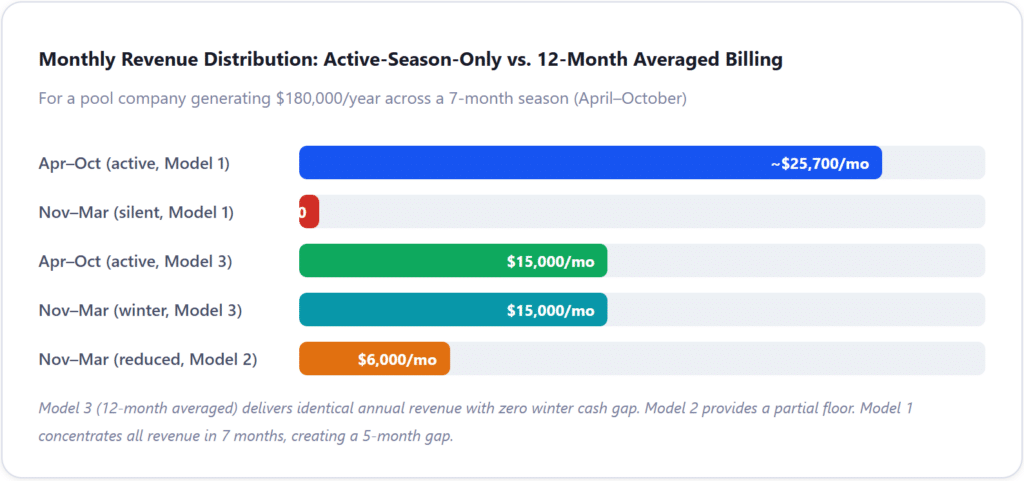
The simplest approach: bill only during the months you service the pool and stop billing when you winterize it. A customer in a 7-month service market pays for 7 months. The other 5 months, no invoice goes out.
This is the easiest model to explain to customers and the hardest on your cash flow. Revenue drops to zero in winter, but your fixed costs don’t. If your operating costs in January are $8,000 and your revenue is $0, you’re drawing down reserves or running up debt every year, predictably. Most pool companies that struggle financially are running this model without realizing it’s the structure, not the season, causing the problem.
Model 2: Reduced Winter Rate
Charge a lower monthly rate during the off-season, typically 30–50% of the active-season rate, in exchange for maintaining the customer relationship and covering some of your fixed costs. The customer pays something year-round; you provide minimal service (or a winterization check-in) in exchange.
This model requires careful communication at signup. Customers need to understand what the reduced rate covers and why they’re paying during months with limited service. Done well, it provides a meaningful revenue floor in winter and keeps you first in mind when spring comes. Done poorly, it creates billing disputes when customers receive a November invoice for a pool they haven’t used since September.
Model 3: 12-Month Averaged Billing
Divide the total annual service cost evenly across 12 months. A customer whose service costs $1,800/year pays $150/month from January through December, including the months with no active service. This is the model that best aligns billing with your actual financial needs and is increasingly standard among well-run pool companies in seasonal markets.
The critical requirement is upfront transparency. The service agreement must clearly state the total annual cost and that it’s billed in 12 equal installments regardless of service frequency in any given month. Customers who understand this from day one almost never push back. Customers who discover it in January without prior explanation often cancel. This is where installment billing logic becomes especially useful, the billing system can manage the annual commitment across 12 equal payments automatically.
The Seasonal Billing Calendar: What Happens When
🌱 Spring: March – May – Billing Starts
Reactivate paused accounts. Adjust pricing. Bill pool opening as a one-time charge. Enroll new customers with prorated start dates.
☀️ Summer: June – August – Peak Billing
Peak revenue. Full recurring billing active. Chemical add-ons billed alongside maintenance. All Auto Pay enrollments should be confirmed.
🍂 Fall: September – November – Season Close
Bill winterization as a one-time charge. Communicate winter billing status to customers. Collect deposits or pre-pay for spring openings.
❄️ Winter: December – February – Pause / Reduced
12-month billing continues (if using Model 3). Pause active-season subscriptions. Review software setup for spring reactivation. Pursue pre-book discounts.
How Automated Seasonal Billing Works: The Full Workflow
Regardless of which billing model you use, the workflow below describes what a properly automated seasonal billing system does and what you should expect from your billing software at each phase of the year.
1. Customer Setup with Defined Billing Parameters
When onboarding a new customer, capture their service start date, billing model (active-season-only, reduced winter rate, or 12-month averaged), and payment method. Customers who authorize Auto Pay at signup have their payment method stored securely, this eliminates the need to collect payment information again at each spring reactivation. The billing profile stays on file; only the schedule changes.
2. Mid-Season Start Proration
A customer who starts service on April 18th shouldn’t pay a full April invoice. Good billing software calculates the prorated amount automatically based on the number of billing days remaining in the first cycle. This removes a common manual calculation error and avoids the awkward “we’ll adjust your first invoice” conversation that often ends with the adjustment never happening.
3. One-Time Charges Alongside Recurring Billing
Pool openings and closings are typically not part of the monthly service rate, they’re charged once per event. Billing software that handles both recurring invoices and one-time add-ons in the same system means a spring opening charge can be issued alongside the first recurring invoice of the season without creating a separate billing stream to track.
4. Billing Pause or Rate Change at Season End
At winterization, the system should allow you to either pause the recurring invoice entirely (for active-season-only billing) or switch the customer to a reduced winter rate (for Model 2). This should be a configuration change in the customer’s billing profile, not a manual process of canceling and recreating the invoice. Billing platforms that require you to cancel and rebuild subscriptions at each season transition create data integrity problems and increase the risk of losing billing history.
5. Spring Reactivation with Updated Start Dates
The most error-prone moment in seasonal billing is spring reactivation. Without a reliable system, companies manually re-enter customer data, miss some accounts entirely, or restart billing a week late for a route of 80 customers, losing $8,000 in revenue they never recover. A proper billing setup allows you to reactivate paused subscriptions in bulk, with updated start dates, at the beginning of each season. Payment methods carry over. History remains intact. The customer receives a renewal notification rather than a first-time setup email.
6. Automated Reminders and Failed Payment Handling
Seasonal transitions are when payment failures spike. Cards that were set up in April may have expired by the following April. The Auto Pay authorization you collected last spring may be stale by this spring if the customer got a new card over the winter. Billing systems should send card expiry alerts 30 days before the expiration date and notify customers immediately when a payment fails, directing them to update their information via a self-service portal without requiring a phone call to your office.
Real-World Use Cases: Seasonal Billing Across Different Pool Markets
Northern Markets (5–7 Month Season)
Pool service companies in states like Minnesota, Wisconsin, Michigan, and the Northeast deal with the most extreme seasonal swing. Service windows of 5 to 7 months mean the billing model carries an outsized financial weight. Companies in these markets that have adopted 12-month averaged billing typically report steadier operations, easier staff retention (because the payroll is more consistent), and significantly less stress around the winter months. The customer communication challenge is higher, but the payoff in cash flow stability is substantial.
Transitional Markets (8–10 Month Season)
Markets like the Mid-Atlantic, Pacific Northwest, and parts of the Midwest operate 8 to 10 months with a genuine winter window of reduced or no service. These companies often find a reduced winter rate works well, 2 to 3 months of 40% billing maintains the customer relationship and provides some revenue floor without the complexity of explaining 12 months of billing for 8 months of work.
Year-Round Markets (12 Month Season)
Florida, Arizona, Southern California, and Texas pool companies don’t face a seasonal billing challenge in the same way, their recurring billing runs year-round without pauses. Their seasonal complexity comes from rate changes tied to summer chemical demand and managing a higher volume of new customer starts in the spring. Florida Pool Care Pros, for example, worked with ReliaBills to handle multiple invoice delivery preferences and recurring billing for maintenance customers, the same recurring billing infrastructure that works in seasonal markets also scales to year-round operations without modification.
Midwest Pool Company: Reducing Spring Billing Chaos by 90%
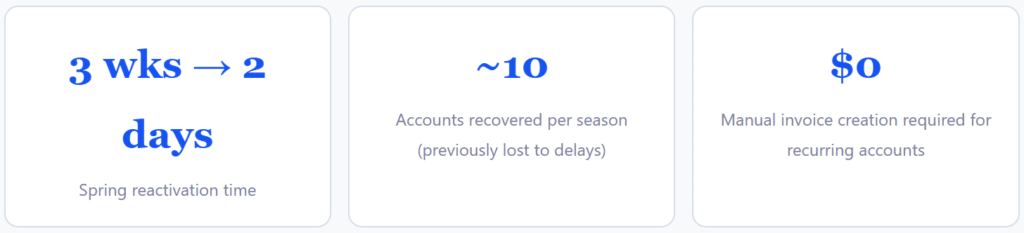
A pool service company operating 110 residential accounts across a 7-month season (April–October) had been managing spring reactivation manually for years. Each March, the owner and one part-time admin spent roughly 3 weeks reviewing customer files, rebuilding invoices from the previous year, contacting customers for updated payment information, and re-entering Auto Pay details. They estimated losing 8–12 billable accounts per year simply because the reactivation process fell behind and customers had already booked with a competitor by the time the invoice arrived.
After migrating to structured recurring billing with seasonal pause and reactivation workflows, the spring setup dropped to two days. Customer payment methods carried over from the prior season. Bulk reactivation triggered automated renewal notifications to all 110 accounts simultaneously. The first billing cycle of the season processed with zero manual invoice creation.
Key Benefits of a Proper Seasonal Billing System
💵 Year-Round Cash Flow Stability
12-month averaged billing turns a 7-month revenue cycle into 12 equal deposits. Fixed costs get covered without drawing on reserves or credit lines.
⚡ Faster Spring Reactivation
Bulk reactivation with stored payment methods cuts spring setup from weeks to hours. The season starts billing the day you flip the switch, not three weeks later.
🔁 Cleaner Pause and Resume Cycles
Pausing a subscription preserves the customer’s billing history, payment method, and profile, so reactivation is a two-click process, not a new customer setup.
🧮 Automatic Proration on Mid-Season Starts
New customers who start in the middle of a billing cycle get automatically prorated, no manual calculations, no awkward first-invoice conversations.
📋 One-Time and Recurring Charges in One System
Opening and closing fees can be billed alongside recurring maintenance charges in the same invoice workflow, no parallel systems, no reconciliation headaches.
👥 Retained Customer Relationships
Customers who stay in a billing relationship through winter, even at a reduced rate, are far more likely to renew in spring than those who receive nothing until April.
Risks and Things to Watch For
⚠️ Billing Without Clear Service Agreement Language
12-month billing only works when customers explicitly agreed to it at signup. Surprise charges during winter months without prior written agreement create disputes and chargebacks. Your service agreement needs a clear statement of annual cost, billing frequency, and what happens during non-service months.
⚠️ Payment Method Expiry Between Seasons
A customer who enrolled in Auto Pay in May may have a new card by the following April. Without proactive expiry alerts sent 30 days in advance, spring billing failures spike and the first cycle of the season turns into a collections exercise instead of a revenue win.
⚠️ Losing Billing History at Season Transitions
Canceling and recreating subscriptions each season, rather than using pause/resume functionality, wipes out payment history and creates accounting gaps. Preserve the customer profile by pausing, not deleting, and make sure your billing system retains full transaction history across seasons.
⚠️ Missing Accounts at Spring Reactivation
Manual reactivation of 80 or 100 accounts is error-prone. Any account that doesn’t get reactivated on time is a week of lost revenue, and in seasonal businesses, lost revenue doesn’t get made up later in the year. Use bulk reactivation tools or a checklist verified against your customer roster before the first billing cycle runs.
⚠️ Mixing One-Time and Recurring Charges Without Separation
Opening and closing fees that aren’t clearly labeled as one-time charges often create customer confusion when they appear alongside a monthly invoice. Label them explicitly and confirm the customer’s understanding at the time of service, not when the invoice arrives.
⚠️ Under-Communicating Rate Changes
Switching from a winter rate to a summer rate, or vice versa, without advance notice is one of the fastest ways to generate payment disputes. Send a rate-change notification 14 days before any pricing transition, with a clear explanation of what’s changing and why.
Comparison: Billing Model Approaches for Pool Service Companies
| Criteria | Active-Season-Only (Model 1) | Reduced Winter Rate (Model 2) | 12-Month Averaged (Model 3) |
|---|---|---|---|
| Cash Flow in Winter | Zero | Partial (30–50% of active rate) | Full, equal monthly deposits |
| Customer Acceptance | Easiest to explain | Moderate, requires explanation | Requires clear upfront communication |
| Billing Complexity | Low | Medium, two rate tiers | Low once configured |
| Spring Reactivation Effort | High, must restart all accounts | Medium, rate change required | Low, billing never stopped |
| Customer Retention Through Winter | Low or no billing = no connection | High, ongoing relationship maintained | High, continuous billing relationship |
| Best For | New companies, short seasons, customer preference markets | Markets with 8–10 month seasons; value-add winter services | Established companies with strong customer relationships |
| Requires Recurring Billing Software | Helpful | Yes, dual-rate management | Yes, 12-month profile management |
What I Got Wrong at First: Common Mistakes in Pool Service Seasonal Billing
Most of these mistakes come up in the first or second season of running structured billing. They’re predictable and avoidable once you know to look for them.
Mistake #1: Starting 12-month billing without updating the service agreement
The number one source of billing disputes in pool service isn’t late payments, it’s customers who didn’t know they signed up for year-round billing. If your current service agreement doesn’t explicitly describe the annual total and 12-month payment structure, do not switch existing customers to Model 3 without a re-sign. Send a new agreement, get explicit acknowledgment, then switch the billing profile. New customers should get the updated agreement at signup with no exceptions.
Mistake #2: Treating pool opening and closing charges as part of the recurring invoice
When a spring opening fee shows up as a line item on the first recurring invoice, customers often read it as a billing error. Bill openings and closings as standalone one-time invoices, issued the day the work is done. Keep them visually distinct from the recurring monthly service invoice. This reduces disputes and makes the billing record cleaner for both you and the customer.
Mistake #3: Not collecting Auto Pay authorization for new spring customers before the first service visit
It’s far easier to collect payment method information during the initial phone call or estimate appointment than after the first invoice has already gone out unpaid. Build payment authorization collection into your onboarding checklist before the technician shows up. Customers who haven’t paid are more cooperative on the authorization question before service begins than after they’ve already received it.
Mistake #4: Not auditing the customer roster before spring reactivation
Every year, some customers move, sell the house, or quietly decide to switch providers over winter. If you reactivate billing for 90 accounts in April without checking whether all 90 are still active customers, you’ll generate billing disputes, failed payments, and customer service calls for accounts that should have been closed. Run a roster audit in February, email every customer, confirm their spring start date, and close inactive accounts before the first billing cycle runs.
Mistake #5: Using spreadsheets or QuickBooks for seasonal billing management
Generic accounting tools weren’t built for pause-and-resume billing logic. They can generate invoices and track payments, but they don’t handle bulk reactivation, prorated start dates, or automated dunning sequences without significant manual workarounds. When the workarounds fail, and they do, usually in late March when you’re also trying to staff up, accounts fall through the cracks. The right recurring billing features make a material difference to how this season transition actually goes.
How to Get Started: Setting Up Seasonal Billing for Your Pool Company
The following sequence works whether you’re setting up billing for the first time or migrating from a manual system. Plan for a two-week setup before your first billing cycle of the season runs.
Choose your billing model before touching any software
The technology follows the decision, not the other way around. Decide which model, active-season-only, reduced winter rate, or 12-month averaged, fits your market and customer base. If you’re in a northern market with a loyal, established customer base, Model 3 almost always produces better financial outcomes. If you’re newer and still building trust, Model 2 is a reasonable middle ground. Document the decision before you configure anything.
Update your service agreement
If you’re switching to Model 3 or introducing any form of winter billing, your agreement needs to reflect it explicitly. State the annual service total, the monthly payment amount, the billing frequency, and how the company handles pauses, cancellations, and season transitions. This document protects you in the event of a dispute and sets clear expectations upfront.
Set up your customer profiles with billing parameters
Import or create your customer list in your customer management system. For each account, define the billing model, service start date, payment method, and Auto Pay enrollment status. For existing customers migrating from manual billing, send a communication explaining the change and collect updated payment authorization before the first automated charge runs.
Configure recurring invoice profiles
Create the recurring invoice templates for each service tier. For Model 3, set these as 12-month continuous profiles. For Models 1 and 2, set them as seasonal profiles with defined start and end months. Build your one-time invoice templates for opening and closing charges separately. In ReliaBills, recurring invoices can be configured to generate automatically on any schedule, sent immediately, or held for review before delivery.
Set up your reminder and dunning sequences
Configure pre-due reminder emails (7 days before), on-due notifications, and a post-due dunning sequence (7, 14, and 30 days past due). Set up card expiry alerts for 30 days in advance. If you’re applying late fees, add a pre-fee notice email one day before the fee triggers. These sequences run automatically, you review exceptions, not every payment. See the automated billing configuration guide for specifics.
Run a pre-season audit in February
Before the first billing cycle launches, confirm every account in your system is a valid active customer. Send a spring confirmation email to your full roster, it doubles as a marketing touchpoint and surfaces any customers who’ve moved or switched providers over winter. Close inactive accounts cleanly so they don’t generate billing disputes when the season opens.
Launch spring reactivation and monitor the first cycle closely
Reactivate paused subscriptions in bulk, review the pre-launch dashboard for any anomalies (missing payment methods, inactive accounts still flagged active), and let the system run the first billing cycle. Monitor the dashboard for the first 72 hours to catch any unexpected failures or issues. After the first cycle processes cleanly, your active ongoing involvement drops to reviewing the exception report once a week.
Frequently Asked Questions
1. What is the best billing model for a pool service company in a seasonal market?
For most established pool service companies in seasonal markets, 12-month averaged billing delivers the best financial outcomes. It converts a 7- or 8-month revenue cycle into 12 equal monthly payments, eliminates the winter cash flow gap, and simplifies spring reactivation. It requires clear service agreement language and upfront customer communication, but customers who understand it from day one rarely object. See the recurring billing overview for setup specifics.
2. How do I handle a customer who starts service mid-season
Prorate the first invoice based on the number of days remaining in the billing cycle. If your cycle runs from the 1st and a customer starts on the 15th, bill for the remaining 15–16 days at the daily rate. Good billing software calculates this automatically. Be transparent about the proration on the invoice, customers appreciate seeing the math clearly laid out.
3. Should pool opening and closing fees be included in the monthly rate or billed separately?
Bill them separately as one-time charges, issued the day the work is completed. Including them in the monthly rate creates confusion about what the monthly fee covers and makes it harder to communicate the value of those specific services. A separate invoice for the opening and closing creates a cleaner record for your own accounting as well.
4. What happens to Auto Pay enrollment when I pause a customer’s account for winter?
With properly designed billing software, pausing a subscription preserves the customer’s payment method and billing profile; there is no need to recollect card information at spring reactivation. The exception is expired cards, which is why proactive 30-day expiry alerts are essential. Always send expiry notices and prompt customers to update before the spring billing cycle launches.
5. How do I handle customers who want to pause service for a vacation mid-season?
This comes down to your service agreement. Most pool companies don’t offer mid-season pauses, the pool still needs chemical maintenance regardless of whether the customer is home. Others offer a reduced-rate “maintenance hold” for extended absences. Whatever your policy, document it in the service agreement and apply it consistently across all customers to avoid one-off negotiation situations.
6. Do I need separate software for pool scheduling and billing?
Not necessarily. For companies focused on billing automation, recurring invoices, Auto Pay, reminders, and seasonal management, a general-purpose recurring billing platform handles everything without paying for scheduling features you may not use. Larger operations needing route optimization, chemical tracking, and technician dispatch alongside billing may benefit from pool-specific field service software, though at a higher cost.
7. What is the biggest cash flow mistake pool service companies make?
Concentrating all revenue in the active service months while carrying fixed costs year-round. The fix isn’t to slash winter costs, it’s to restructure billing so revenue continues flowing even when service is paused. 12-month averaged billing solves this directly. Annual prepayment is another approach, though it requires stronger customer relationships and clear incentives for the customer to pay upfront.
The Bottom Line
Seasonal billing for pool service companies isn’t a billing problem, it’s a cash flow design problem that billing solves. The right model, set up correctly from the start, smooths your income across all 12 months, reduces the manual work of season transitions, and keeps customers in a billing relationship through the months when service is lighter. That relationship and the revenue continuity that comes with it are what separate pool companies that grow steadily from those that scramble every spring to rebuild the route they worked all summer to establish.
The season always comes back. The question is whether your billing structure comes back with it automatically or whether you rebuild it by hand again in March. For a deeper look at the billing infrastructure that makes this work at scale, see our guides on recurring billing, installment billing, and must-have recurring billing features for service businesses.
Recent Articles:
- Pet Grooming Invoice Template: What to Include for Professional Billing
- How to Automate Membership Dues Collection and Reduce Delinquencies