
A professional pet grooming invoice isn’t just a payment request, it’s a chargeback shield, an add-on revenue tool, a client communication record, and a paper trail all in one document. Most grooming businesses underinvoice by $30–$60 per visit because they don’t itemize add-ons, and they lose disputes they could have won because they have no documented service record. Getting the invoice right fixes both problems at once.
What Is a Pet Grooming Invoice?
A pet grooming invoice is a formal billing document issued to a client after (or sometimes before) a grooming session, itemizing every service performed and product used, the quantity and unit price of each, any applicable add-ons, and the total amount due. It functions simultaneously as a payment request, a service receipt, and a legal record of what was agreed and delivered.
For a solo groomer or small salon, the invoice is the primary financial document in the client relationship, it sets payment expectations, defines what was delivered, and provides the documentation needed to contest a chargeback or resolve a billing dispute. A complete, professional invoice does all of this passively, without additional effort, because the information is captured at the point of service rather than reconstructed later from memory.
The term is often used interchangeably with “receipt” or “service record,” but they’re different things. A receipt confirms payment received. An invoice requests payment. A service record documents what was done. A well-built grooming invoice combines all three. See also: invoicing software, recurring billing for grooming membership clients, and customer management for connecting invoice history to client profiles.
Why a Professional Invoice Changes the Economics of Pet Grooming
The pet grooming industry in the U.S. was valued at approximately $2.06 billion in 2024 and is growing at 6.7% annually, according to Grand View Research. The national average for a full grooming session now sits at $65–$85, with grooming prices rising 20–30% from 2020 to 2025 driven by supply costs, labor shortages, and increased demand, according to PetGroomerStack’s 2026 industry analysis.
Those averages, though, assume the groomer is collecting every dollar owed. In practice, a significant share of per-visit revenue is lost not to bad clients but to billing practices: add-ons performed but never charged, disputed payments where no documentation exists, and unpaid invoices that never get followed up on because the groomer doesn’t have a formal system.

The invoicing gap is most visible in add-on revenue. De-matting services typically add $10–$25 to the base price, flea treatments range from $15 to $30; and hand-stripping commands $20–$40 in addition to the standard grooming fee, according to BusinessDojo’s verified pet grooming salon fees data (2024–2025). A groomer who performs three add-ons but doesn’t itemize them on the invoice, or charges a round number without specifying what it covers, isn’t just losing revenue on that visit. They’re also creating the conditions for a dispute when the client sees a larger charge than expected and has nothing to reference.
The chargeback risk is real and documented. Chargebacks are one of the biggest headaches for pet grooming businesses, according to Groomsoft’s 2025 chargeback protection guide, and a confusing charge on a customer’s bank statement that doesn’t match a clear service record is one of the most common triggers.
What Most Pet Grooming Invoice Guides Get Wrong
Search for “pet grooming invoice template,” and you’ll find articles that describe the obvious fields, client name, service date, total amount, without addressing the specific details that actually protect a grooming business.
The first and most consequential gap is the pet information section. Every grooming invoice should include the pet’s name, breed, approximate weight, coat condition on arrival, and any behavioral notes. This isn’t busywork, it’s the documentation that lets a groomer explain a matting surcharge, justify an extended session fee, or defend against a “my dog came home injured” dispute. A groomer who has documented “severely matted coat on arrival, owner informed before de-matting commenced” is in a completely different legal and practical position from one who has nothing in writing.
The second gap is how add-ons are presented. Most templates show add-ons as a single “additional services” line with a combined price. That’s the worst possible format for both revenue recognition and dispute resolution. Each add-on should be its own line item with its own price. This serves three purposes simultaneously: it makes the invoice auditable, it makes upselling easier (clients see the value of each service individually), and it makes chargebacks much harder to win because the client can see exactly what they’re paying for.
The third gap is the late fee and cancellation policy. Most grooming invoices include no policy language whatsoever. When a client cancels a one-hour appointment with four hours’ notice or disputes a deposit charge, the invoice, and the booking confirmation linked to it, is the only documentation that a policy existed. Without it, there’s nothing to enforce.
Every Field a Professional Pet Grooming Invoice Needs
The table below categorizes every invoice field by whether it’s essential (must have), strongly recommended (should have), or optional enhancement (nice to have). The “essential” fields are the minimum for a document that functions as a legal billing record. Everything in the “should have” category directly affects either revenue collection or dispute protection.
| Field | Category | Why it matters | Common mistake |
|---|---|---|---|
| Business name, address, phone, email | ✓ Must have | Legal identification and a recognizable billing descriptor prevents “unrecognized charge” disputes | Using a shortened business name that doesn’t match card statement descriptor |
| Unique invoice number | ✓ Must have | Audit trail; required to reference specific transactions in disputes | Omitting entirely or resetting numbering each year, creating duplicates |
| Invoice date and service date | ✓ Must have | Payment timeline reference; proves service was rendered before payment was requested | Using only one date, invoice and service dates are often different |
| Client name and contact information | ✓ Must have | Legal recipient identification for billing and follow-up | Only capturing phone, not email, follow-up options become limited |
| Pet name and breed | ✓ Must have | Confirms which pet was groomed; required for size-based pricing justification | Only listing “dog” or “cat” with no breed, undermines breed-based pricing |
| Pet weight / size category | ● Should have | Documents the basis for size-tier pricing (small/medium/large/XL) | Stating the price without explaining why a large-breed surcharge applies |
| Coat condition on arrival | ● Should have | Chargeback protection justifies de-matting surcharges and extended session fees | Not documenting matting level, single biggest source of grooming disputes |
| Itemized base service with description | ✓ Must have | Tells the client exactly what they’re paying for; required for meaningful receipt | “Full groom” with no description, client doesn’t know what’s included |
| Each add-on as a separate line item | ✓ Must have | Revenue transparency; dispute protection; upsell visibility | Bundling add-ons into one “extras” line, makes overcharges easy to dispute |
| Quantity and unit price per line | ✓ Must have | Auditability; required for any dispute response | Showing only the total, leaves no basis for line-level dispute resolution |
| Subtotal, tax (if applicable), total due | ✓ Must have | Legal clarity; tax compliance where grooming services are taxable | Not checking state sales tax applicability for grooming services |
| Payment due date | ✓ Must have | Sets collection timeline; required to enforce late fees | Writing “upon receipt”, creates ambiguity for follow-up |
| Accepted payment methods | ● Should have | Removes friction from payment; reduces “I didn’t know how to pay” delays | Not listing the link or QR code for online payment |
| Late fee policy | ● Should have | Enforcement basis; discourages late payment without a conversation | Stating the policy verbally but not in writing, unenforceable |
| Cancellation / no-show policy | ● Should have | Documents agreement to policy; required to retain deposit on late cancellation | Relying on a sign in the salon rather than client-signed acknowledgment |
| Behavioral notes / special handling | ○ Nice to have | Documents handling fees; protects groomer in injury or stress-related complaints | Not documenting aggressive behavior before charging a handling surcharge |
| Before/after photo reference | ○ Nice to have | Visual documentation of condition and result; strongest chargeback defense | Taking photos but storing them separately from the client record |
| Next appointment suggestion | ○ Nice to have | Reduces scheduling gaps; increases repeat booking rate | Missing the booking prompt at the moment of highest client satisfaction |
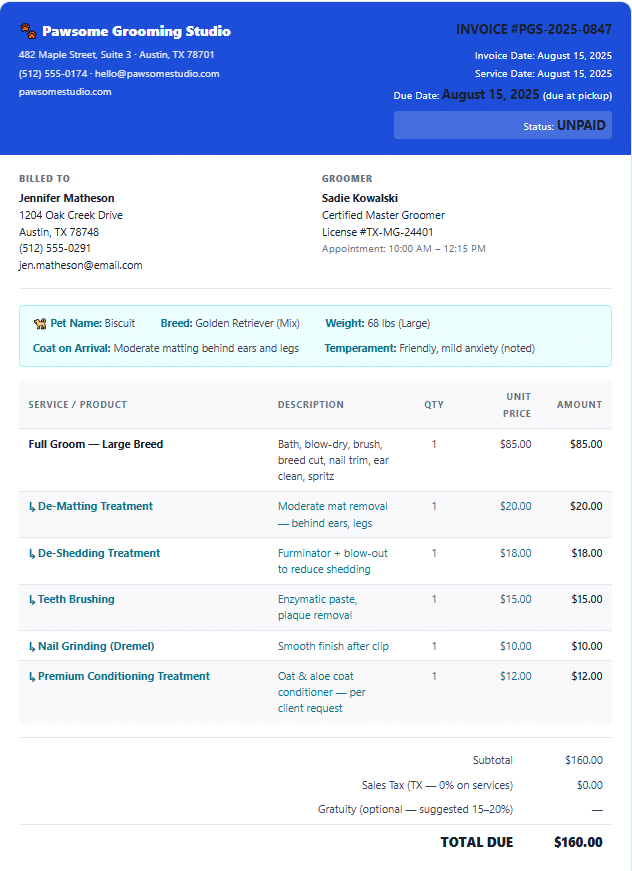
A Complete Pet Grooming Invoice: Annotated Example
The sample invoice below shows every section in its correct position, with real grooming line items and add-on pricing based on current industry rate data. This is what a professional pet grooming invoice looks like when it’s doing its full job: billing accurately, documenting clearly, and protecting against disputes.
Grooming-Specific Invoice Nuances That Generic Templates Miss
Breed and Weight Surcharge Documentation
Size-based pricing is standard in pet grooming, a large-breed groom takes longer, uses more product, and requires more physical effort than a small-breed groom. But when a client sees a charge that’s 40% higher than a friend’s grooming bill for what appears to be “the same service,” the invoice needs to explain why. Documenting the pet’s weight and size category alongside the base price gives clients the context they need without requiring an explanation from the groomer every time.
Coat Condition and Matting Surcharges
De-matting is one of the most disputed add-on charges in pet grooming, specifically because it’s applied after the appointment has started and the client isn’t present to approve it. The professional solution is a two-step process that’s documented in the invoice: a pre-groom coat assessment note (written, not just verbal) and a separate de-matting line item with a brief description of the condition found. When both are present in the invoice record, a client disputing the charge has to contend with the groomer’s written, contemporaneous notes, not just their word against the groomer’s.
Handling Fees for Difficult Pets
Some pets require significantly more handling time, like an anxious dog that needs breaks, a cat that requires a second groomer for safety, or a pet that has never been professionally groomed before. Handling fees are legitimate and defensible, but only when they’re documented. An invoice line item reading “Extended handling / two-groomer assist, $25” with a behavioral note in the pet section creates a clear and professional explanation. The same charge appearing as part of an unexplained total is what triggers “why is this more expensive than last time?” conversations.
Sales Tax on Grooming Services
Grooming services are not uniformly taxable. In most U.S. states, services (as opposed to products) are exempt from sales tax. Texas, for example, does not tax pet grooming services. In states where services are taxable, or where the sale of grooming products alongside services creates taxable revenue, the invoice needs to separate taxable and non-taxable components and apply the correct rate. Getting this wrong in either direction, collecting tax you don’t owe or not collecting tax you do, is a compliance problem. Check your state’s specific rules and display the tax line on every invoice even if the rate is 0%, so the client can see that the question was considered.
Deposit Invoices for Pre-Paid Appointments
If your salon collects a deposit at booking, the deposit should generate its own invoice (or at minimum a booking confirmation that functions as an invoice), with the deposit amount clearly stated and the balance due at service noted. The final invoice at pickup then shows the full price, the deposit already applied, and the remaining balance due. This two-document approach creates a complete paper trail for both the deposit and the final collection and is the only reliable basis for retaining a deposit when a client cancels late or doesn’t show.
When to Use Recurring Billing Instead of Individual Invoices
Individual per-visit invoices are the right tool for most grooming relationships, walk-ins, first-time clients, and clients on no fixed schedule. But for groomers who offer grooming memberships or prepaid packages, individual invoices are the wrong billing model entirely.
Grooming memberships are one of the smartest moves a pet salon can make, rather than pursuing individual bookings, you secure a predictable monthly income while providing pet owners with convenience and savings, according to QuadraPay’s pet salon payment processing guide (2026). According to SchedulingKit’s 2026 pet grooming statistics, 18% of grooming businesses already offer subscription or membership plans.
For clients on a monthly grooming membership, paying, say, $89/month for one bath and brush plus discounts on add-ons, generating a manual invoice each month is the wrong tool. The correct setup is recurring billing: automated monthly charge on the same date, automatic receipt, no manual action required. The per-visit service record (which still documents what was done, the pet’s condition, and any add-ons) is separate from the billing cycle. This is also where customer management records become especially important, membership clients need their billing history, appointment history, and service notes all accessible from one profile, not stored across three separate systems.
For large prepaid packages, a client who pays $300 upfront for five grooming sessions, installment billing logic applies: the total is agreed upon upfront, the sessions are used over time, and the financial record needs to track both the payment and the session credits remaining.
Common Invoicing Mistakes That Cost Groomers Money
Mistake 01: Telling clients about add-ons verbally but not writing them down
A verbal conversation about de-matting charges or a flea treatment is not documentation. If the client disputes the charge two weeks later, the groomer’s recollection is the only evidence, and card issuers weigh documentation far more heavily than testimony. Every add-on that’s discussed before or during a grooming session should be noted in the pet record and appear as a separate line item on the invoice before pickup. “I mentioned it when they dropped off” is not a chargeback defense.
Mistake 02: Using a business name on the invoice that doesn’t match the card billing descriptor
A confusing charge on a customer’s bank statement can result in fast disputes if the business name isn’t recognizable, according to QuadraPay’s 2026 pet salon payment processing guide. If your business is “Pawsome Grooming Studio” but your card processor descriptor shows “PWSM GRMING” or a generic processor code, clients who don’t immediately recognize the charge will dispute it as unauthorized. Ensure your card billing descriptor matches your business name closely enough that any client will recognize it.
Mistake 03: Charging a round number that doesn’t match any itemized service
Charging $120 for a session that has a $85 base and $35 in add-ons is fine, but only if the invoice shows $85 + $35 = $120. Charging $120 as a flat amount with no breakdown gives the client nothing to evaluate, makes overcharging impossible to verify, and creates an easy dispute scenario. Even if the math is right, an unexplained total looks arbitrary.
Mistake 04: Sending invoices after the client has already left with no payment collected
For pet grooming, payment at pickup is the industry standard, and for good reason. Once a client has their pet back, the groomer has zero leverage for collection. According to a 2024 PYMNTS report cited by NetSuite, 22% of small businesses struggled to pay bills because of cash flow problems driven by unpaid invoices. For grooming businesses, “pay at pickup” removes the entire outstanding invoice problem. If a client needs to be invoiced (absentee pickup, multi-owner scenario), the invoice should be sent immediately with a direct payment link and a 24-hour due date.
Mistake 05: Storing invoice records separately from client pet records
When a client calls to ask about a charge from six months ago, the groomer should be able to pull up the client’s record and see the invoice, the service notes, the pet’s condition at the time, and the groomer who performed the service, all in one place. When invoice records are in one system (or a file folder, or an email thread) and client notes are in another, that conversation becomes difficult, slow, and unpersuasive. Invoice history and client history belong in the same system. See: Customer Management.
Mistake 06: Not including a next appointment prompt on the invoice
The moment a client picks up a freshly groomed, great-smelling pet is the moment they are most likely to rebook. An invoice that includes “Next recommended grooming: [date range], book at [URL]” captures that moment automatically. Most groomers miss this entirely. It doesn’t require a booking system conversation, just a line at the bottom of the invoice and a working booking link.
How to Set Up Professional Pet Grooming Invoicing: Step by Step
Build your service menu with individual prices for every service and add-on
Before you can invoice correctly, you need a complete price list: base groom by size tier, every add-on with its own price, handling fees, and any surcharges. This list becomes the foundation of your invoice line items and should be the same list you show clients at booking. Using BusinessDojo’s 2024–2025 verified price data as a baseline: full large-breed groom is $65–$85, de-matting is $10–$25, flea treatment is $15–$30, teeth brushing is $10–$20, de-shedding is $15–$25, and nail grinding is $8–$15.
Set up a client intake form that captures the pet information your invoice needs
Every new client should complete an intake form, in person or digitally, that captures the following: client name and contact, pet name, breed, approximate weight, known health conditions, behavioral notes, and signature acknowledgment of your cancellation and late-fee policy. This form is what populates the pet information section of every invoice for that client from that point forward, and it’s the policy acknowledgment that backs up any deposit retention or late fee.
Create a pre-groom checklist that generates your invoice line items
At the start of each appointment, complete a brief pre-groom assessment: coat condition, any visible health concerns, behavioral observations, and the services the client has requested. Each item on this assessment becomes either a line item on the invoice or a documented note in the pet record. Some groomers take a photo at this stage, which is the highest-quality chargeback defense available.
Document any additional services as they occur, not at billing time
The most common invoicing error in grooming isn’t forgetting to charge for an add-on, it’s not writing it down at the time. When a groomer notices matting mid-session and performs a de-matting treatment, that should be added to the job record immediately, with a note that the client was informed. Adding it from memory when building the final invoice at pickup is where errors, omissions, and disputes originate.
Generate and present the itemized invoice before the client pays, not after
The invoice should be ready and reviewed by the groomer, not just handed to the client cold, before payment is collected. This gives the groomer the opportunity to walk through any unexpected add-on charges before the client sees them, reducing the chance of a disputed payment after the fact. “Here’s what Biscuit had done today” is a much better pickup conversation than “Here’s the total.”
Send a digital receipt with a payment link immediately after collection
Whether you’re collecting payment in person by card or requesting online payment, send a digital receipt to the client’s email within minutes of the appointment ending. This receipt confirms the transaction, reduces “I don’t remember what I paid for” calls, and serves as a timestamped billing record. For online payment requests, include a direct payment link that takes the client to the exact invoice, not your website homepage.
Move recurring clients to automated billing through a dedicated billing platform
For membership or package clients, switch from per-visit invoicing to automated recurring billing. This eliminates the monthly invoice cycle, ensures consistent collection on the same date, and gives recurring clients the seamless experience that makes memberships feel worth the commitment. Platforms like ReliaBills support both recurring membership billing and per-visit invoicing under the same client account, so you’re not managing two separate systems for two different client types.
Frequently Asked Questions
1. What should a pet grooming invoice always include?
At minimum: your business name and contact information, a unique invoice number, the service date and due date, the client’s name and contact details, the pet’s name and breed, an itemized list of every service performed with individual prices, the subtotal, any applicable tax, and the total due. Each add-on should appear as its own line item, not bundled into a single “extras” charge, so the client can verify what they’re paying for.
2. Why do I need to document coat condition and pet behavior on my invoice?
Two reasons: revenue protection and dispute protection. A written note that a pet arrived with “moderate matting behind ears and legs” is the documentation that justifies a de-matting surcharge when the client questions it. A behavioral note that a pet required extended handling is the basis for a handling fee. Without written contemporaneous documentation, any add-on charge that differs from what the client expected is hard to defend, and card issuers side with cardholders in ambiguous disputes.
3. Is pet grooming taxable? Should I include sales tax on my invoice?
It depends on your state. Most U.S. states don’t impose sales tax on grooming services, though a few do. The sale of products (shampoos, accessories) is typically taxable even in states that exempt services. Check your specific state’s rules, then include a tax line on your invoices. Even if the rate is 0%, it shows clients the question was considered and keeps the invoice structure consistent if your state’s rules change.
4. How should I handle a client who disputes a grooming charge?
Respond with documentation, not conversation. Pull the invoice showing the itemized services performed. Pull the intake form showing the client’s signed acknowledgment of your policies. And pull out your pre-groom assessment notes showing coat condition. Provide any before and after photos. Submit all of this to your payment processor’s dispute resolution system promptly, most processors give you 7–10 days to respond. A groomer who has clear, written, timestamped documentation wins the overwhelming majority of disputes. A groomer responding from memory wins almost none.
5. What’s the difference between a pet grooming invoice and a receipt?
An invoice is a payment request, it tells the client what they owe and when payment is due. A receipt confirms payment already received. Many grooming businesses issue a single document that functions as both, labeled as an invoice when sent and updated to “PAID” when payment is collected. Either approach works as long as the document clearly shows whether payment has been received.
Recent Articles:
- How to Automate Membership Dues Collection and Reduce Delinquencies
- Recurring Billing vs. One-Time Invoicing: Which Is Right for Your Service Business?