
Freight and logistics companies operate in one of the most operationally complex billing environments, where no two shipments are always exactly the same. Every delivery can involve multiple cost variables such as distance, fuel surcharges, customs fees, weight classifications, handling charges, and service tiers. When these variables are multiplied across hundreds or thousands of shipments, manual invoicing becomes extremely difficult to manage accurately.
On top of this complexity, freight businesses often serve long-term clients with recurring shipping schedules. These repeat transactions require consistent and timely invoicing, which becomes even harder when handled manually across spreadsheets or disconnected systems. Delays or errors in billing can quickly disrupt cash flow and create disputes with clients.
This is why recurring invoicing for freight companies combined with automation has become a critical operational necessity. By digitizing billing workflows and integrating them with logistics data, companies can reduce errors, speed up payment cycles, and maintain financial consistency at scale.
What Are Recurring Client Invoices in Freight Operations?
Recurring client invoices in freight operations refer to automated billing documents generated at fixed intervals or triggered by predefined logistics events for repeat customers. These invoices are commonly used for clients who have ongoing shipping contracts, such as weekly deliveries, monthly logistics retainers, or warehouse and distribution agreements.
Instead of manually creating invoices for every shipment, freight companies rely on automated systems that generate invoices based on contract terms and shipment activity. This ensures that billing is consistent, predictable, and aligned with service agreements. It also helps eliminate missed invoices that can occur in high-volume operations.
Unlike one-time or ad hoc billing, recurring invoices follow structured schedules and standardized pricing logic. This makes them ideal for long-term logistics relationships where services are continuous rather than transactional. Over time, this approach significantly improves financial predictability and operational efficiency.
Why Freight Companies Need Invoice Automation
High volume of shipments and transactions
Freight companies process large numbers of shipments daily, often across multiple regions or service categories. Manually creating invoices for each transaction becomes time-consuming and unsustainable at scale. Automation ensures that billing keeps pace with operational volume without delays or backlogs.
Complex pricing structures (fuel surcharges, distance, weight, etc.)
Freight billing often involves layered pricing models that vary based on shipment type, distance, fuel costs, and handling requirements. Calculating these manually increases the risk of inconsistencies and errors. Automated systems apply predefined rules to ensure accurate and consistent pricing every time.
Need for timely billing to maintain cash flow
In logistics, cash flow depends heavily on how quickly invoices are issued after delivery. Delays in billing directly translate into delays in payment collection. Automation ensures invoices are generated immediately after shipment completion or at scheduled intervals.
Risk of errors in manual invoicing processes
Manual data entry can result in incorrect charges, missing fees, or mismatched shipment details. These errors often lead to disputes and delayed payments. Automation reduces human involvement in repetitive tasks, significantly improving accuracy and reliability.
How Freight Companies Automate Recurring Invoices
Freight companies automate recurring invoicing by connecting billing systems directly with logistics and shipment tracking platforms. Once a shipment is completed or a billing cycle is reached, the system automatically generates an invoice based on real-time shipment data and predefined contract terms.
These systems also rely on standardized pricing rules that account for variables such as distance, weight, service type, and surcharges. Instead of recalculating each invoice manually, the system applies these rules automatically, ensuring consistency across all clients. This reduces operational friction and improves speed.
Many freight companies also integrate auto-pay systems for recurring clients, allowing payments to be collected automatically once invoices are issued. This creates a fully automated billing cycle—from shipment to invoice to payment—reducing manual intervention and improving financial efficiency.
Key Features of Automated Freight Billing Systems
Recurring billing and scheduling tools
These tools allow freight companies to automate billing cycles for regular clients based on weekly, monthly, or contract-based schedules. They ensure invoices are consistently generated without manual input. This improves reliability and eliminates missed billing cycles.
Dynamic pricing and rate calculation
Automated systems calculate shipping costs based on multiple variables such as weight, distance, fuel surcharges, and service level agreements. This removes the need for manual calculations and reduces pricing errors. It ensures every invoice reflects accurate and contract-compliant pricing.
Integration with shipment tracking and logistics systems
Billing platforms integrate directly with logistics systems to pull real-time shipment data. This ensures invoices are always based on actual delivery performance. It eliminates discrepancies between operations and finance teams.
Automated invoice generation and delivery
Invoices are automatically created and sent to clients once conditions are met, such as shipment completion or billing cycle triggers. This speeds up the entire billing process significantly. It also improves client communication and reduces delays.
Real-time payment tracking and reporting
Businesses can monitor invoice status, payment progress, and overdue accounts in real time. This improves visibility into financial performance. It also helps identify cash flow risks early.
Customer account management and billing history
All client transactions are stored in a centralized system for easy access and review. This simplifies account management and improves transparency. It also supports better customer service and dispute resolution.
The Role of Recurring Billing in Freight Operations
Recurring billing plays a foundational role in simplifying financial operations for freight companies that manage long-term clients. Instead of manually generating invoices for each shipment, businesses can automate billing based on recurring schedules or contract terms. This ensures consistent and predictable revenue collection.
It also improves communication with clients by establishing clear billing expectations. Customers know exactly when invoices will arrive and what they are for, which reduces confusion and disputes. Predictability strengthens business relationships over time.
Most importantly, recurring billing reduces repetitive administrative work, allowing finance teams to focus on analysis rather than manual processing. This is one of the key advantages of recurring invoicing for freight companies looking to scale efficiently.
Challenges Without Automation
Delayed invoicing and slower payment cycles
Without automation, freight companies often rely on manual data entry and delayed invoice creation after shipment completion. This slows down the entire billing cycle and directly impacts how quickly payments are received. Over time, these delays create cash flow gaps that make financial planning less predictable.
Increased risk of billing errors and disputes
Manual invoicing increases the likelihood of mistakes in pricing, shipment details, or applied surcharges. These errors often lead to disputes with clients, requiring additional time to investigate and correct. This not only delays payments but also weakens client trust in billing accuracy.
Difficulty managing large volumes of invoices
As freight operations scale, the number of invoices can quickly become overwhelming for finance teams. Without automation, keeping track of each invoice manually becomes inefficient and error-prone. This can result in missed invoices or duplicate billing issues.
Lack of visibility into payment status and cash flow
Manual systems make it difficult to track which invoices are paid, pending, or overdue in real time. This reduces financial visibility and makes it harder to forecast revenue accurately. As a result, businesses may struggle to identify cash flow risks early enough to respond effectively.
Best Practices for Automating Freight Invoices
Standardize pricing and contract terms
Establishing clear and consistent pricing rules ensures that all invoices are generated accurately and uniformly. This reduces confusion between finance teams and clients regarding charges and service fees. It also makes automation setup easier and more reliable across different contract types.
Automate invoice generation based on shipment data
Integrating billing systems with logistics platforms ensures invoices are automatically created as soon as shipment data is confirmed. This removes the need for manual entry and significantly reduces processing time. It also ensures invoices always reflect actual shipment activity.
Integrate billing with logistics and accounting systems
Connecting systems across departments allows data to flow seamlessly between operations, finance, and accounting. This eliminates duplication of work and reduces the risk of inconsistencies. It also improves reporting accuracy and operational efficiency.
Enable auto-pay for recurring clients
Auto-pay ensures that payments are automatically collected once invoices are issued. This reduces delays caused by manual payment processing or customer oversight. It also improves cash flow stability and reduces administrative follow-ups.
Regularly review billing accuracy and reports
Even with automation in place, periodic reviews are necessary to ensure system accuracy and performance. This helps identify pricing issues, configuration errors, or unusual billing patterns early. It also ensures long-term reliability of the automated billing system.
How Automation Improves Cash Flow and Accuracy
Automation significantly improves cash flow by ensuring invoices are generated immediately after shipments are completed or billing cycles are triggered. This reduces delays and accelerates payment collection. Faster billing directly leads to healthier cash flow.
It also improves accuracy by removing manual calculations and reducing human involvement in repetitive tasks. Automated systems apply standardized rules consistently across all transactions. This minimizes disputes and improves client trust.
Additionally, real-time reporting provides visibility into outstanding payments and revenue trends. This helps businesses make more informed financial decisions. It strengthens overall financial planning and forecasting.
Key Benefits of Automating Freight Invoicing
- Saves time on manual billing tasks: Automation eliminates repetitive invoice creation work. This allows teams to focus on logistics operations instead. It significantly improves productivity.
- Reduces billing errors and disputes: Automated calculations ensure accuracy in every invoice. This reduces the risk of disputes with clients. It also improves billing consistency.
- Speeds up payment collection: Faster invoicing leads to quicker client payments. This improves cash flow cycles. It supports financial stability.
- Improves cash flow predictability: Recurring billing creates consistent revenue streams. This helps businesses plan finances more effectively. It reduces uncertainty in operations.
- Enhances operational efficiency: Automation streamlines workflows across billing and logistics teams. This reduces bottlenecks and delays. It improves overall business performance.
Common Use Cases
- Contract-based shipping agreements: Freight companies automate billing for long-term contracts. This ensures consistent invoice generation. It reduces manual effort significantly.
- Regular freight routes and scheduled deliveries: Automated invoicing supports recurring delivery routes. This ensures accurate and timely billing. It improves operational consistency.
- Third-party logistics (3PL) providers: 3PL companies manage multiple clients with recurring shipments. Automation simplifies complex billing structures. It improves scalability.
- Warehousing and distribution services: Storage and handling fees are billed on a recurring basis. Automation ensures accuracy and consistency. It reduces administrative workload.
- Subscription-based logistics services: Some logistics providers offer subscription-style services. Recurring billing ensures predictable revenue streams. It supports business growth.
How ReliaBills Helps Freight Companies Automate Recurring Invoices
ReliaBills helps freight companies simplify and streamline complex billing workflows by automating invoice creation, scheduling, and delivery. Instead of relying on manual processes that are prone to delays and errors, logistics teams can generate accurate invoices directly from service data and contract terms. This reduces administrative workload and ensures consistent billing across all clients. As a result, freight businesses can maintain better financial control while improving operational efficiency.
With recurring billing functionality, ReliaBills supports recurring invoicing for freight companies by automating billing cycles for long-term contracts, scheduled deliveries, and repeat clients. Businesses can set up predefined schedules that automatically generate invoices at fixed intervals or after shipment completion. This ensures that no billing cycle is missed and that clients receive invoices on time, every time. It also improves cash flow predictability by maintaining consistent billing patterns.
ReliaBills PLUS enhances these capabilities with advanced automation tools, detailed reporting, and centralized customer management features. Freight companies can monitor invoice status in real time, track payment performance, and manage client accounts from a single platform. These insights help businesses identify trends, reduce delays, and optimize billing operations at scale. With these tools, logistics providers can grow efficiently while maintaining accuracy and full visibility over their financial processes.
How to Create a New Recurring Invoice Using ReliaBills
Creating a New Recurring Invoice using ReliaBills involves the following steps:
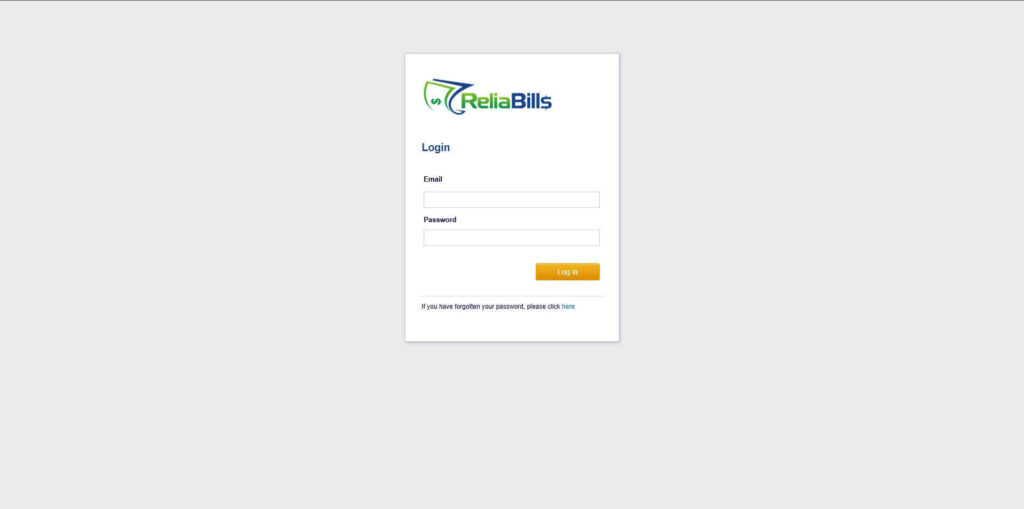
Step 1: Login to ReliaBills
- Access your ReliaBills Account using your login credentials. If you don’t have an account, sign up here.
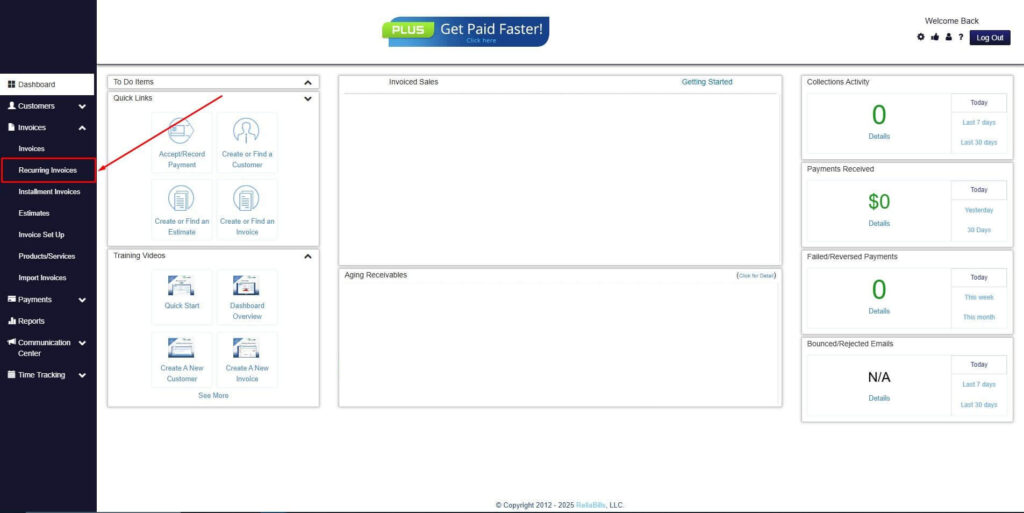
Step 2: Click on Recurring Invoices
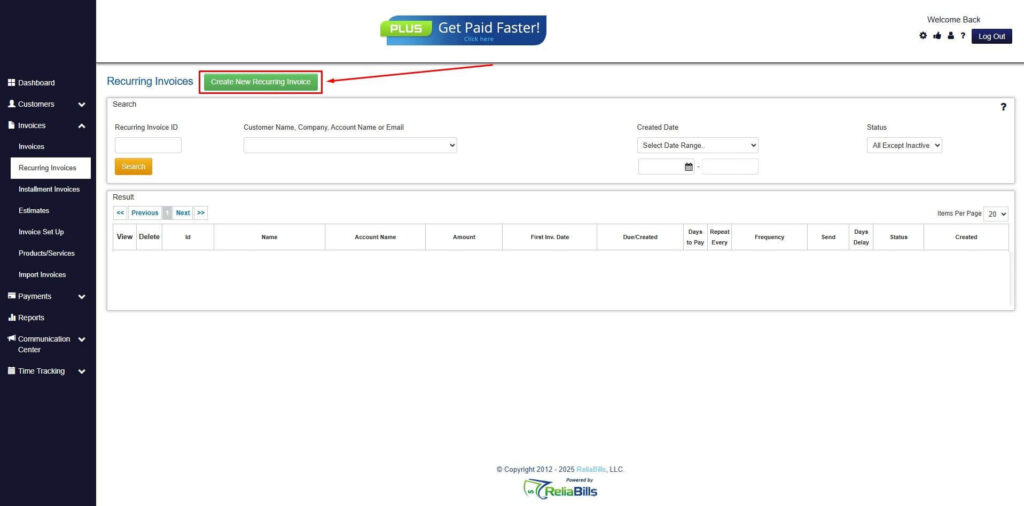
- Navigate to the Invoices Dropdown and click on Recurring Invoices for an overview of the list of your existing customers.
Step 3: Go to the Customers Tab
- If you have already created a customer, search for them in the Customers tab and make sure their status is “Active”.
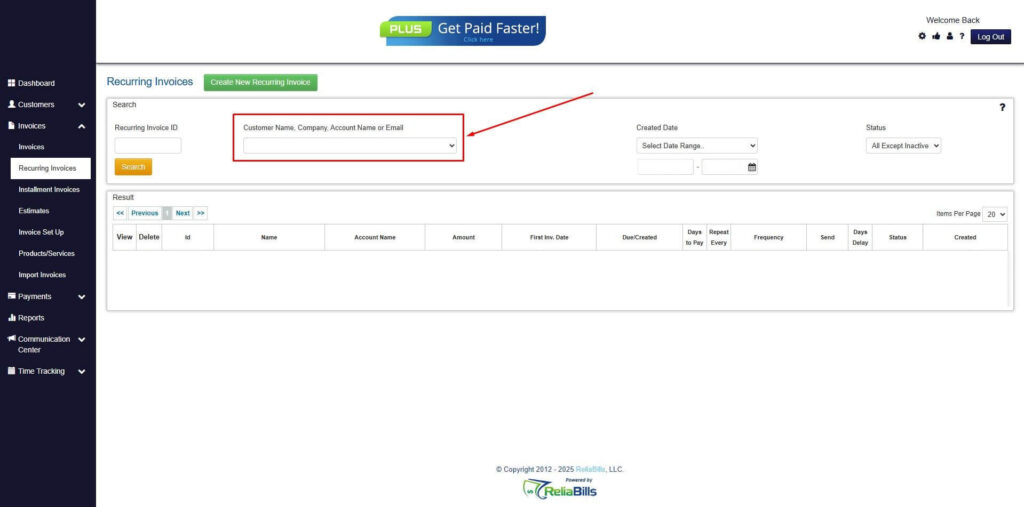
Step 4: Click the Create New Recurring Invoice
- If you haven’t created any customers yet, click the Create New Recurring Invoice to create a new customer.
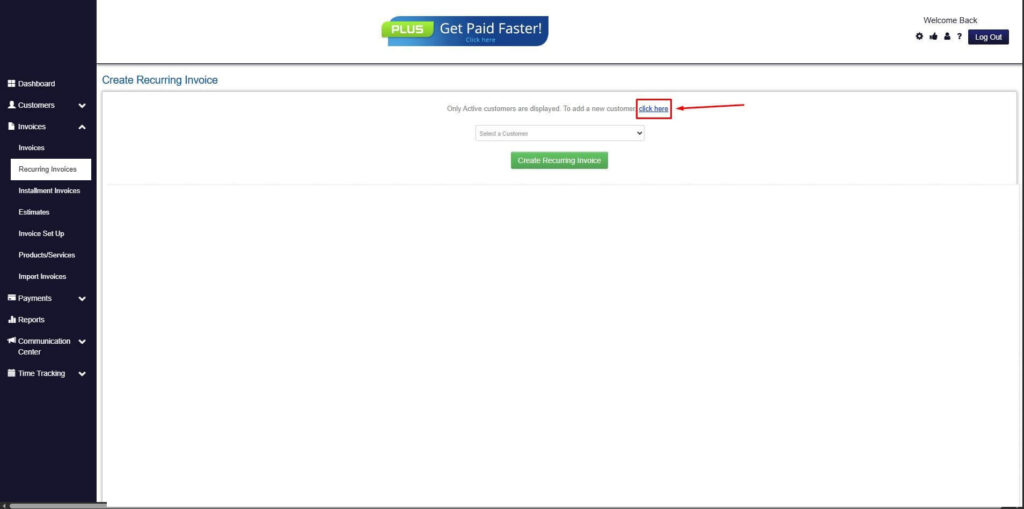
Step 5: Click on the “Click here” Button
- Click on the “Click here” button to proceed with the recurring invoice creation.
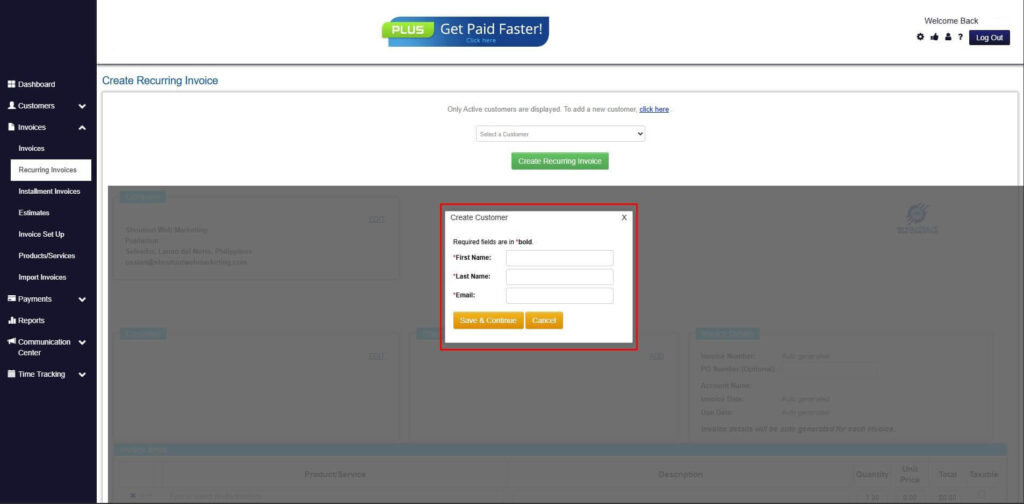
Step 6: Create Customer
- Provide your First Name, Last Name, and Email to proceed.
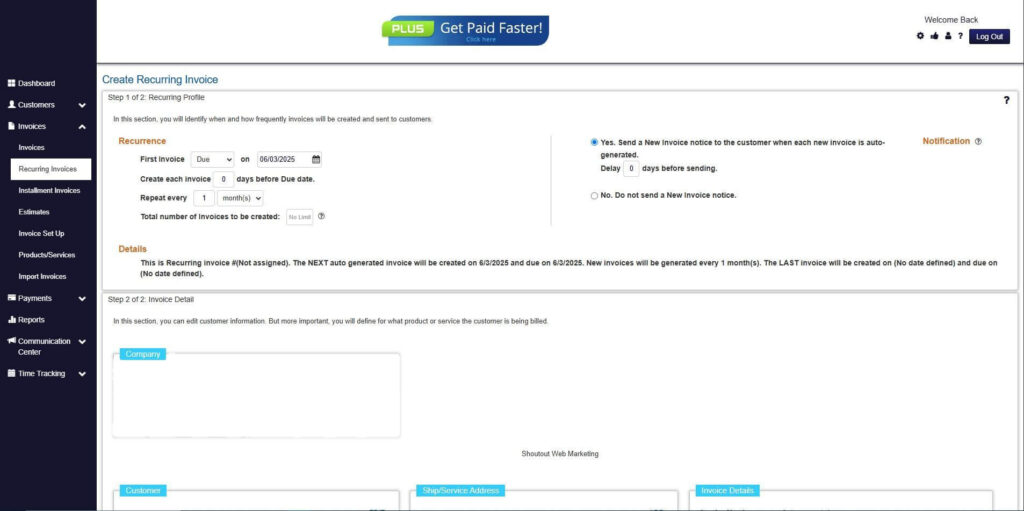
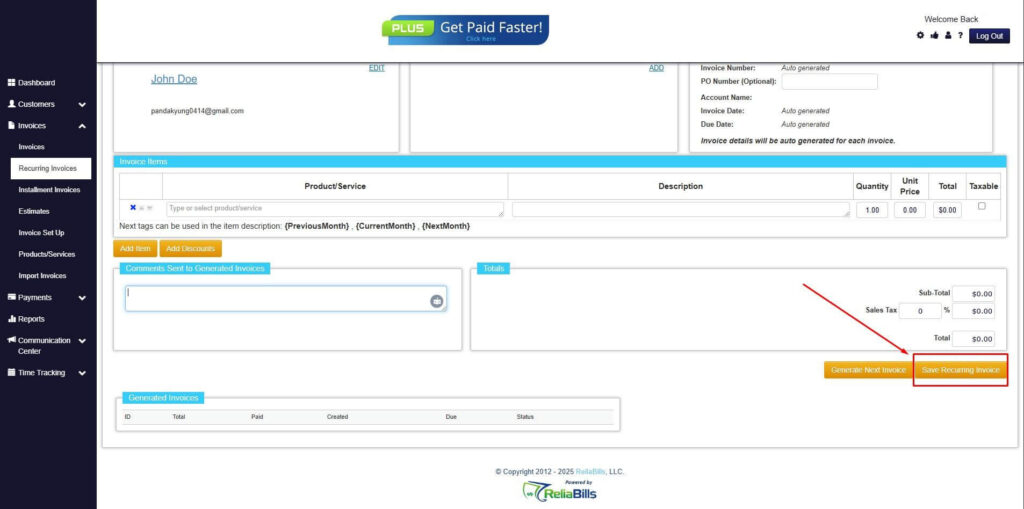
Step 7: Fill in the Create Recurring Invoice Form
- Fill in all the necessary fields.
Step 8: Save Recurring Invoice
- After filling up the form, click “Save Recurring Invoice” to continue.
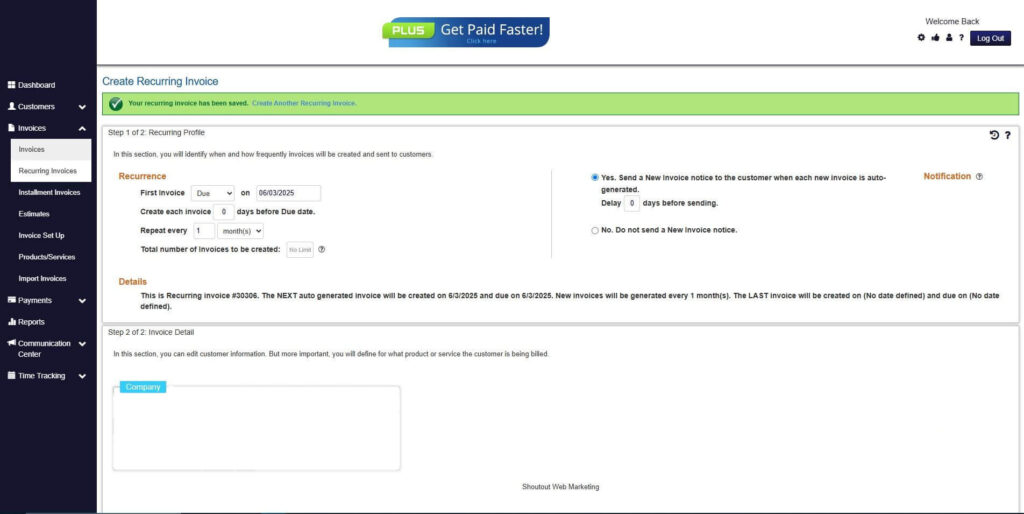
Step 9: Recurring Invoice Created
- Your Recurring Invoice has been created.
Frequently Asked Questions (FAQs)
1. What is recurring invoicing in freight operations?
It is automated billing for repeat logistics services or contract-based clients. It eliminates manual invoice creation. It ensures consistent billing cycles.
2. How does automation improve freight billing?
It reduces errors and speeds up invoice generation. It improves accuracy and consistency. It also enhances cash flow management.
3. Can freight charges be calculated automatically?
Yes, systems use predefined rules for weight, distance, and surcharges. This ensures accurate pricing. It reduces manual work.
4. Is recurring billing suitable for all freight clients?
It works best for contract-based or repeat clients. One-time shipments may still require manual billing. It depends on business structure.
5. How secure are automated billing systems?
Most systems use encryption and secure payment protocols. This protects sensitive financial data. It ensures compliance and trust.
Conclusion
Freight companies that implement automation for recurring client invoices gain significant advantages in speed, accuracy, and financial control. By reducing manual processes, they can improve cash flow and eliminate common billing errors that disrupt operations.
Recurring billing systems are especially valuable for logistics providers managing long-term clients and high shipment volumes. They ensure predictable revenue and reduce administrative strain, making recurring invoicing for freight companies a critical part of modern logistics operations.
As the logistics industry continues to grow in complexity, automation will become essential for scaling efficiently and maintaining competitive advantage. Companies that adopt these systems early will be better positioned for long-term success.