
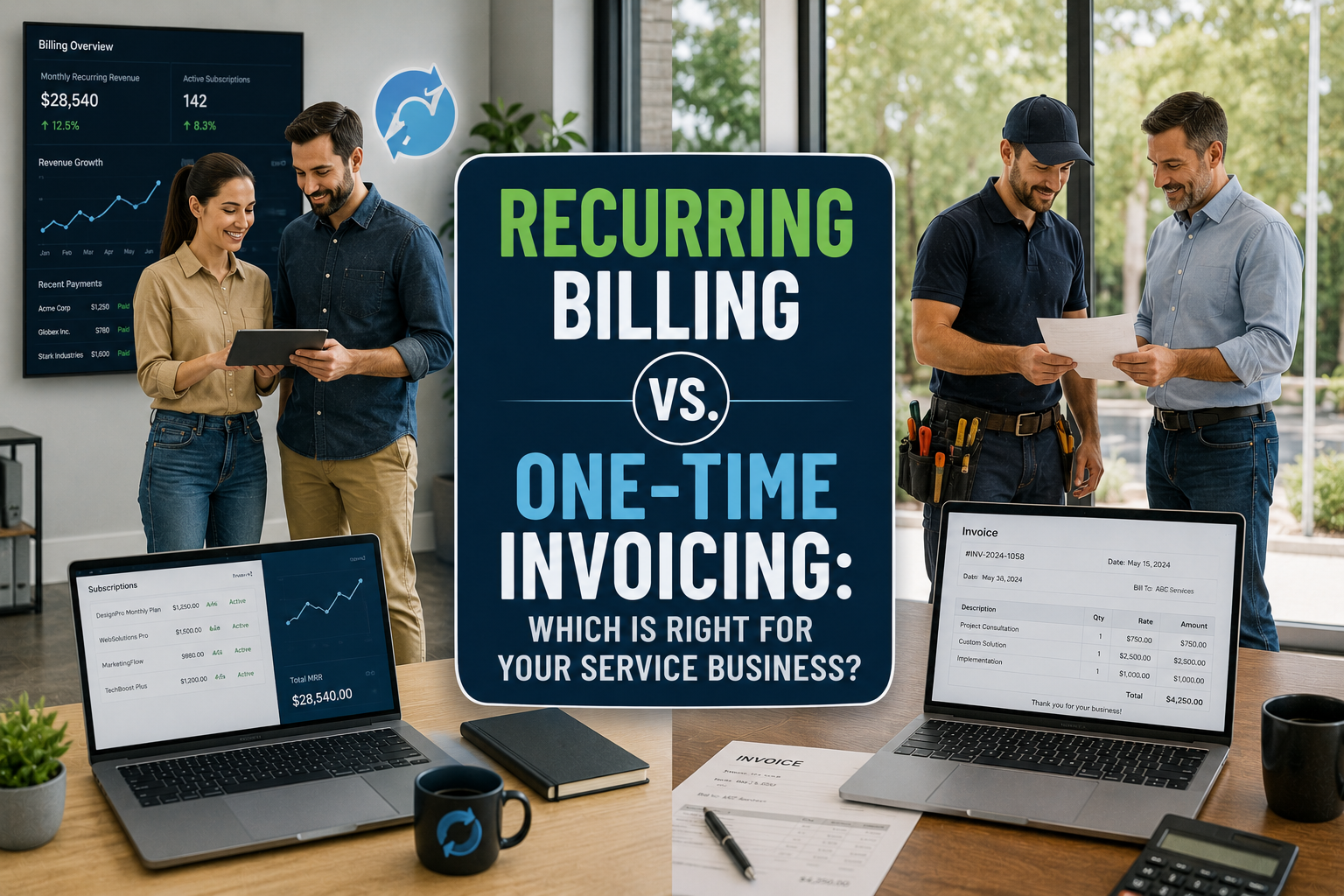
At some point, every service business owner sits down and asks a version of the same question: Should I be billing my clients on a set schedule or sending invoices when the work is done? It sounds like an administrative detail. It isn’t. The billing model you choose shapes your cash flow, your client relationships, the overhead your team carries, and how predictable your revenue looks at the end of each month.
This guide cuts through the noise around recurring billing vs. one-time invoicing and gives you a practical, experience-grounded framework for making the right call, or the right combination of calls, for your specific business.
What Is Recurring Billing?
Recurring billing is a payment model in which a client is automatically charged, or invoiced, at regular, pre-agreed intervals (weekly, monthly, quarterly, or annually) for ongoing services. The billing cycle repeats without requiring the business to manually initiate each invoice. Common in retainer arrangements, subscription services, managed services, and maintenance contracts.
What Is One-Time Invoicing?
One-time invoicing (also called project billing or transactional billing) is a model in which a business issues a standalone invoice for a specific piece of work, deliverable, or purchase. Each invoice is independent, there is no automatic recurrence. Common for project-based work, custom engagements, and one-off services.
How Each Model Works
The mechanical difference between the two models is straightforward, but the downstream effects on your business are not.
How Recurring Billing Works
When a client agrees to a recurring arrangement, the business sets up a billing profile: frequency, amount (fixed or variable), start date, and notification preferences. From that point, the system generates and sends invoices automatically on the scheduled date. If payment collection is automated, funds are drawn from the client’s card or bank account on file without any manual action on either side.
| 🔁 Recurring Billing | 📄 One-Time Invoicing |
| Client signs service agreement with billing terms defined | Work is scoped and agreed upon with a defined deliverable |
| Business creates a recurring profile in billing software | Business completes work (or reaches a milestone) |
| System auto-generates invoice on scheduled date | Invoice is manually created and sent to the client |
| Invoice sent to client (or payment auto-collected) | Client reviews, approves, and pays within net terms |
| Failed payments trigger automated retries & notification | Business follows up if payment is late |
| Cycle repeats until contract ends or is cancelled | Engagement closes, no future billing without new scope |
Real-World Use Cases
The clearest way to understand when each model fits is to look at the types of businesses that use them day to day.
When Recurring Billing Fits
💻 Managed IT Services
Monthly flat-fee managed service providers are the textbook recurring billing case. The service is always on, the value is delivered continuously, and the client expects a consistent monthly charge.
📊 Marketing Retainers
Agencies that retain clients for ongoing SEO, content, or social media management bill monthly. The scope is stable, and automation removes administrative friction from both sides.
🌿 Lawn Care & Maintenance
Seasonal service businesses, lawn care, pest control, and HVAC maintenance, benefit enormously from recurring billing, particularly on annual service contracts billed monthly.
🏋️ Gyms & Fitness Studios
Membership-based businesses are built on recurring revenue. The billing cycle is the business model, missed charges are missed revenue with no way to recover the time lost.
When One-Time Invoicing Fits
🏗️ Website Builds & Rebrands
Custom creative or technical projects with a defined scope, a fixed price, and a clear delivery date are a natural fit for project-based invoicing, sometimes with milestone-based tranches.
🧾 Legal & Consulting Work
Attorneys, accountants, and consultants engaged for a specific matter typically bill on completion or by the hour, issuing invoices that reflect actual time and scope rather than a flat recurring fee.
🛠️ Contractors & Trades
Plumbers, electricians, and general contractors work on a project-by-project basis. The scope varies with every job. One-time invoicing maps directly to how work is bought and sold in these trades.
📸 Event Photography & Video
A wedding or corporate event is a one-time engagement. Billing recurs only if the client books again, which means a new invoice for a new engagement, not an automated cycle.
Key Benefits of Each Approach
Benefits of Recurring Billing
- Predictable Revenue: Monthly Recurring Revenue (MRR) gives you a reliable baseline for financial planning, hiring, and investment decisions.
- Reduced Admin Load: Once set up, recurring invoices generate and send themselves. You’re not recreating the same invoice 12 times a year per client.
- Fewer Late Payments: Automated billing with payment on file eliminates the chase cycle. Failed payments trigger automatic retries and client notifications.
- Better Client Retention: Ongoing billing relationships reinforce the ongoing nature of the engagement. Clients in a billing cycle are less likely to drop off between projects.
- Stronger Cash Flow: Revenue lands on a known date each cycle. You can match payroll, vendor payments, and operating costs to predictable inflows.
- Scalability: Adding a 50th recurring client takes the same setup time as adding the fifth. The model scales without proportional increases in administrative work.
Benefits of One-Time Invoicing
- One-time invoicing often gets framed as the “less sophisticated” option, which undersells it considerably. It has genuine structural advantages for the right use cases.
- Clarity per engagement: Each invoice maps precisely to a piece of work. Clients see exactly what they’re paying for, which reduces disputes and makes sign-off straightforward. For large or complex projects, this transparency is not just convenient, it’s essential.
- Flexibility: You’re not locked into any fixed amount or schedule. If scope changes, the invoice changes. There’s no billing infrastructure to update and no client to notify about a mid-cycle adjustment.
- Lower client commitment: Some clients are simply not ready for a retainer. One-time invoicing lets you begin a working relationship with lower friction and move toward recurring arrangements as trust builds.
- Better for variable or irregular services: If your workload for a given client fluctuates significantly month to month, one-time invoicing gives you the ability to bill accurately rather than estimating a monthly average and constantly reconciling against it.
Risks and What to Watch For
Risks of Recurring Billing
The most underappreciated risk in recurring billing is scope creep that doesn’t get billed. When clients know their invoice will arrive on the first of the month regardless of what they asked for, there’s a natural tendency to ask for more. If the retainer agreement isn’t clearly scoped, and regularly reviewed, you can find yourself doing materially more work for the same flat fee.
Failed payments are also a real operational concern. A card that expires, an account with insufficient funds, or a client who deliberately delays can create a gap in your revenue that takes weeks to resolve if you don’t have automated dunning and payment retry logic built in. Most purpose-built recurring billing platforms handle this automatically.
Finally, recurring billing requires clear contract language. What happens if the client wants to pause? What’s the notice period to cancel? These questions need answers before the first invoice generates.
Risks of One-Time Invoicing
The most common failure mode in one-time invoicing is the late invoice, the business that completes work and then waits days or weeks to invoice. Research on accounts receivable patterns consistently shows that the longer a business waits to invoice after delivering work, the longer clients take to pay. Same-day invoicing is one of the most effective and underused cash flow tools available to service businesses. For practical scripts on following up on overdue invoices, see our guide on how to invoice late-paying clients.
One-time invoicing also creates an uneven cash flow pattern. Large project invoices might cluster in some months and be absent in others. If your operating costs are relatively fixed, this unevenness creates real financial strain. Businesses that experience this problem often find that moving to milestone-based billing, which is closer to installment billing, smooths the curve considerably.
Full Comparison: Recurring Billing vs. One-Time Invoicing
The table below also includes installment billing in the comparison, since many service businesses confuse it with recurring billing or use it as a bridge between the two primary models.
| Factor | Recurring Billing | One-Time Invoicing | Installment Billing |
|---|---|---|---|
| Best for | Ongoing services, retainers, subscriptions | Projects, custom engagements, one-off work | Large purchases spread over time |
| Revenue predictability | High, amount and date are fixed | Low, depends on project cadence | Medium, total is fixed, payment dates are scheduled |
| Admin effort | Low after setup | High, each invoice is manual | Low, invoices pre-generated at the start. |
| Client commitment | Higher, ongoing agreement required | Lower, pay per engagement | High, fixed commitment to total amount |
| Scope flexibility | Low, requires contract change | High, each invoice can reflect new scope | Very low, total and schedule fixed upfront |
| Total contract amount | Open-ended | Per invoice | Fixed from day one |
| End date | Typically open (until cancelled) | Per project | Defined at start |
| Failed payment handling | Automated retry recommended | Manual follow-up | Applied to final or last open invoice |
| Cash flow impact | Smooths and stabilizes inflows | Lumpy and unpredictable | Structured and predictable for the contract duration |
| Churn risk | Cancellation risk if value isn’t felt | Low, no subscription to cancel | Medium, client is committed but may dispute |
| Software complexity | Requires recurring billing platform | Works with basic invoicing tools | Requires installment-capable billing software |
| Common industries | SaaS, agencies, managed services, fitness | Design, legal, trades, consulting | Website builds, landscaping, vehicles, large contracts |
Revenue Predictability: A Visual Breakdown
One of the clearest practical arguments for recurring billing is the effect it has on revenue predictability over time. The chart below models two hypothetical service businesses with identical total annual revenue, one relying entirely on one-time project invoicing, the other running 60% of revenue through recurring billing and 40% through project work.
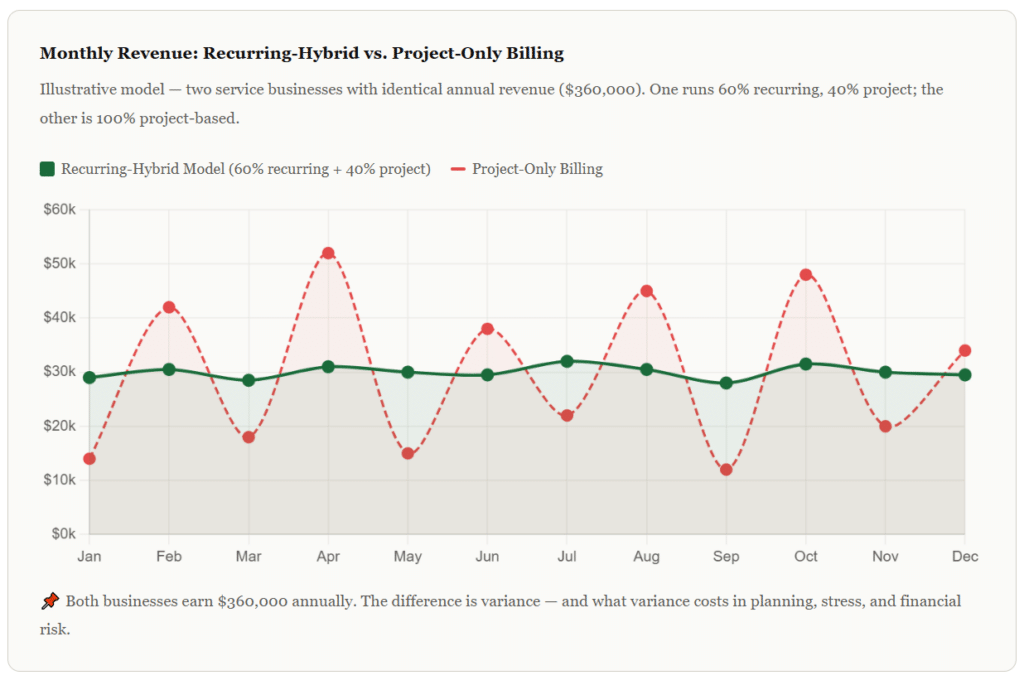
The revenue is identical throughout the year. The experience of running the business is not. The project-only business faces months where revenue falls to $12,000, while carrying the same fixed costs as months where it peaks at $52,000. That variance isn’t just uncomfortable. It creates real decisions about cash reserves, payroll timing, and whether to take on new overhead.
How to Decide: A Practical Framework
The choice between recurring billing and one-time invoicing is rarely binary. Most service businesses should be asking a more nuanced question: which model fits which client and which type of work? The framework below helps you sort your client base and service types into the appropriate billing model.
| Your Situation | Recommended Model |
|---|---|
| Client needs ongoing service with consistent monthly deliverables | Recurring Billing |
| Project has a clear scope, deliverable, and end date | One-Time Invoice |
| Client is paying a large sum for a defined project in phases | Installment Billing |
| You have both retainer and project clients in the same business | Recurring + One-Time in parallel |
| Work volume varies significantly month to month | One-Time Invoice (or variable recurring) |
| Cash flow instability is your biggest operational pain | Recurring Billing |
| Client prefers maximum billing transparency per deliverable | One-Time Invoice |
| You run a subscription-based SaaS or digital product | Recurring Billing |
| You’re onboarding a new client not yet ready for a retainer | One-Time Invoice (then migrate to recurring) |
Common Mistakes And What I Got Wrong at First
Most of the mistakes in this area aren’t about the billing model itself, they’re about how businesses implement it. Here are the ones that show up most often and the ones that are genuinely easy to get wrong early on.
Mistake 1: Treating “Recurring” as a Synonym for “Subscription”
Recurring billing and subscription billing are related but not identical. A subscription implies a specific product tier, features, and usually the ability for the customer to self-serve upgrades or cancellations. Recurring billing is the mechanism, it’s the payment automation layer. You can run a recurring billing arrangement for a custom retainer, a maintenance contract, or a utility service. Subscription thinking applied to custom service relationships creates expectation mismatches on both sides.
Mistake 2: Setting Up Recurring Billing Without Reviewing It
The automation that makes recurring billing powerful can also let incorrect invoices run for months without anyone noticing. If a client’s scope changes, if a price adjustment was agreed to verbally, or if the service is paused temporarily, the recurring system doesn’t know. Setting a calendar reminder to audit your recurring invoice profiles quarterly is unglamorous but genuinely important.
Mistake 3: One-Time Invoices Without Payment Terms
An invoice without explicit payment terms is an invoice without a due date. “Due upon receipt” is better than nothing, but net-30 or net-15 with a clearly stated late payment fee is better still. Businesses that invoice on net-30 terms but don’t actually enforce them teach their clients that late payment carries no consequence, a lesson that’s difficult to undo later.
Mistake 4: Picking a Model Based on Industry Convention, Not Business Reality
Some industries are almost entirely project-billed by tradition, lawyers, architects, and contractors. That doesn’t mean all of their work belongs in a one-time invoice. An architecture firm with a client who needs ongoing coordination meetings, planning reviews, and permit support might be better served by a recurring management retainer alongside project-specific invoices. Convention is a starting point, not a constraint.
Mistake 5: Waiting Too Long to Move Clients to Recurring
The business that completes a project, gets paid, and then starts the proposal process from scratch for the next engagement is leaving a predictable revenue opportunity on the table. If a client is coming back for repeat work, the conversation about a retainer or maintenance arrangement should happen during, or right after, the project debrief, not six months later.
How to Get Started
The practical path to implementing either model, or both, comes down to three things: the right tooling, clear service agreements, and a disciplined onboarding process for each client.
For Recurring Billing
Start by identifying which of your existing clients are already being billed for ongoing work at a consistent monthly fee. These are your immediate migration candidates. The setup process in a platform like ReliaBills involves creating a recurring invoice profile for each client, defining the billing amount, frequency, start date, and whether you want invoices sent automatically or held for your review before dispatch.
For clients you’re migrating from manual monthly invoicing, the transition is typically smooth. Most clients appreciate the consistency, and many will opt in to autopay once it’s offered. For new clients, position the recurring arrangement as a feature of your retainer service, not just a billing preference.
You’ll also want to ensure your recurring billing setup includes:
- Automated payment reminders before and after the due date
- Failed payment retry logic with client notification
- Clear customer records with updated payment details, see Customer Data Management
- A review cadence to catch scope drift early
For One-Time Invoicing
If you’re starting with project-based invoicing, the priority is speed and consistency. Invoice the day you deliver, not the end of the week, not after the client confirms receipt. Your invoicing software should make it possible to generate a professional invoice in under two minutes for a returning client.
Set clear payment terms in every engagement letter and in the invoice itself. If you’re dealing with larger projects, consider milestone billing, where you invoice at agreed checkpoints rather than at the very end. This reduces your exposure if a project runs long and protects cash flow throughout the engagement. For large contracts where a client needs payment flexibility, installment billing gives them structured payment options while guaranteeing you the full contract amount.
Combining Both Models
The most effective billing architecture for most multi-service businesses is a hybrid: recurring billing for retainer and ongoing clients, one-time invoicing for project clients, and installment billing for large project contracts. A platform that handles all three within a single dashboard, with unified customer management, eliminates the need to juggle separate tools or reconcile records across systems.
Frequently Asked Questions
1. What is the main difference between recurring billing and one-time invoicing?
Recurring billing automatically charges or invoices a client at regular intervals for ongoing services. One-time invoicing issues a standalone invoice for a specific piece of work, with no automatic repetition. The core difference is in continuity: recurring billing assumes an ongoing relationship; one-time invoicing assumes a discrete transaction.
2. Can a service business use both recurring billing and one-time invoicing?
Yes, and most should. Many service businesses serve both retainer clients (recurring billing) and project clients (one-time invoicing) simultaneously. Modern billing platforms handle both models within a single system, so there is no need for separate tools.
3. Is recurring billing the same as subscription billing?
Not exactly. Subscription billing typically refers to a specific product or service tier with standardized features and self-service options. Recurring billing is the broader mechanism, the automatic generation of invoices on a defined schedule. You can use recurring billing for custom retainers, maintenance contracts, and memberships that are not “subscriptions” in the product sense.
4. What is installment billing, and how is it different from recurring billing?
Installment billing splits a fixed total amount into scheduled partial payments across a defined period. The contract amount, number of payments, and end date are all established upfront. Recurring billing, by contrast, is open-ended, the total amount is not fixed in advance, and billing continues until the arrangement is cancelled. Use installment billing for large project contracts; use recurring billing for ongoing service relationships. See our full guide to installment billing for a deeper comparison.
5. How do I handle clients who miss payments on a recurring billing schedule?
The most effective approach is automated dunning, a sequence of payment retries and client notifications triggered automatically when a payment fails. Most recurring billing platforms identify the specific reason for failure (expired card, insufficient funds, etc.) and send targeted notifications. Without automation, missed recurring payments can go undetected for multiple cycles, compounding the collections problem. See also: the most common recurring billing issues and how to solve them.
Recent Articles:
- How to Set Up Recurring Billing for Digital Marketing Agency Retainers
- How to Set Up Recurring Billing for SaaS and Tech Subscription Services