

Main Takeaway
An electronic invoice is not simply a PDF sent by email, it is a structured, machine-readable data file that flows directly into the recipient’s accounting system without manual entry. Whether your business needs one today depends on where you operate, who you invoice, and which direction compliance in your industry is heading. Many businesses are ahead of the curve; many more are about to be caught off-guard. This guide tells you exactly which side of that line you are on and what to do either way.
What Is an Electronic Invoice?
An electronic invoice (commonly shortened to e-invoice) is a billing document issued in a structured, machine-readable digital format that can be automatically received, processed, and stored by the recipient’s financial systems without any manual data entry. The defining characteristic is the structured data format, typically XML or a related standard, not simply the fact that an invoice was delivered digitally. A PDF sent by email is a digital invoice, but it is not a true electronic invoice in the technical and regulatory sense.
The distinction matters far more than it once did. As governments worldwide introduce e-invoicing mandates, many of them already in force, more arriving through 2025 and 2026, businesses that conflate “digital invoice” with “electronic invoice” risk non-compliance, delayed payment approvals, and potential penalties. Understanding the correct definition is the first step toward knowing whether your current invoicing process is adequate or needs to evolve.
These are the key terms the e-invoicing space uses and what each one actually means:
| Term | Definition |
|---|---|
| Electronic Invoice (E-Invoice) | A structured, machine-readable invoice file (XML, UBL, etc.) that can be auto-processed by accounting systems. A true e-invoice. |
| Digital Invoice | Any invoice delivered digitally, including PDFs, Word docs, and images. Does not imply structured data or machine-readability. |
| Paper Invoice | A physical, printed billing document. The costliest form of invoicing to process and the least suitable for compliance mandates. |
| EDI (Electronic Data Interchange) | An older, enterprise-focused framework for exchanging structured business documents, invoices, POs, and shipping notices between computer systems. |
| UBL (Universal Business Language) | An open XML standard for business documents, widely used across Europe and other regions for interoperable e-invoicing. |
| PEPPOL | Pan-European Public Procurement Online, a standardized network that enables cross-border e-invoice exchange, is now used globally. |
| B2G / B2B / B2C | Business-to-government, business-to-business, and business-to-consumer. E-invoicing mandates typically apply first to B2G, then expand to B2B. |
| Clearance Model | A compliance approach (used in Italy, Mexico, and Brazil) where invoices are submitted to a government platform for validation before or immediately after being sent to the buyer. |
| Post-Audit Model | An alternative compliance approach where invoices are exchanged directly between parties, with government audit access to records after the fact. |
For businesses already using a structured invoicing software platform, the transition to e-invoicing is typically an incremental upgrade, enabling a structured output format and connecting to the relevant transmission network. For businesses that currently send PDFs manually, the gap is larger but still entirely manageable with the right platform choice.
How E-Invoicing Works: The End-to-End Flow
The mechanics of electronic invoicing look different depending on which country’s standards apply, but the core workflow follows a consistent pattern. Understanding this flow makes it easier to identify where your current process fits and where changes are needed.
📋 1. Invoice Created
The supplier’s system generates a structured data file (XML/UBL) from the order or contract data.
🔍 2. Validated
The file is checked against the required format schema. Errors are flagged before transmission.
📡 3. Transmitted
Sent via a secure network (PEPPOL, EDI, or a government platform) directly to the buyer’s system.
⚙️ 4. Auto-Processed
The buyer’s accounting or ERP system ingests the structured data automatically; there is no manual entry.
✅ 5. Approved & Paid
Payment is authorized and executed. The full transaction is logged for both parties’ records and tax compliance.
In a clearance-model country such as Italy or Mexico, there is an additional step between validation and transmission: the invoice is submitted to a government platform (Italy’s SDI system or Mexico’s SAT) for tax authority sign-off before it is forwarded to the buyer. This gives the government near-real-time visibility into every B2B transaction, which is the primary reason these systems were introduced in the first place.
In post-audit model countries such as the Netherlands or Sweden, the invoice flows directly between supplier and buyer via the PEPPOL network. The government does not see it in real time but retains the right to audit stored records. The outcome from a business perspective is similar; the mechanism differs.
Why This Matters for Businesses with Recurring Clients
If you invoice the same clients on a regular schedule, e-invoicing integrates naturally with automated recurring billing, structured invoice files can be generated, validated, and transmitted automatically on each billing cycle without any human intervention beyond the initial setup.
E-Invoice Formats and Global Standards
One of the more confusing aspects of e-invoicing is that there is no single universal format. Different countries, trade blocs, and industries have developed their own standards, though international efforts like PEPPOL are gradually establishing greater interoperability. The table below maps the formats most relevant to businesses operating in major markets.
| Standard / Format | Region / Jurisdiction | Underlying Technology | Used For |
|---|---|---|---|
| PEPPOL BIS (UBL) | EU, Australia, NZ, SG, MY, and 40+ countries | XML (UBL 2.1) | B2G and B2B cross-border |
| FatturaPA / SDI | Italy | XML (specific Italian schema) | B2G and all B2B (mandatory) |
| Factur-X / ZUGFeRD | France, Germany, and EU broadly | PDF/A-3 with embedded XML | Hybrid, human-readable, and machine-readable |
| XRechnung | Germany | XML (UBL or CII) | B2G (mandatory since 2020) |
| CFDI | Mexico | XML with SAT digital stamp | All B2B invoices (mandatory) |
| NF-e / NFS-e | Brazil | XML with SEFAZ validation | Goods (NF-e) and services (NFS-e), mandatory |
| MyInvois (LHDN) | Malaysia | XML / JSON | B2B and B2G (rolling mandate from 2024) |
| ANSI X12 (EDI) | United States | EDI X12 810 | Large enterprise supply chains, government contractors |
For businesses operating in multiple markets, selecting an invoicing platform that supports multiple output formats, or one that connects to the PEPPOL network, is the most practical approach to managing cross-border compliance without building separate workflows for each jurisdiction.
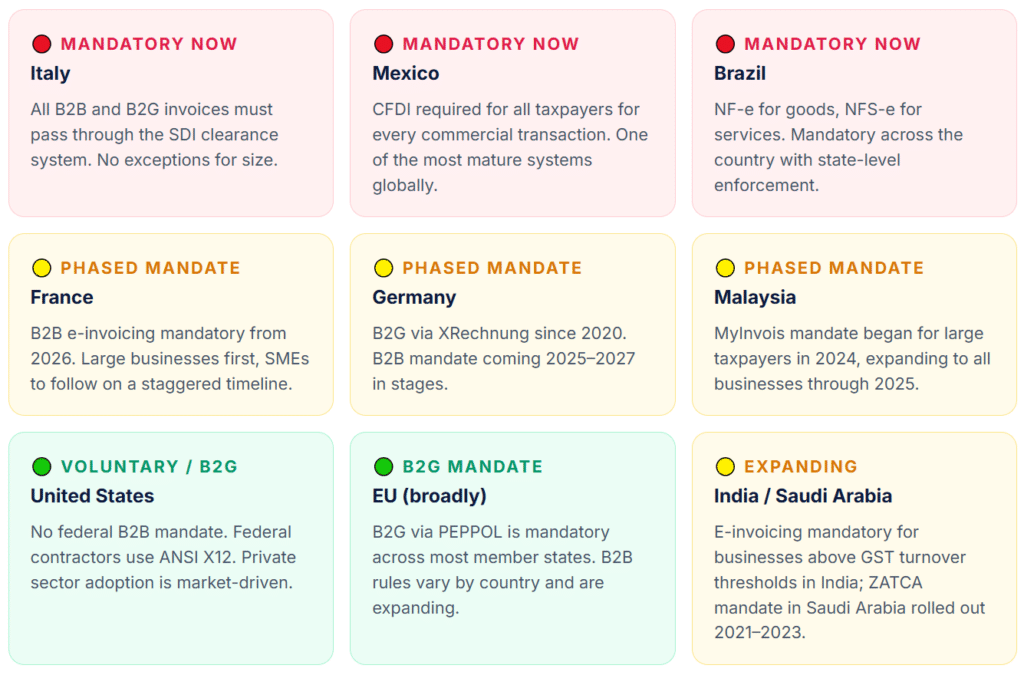
Who Needs E-Invoicing? A Global Compliance Overview
The most important practical question is simple: does your business actually need to issue electronic invoices, and if so, when? The answer depends on three variables, your country of operation, the type of entity you are invoicing (government, business, or consumer), and the size or sector of your business.
The Direction of Travel Is Unmistakable
Even in countries without a current B2B mandate, the regulatory direction is clear. Businesses that build e-invoicing capability now, rather than scrambling to comply at a deadline, avoid the disruption, implementation cost, and potential penalties that come with a rushed transition. The question is not if e-invoicing becomes the norm, but when.
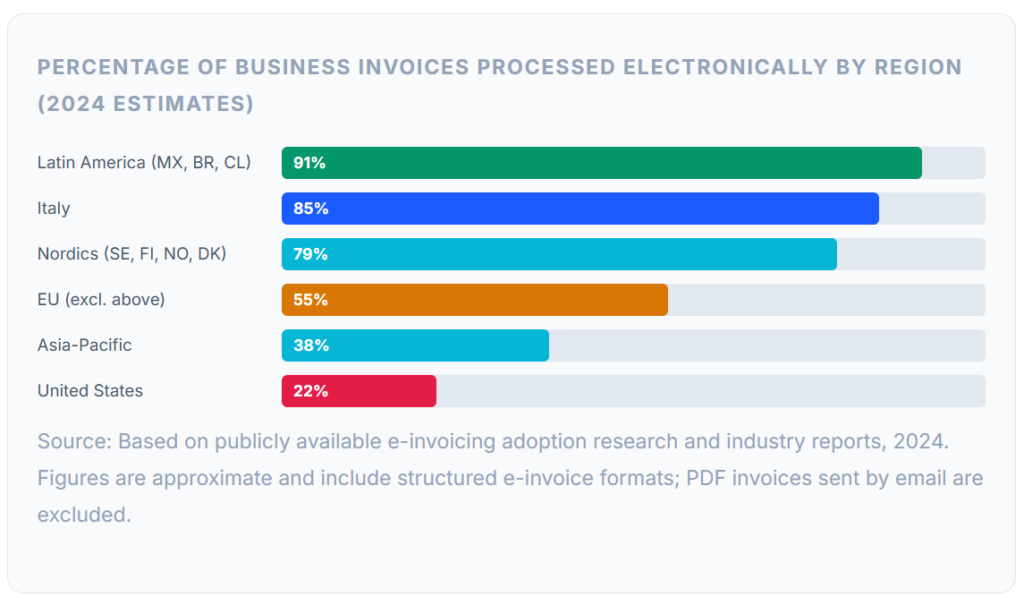
The regional disparity shown above reflects where mandates are most mature. Latin America and Italy, both early movers on clearance-model e-invoicing, show the highest adoption. The United States, with no federal B2B mandate, lags significantly, though enterprise adoption via EDI remains high in specific sectors like retail, healthcare, and logistics.
Real-World Use Cases: When E-Invoicing Makes an Immediate Difference
Understanding where electronic invoicing delivers its clearest value helps businesses identify whether the investment is justified for their specific situation before compliance forces the issue.
Government Contractors and Public Sector Suppliers
If any portion of your revenue comes from government contracts, at the federal, state, or municipal level, electronic invoicing is likely either already required or will be within the next two years. Government procurement offices were the first target of e-invoicing mandates globally because the volume of transactions is high and the verification requirements are strict. For these businesses, e-invoicing is not a choice; it is a condition of payment.
International B2B Businesses
A company that invoices clients across multiple countries faces fragmented compliance obligations: different formats, different transmission networks, and different validation rules. A PEPPOL-connected invoicing platform handles much of this complexity by translating between compatible national formats and routing through the appropriate access points. For cross-border trade, e-invoicing also accelerates payment and structured data processes faster at both ends than a PDF requiring manual handling.
High-Volume Service Businesses
A business generating hundreds of invoices per month absorbs the benefits of e-invoicing most quickly. Every invoice that arrives at a client’s AP department as a structured data file is processed without human review, queued for payment automatically, and reconciled against the purchase order without a single email or phone call. For businesses that have historically needed a dedicated AP liaison or account manager to manage invoice queries, that reduction in friction is significant. Pairing e-invoicing with centralized customer management ensures client-specific format preferences and PEPPOL IDs are stored and applied automatically at invoice generation.
Businesses Offering Installment Plans or Recurring Billing
For businesses that issue the same structured invoice to the same client on a repeating schedule, e-invoicing and automation are natural partners. The invoice file is generated from a template, validated, and transmitted automatically on each cycle, without manual preparation. For clients on payment plans, structured installment billing combined with e-invoice delivery removes nearly all manual overhead from the accounts-receivable process.
Key Benefits of Electronic Invoicing
The business case for e-invoicing is strong even in markets where it is not yet mandated. These are the benefits that drive voluntary adoption and that make compliance a competitive advantage rather than a burden.
⚡ Dramatically Faster Invoice Processing
A structured e-invoice can be received, validated, matched to a purchase order, and queued for payment in minutes. sometimes seconds. A PDF invoice requires a human to open it, extract the data, and enter it into an accounting system. The difference in processing time runs from hours to days in the best-case paper scenario; e-invoicing compresses this to near-instant.
💰 Significant Cost Reduction
Industry research consistently puts the cost of processing a paper invoice, including printing, postage, manual data entry, and error correction, at $10 to $15 per invoice. An equivalent e-invoice costs between $0.50 and $2.00 to process. For businesses issuing hundreds of invoices per month, this difference compounds quickly into a material line item on the operating budget.
🎯 Near-Zero Data Entry Errors
Manual data entry is the primary source of invoice discrepancies: transposed numbers, wrong amounts, and incorrect PO references. Structured e-invoices carry the data directly from the supplier’s system to the buyer’s system without reinterpretation. The error rate drops to essentially zero for the transmission itself; errors that do exist originate in the source data and are caught by format validation before the invoice is sent.
🔒 Built-In Audit Trail and Tax Compliance
Every e-invoice is timestamped, digitally logged, and in many systems digitally signed. This creates an immutable record of every transaction that satisfies audit requirements and simplifies VAT, GST, and sales tax reporting. In clearance-model countries, the government validation step itself serves as a legally recognized record of the transaction.
🌍 Future-Proof Compliance Positioning
Businesses that implement e-invoicing infrastructure before mandates take effect avoid the cost and disruption of a rushed implementation. They also build the systems fluency that makes adapting to format updates and new markets significantly easier than starting from scratch under deadline pressure.
Risks and Common Misunderstandings
Despite its advantages, e-invoicing comes with its own set of risks, most of them rooted in misunderstanding what e-invoicing actually requires. These are the mistakes businesses most often make.
Assuming a PDF Is an E-Invoice
This is the single most common misunderstanding. Emailing a PDF to a client is digital delivery, it is not e-invoicing in any regulatory or technical sense. If your jurisdiction or a client requires a structured e-invoice, a PDF will not be accepted. Discovering this at the point of submission, rather than during planning, is costly. Verify exactly what format your clients or local regulations require before assuming your current process is compliant.
⚠️ Format Mismatch Is a Common Rejection Cause: Submitting an invoice in the wrong format, or to the wrong platform, is one of the leading causes of invoice rejection in countries with active e-invoicing mandates. Always confirm the specific format and transmission channel your client or the relevant government authority requires before sending your first e-invoice. A rejected e-invoice can delay payment just as much as a disputed paper one.
Underestimating the Implementation Lead Time
Connecting to a PEPPOL network, configuring a government clearance system, or setting up EDI with a large enterprise client is not a one-day project. These implementations typically take two to eight weeks depending on system complexity. Businesses that wait until a compliance deadline is imminent often face rushed integrations, testing failures, and the risk of non-compliant invoices during the transition window. Build in adequate lead time.
Choosing a Platform Without the Required Format Support
Not every invoicing platform supports every e-invoice format. A platform that works perfectly for PDF invoicing may not support PEPPOL transmission, XRechnung generation, or clearance-model submission. Verify format support explicitly before committing to a platform, particularly if you operate across multiple countries or expect to add international clients in the near future.
Ignoring Country-Specific Data Requirements
E-invoice schemas often include mandatory fields that are not present on a standard commercial invoice, buyer and seller tax registration numbers, specific item classification codes, delivery references, and more. Missing required fields cause validation failures. Review the data requirements for your target format carefully, and ensure your source systems can produce all the required data fields before going live.
✅ Start with a Test Environment: Every major e-invoicing platform and government submission system offers a sandbox or test environment. Use it. Run 20 to 30 test invoices through the full workflow, generation, validation, transmission, and receipt confirmation before going live. Catching format or data errors in a test environment costs nothing; catching them after a mandate deadline can mean penalties, delayed payments, and emergency consulting fees.
E-Invoice vs. PDF Invoice vs. Paper Invoice: Full Comparison
The three invoicing formats that businesses use most commonly differ significantly across every dimension that matters to accounts-receivable management, compliance, and cash flow. The table below maps those differences clearly.
| Dimension | Electronic Invoice (E-Invoice) | PDF Invoice (Digital) | Paper Invoice |
|---|---|---|---|
| Format | Structured data (XML, UBL, EDI) | Fixed-layout document (PDF) | Printed document |
| Machine-readable? | Yes, fully | Partially (OCR only) | No |
| Processing method | Automatic, ingested by AP system | Manual, human reads and enters data | Manual, human reads and enters data |
| Processing cost | ~$0.50–$2 | ~$5–$8 | ~$10–$15 |
| Error rate | Near zero | Low–moderate | Higher |
| Compliance (B2G) | Usually required | Often not accepted | Rarely accepted |
| Audit trail | Built-in, immutable | Partial (email records) | Manual filing required |
| Speed to payment | Fastest | Moderate | Slowest |
| Best for | B2G, high-volume B2B, international, compliance | SMBs, freelancers, low-to-mid volume B2B | Very small local businesses; legacy relationships |
It is worth noting that the middle column, PDF invoicing, remains entirely appropriate for the majority of small and mid-size businesses in markets without active B2B mandates. The goal of this comparison is not to suggest that everyone needs to migrate to XML-based invoicing immediately but to make clear that the gap between PDF and true e-invoicing is real, consequential in compliance contexts, and growing in importance as mandates expand.
How to Get Started with E-Invoicing
The right starting point depends on where you are now and what your obligations or goals are. Here is a practical framework for approaching the transition, whether you are just beginning to investigate e-invoicing or actively preparing for a compliance deadline.
Step 1: Establish Your Compliance Baseline
Before choosing any tool or making any changes to your invoicing process, determine your actual obligations. Check whether your country of operation has an active or upcoming B2B e-invoicing mandate, whether any of your clients, especially government agencies or large enterprises, require a specific format, and whether you have international clients subject to their own local requirements. This baseline determines whether e-invoicing is optional, imminent, or already required.
Step 2: Audit Your Current Invoicing Process
Identify exactly how you currently create, send, and track invoices. What format do you issue? How do clients receive and process them? Where do errors or delays most commonly occur? This audit reveals the gap between your current state and where you need to be and helps you prioritize which changes will have the most immediate impact on payment speed and compliance.
Step 3: Choose an Invoicing Platform with E-Invoice Support
Select a platform that supports the output formats relevant to your market, PEPPOL UBL for EU business, ZUGFeRD or XRechnung for Germany, FatturaPA for Italy, and so on. For businesses in markets without a current mandate, choosing a platform that can generate structured outputs and connect to PEPPOL when needed is a reasonable future-proofing investment. ReliaBills offers the invoicing infrastructure to move from manual PDF billing to a fully structured, automated workflow, including support for recurring billing and installment billing schedules that integrate cleanly with automated invoice generation.
Step 4: Test Before You Go Live
Generate test invoices in the required format, run them through the target validation system, and confirm receipt and processing on the buyer’s side. Identify and resolve any data gaps, missing tax ID fields, incorrect classification codes, or misformatted dates in the test environment before sending live invoices. Document the process so that whoever manages invoicing in your business has a clear, repeatable procedure.
Step 5: Automate and Monitor
Once the workflow is confirmed and live, automate as much of it as possible, including invoice generation, format conversion, transmission, and confirmation receipt. Set up exception alerts for validation failures or transmission errors so problems surface immediately rather than being discovered when a payment fails to arrive. Review your average payment time and accounts-receivable aging regularly to confirm the new process is delivering the expected improvements.
Frequently Asked Questions
The questions businesses most often ask when exploring electronic invoicing for the first time:
1. What is the difference between an electronic invoice and a PDF invoice?
A PDF sent by email is a digital invoice, it delivers the billing information digitally, but the recipient still needs to open it and manually enter the data. A true electronic invoice is a structured data file (typically XML) that flows directly into the recipient’s accounting or ERP system and is processed automatically without human intervention. The distinction is critical for regulatory compliance in countries with active e-invoicing mandates, where PDFs are not accepted as valid e-invoices.
2. Is e-invoicing mandatory for my business?
It depends on your country and your client type. E-invoicing is already mandatory for B2G transactions in most EU member states and is mandatory for all B2B transactions in countries including Italy, Mexico, and Brazil. Germany and France are rolling out B2B mandates through 2025 and 2026, respectively. In the United States, there is no federal B2B mandate, but government contractors may face agency-specific requirements. Verify your obligations with a local compliance advisor.
3. What formats are used for electronic invoices?
Common formats include PEPPOL BIS UBL (used across the EU and 40+ countries globally), FatturaPA in Italy, XRechnung and ZUGFeRD in Germany, Factur-X in France, CFDI in Mexico, NF-e in Brazil, and ANSI X12 EDI in US enterprise supply chains. There is no single universal standard, though PEPPOL is the closest thing to an international common platform for structured e-invoicing.
4. Do small businesses need to use e-invoicing?
Not necessarily; it depends on who you invoice and where you operate. If all your clients are private individuals or small businesses in a country without a B2B mandate, a well-structured PDF sent by email remains perfectly acceptable. However, if you invoice government entities, large enterprises with EDI requirements, or operate in a country with active mandates, e-invoicing is required regardless of your size. Many mandates include all businesses above a revenue threshold, which can include quite small operations.
5. What is PEPPOL and do I need it?
PEPPOL is a standardized network and set of document specifications that allows businesses across different countries to exchange invoices and procurement documents in a consistent, interoperable format. It is particularly important for businesses that invoice EU government bodies or large enterprises that use PEPPOL-connected AP systems. If a client or government authority asks you to submit invoices via PEPPOL, you will need an invoicing platform registered as a PEPPOL access point or connected to one.
Recent Articles:
- How to Create a Professional Invoice Without Accounting Software
- How to Automate Invoice Generation: A Guide for Non-Technical Owners