
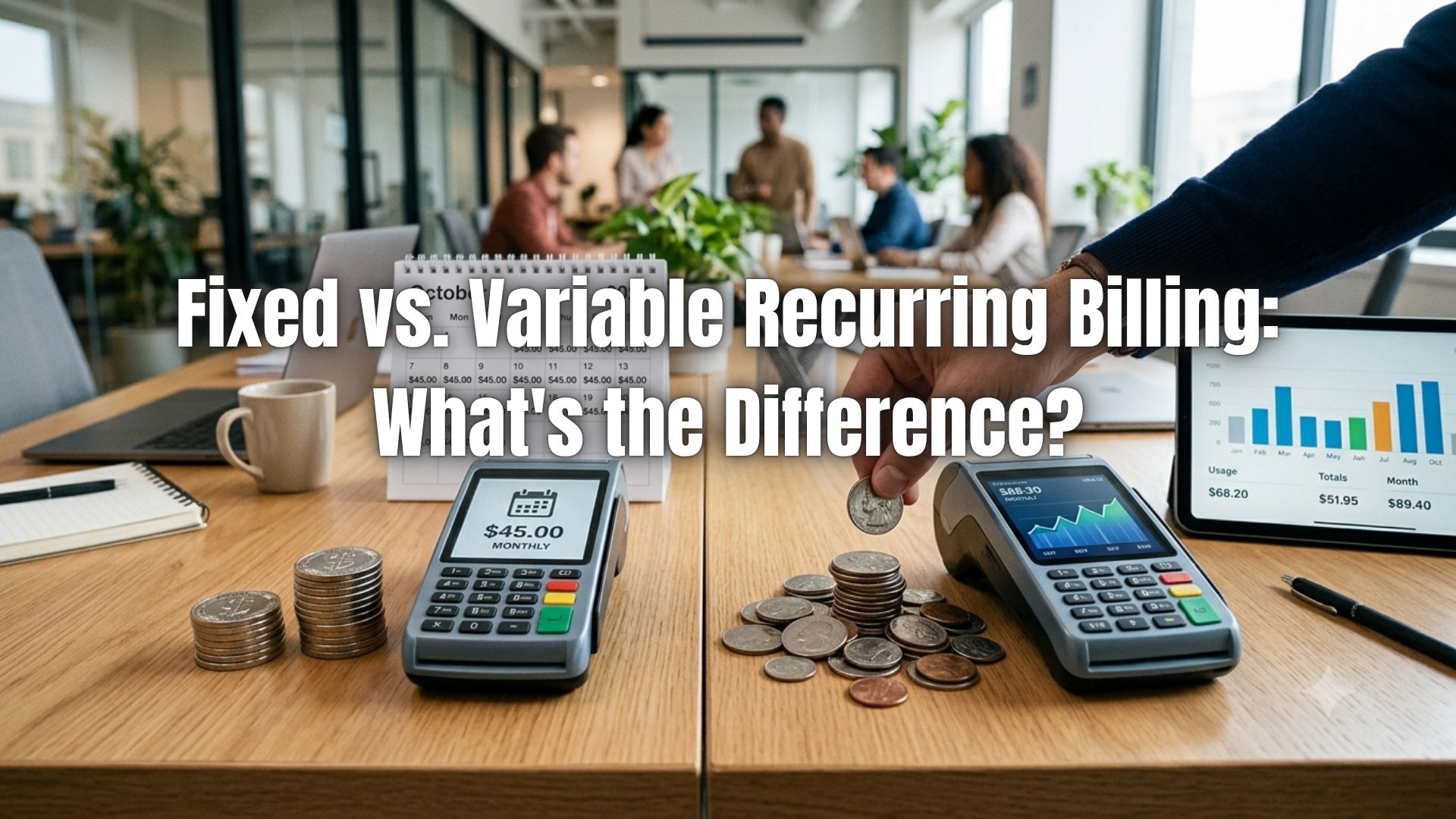
Fixed vs variable billing comes down to one question: does the amount your customer pays stay the same every cycle, or does it change based on what they used? Fixed billing charges a set amount on a defined schedule. Variable billing calculates the charge at the end of each cycle based on actual consumption. Both operate as recurring models, but they suit different services, different customer relationships, and different approaches to revenue forecasting.
Choosing between them, or knowing when to combine them, is a decision with real downstream effects on cash flow, customer experience, and the complexity of your billing operations.
Table of Contents
ToggleHow Fixed Recurring Billing Works
Fixed billing, sometimes called flat-rate billing, charges the same predetermined amount on the same schedule every period. The customer knows exactly what they will owe each month, quarter, or year, and so do you.
This model works cleanly for services where the value delivered is consistent regardless of how much the customer engages with it. A monthly retainer for ongoing consulting, a flat-fee software subscription, a childcare provider charging a set monthly rate, a home security monitoring plan. None of these vary based on hours consumed or features used. The fee is for access and availability.
From a revenue standpoint, fixed billing is the easier model to manage. These payments may be for the same amount every period, known as fixed billing, and common examples include website hosting services, childcare, home security systems, and content streaming services. The invoice generates automatically, the charge processes, and the revenue lands on a known date. Forecasting is straightforward because every active customer represents a predictable line item.
The limitation is coverage. Fixed costs can create inefficiencies, where customers pay for a fixed level of service regardless of how much they use it, which can result in over-licensing or paying for features they rarely or never end up using. For customers whose usage fluctuates significantly, a flat fee may feel misaligned with the value they are actually receiving.
How Variable Recurring Billing Works
Variable billing, also called usage-based or metered billing, calculates the charge at the close of each billing cycle based on what the customer consumed during that period. The billing is still recurring in structure, the cycle runs on a schedule and the charge collects automatically, but the amount changes cycle to cycle.
While flat-rate subscriptions charge for access, usage-based billing charges for outcomes: $0.10 per API call, $5 per GB of data processed, $2 per active user. Utility bills are the most familiar example. Electricity usage varies month to month, and the bill reflects it. Cloud infrastructure follows the same logic. A business pays for the compute and storage it actually uses, not a fixed amount that may over- or undershoot actual consumption.
For customers, variable billing feels fair precisely because it aligns cost with value. A slow month generates a smaller invoice. A high-demand month generates a larger one. That alignment encourages adoption and reduces the friction that comes from paying for unused capacity.
The trade-off lands on the business side. Variable billing requires real-time usage tracking, more complex invoice generation, and more careful financial planning. Revenue forecasting is a must for usage-based pricing: 73% of SaaS companies with usage-based models are actively forecasting variable revenue for financial predictability. Without forecasting discipline, variable billing creates cash flow uncertainty that fixed billing avoids entirely.
Fixed vs Variable Billing: Side-by-Side
| Factor | Fixed Billing | Variable Billing |
|---|---|---|
| Charge per cycle | Same every period | Changes based on usage |
| Revenue predictability | High | Requires active forecasting |
| Customer perception | Simple, predictable | Fair, usage-aligned |
| Best for | Retainers, subscriptions, flat-fee services | Utilities, cloud services, API tools |
| Invoice complexity | Low | Higher; requires usage data |
| Cash flow planning | Straightforward | More variable; needs monitoring |
| Setup complexity | Minimal | Requires usage tracking infrastructure |
The Hybrid Model: Using Both Together
Most businesses operating at scale do not choose strictly one or the other. They use a base fixed charge to cover the cost of access, then layer variable charges on top for consumption beyond a defined threshold. This hybrid approach is increasingly the standard.
Companies using hybrid models (subscription plus usage) report the highest median growth rate at 21%, outperforming pure subscription and usage-based models. The logic is straightforward: the fixed base provides revenue floor certainty, while the variable component captures additional value as customers grow their usage.
A managed services firm might charge a flat monthly retainer for a defined scope of work, then bill separately for hours or tasks that exceed the retainer scope. A software platform might charge a base monthly fee per account, then meter API calls or storage above a set limit. In both cases, the customer benefits from cost predictability on the baseline while the business captures upside when usage expands.
Setting up a hybrid model requires billing software that can handle both a fixed cycle charge and a variable usage component within the same invoice. That is not a standard feature in every platform. Understanding what recurring billing features your software supports before building a hybrid structure prevents significant operational friction later.
Revenue Forecasting Implications
The difference between fixed and variable billing becomes most visible when a business tries to plan ahead.
Fixed billing produces monthly recurring revenue (MRR) figures that are reliable and comparable month over month. Every active subscription represents a known dollar amount. If you have 80 customers on a $500 per month plan, your MRR is $40,000. You can staff, invest, and plan against that number with confidence.
Variable billing requires a different approach. Revenue depends on how much customers use the product, which means forecasting requires usage trend analysis rather than a simple count of active accounts. Businesses that do this well track usage patterns, identify high-consumption accounts, and model scenarios based on historical usage data.
The failure mode for variable billing is treating it like fixed billing: assuming last month’s revenue will repeat next month without examining whether usage is trending up, down, or flat. The subscription and recurring billing guide covers how to structure billing cycles and revenue tracking for both models.
Choosing the Right Model for Your Business
The decision depends on three factors: how you deliver value, how much your customers’ needs vary, and how much billing complexity your team can absorb.
Fixed billing fits when the service is consistent, when customers expect simplicity, and when you want clean revenue forecasting from day one. It is the lower-friction option operationally and the one most small businesses start with.
Variable billing fits when usage genuinely differs between customers or across time, when charging a flat fee would either overcharge low-usage customers or undercharge high-usage ones, and when you have the tracking infrastructure to meter consumption accurately.
For businesses managing project-based work alongside ongoing services, installment billing offers a third structure worth understanding. It splits a defined total across scheduled payments, distinct from both the flat-fee recurring model and the consumption-based one. Learning the difference between installment and recurring structures, covered in the installment vs. recurring invoices comparison, helps clarify which structure applies to which client engagement.
ReliaBills supports fixed recurring billing natively, with automated invoice generation and collection on any schedule. For businesses exploring variable or hybrid billing structures, the automated billing and payment collection tools allow customized billing rules that can accommodate both models.
Frequently Asked Questions
1. What is the main difference between fixed and variable recurring billing?
Fixed billing charges the same amount every cycle regardless of usage. Variable billing calculates the charge at the end of each cycle based on how much the customer consumed. Both are recurring in that they repeat automatically on a schedule, but the amount differs.
2. Which model produces more predictable revenue?
Fixed billing produces more predictable revenue. Because the charge is the same every period, active subscriptions translate directly into a stable MRR figure. Variable billing requires usage-pattern forecasting to estimate what revenue will arrive each cycle.
3. Can a business use both fixed and variable billing at the same time?
Yes. Hybrid billing combines a base fixed charge with variable overage charges. This approach is linked to stronger growth, with hybrid-model companies reporting a 21% median growth rate, outperforming both pure subscription and pure usage-based models. It works well when there is a defined service baseline and genuine variance in usage beyond it.
4. What industries typically use variable billing?
Utilities, cloud infrastructure providers, telecommunications companies, and API-based software platforms are the most common. The market for usage-based billing software is projected to reach $11.5 billion by 2032, marking a near 68% increase from 2025, driven by cloud services and AI-powered products where infrastructure costs scale with usage.
5. Is variable billing harder to set up than fixed billing?
Yes. Variable billing requires usage tracking, metered data collection, and invoice generation that reflects actual consumption per cycle. Fixed billing only requires a schedule and an amount. Businesses adopting variable billing need to confirm their billing platform can handle metered invoicing before committing to the model.
6. Does the billing model affect customer retention?
Both models affect retention differently. Fixed billing creates a consistent, low-friction experience that reduces cancellation decisions, since there are no surprise charges. Variable billing aligns cost with value, which can reduce resentment from customers who feel they are overpaying for a flat fee they are not fully using. The right model for retention depends on how variable your customers’ actual usage patterns are.
Bottom Line
Fixed vs variable billing is not a universal right-or-wrong choice. Fixed billing delivers simplicity, predictability, and straightforward cash flow for businesses providing consistent services at a consistent price. Variable billing delivers fairness and usage alignment for businesses where consumption genuinely differs from customer to customer or month to month.
Most businesses that grow eventually reach a point where one model alone does not cover every client relationship. A retainer covers the baseline. An overage structure captures additional usage. An installment plan handles a large project. Understanding all three structures and when each applies gives a growing business the flexibility to price accurately across its full range of work.
Recurring billing is the operational foundation for both fixed and variable models. Getting that foundation right, automated, reliable, and matched to the nature of each engagement, determines how consistently the business gets paid for the value it delivers.