

If your business delivers ongoing value, whether that is software access, a monthly service package, or a standing retainer, you eventually face a choice: keep chasing invoices manually every billing cycle or automate it. Recurring billing is the infrastructure that makes automation possible. This guide breaks down exactly how it works, who it is built for, and what small business owners need to know before setting it up.
Main Takeaway
Recurring billing automatically charges customers on a fixed schedule, eliminating manual invoicing and turning unpredictable revenue into a stable, forecastable baseline. For small businesses, it is one of the fastest paths to stronger cash flow, lower administrative overhead, and better customer retention provided the right platform and customer authorization practices are in place from the start.
What Is Recurring Billing?
Recurring billing is a payment model in which a business automatically charges a customer a predetermined amount at regular intervals (weekly, monthly, quarterly, or annually) in exchange for continuous access to a product, service, or subscription. Rather than generating a new invoice and waiting for manual payment each period, the system stores the customer’s authorized payment credentials and executes the transaction on their behalf on a scheduled basis, with no action required from either party.
How Recurring Billing Works
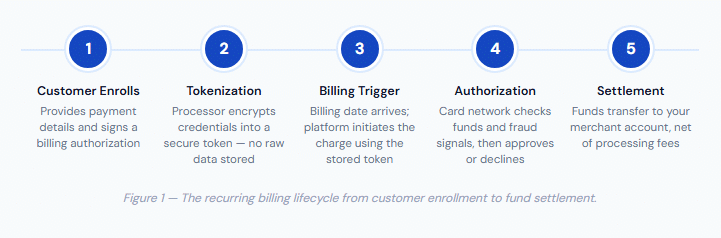
At its core, recurring billing connects four parties: the customer, the business, a payment processor, and the customer’s bank or card network. Each billing cycle, a pre-authorized charge flows through this chain automatically. Here is how that process unfolds from enrollment to settlement.
The Role of Tokenization
When a customer enters their credit card details at sign-up, that information never touches your server in raw form. The payment processor immediately converts those credentials into a randomized reference string, a token, that your billing system uses for all future charges. The original card data is stored in the processor’s encrypted vault, not yours. This is why businesses that attempt to build their own recurring billing without a certified processor face an enormous PCI DSS compliance burden that is almost never worth taking on.
Fixed vs. Variable Recurring Billing
Most people picture a flat monthly fee when they think about recurring billing, but modern platforms support several structural models. Choosing the right one for your business is a strategic decision, not a technical one.
| Model | How the Amount Is Set | Best For | Example |
| Fixed Recurring | Same amount every cycle regardless of usage | SaaS, memberships, retainers | $99/month for software access |
| Usage-Based (Metered) | Varies based on consumption tracked during the cycle | Utilities, API platforms, cloud | $0.004 per API call, billed monthly |
| Hybrid | Fixed base fee plus a variable usage component | Telecom, cloud storage, agencies | $29 base + $0.01/GB over 100 GB |
| Tiered | Flat fee within a usage bracket, higher fee in the next | Email marketing, CRM tools | $49 up to 5,000 contacts; $79 to 10,000 |
For most small businesses starting out, fixed recurring billing is the right model. It is the simplest to explain to customers, the simplest to forecast, and the simplest to implement with any mainstream invoicing software. Usage-based models become attractive once you have the analytics infrastructure to accurately measure consumption and communicate it clearly.
Real-World Examples and Use Cases
Recurring billing is not a technology-company concept. It surfaces in virtually every industry where an ongoing relationship between a business and its customers exists. The normalization of subscription and autopay arrangements across consumer spending from streaming services to pet food boxes has made customers far more comfortable authorizing recurring charges than they were a decade ago.
- SaaS & Software: Monthly or annual access to hosted tools. Platforms from project management to accounting run almost exclusively on recurring billing.
- Fitness & Wellness: Gym memberships, yoga studios, and personal training retainers are all billed on a fixed monthly cycle, often with annual prepayment options.
- Subscription Boxes: Curated product shipments charged monthly. The customer commits once; fulfillment and billing happen automatically each cycle.
- Education & Coaching: Online courses, tutoring services, and coaching programs billed monthly or per term often with tiered access levels.
- Managed Services: IT support, bookkeeping, and marketing agencies billing flat monthly retainers for ongoing delivery. One of the fastest-growing recurring billing segments.
- Property Management: Rent collection, HOA dues, and storage unit fees are among the oldest recurring billing use cases in existence.
Key Benefits for Small Businesses
The case for recurring billing runs deeper than simple convenience. When structured correctly, it changes the fundamental economics of a small business in ways that one-time transaction models simply cannot match.
Predictable, Forecastable Revenue
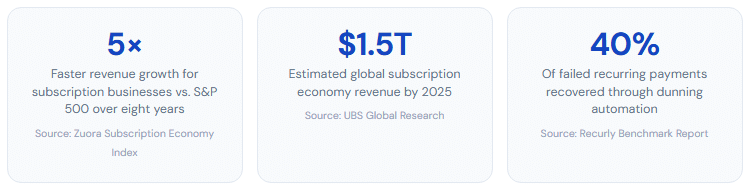
This is the headline benefit, and for good reason. When you know that 150 customers at $79 per month will generate approximately $11,850 on the first of each month, you can plan headcount, inventory, and marketing spend with genuine confidence. Compare that to a project-based business where revenue arrives in lumps, occasionally large and occasionally sparse, and the operational difference is stark. Businesses that can forecast reliably tend to invest more boldly because they make decisions with clarity rather than anxiety.
This predictability is also what makes Monthly Recurring Revenue (MRR) the single most-watched metric in subscription businesses. Once MRR is stable and growing, virtually every other financial decision becomes easier to make.
Reduced Administrative Overhead
Manually issuing invoices, following up on outstanding balances, and reconciling payments consumes real time every billing cycle. For a solo operator or a lean team, this is time that could go toward sales, delivery, or product improvement instead. Recurring billing automation eliminates most of this. Once a customer is enrolled, the system handles invoice generation, charging, receipt delivery, and accounting sync every cycle, without a human hand on it.
Structurally Higher Customer Retention
There is a behavioral economics dimension to recurring billing that is easy to underestimate. With manual invoicing, every payment represents an active decision to continue a moment where a customer weighs value against cost. With autopay, the default is continuity. The customer must actively decide to cancel rather than actively decide to renew. This asymmetry, the “status quo bias,” is well-documented, and it meaningfully shifts retention rates in the business’s favor without requiring any additional effort or product improvement.
This is one reason customer management becomes far more tractable once billing is automated. Your baseline retention is higher, so your management efforts can focus on growth rather than recovery.
Lower Cost of Collections
Processing fees are unavoidable, but the cost of failed collections and bad debt is not fixed. Recurring billing platforms include built-in retry logic and dunning workflows that automatically re-attempt failed charges and prompt customers to update payment information. The result is a higher collection rate with significantly less manual effort than any invoice-chasing process could achieve. For businesses that previously wrote off 3–5% of revenue to bad debt, this alone can justify the switch.
Risks and Things to Watch For
Recurring billing is not without its complications. A clear-eyed view of these risk areas before you go live will save you from problems that are genuinely difficult to undo.
| ✅ Works in Your Favor | ⚠️ Requires Active Management |
| → Automatic retry logic recovers failed payments without manual effort | → Chargeback disputes can be costly if billing terms are undocumented |
| → Tokenization keeps you out of scope for most PCI compliance requirements | → Card expiration and closures cause involuntary churn without dunning systems |
| → Transparent scheduled billing reduces billing disputes and confusion | → Unclear cancellation policies generate fraud reports, not just refund requests |
| → Annual prepay options improve cash position and naturally reduce churn | → Revenue recognition rules for prepaid subscriptions differ from one-time sales |
Chargeback Risk
Chargebacks when a customer disputes a charge directly with their bank are among the most disruptive events in recurring billing. They cost you the transaction amount plus a dispute fee, and a sustained high chargeback rate can trigger penalties from card networks or even loss of your merchant account. The most common cause is a customer who forgot they had an active subscription. This is preventable through pre-billing email notifications, clear statement descriptors, and a self-service cancellation link that is genuinely easy to find.
Involuntary Churn from Payment Failures
Not all subscription cancellations are intentional. A meaningful share of churned subscribers are lost because of failed payments, expired cards, exceeded credit limits, or fraud flags rather than dissatisfaction. This is called involuntary churn, and the right platform handles it automatically. Dunning management workflows retry the charge on a schedule (typically day 3, day 7, and day 14 after failure) and send tiered customer emails with direct links to update payment information. Businesses that implement this properly recover 20–40% of payments that initially fail.
Compliance note: In most jurisdictions, you are legally required to obtain explicit written or digital consent before charging a customer on a recurring basis. This disclosure must include the billing amount, frequency, and cancellation process. Billing without proper authorization is both a regulatory risk and the primary trigger for chargeback disputes. Always review the requirements for your jurisdiction with a qualified legal or compliance professional before going live.
Revenue Recognition Complexity
If you accept annual prepayments, the full amount you receive on day one is not fully “earned” revenue under standard accounting principles. Under both GAAP and IFRS, you recognize it ratably over the subscription period, 1/12 per month for an annual plan. This distinction matters for financial reporting, tax planning, and any future due diligence if you pursue investment or acquisition. Involve a qualified accountant when designing your billing structure, not after you have already collected a year of prepaid subscriptions.
Recurring Billing vs. Related Concepts
Recurring billing is frequently confused with adjacent payment models. The distinctions matter both for choosing the right operational structure and for having accurate conversations with your payment vendor, your accountant, and your customers.
| Concept | How It Works | Defined End Date | Amount Fixed | Customer Action Per Cycle |
| Recurring Billing | Automatic charge on a schedule using stored credentials | ✗ No | ✓ Usually | ✗ None required |
| Installment Billing | Fixed total split into payments over a defined term | ✓ Yes | ✓ Yes | ✗ None required |
| One-Time Invoice | Single invoice per transaction, paid manually | ✓ Yes | ~ Varies | ✓ Each cycle |
| Subscription Billing | Subset of recurring billing tied to ongoing product access | ✗ No | ✓ By tier | ✗ None required |
| Pay-as-You-Go | Charges issued after each use event; no fixed schedule | ✗ No | ✗ Varies | ~ Partial |
| Retainer Agreement | Pre-paid recurring fee for reserved capacity or access | ✗ No | ✓ Yes | ✗ None required |
The distinction between installment billing and true recurring billing is worth internalizing carefully. An installment plan has a defined end; after 12 payments, the obligation is fully discharged. Recurring billing continues indefinitely until the customer cancels. Conflating these two in customer-facing communications is one of the most common sources of billing disputes and chargeback filings.
Revenue Stability: One-Time vs. Recurring
The word “predictability” is easy to say but harder to feel abstractly. The chart below makes it concrete. Both hypothetical businesses generate roughly the same annual revenue, but the way that revenue arrives throughout the year is fundamentally different. One is manageable; the other requires constant reactive planning.
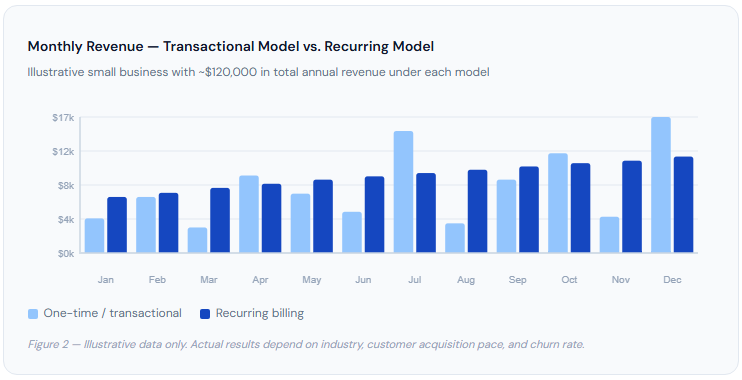
The recurring-model business also benefits from natural compounding: new customers added each month stack on top of the retained base, so MRR grows even without dramatic sales spikes. This is the mathematical engine behind why investors assign premium valuations to recurring revenue businesses over project-based ones with identical top-line numbers.
How to Get Started with Recurring Billing
Setting up recurring billing is more accessible than many small business owners assume. The infrastructure is mature, the tools are widely available, and the core decisions you need to make are business decisions, not technical ones. Here is a practical sequence for getting from zero to live.
1. Define Your Pricing Model and Billing Frequency
Before touching any software, decide what you are selling and when you will charge for it. Monthly billing maximizes customer flexibility and reduces sign-up friction. Annual billing improves cash position and reduces churn, but typically requires a meaningful discount of 10 to 20 percent to feel worthwhile to the customer. Most businesses that can operationally support it should offer both and let customers choose at sign-up. The revenue mix between monthly and annual subscribers becomes a meaningful lever for managing churn over time.
2. Choose a Billing Platform Built for Recurring Payments
You need software that can securely store payment credentials, schedule and execute charges, generate receipts, handle failed payment retries, and produce clear reconciliation reports. Purpose-built invoicing software with native recurring billing like ReliaBills combines all of this in one product. Evaluate platforms on three criteria: the payment methods they support, the quality of their dunning management, and whether their reporting surfaces MRR, churn, and LTV automatically.
3. Build a Clear Customer Authorization Flow
Every recurring billing relationship legally begins with customer consent. Your enrollment flow must clearly disclose what will be charged, how much, on what date, how often, and how the customer can cancel. Best practice is to send a pre-billing notification 3 to 5 days before each charge for annual plans and at minimum before the first charge and before any amount changes for monthly plans. This is not just compliance hygiene; it is the single most effective step you can take to reduce chargebacks.
4. Configure Dunning and Failed Payment Recovery
Set your platform to automatically retry failed charges typically on day 3, day 7, and day 14 after the initial failure and to trigger email sequences that direct customers to a self-service page to update their payment information. Strong dunning management done well typically recovers between 20 and 40 percent of initially failed payments, which means retained revenue at essentially zero incremental cost.
5. Track MRR, Churn Rate, and Customer Lifetime Value
Once live, these three metrics tell you whether your recurring billing engine is healthy or leaking. Monthly Recurring Revenue shows the baseline. Churn rate, the percentage of subscribers lost per month tells you whether your retention is sustainable. Customer lifetime value puts a dollar figure on what each relationship is worth, which in turn informs how much you can responsibly spend to acquire a new customer. Most modern customer management platforms surface these automatically in a dashboard. If yours does not, reconsider your tooling.
Practical note: ReliaBills is built specifically for small and growing businesses that want recurring billing without enterprise-grade complexity. You can set up your first recurring billing schedule, enroll customers, and see your first automated charges go through in a single day. Start your free trial →
Frequently Asked Questions
1. What is the difference between recurring billing and subscription billing?
Subscription billing is a specific form of recurring billing tied to ongoing access to a product or service, a SaaS platform, a streaming service, or a content membership. Recurring billing is the broader mechanism: any automatic, scheduled charge. A law firm billing a monthly retainer for reserved consulting time is using recurring billing, but not typically what you would call a subscription. All subscription billing is recurring billing; not all recurring billing is subscription-based. Understanding which category your offering falls into matters for how you position pricing to customers and how you account for the revenue.
2. Is recurring billing safe for customers?
Yes, when set up correctly. Payment credentials are stored as encrypted tokens, never on the merchant’s server, and most card networks provide zero-liability protections for unauthorized recurring charges. The greatest practical risk to customers is not technical; it is procedural. Businesses with opaque cancellation flows, unclear billing descriptors, or inconsistent notification practices generate the majority of billing complaints and chargebacks. These are entirely preventable problems with proper setup and communication standards.
3. What happens when a recurring payment fails?
Modern billing platforms automatically trigger a retry sequence, re-attempting the charge on a set schedule (commonly day 3, day 7, and day 14 after the initial failure). In parallel, a dunning email sequence notifies the customer and provides a direct link to update their payment method. If all retries fail, the account is flagged, and the customer is informed their access may be restricted. This automated approach recovers a significant portion of initially failed payments without any manual intervention. Businesses relying on manual follow-up for failed payments typically recover far less and spend considerably more time doing it.
4. How do I set up recurring billing for my small business?
You need three things: a payment processor that supports recurring charges (Stripe, Braintree, and Authorize.Net are the most widely used), billing software to manage customer subscriptions and automate the charging schedule, and a customer authorization agreement that clearly discloses what, when, and how much will be charged. Platforms like ReliaBills bundle the billing software and payment processing integration together, which simplifies setup considerably for small businesses without dedicated technical staff. You can typically be there live within a single business day.
5. Can I offer different billing frequencies to different customers?
Yes. Modern recurring billing platforms support monthly, quarterly, semi-annual, and annual billing cycles simultaneously and let individual customers choose their preferred cadence at sign-up or switch later. Many businesses offer a monthly plan at full price and an annual plan at a 10–20% discount. The annual plan improves cash position, and the price incentive meaningfully reduces churn among customers who commit to it. Some platforms also support custom billing dates, so all customers in a cohort are billed on the same day of the month regardless of when they signed up, which simplifies monthly reconciliation.
Related Articles:

Brant Pallazza is the Founder and President of ReliaBills, an invoicing and recurring billing platform built to help small businesses secure predictable cash flow. With over 20 years of experience in direct response marketing and e-commerce leadership, including a 13-year tenure managing over $500 million in gross sales at Digital River. Brant writes actionable guides on automated billing, payment processing, and scaling SMBs.