
Security system installment billing splits the upfront cost of equipment and installation into scheduled payments collected automatically over a defined term, making high-cost security projects accessible to customers who would decline a lump-sum quote. When set up correctly, it does more than reduce sticker shock: it separates the equipment cost recovery stream from the monthly monitoring fee, protects the integrator’s recurring revenue if a customer defaults on equipment installments, and creates a billing structure that can survive contract disputes without taking down the entire account. The difference between doing it right and doing it poorly comes down to three decisions: how you separate equipment from monitoring in the contract, what happens to service access during a payment failure, and whether your billing platform treats installments as a contract obligation or a rolling subscription.
What Is Security System Installment Billing?
Security system installment billing is a payment structure in which the cost of physical security equipment and professional installation is collected in a series of fixed, scheduled payments over a defined period, rather than as a single upfront charge. The customer commits to the full equipment and installation cost at the time of contract signing. Subsequent monthly installments reduce the outstanding balance until the total is recovered, at which point the payment obligation ends even if the monitoring relationship continues.
This structure is distinct from a monthly monitoring subscription, which is an open-ended recurring payment for ongoing service. A properly structured security billing arrangement separates these two streams: installment billing for the depreciating hardware and one-time installation labor and recurring billing for the ongoing monitoring, maintenance, and service contract. Combining them into a single monthly charge is the most common mistake security companies make, and it creates legal and operational problems when either stream changes.
The installment portion connects directly to installment billing principles, while the monitoring portion is managed through standard recurring billing infrastructure. Both are tracked in the same customer management system, but they operate under different billing logic, different contract terms, and different failure-handling rules.
The Two Revenue Streams Security Companies Must Separate
Every security installation generates at least two distinct revenue streams, and most billing disputes, contract enforcement problems, and revenue leakage issues in the security industry trace back to treating those streams as one. Understanding the distinction is the prerequisite for any useful billing discussion.
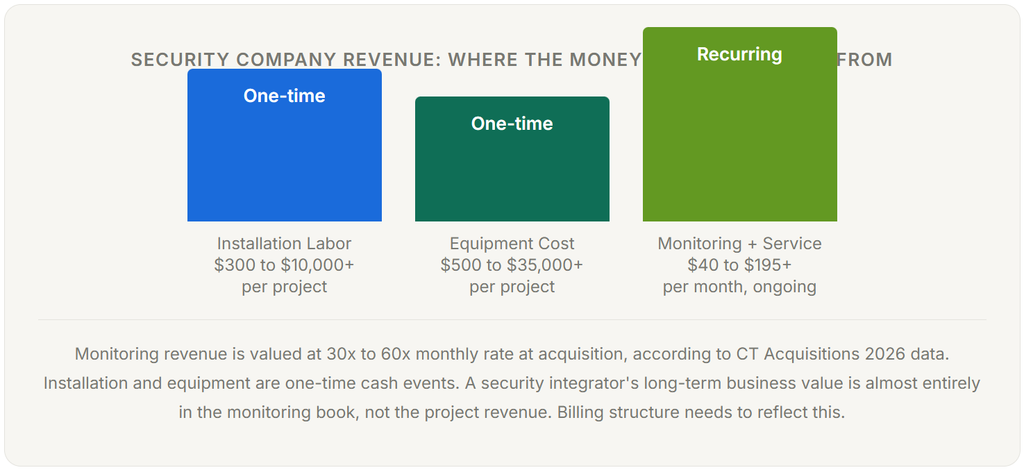
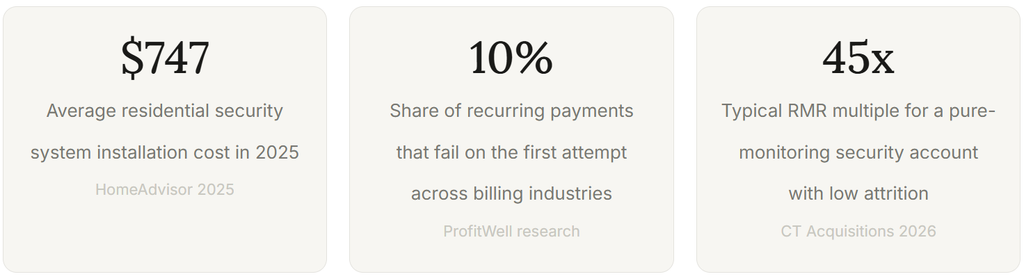
The monitoring stream is recurring revenue with compounding value. Pure-monitoring recurring monthly revenue transacts at 30x to 60x monthly RMR, while installation-heavy operators trade at 5x to 8x EBITDA because one-time install revenue carries a lower quality multiplier. That valuation difference is why protecting the monitoring relationship during an equipment payment dispute is worth more, in the long run, than accelerating equipment cost recovery at the risk of losing the account entirely.
The practical implication: equipment installment payments and monitoring fees should be on separate line items in every contract and every invoice. When a customer misses a payment, the billing system needs to know whether it is an equipment installment failure or a monitoring fee failure, because the response and the consequences are different in each case.
How Security System Installment Billing Works
The billing cycle for a security installation with an installment component has more moving parts than a standard subscription. Getting the sequence right at setup prevents almost every common dispute and collection problem downstream.
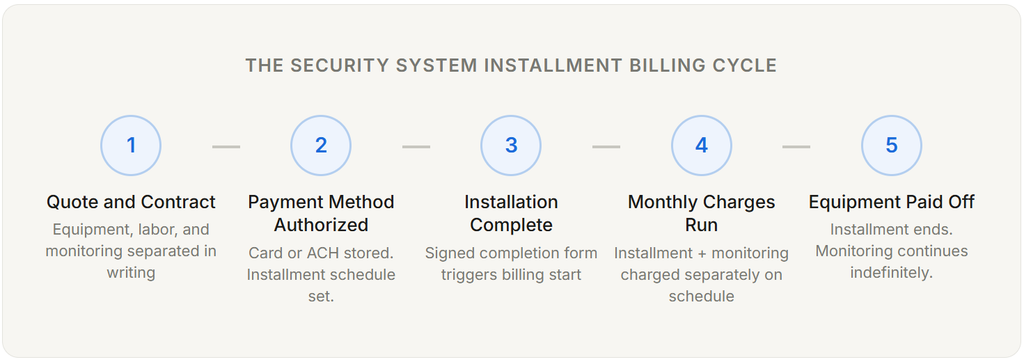
Step three is where most security billing setups create problems. Triggering the installment billing on the installation date rather than the signed completion date means billing can begin before the customer has formally accepted the work. That gap is the source of more payment disputes than any other single factor in residential and commercial security billing. The completion form, signed by the customer or site manager on the day the system is tested and handed over, is what justifies the first installment charge.
What Happens When an Equipment Installment Fails
A failed equipment installment payment should not automatically affect the monitoring service, at least not immediately. The two obligations are contractually separate, and treating an equipment payment failure as grounds for immediate monitoring termination creates liability in most jurisdictions. A better-structured response: retry the equipment installment automatically at day 3 and day 7, notify the customer with a payment update link, and flag the account for review at day 14. Monitoring suspension, if it comes at all, should follow a separate, clearly disclosed process with its own notice requirements.
This is the kind of nuance that most billing guides for security companies miss entirely. Standard subscription billing platforms do not distinguish between these failure types. A platform built for installment billing, such as ReliaBills, can apply different dunning logic to the equipment installment and the monitoring fee within the same customer account.
Pricing Scenarios and Installment Structures
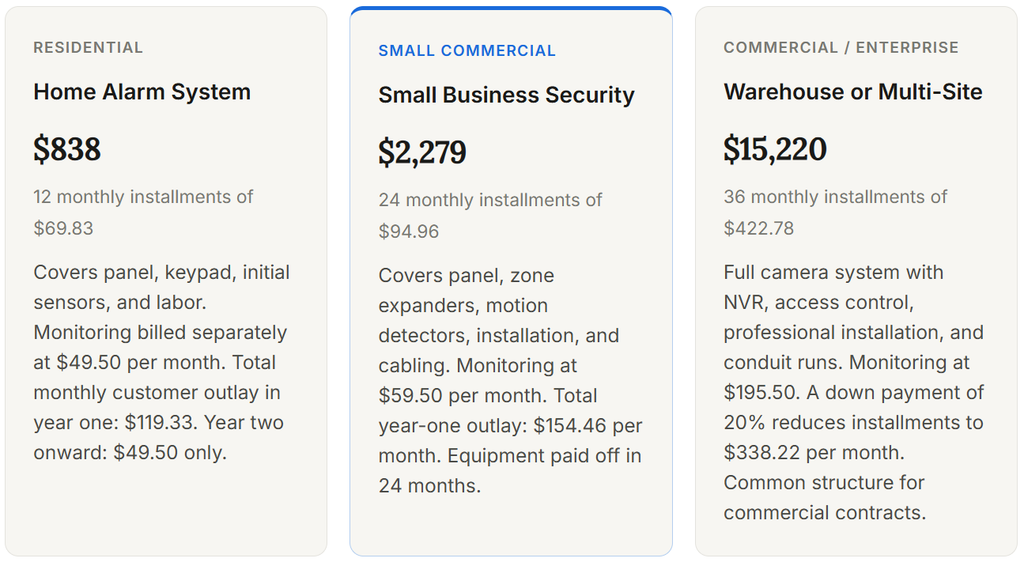
Security system projects vary enormously in scope. A residential alarm installation for a single-family home and a commercial access control and camera system for a 10,000-square-foot office building require completely different installment structures. Here is how the math works across three common scenarios.
Down Payments and Their Effect on Installment Structure
A down payment at contract signing changes the installment structure in two ways. It reduces the monthly installment amount, which makes the ongoing commitment easier for the customer to sustain, and it partially offsets the integrator’s materials and labor cost before any recurring revenue is established. For commercial accounts with project costs above $5,000, requesting a 20% to 30% deposit at contract signing and 30% upon completion, with the remainder financed over 12 to 24 months, is a common structure that balances cash flow for both parties. For residential accounts, down payments are less common and may create friction that costs the sale.
Real-World Use Cases by Property Type
The installment billing structure that works for a small retail store is not the right structure for a multi-site commercial property or a residential builder selling pre-wired homes. The specifics matter, and most guides on this topic treat all security installations as interchangeable.
Retail Business with Existing System (Takeover)
A retail business taking over an existing security system pays primarily for the conversion and reprogramming labor, plus the first year of monitoring. Equipment costs are minimal because the hardware is already in place. In this scenario, the installment component may cover only $499 in labor spread over 6 months, while monitoring billing begins immediately. The key billing discipline: do not bundle the takeover fee into the first few monitoring invoices. Keep it as a separate installment line so that when the takeover is paid off, the monitoring-only billing is clean and accurate.
New Construction: Builder or Developer Pre-Wire
Builders who pre-wire developments for security often work on a different billing model: the builder pays for rough-in wiring at cost, and the end-buyer activates the system after closing. The installment structure typically starts at the buyer’s closing, covering the finish hardware and activation fee over 12 to 18 months. This model requires the security company to carry the installation cost through the construction period and convert it to a customer account at closing, which means the billing system needs to track pre-activation accounts separately from live billing accounts.
Commercial Property Manager with Multiple Units
A property manager overseeing multiple commercial tenants has a billing challenge that most installment billing setups cannot handle without configuration work: each unit may have its own equipment cost and installation date, but the monitoring invoice may go to a single billing entity. The cleanest structure is a separate installment contract and payment schedule per physical location, even if the billing contact is the same. Combining multiple unit installments into one monthly charge makes it impossible to handle unit-level changes like a tenant move-out or a system upgrade without rebuilding the entire billing structure.
Healthcare or Compliance-Regulated Facility
Healthcare facilities installing security systems often face compliance requirements (HIPAA privacy zones, access logging) that increase system complexity and cost significantly. Healthcare security systems typically cost $10,000 to $50,000, with HIPAA compliance and restricted area access logging as key requirements. At these price points, installment plans over 36 to 48 months with a 20% to 30% down payment at contract signing are the standard commercial structure. The compliance requirement also means the contract must specify exactly which equipment and access control settings are covered by the installment, since changes required by a compliance audit may generate a separate billing event mid-contract.
Key Benefits of Installment Billing for Security Integrators
More Closed Jobs, Fewer Lost Sales
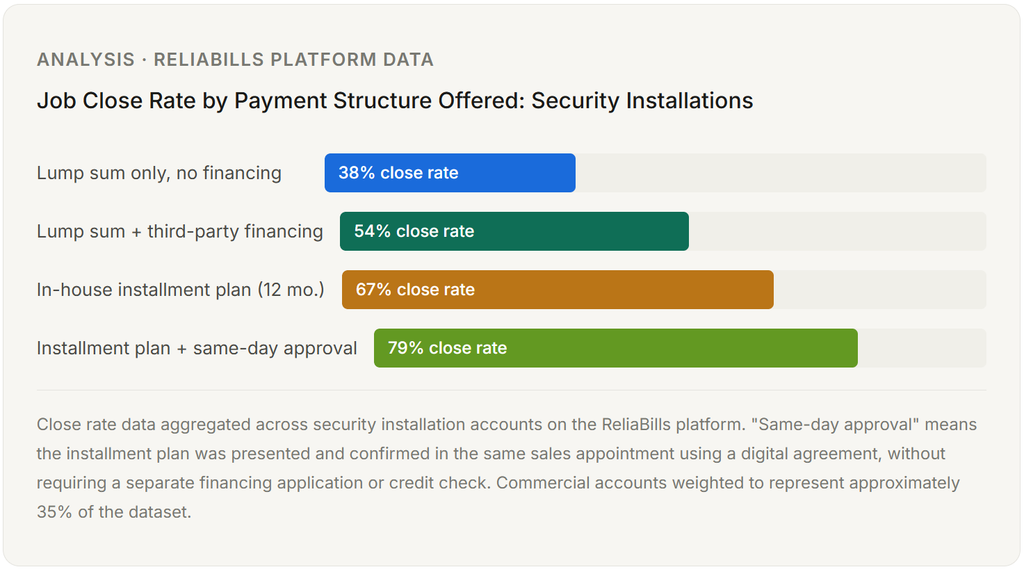
The most immediate benefit of installment billing is conversion. A $2,279 commercial security quote presented as a single payment competes against a customer’s instinct to delay or shop around. The same quote presented as $94.96 per month for 24 months, with monitoring at $59.50, competes against a $154 monthly line item in the customer’s operating budget. The objection changes from “that’s a lot of money” to “can I afford this monthly?” For most customers, the answer to the second question is yes when the first was no.
Consistent Cash Flow on Projects That Would Otherwise Be One-Time Events
An installation paid upfront generates a single cash event at project completion. The same installation on a 24-month installment plan generates 24 cash events, predictable to the day, for the next two years. For integrators managing crew costs, equipment purchases, and vehicle fleets on a monthly basis, that predictability changes how they plan staffing and inventory. It also makes the business more valuable at exit, since future installment obligations appear as contracted future revenue rather than one-time project income.
Reduced Upfront Objections That Kill Commercial Deals
Commercial security systems for mid-size businesses routinely cost $5,000 to $35,000 for equipment and installation. At those price points, the capital expenditure process at the customer’s business can involve multiple approvals, budget cycles, and significant delays. An installment plan converts the project from a capital expense requiring board-level approval into an operating expense that a facilities manager can often approve directly. This alone can reduce the sales cycle by weeks and increase close rates meaningfully on commercial accounts.
Comparison: Installment Plan vs. Monitoring Contract vs. Equipment Lease
Security companies offer customers several ways to acquire and pay for security equipment, and each has a different risk profile, cash flow pattern, and contractual implication. Understanding the differences is essential before deciding which structure to offer.
| Factor | Installment Plan (In-House) | Long-Term Monitoring Contract (Equipment Bundled) | Equipment Lease (Third Party) |
|---|---|---|---|
| Who owns the equipment | Customer owns after payoff | Often disputed; depends on contract language | Leasing company owns throughout term |
| Cash flow for integrator | Distributed over installment term | Distributed monthly; equipment cost embedded in rate | Lump sum from leasing company at close |
| Early termination complexity | Remaining installments due or negotiated payoff | High. Remaining contract value plus fees. | Very high. Lease buyout often required. |
| Credit check required | Depends on integrator policy. Not always. | Usually no formal check | Yes. Leasing company underwrites. |
| Customer perception | Transparent. Clear path to ownership. | Often misunderstood. Equipment ownership unclear. | Complex. Customers often dislike long lease terms. |
| Monitoring independence | Monitoring is a separate contract. Can be changed. | Monitoring is tied to equipment cost. Cannot be separated. | Monitoring may be separate or bundled depending on terms. |
| Best for | Integrators who want full billing control, transparent customer relationships, and recurring monitoring revenue | High-volume residential dealers focused on account creation at low upfront cost | Large commercial projects where the integrator needs immediate capital recovery |
The long-term monitoring contract model, where equipment and installation costs are buried inside a monthly rate over a 3- to 5-year term, is the dominant model for national alarm dealers like ADT and Vivint. For independent integrators, this model creates a practical problem: the customer does not understand what they are paying for, which makes price increase conversations difficult and generates more cancellation disputes than the installment model does.
Key Risks and What to Watch For
Equipment Obsolescence During the Installment Term
Security technology evolves faster than most other home or business equipment categories. A camera system that was current at installation may be a generation behind by the end of a 36-month installment plan. Customers who notice this sometimes use it as leverage to stop installment payments or renegotiate. The practical protection is a warranty that at minimum covers the installment term, clear contract language specifying that the installment obligation is independent of technology evolution, and a proactive upgrade conversation at or before the halfway point of the term.
State Consumer Protection Law Compliance
Security contracts are regulated in many U.S. states. Requirements vary but commonly include: mandatory cancellation rights within 3 to 10 business days of signing, specific disclosure requirements for the total cost of the installment obligation, restrictions on early termination fees, and in some states, licensing requirements for security dealers that affect what billing structures are permissible. California, Texas, Florida, and New York all have specific security dealer regulations. Installing a system and billing installments without reviewing applicable state requirements is a compliance risk that surfaces most painfully during a billing dispute.
Conflating Equipment Default with Monitoring Cancellation
When a customer stops paying equipment installments, the default response for many security companies is to suspend monitoring. This creates two problems: it removes the service the customer was actually receiving and valued, which increases the likelihood of escalation to a dispute or chargeback, and in some states, terminating service for non-payment of a related but separate obligation may violate consumer protection rules. The correct response to an equipment installment default is to pursue collection on the installment obligation while keeping the monitoring relationship intact, at least through the notice and cure period specified in the contract.
Failed Payments Without Recovery Logic
The average subscription company loses roughly 9% of monthly recurring revenue to failed payments, with insufficient funds accounting for 42.3% of declines. Security companies collecting installment payments face the same failure rates. Without automated retry logic and a dunning sequence, those failed payments become manual follow-up tasks that consume staff time and frequently result in the payment simply not being collected. Configuring the billing platform to retry automatically, notify the customer, and escalate at defined intervals recovers the majority of first-attempt failures without any manual involvement.
Common Mistakes Security Companies Make with Installment Billing
1. Bundling equipment and monitoring into one monthly charge
This is the most consequential mistake, and it is nearly universal among smaller integrators. When a $94.96 equipment installment and a $59.50 monitoring fee are combined into a single $154.46 monthly charge, the billing system cannot distinguish between the two when one changes. An equipment payoff, a monitoring rate increase, or a service upgrade requires manually recalculating and reissuing the combined charge every time. Separate billing for separate obligations is the foundational discipline that everything else depends on.
2. Starting billing before the customer has signed off on the installation
Triggering installment billing on the installation date rather than the customer-signed completion date creates a window during which the customer is being charged for a system they have not formally accepted. Any quality or performance issue discovered during that window becomes both a service complaint and a billing dispute. The completion form, signed by the customer when the system is tested and operational, is the billing trigger. This takes one extra step at closeout and prevents most of the disputes that arise in the first billing period.
3. No dunning sequence for failed equipment installments
A failed installment payment that goes to a manual follow-up queue is a payment that frequently does not get collected. Staff follow up inconsistently, customers who are not contacted promptly become harder to reach, and the window for recovery narrows as time passes. An automated dunning sequence that retries on day 3, sends a payment update notification on day 5, and escalates to account review on day 14 recovers the large majority of first-attempt failures without anyone having to remember to follow up. Most security billing systems do not have this configured by default.
4. Vague early termination language
What happens when a customer wants to cancel six months into a 24-month installment plan? If the contract does not specify this clearly, the answer becomes a negotiation, and the outcome is inconsistent across accounts. Clear early termination language should state whether the remaining installment balance becomes immediately due, whether there is a buyout option at a discounted amount, what happens to the equipment, and whether the monitoring contract is affected independently of the equipment payoff. Having these terms written and signed at the start of the relationship makes every early termination conversation shorter and more predictable.
5. Using a subscription billing platform for installment logic
Subscription platforms are designed for recurring open-ended charges. An installment plan is a fixed-term obligation with a defined end point. When a subscription platform is used for installment billing, the system treats each month’s charge as an independent renewal event rather than a payment against a fixed total. This means the system does not know when the installment is paid off, cannot generate an accurate remaining-balance statement, and treats a missed installment as a potential subscription cancellation rather than a payment failure against a contract. The billing platform needs to be able to distinguish between these two structures to manage them correctly.
How to Set Up Security System Installment Billing: Step by Step
The setup sequence matters. Configuring the billing platform before writing the contract creates a mismatch between what the system does and what the customer signed. Start with the contract structure, then configure the system to implement it.
Step 1: Write Separate Contract Sections for Equipment and Monitoring
Your customer contract should have a distinct section for the equipment installment obligation and a separate section for the monitoring service agreement. Each section should state the total amount, the payment schedule, the charge date, the payment method, what happens on default, and the early termination terms. The two sections can be in the same document, but they must be clearly separated so that either party can point to the specific obligation being discussed in a dispute.
Step 2: Define Your Installment Terms by Project Size
Establish standard installment structures for different project cost ranges. For example: projects under $1,500 on 12-month installments, projects between $1,500 and $5,000 on 24-month installments with an optional down payment, projects above $5,000 on 36-month installments with a 20% deposit required. Having standard terms reduces the time spent structuring each deal and makes your billing platform configuration straightforward.
Step 3: Configure Separate Billing Schedules in Your Platform
In your billing system, create two separate recurring charge configurations for each account: the equipment installment at its fixed monthly amount with a defined end date, and the monitoring fee as an open-ended recurring charge. Both should be linked to the same customer record in your customer management system, but they should operate independently so that changes to one do not affect the other.
Step 4: Set Up Dunning Sequences for Both Charge Types
Configure your dunning sequence for the equipment installment: automated retry at day 3, customer notification with payment link at day 5, second retry at day 7, account review flag at day 14. Configure a separate dunning sequence for monitoring fee failures with different timing and escalation thresholds, since the response to a monitoring fee failure may include temporary service suspension while the equipment installment response does not.
Step 5: Use a Signed Completion Form as the Billing Trigger
Build the completion form into your technician workflow. The technician tests the system, walks the customer through the operation, collects the signed form, and submits it digitally. The first installment charge is triggered by that submission, not by the installation date. This one process change eliminates the most common source of first-billing disputes across security installation accounts.
Frequently Asked Questions
1. What is the difference between a security system installment plan and a monitoring contract?
An installment plan is a fixed-term payment obligation for the physical equipment and installation labor. It has a defined start date, a defined end date, and a fixed number of payments that total the equipment and installation cost. Once all payments are made, the obligation is complete and the customer owns the equipment outright. A monitoring contract is an ongoing service agreement for central station monitoring, typically month-to-month or with a specified term that renews automatically. The two are legally and financially separate, and they should be documented and billed as separate obligations even when offered together as part of the same sales proposal.
2. Should I do a credit check before offering an in-house installment plan?
For residential accounts, many integrators do not run a credit check and instead rely on the stored payment authorization and the monitoring relationship as the primary collection leverage. For commercial accounts above $5,000, a soft credit pull or business credit review is reasonable and reduces the risk of extending a large installment plan to a business with poor payment history. If you decide to run credit checks, disclose this clearly in your sales process and ensure your process complies with applicable fair credit reporting requirements. For most small and mid-size integrators, requiring ACH bank account authorization rather than card-on-file is a practical way to reduce payment risk without a formal credit underwriting process.
3. What happens to the monitoring service if a customer stops paying their equipment installments?
This depends entirely on your contract language and applicable state law. The cleanest approach is to pursue the equipment installment default through your standard dunning and collection process while keeping monitoring active at least through the notice and cure period specified in your contract. Suspending monitoring immediately upon an equipment payment failure creates additional liability and, in many states, may violate consumer protection rules around service termination. Your contract should specify clearly that the installment obligation and the monitoring obligation are separate, that default on one does not automatically terminate the other, and that service suspension, if it occurs, follows a separate notice process with defined timing.
4. How long should installment terms be for different project sizes?
The general guideline is to keep the installment term at or below the expected useful life of the equipment and to keep the monthly payment at a level the customer can sustain alongside the monitoring fee. For residential systems under $1,500, 12 months is standard. For small commercial systems between $1,500 and $5,000, 24 months balances affordability with reasonable recovery speed. And for large commercial systems above $5,000, 36 months with a down payment is common. Avoid 48- or 60-month installment terms unless the equipment is enterprise-grade and genuinely has that lifecycle, because customers who are still paying for a security system several years after installation tend to become disgruntled at renewal time, particularly if the technology has advanced significantly.
5. Can I use a standard subscription billing platform for security installment billing?
You can, but with significant limitations. Subscription platforms are designed for open-ended recurring charges. They do not natively track a remaining installment balance, automatically terminate the installment charge at the end of a defined term, or apply different dunning logic to installment and subscription charges in the same account. If you use a subscription platform for installment billing, you will need to manually track payoff dates and cancel the charge at the right time, which is a recurring administrative task that becomes error-prone as your account base grows. A platform that natively supports installment billing, like ReliaBills, handles the fixed-term logic automatically: the installment ends when the defined number of payments is complete, and the monitoring charge continues independently.
6. What is the best payment method for security system installments: card or ACH?
For residential accounts with smaller monthly amounts, card-on-file is generally more convenient for customers and acceptable given the lower per-transaction cost. For commercial accounts with higher monthly installment amounts, ACH is preferable for two reasons: processing fees on card transactions at 2.9% can add up to several hundred dollars over a 24- or 36-month term on a commercial system, and bank accounts rarely expire, eliminating the most common source of failed payments in card-based recurring billing. And for any account where the monthly installment plus monitoring fee exceeds $150 per month, routing to ACH saves meaningful processing costs over the life of the installment term.
Recent Articles:
- How to Automate Payment Collection for Dog Boarding and Kennel Services
- How to Set Up Recurring Billing for Monthly Accounting Retainers

Brant Pallazza is the Founder and President of ReliaBills, an invoicing and recurring billing platform built to help small businesses secure predictable cash flow. With over 20 years of experience in direct response marketing and e-commerce leadership, including a 13-year tenure managing over $500 million in gross sales at Digital River. Brant writes actionable guides on automated billing, payment processing, and scaling SMBs.