

A retainer agreement solves the wrong problem if the billing infrastructure underneath it is still manual. Most digital marketing agencies bill net-30 by invoice, follow up by email when payment doesn’t arrive, and absorb the cash-flow gap in silence. The fix is automated recurring billing with pre-authorized payment on a fixed date, not stricter payment terms on the same manual system that’s already failing. Get the billing setup right, and the retainer model delivers what it promises: predictable revenue, less admin, and client relationships built on work rather than payment chasing.
What Is Recurring Billing for an Agency Retainer?
Recurring billing for a digital marketing agency retainer is the automated process of charging a client’s saved payment method, typically by ACH direct debit or card, on a fixed date each month for the agreed retainer fee, without the agency needing to issue a manual invoice or follow up for payment.
The retainer itself is a contractual commitment: a client pays a fixed monthly fee for a defined scope of ongoing marketing services. Recurring billing is the financial infrastructure that makes that commitment automatic. Instead of generating an invoice, waiting for the client to action it, and following up if payment doesn’t arrive by net-30, the billing system charges the client’s account on day one of the service period and delivers a receipt, the same way a SaaS subscription does.
Key terms throughout this guide: “retainer,” a fixed-fee ongoing engagement with a defined monthly scope; pre-authorization, permission granted by the client at engagement start to charge a saved payment method on a recurring schedule; scope change invoice, a separate, one-time invoice for work that falls outside the agreed retainer scope; dunning, the automated sequence of payment retries and client notifications when a charge fails; and MRR (Monthly Recurring Revenue), the normalized monthly value of all active retainer clients, the primary financial health metric for a retainer-based agency. See also: Recurring Billing, Collection Automation, and Invoicing Software.
Why Manual Billing Breaks the Agency Retainer Model
The retainer model is structurally sound. A client commits to a fixed monthly spend; the agency allocates resources, forecasts revenue, and gets paid reliably. That’s the promise. The gap between the promise and the reality for most independent digital marketing agencies isn’t the retainer model, it’s the billing system underneath it.
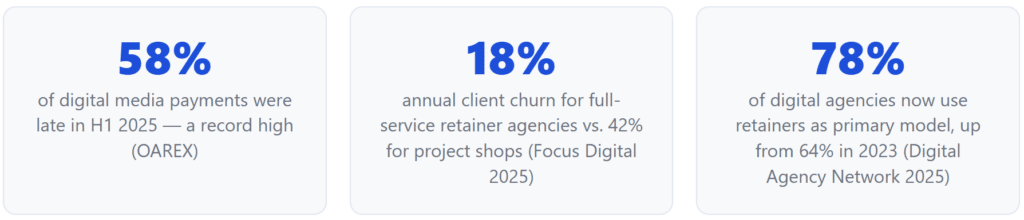
The numbers make the problem impossible to ignore. According to OAREX’s H1 2025 Digital Media and Advertising Payments Study, 58% of all digital media and advertising payments were late in the first half of 2025, the highest rate since OAREX began tracking. That figure has been climbing every measurement period: from 35% in December 2019 to 46% in H2 2023 to 58% in H1 2025. The retainer model is right. The billing system underneath it is broken.
The consequence isn’t just a delayed check. It’s a structural cash-flow problem that compounds month over month. An agency carrying three retainer clients on net-30 invoicing, all of whom pay late, is effectively financing a 45–60 day receivable on every single client every single month, using their own working capital. For smaller agencies without a cash reserve, that’s the mechanism by which otherwise-profitable retainer books quietly produce operating losses.
The fix isn’t better invoicing. It’s removing invoices from the payment equation entirely for recurring work. An automated recurring billing setup, where the client’s payment method is charged on day one of each service period, without an invoice being generated, actioned, and followed up on, is what converts a retainer from a billing model into an actual recurring revenue model.
What Most Agency Billing Guides Get Wrong
Search for “how to set up agency retainer billing,” and you’ll find dozens of articles covering the same ground: invoice in advance, use clear payment terms, and send a reminder when invoices are late. All of that advice is directionally correct. None of it addresses the structural issues that determine whether retainer billing actually produces reliable cash flow.
First gap: the distinction between a retainer with net-30 invoicing and a retainer with pre-authorized recurring collection. These look similar in a contract but behave completely differently in practice. Net-30 invoicing with a monthly retainer still puts the payment burden on the client, they have to see the invoice, approve it, and initiate payment. Pre-authorized recurring billing shifts the burden entirely: the payment is collected automatically unless the client actively stops it. Most billing guides treat these as equivalent. They aren’t.
Second gap: how scope changes should integrate with the recurring billing infrastructure. Retainer billing and scope change billing are two different financial flows that have to be configured separately. A scope change invoice isn’t a modification to the retainer, it’s a standalone one-time charge that should be billed separately and tracked independently. Agencies that process scope changes as “add-ons” to the next retainer invoice create reconciliation problems, revenue recognition issues, and client confusion about what the retainer covers.
Third gap: what happens when a recurring retainer payment fails, and specifically, why the dunning sequence for an agency retainer needs to be configured differently from a SaaS subscription. A failed payment from a $500/month SaaS customer is a routine operational event. A failed payment from a $10,000/month retainer client is a relationship event that requires a different communication approach than an automated dunning email.
The Data Behind Retainer Billing and Agency Retention
The case for retainer-based billing is well-supported by agency benchmarking data. What’s less often discussed is how the billing model itself, not just the retainer agreement, drives the retention outcomes.
The billing component of that “structured process” is consistently underweighted. Agencies that bill consistently on the same date, using pre-authorized payment collection with automated receipts, report fewer client billing disputes, faster time-to-cash, and, critically, stronger perceived professionalism from clients. The perception of operational reliability that comes with a well-run billing system carries into the client’s confidence in the agency’s delivery.
The late payment trend is the most actionable data point in the chart. PPC specialists and single-service agencies experience 49% annual churn, higher even than pure project shops, which reflects both the commoditization of individual channels and the fact that single-service retainers are the first to be cut when a client’s marketing budget tightens. Full-service retainers, with their higher embedded value and more complex switching cost, hold at 18% annual churn. The billing model doesn’t explain all of that difference, but consistent, professional automated billing is part of what makes a full-service retainer feel like a business-critical relationship rather than a vendor invoice.
Agency Retainer Billing Models: Which Structure to Use
Not every retainer client should be set up on the same billing structure. The right model depends on the scope of services, the client’s payment infrastructure, and whether the engagement includes performance components.
Fixed Monthly Retainer With Pre-Authorized Collection
The optimal setup for most retainer relationships: a fixed monthly fee, the same amount every month, charged automatically on day one of the service period against a saved card or ACH authorization. The agency delivers services; the payment happens without either party having to take action. This is the model that produces the most predictable cash flow and the cleanest financial records.
Tiered Retainer (Base + Performance)
A fixed base fee (billed via automated recurring collection on the standard schedule) plus a performance bonus billed separately if agreed milestones are hit. The billing configuration requires two separate invoice types: the recurring base charge, which runs automatically, and the performance component, which is triggered manually based on results. According to the SaaSHero 2024 B2B agency pricing benchmark, 14% of B2B demand generation contracts in 2024 combined a base retainer with a performance bonus component. This model rewards outcome delivery but adds billing complexity, and the performance bonus invoice should always be a distinct, separate charge from the base retainer, not an adjustment to it.
Stepped Retainer (Milestone-Based Billing)
A retainer structure where the monthly fee increases at pre-defined milestones, after the first 90 days, at year one renewal, or when the client’s ad spend crosses a threshold. The billing setup requires configuring future schedule changes at the outset, so the billing platform updates the charge amount automatically at the agreed milestone without requiring a new authorization. This model is useful for new client relationships where the agency is building toward a higher-value engagement over time. See also: Installment Billing for fixed-schedule billing that applies to non-recurring project components within an ongoing retainer relationship.
Retainer + Scope Change Invoices
The most common structure in practice, regardless of what the contract says. The recurring retainer covers the agreed monthly scope; any work outside that scope generates a separate, one-time invoice billed through the agency’s invoicing software. These two billing flows, recurring and one-time, must be kept separate in the billing platform, both for accurate revenue reporting and for clean client-facing statements.
| Billing model | Collection method | Cash-flow predictability | Admin burden | Best fit |
|---|---|---|---|---|
| Fixed retainer, pre-authorized ACH | Auto-debits on billing date | Very high, deterministic | Minimal, automated | Ongoing services, stable scope |
| Fixed retainer, net-30 invoice | Client-initiated on receipt of invoice | Low, depends on client behavior | High, manual follow-up | Large enterprise clients with AP departments |
| Tiered (base + performance) | Base: automated; performance: manual trigger | Medium base, predictable, bonus variable | Medium, two invoice types | Performance-accountable engagements |
| Stepped / milestone-based | Auto-debit with scheduled rate changes | High with planned increases | Low once configured | New clients ramping to full retainer value |
| Installment billing | Pre-generated fixed schedule, auto-collect | High, full schedule visible at setup | Low, runs automatically | Large setup/onboarding fees billed in portions |
| Project billing (no retainer) | Manual invoice per project | None, no recurring revenue | Very high | One-time engagements; high churn exposure |
Real-World Retainer Billing Scenarios Across Agency Types
SEO / Content Agency (3–15 clients)
Typically fixed monthly retainers of $1,500–$8,000. The key billing challenge: monthly deliverables vary in actual hours, but the fee is fixed, and scope creep (add-on content requests, reporting, and strategy calls) accumulates quickly. Ideal setup: automated ACH collection on the 1st, with a monthly scope-check process that triggers a separate scope change invoice within 48 hours of any approved out-of-scope request.
Paid Media / PPC Agency
Management fee retainer ($1,200–$6,000/month) billed separately from ad spend. The billing complexity here is that client ad spend passes through the agency before being charged to client ad accounts, creating a float exposure if retainer and ad spend billing aren’t synchronized. Recurring billing solves the management fee; ad spend billing should have its own cycle, typically in arrears with a card authorization hold.
Full-Service Digital Agency
Monthly retainers of $5,000–$50,000+ across multiple clients, often with tiered service levels and annual contract terms. These agencies benefit most from billing software with client-level reporting, showing each retainer’s billing status, renewal date, and any outstanding scope change invoices in a single view. See: Customer Management for how to connect billing data to client profiles.
Boutique / Solo Consultant Retainer
The use case where manual billing is most tempting and most costly. A solo consultant with four $3,000/month retainers is managing $12,000/month MRR, real money on which cash-flow delays have real consequences. Automated billing with same-date collection across all clients eliminates the monthly invoice-and-wait cycle that can keep $8,000–$15,000 in outstanding receivables at any given time.
Key Benefits of Automated Recurring Billing for Agency Retainers
Eliminates the Invoice-Chase Cycle
Every hour spent chasing a late invoice is an hour not spent on client work. For a 10-client retainer agency, manual billing follow-up on two or three reliably late clients consumes 3–5 hours per month, time with a real cost when the billable rate is $150–$300/hour. Automated collection removes the follow-up requirement entirely for clients on pre-authorized payment; only genuinely failed charges require human attention.
Predictable Monthly Cash Flow
When every retainer client is collected on the same date, the 1st or 15th of the month, the agency knows within a 48-hour window exactly what revenue will clear each month. That predictability enables confident resource allocation, payroll planning, and investment in the team without the uncertainty of waiting to see which invoices the client decided to pay this month.
Professional Client Perception
Clients who experience automated, consistent billing, charge notification, automatic collection, receipt, and same-day every month perceive the agency as operationally mature. The inverse is also true: an agency that emails an invoice on a different day each month, follows up two weeks later, and sometimes waits six weeks to get paid is signaling operational disorder, regardless of the quality of the work they deliver.
Clean Financial Records for Forecasting
Automated recurring billing produces transaction-level financial data, every charge, every receipt, and every failed payment without manual reconciliation. Connected to the agency’s accounting software via integration or CSV export, this data enables real MRR tracking, revenue-per-client analysis, and the month-over-month visibility that informs pricing and scope decisions.
Better Scope Change Enforcement
When the recurring retainer is clearly delineated in the billing system, a fixed monthly amount, same date, same description, it’s easier to identify and separately invoice anything outside that scope. The retainer line becomes the reference point: if the client is asking for something that isn’t in the monthly fixed charge, it should generate a separate invoice immediately, not be absorbed into “we’ll figure it out.”
Key Risks and Things to Watch For
Scope Creep That Compounds Monthly
The most common way retainers become unprofitable isn’t a bad client, it’s a retainer that gets renewed at the original price while the scope has quietly doubled. Agency advisor research documented in GigRadar’s retainer pricing guide notes that the most dangerous retainer is the one that looks stable: the “$4,000/month account that was actually the lowest-margin account by the time the agency measured it.” Automated billing makes the revenue stable, but it doesn’t protect the margin. A quarterly scope review, built into the retainer agreement and calendared at billing setup, is the margin protection that billing software doesn’t provide on its own.
High-Value Client Dunning Risk
A standard dunning sequence, automated retry on Day 3, firm escalation email on Day 7, and account suspension warning on Day 14 are appropriate for a $99/month SaaS customer. Applied to a $15,000/month retainer client, the same sequence is a relationship risk. Large retainer clients should be on a modified dunning flow: immediate personal outreach from the account lead on Day 1 of a failed charge, followed by an automated receipt-update request. Billing software that doesn’t allow per-client dunning customization creates this risk automatically.
ACH Return Window Exposure
ACH transactions can be disputed and returned by the client’s bank for up to 60 days after the original debit (for unauthorized return claims). For an agency that has delivered a full month of services and collected the retainer fee, a late ACH return dispute represents a double loss: services delivered and payment reversed. The mitigation is a signed pre-authorization agreement (a written or electronic authorization from the client to debit their account on a recurring basis) that establishes the authorization record for any dispute. Never begin ACH collection without a signed authorization on file.
Annual Rate Changes and Billing Platform Synchronization
Retainer rate increases, even the standard 5–8% annual adjustment that most agencies implement, require the billing platform to be updated to reflect the new amount before the next billing cycle. Agencies that update their contracts but forget to update the billing platform continue charging the old rate, sometimes for months, before the discrepancy surfaces in a revenue reconciliation. The fix is a billing-update checklist that’s triggered whenever a contract is amended.
Common Mistakes When Setting Up Retainer Billing
What experienced agency operators consistently get wrong at first and what to do instead.
Mistake 01: Starting the retainer on net-30 invoicing “until the relationship is established.”
The most expensive first 90-day mistake in retainer billing. Agencies that start new clients on invoice-based billing and plan to shift to automated collection once the relationship matures almost never make the shift, the client’s expectation of invoice-based payment is set in the first month and becomes extremely difficult to change without friction. Establish pre-authorized recurring billing at contract signing, before the first service period begins. Present it as standard practice, not an exception, because it should be.
Mistake 02: Billing scope changes as adjustments to the retainer invoice
Adding scope change charges to the monthly retainer invoice, “I just added $800 for the extra landing pages,” conflates two distinct billing relationships. The retainer invoice represents a fixed, pre-agreed monthly commitment. A scope change is a separate, negotiated, one-time charge. Mixing them together makes both the retainer and the scope change harder to track, dispute, and explain. Bill scope changes as standalone invoices with their own reference number, delivery date, and description, separate from the recurring retainer in every system that touches the data.
Mistake 03: Using a generic SaaS dunning sequence for all retainer clients
Default dunning sequences from billing platforms are calibrated for high-volume, low-value subscription businesses. A Day-7 escalation email that reads “your account will be suspended unless payment is received” is appropriate for a $29/month project management tool. Applied to a retainer client representing 20% of an agency’s monthly revenue, that email can end a relationship. Configure per-client or per-tier dunning rules: for clients above a revenue threshold, failed payment follow-up should be a personal call or email from the account lead, not an automated escalation.
Mistake 04: Not connecting billing records to the client’s service record
A retainer client’s billing history, payment dates, amounts, any failed charges, and scope change invoices should be accessible from the same view as their service history, deliverables, and communications. Agencies that store billing data in one platform and client notes in another lose the context needed to handle billing conversations professionally. If a client questions an invoice, the response should come from someone who can see both the scope agreement and the payment history in the same system. This is what integrated customer management built alongside billing delivers.
Mistake 05: Renewing retainers at the same price without reviewing scope or margin
Automated billing makes it easy to renew a retainer without reviewing whether the scope, and therefore the price, still reflects the work being done. An agency that auto-renews ten retainer clients at January 1st prices without a scope review in Q4 is almost certainly undercharging several of them. Agency benchmarking consistently finds that small, founder-led studios that track margin per retainer outperform larger agencies on profitability (Promethean Research 2025). The billing platform doesn’t protect margin, the pre-renewal scope review does.
How to Set Up Recurring Billing for Your Retainer Clients: Step by Step
The setup sequence below is ordered to prevent the rework that happens when billing infrastructure is built in the wrong order or when the first client gets onboarded before the configuration is validated.
Define the billing structure before the contract is signed
The retainer agreement and the billing setup should be designed together, not sequentially. Before the contract is finalized, decide on the monthly fee and billing date, whether scope changes will be billed on a separate invoice cycle, the pre-authorization language (which should be included in the contract, not a separate form), the late payment policy (including whether a late fee applies and at what threshold), and the escalation process for a failed charge. Every one of these decisions is harder to implement retroactively than at setup.
Choose a billing platform that supports both recurring and one-time invoices
Agency retainer billing requires two distinct invoice types: a recurring automated charge for the fixed monthly fee and a one-time manual invoice for scope changes. These need to be handled by the same platform, connected to the same client record, but tracked separately in financial reporting. Platforms like ReliaBills support both recurring billing and one-time invoicing under the same client account, which is the architecture retainer billing requires. Evaluate platforms on this specific combination before committing, not on feature lists designed for SaaS subscription management.
Collect payment authorization at contract signing
Before the first service period begins, obtain the client’s payment method (ACH bank details or card) and a signed authorization to charge it on the agreed recurring schedule. For ACH, a written authorization statement, either embedded in the contract or as a separate document, is required to defend against unauthorized return claims. For cards, the authorization is implicit in the card-on-file setup but should be confirmed in the contract language (“Client authorizes Agency to charge the card on file on the [date] of each month…”). Never begin service before payment authorization is in place.
Configure the recurring billing schedule for the retainer
Set the billing date (the 15th is generally optimal for agency retainers), the billing amount, the billing description (which should match the contract language, not an internal shorthand), and the notification settings (a charge notification sent to the client 3–5 days before each billing date). Configure the billing platform to send an automatic receipt on payment success. These notifications are not optional, they reduce client surprise, reduce card disputes, and serve as the documentation record for each payment.
Configure dunning rules per client tier
Build at least two dunning tiers: a standard tier for lower-value retainers (automated retry Day 1, automated escalation email Day 5, account review notice Day 10) and a high-value tier for clients above a revenue threshold (personal outreach Day 1, followed by automated receipt-update request Day 3, escalation to account lead Day 7). Map each new retainer client to the appropriate dunning tier at setup, not when a payment fails.
Set up the scope change invoicing workflow separately
Create a scope change request process, a lightweight form or email template that captures what was requested, who approved it, and the agreed price that triggers a standalone invoice through the billing platform. This invoice should use a different naming convention from the retainer invoice (e.g., “Scope Change: [Project Name]” vs. “Monthly Retainer: [Month Year]”) and should be collected on its own payment timeline, not added to the next retainer cycle.
Connect billing to client records and calendar a quarterly scope review
Link the recurring billing schedule to the client’s account in your customer management system, so billing history is visible alongside service history. Then calendar a scope review 60 days before each retainer’s anniversary date to confirm the scope still matches the price and to initiate any rate adjustment conversation with enough lead time that it doesn’t feel like a surprise at renewal. The billing platform handles the payment automation; the scope review protects the margin.
Validate the first billing cycle manually before trusting the automation
For each new retainer client, log into the billing platform on the first billing date and confirm the charge was initiated correctly, the correct amount was debited, the receipt was sent to the right email address, and the client’s account in your management system was updated to reflect payment received. After one clean cycle per client, the automation is validated. The manual check takes five minutes and prevents the problems that take an hour to explain to an unhappy client.
Frequently Asked Questions
1. What is recurring billing for a digital marketing agency retainer?
Recurring billing for an agency retainer is the automated process of charging a client’s saved payment method, card, or ACH bank account, on a fixed date each month for the agreed retainer fee, without the agency issuing a manual invoice or following up for payment. The client provides pre-authorization at contract signing; from that point, the billing runs automatically each cycle.
2. Should I bill retainer clients in advance or in arrears?
Always in advance, charge on day one of the service period, before the work begins. Billing in arrears means the agency is financing the client’s marketing for the month before collecting any revenue. Advance billing also clearly establishes that the retainer is a commitment to time and capacity, not a payment for specific deliverables, an important distinction when scope change conversations arise.
3. What payment method is best for agency retainer collection?
ACH (bank-to-bank direct debit) is the optimal method for most B2B agency retainer relationships. ACH processing costs are significantly lower than card processing fees (typically $0.26–$0.50 per transaction versus 2.5–3% for cards), ACH is standard and expected in professional B2B relationships, and the payment clears reliably without the card expiration issues that drive involuntary churn in consumer billing. For clients who prefer card payment, accepting cards is worth the processing cost to reduce payment friction, but ACH should be the default offer.
4. How should scope change work be billed on top of a recurring retainer?
Scope changes should always be billed as standalone, one-time invoices separate from the recurring retainer charge. The retainer invoice represents the fixed monthly commitment; a scope change invoice represents a separate, negotiated engagement. Mixing them on the same invoice creates reconciliation problems and client confusion about what the retainer covers. Issue the scope change invoice as soon as the additional work is approved, not at the end of the month or added to the next retainer cycle.
5. What happens if a retainer client’s ACH payment fails?
A failed ACH charge for a high-value retainer client should trigger personal outreach from the account lead within 24 hours, not an automated escalation email. The billing platform should be configured to alert the agency account lead immediately on a failed charge so they can contact the client directly before an automated sequence fires. For smaller retainer clients, a standard retry and automated notification workflow is appropriate. The key is configuring different responses for different client tiers, not applying a one-size-fits-all dunning sequence to all retainer clients regardless of value.
Recent Articles:
- How to Set Up Recurring Billing for SaaS and Tech Subscription Services
- How to Set Up Recurring Billing for Gym and Fitness Studio Memberships