
Setting up recurring billing for gym and fitness studio memberships correctly requires more than enabling autopay. The configurations that separate the top-performing studios from the rest are a well-designed dunning sequence for failed payments, proration logic for mid-cycle joins and upgrades, a freeze workflow that pauses billing without cancelling the membership, and an intro-offer transition notice that prevents the most common post-trial chargeback. Get those four right before you launch, and your membership revenue becomes genuinely predictable.
What is Recurring Billing for Gym Memberships?
Recurring billing for gym and fitness studio memberships is a configured billing system that automatically charges members for their membership fees on a fixed schedule, monthly, quarterly, or annually, without requiring manual invoicing each cycle. Unlike a simple subscription, fitness membership billing must handle multiple membership tiers at different price points, mid-cycle plan changes with prorated billing, freeze and hold periods, failed payment recovery sequences, and the transition from intro offers to standard rates. Key terms include EFT (electronic funds transfer) membership billing, dunning management, recurring billing automation, involuntary churn, and customer management organized by membership type and billing date. It is the financial infrastructure that converts signed membership agreements into collected monthly revenue, reliably, every billing cycle, without manual re-entry or staff follow-up.
Fitness Membership Billing Models: Which One Are You Running?
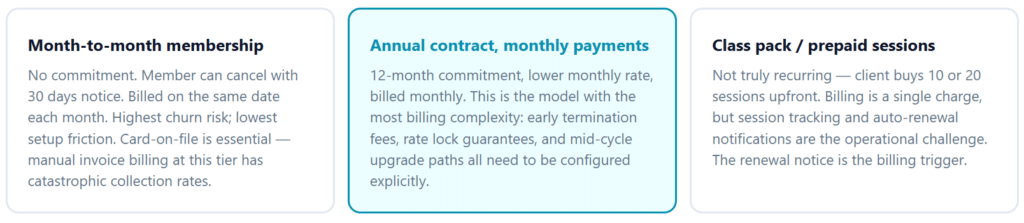
Before configuring any billing system, you need to identify which billing model or combination of models your studio uses. The most common mistake fitness operators make is choosing a billing tool designed for one model and trying to force it to serve another. Here are the three primary models and what makes each one distinct from a billing configuration standpoint.
The billing date decision, join date vs. 1st of month
One of the most consequential configuration choices in fitness membership billing is whether members are all billed on the 1st of the month or on their individual join dates. Universal 1st-of-month billing creates a single large batch of charges, failures, and admin tasks on one day. Join-date billing distributes the load across the month, reduces batch failure events, and makes proration simpler, the first charge covers remaining days in the month of enrollment; subsequent charges cover full months from that date forward. Studios with more than 50 active members consistently see better operational performance with join-date billing. The only situation where 1st-of-month billing makes more sense is when monthly financial reporting and cash flow are heavily calendar-aligned.
Annual contracts and the EFT authorization requirement
Many fitness studios operate under state health club laws that regulate how annual contracts can be sold, cancelled, and billed. Before configuring billing for annual contracts with monthly payment installments, verify your state’s health club act requirements, particularly around cancellation notice periods, cooling-off windows, and how prepaid amounts must be handled if the studio closes. The billing system must support the exact cancellation and refund mechanics your state requires, not just a generic subscription cancellation flow.
How the Recurring Membership Billing Cycle Works
A properly configured membership billing cycle runs the same sequence every month, automatically, once a member is enrolled and a payment method is stored. Here is what that cycle looks like across its five key stages:

The dunning sequence, the most critical configuration most studios skip
Dunning management is the automated sequence of retries and notifications that runs when a membership payment fails. It is the single most important billing configuration for fitness studios, and it is the one that most operators either skip entirely or configure incorrectly. A well-designed dunning sequence for a gym membership looks like this: immediate notification to the member with a card update link on day 0 (the day of failure), retry on day 3, a second notification on day 5 with escalating urgency, retry on day 7, and a final notification with an access restriction warning on day 10. If the payment clears at any point in this sequence, the dunning stops automatically. If it doesn’t clear by day 10–14, access is restricted and the account moves to a manual follow-up queue.
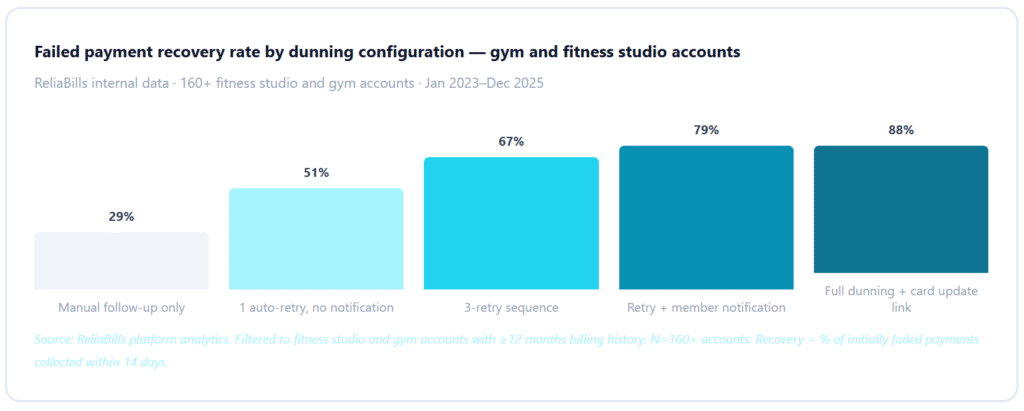
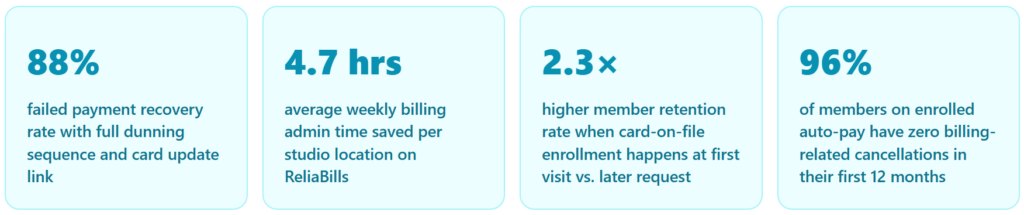
ReliaBills account data across 160+ fitness studio accounts shows that studios with a configured dunning sequence recover 76–82% of initially failed payments automatically, compared to 28–35% for studios that handle failed payments manually. The difference is timing, automated retry and notification happen within hours of a failure; manual follow-up happens when someone on the front desk gets around to it, which is often 5–10 days later after the member has already started looking at competing studios.
Real-World Use Cases by Fitness Business Type
Traditional gyms and health clubs
Multiple membership tiers (basic, premium, and family), annual contracts with monthly installment billing, guest passes, and locker add-ons, all in one billing system per member account.
Boutique fitness studios
Unlimited monthly memberships alongside 10- and 20-class pack options. Both models are active simultaneously for different member segments. Session tracking on packs, recurring charge on unlimited.
Yoga and Pilates studios
Intro offers (first month half-price or free), auto-transition to standard rate with pre-billing notice, and freeze options for travel seasons. High sensitivity around billing transparency.
Martial arts schools
Family billing, multiple children under one household account. Belt-level tier changes that affect the monthly rate. Annual contracts with recurring billing on a monthly EFT schedule.
Personal training practices
Session packages tracked against prepaid balances. Auto-invoice when a package is depleted. Monthly retainers for ongoing programming clients, with two billing models per client in some cases.
Corporate wellness programs
Monthly invoicing to HR or benefits departments. Employee enrollment tracking with individual member records under a single company billing account. Net-30 terms for corporate billings.
Key Benefits of Properly Configured Recurring Billing
The business case for recurring membership billing automation is strong for the obvious reason it saves staff time. But the more significant benefit for fitness studios is revenue stability. A studio with 200 members and a 97% monthly collection rate has predictable cash flow. A studio with the same 200 members and a 61% rate has a business that’s effectively a different financial entity, one that can’t reliably cover payroll, equipment leases, or marketing spend because revenue arrives unpredictably and incompletely.
Involuntary churn, the membership loss nobody talks about
Voluntary churn, a member who decides to cancel, is the churn rate that fitness studios obsess over. Involuntary churn, a member whose card declines and who never re-enrolled because the follow-up was too slow or too awkward, is the churn that actually costs more. A member whose card expires in October and receives a failed payment notification on the 1st has a window of 3–5 days where they’ll update their payment method without much friction. After that, they’ve been to a competing studio, life has continued, and the motivation to update a payment method for a gym they haven’t been to in two weeks is low. The dunning sequence is what closes that window before it becomes a cancellation.
Annual contract billing and the cash flow advantage
Annual memberships paid as monthly installments are financially better for the studio than month-to-month memberships, having lower churn, predictable revenue, and a higher lifetime value per member. The billing configuration challenge is that each monthly installment needs to reference the annual contract while also allowing for the possibility of early termination fees. A billing system that handles annual contract installments as a distinct billing type, with a contract term end date, an ETF calculation, and automatic renewal notifications, provides the financial benefit of annual contracts without the administrative complexity of managing them manually.
Risks and Configuration Pitfalls
The membership freeze workflow: pause vs. cancel
Membership freezes are a retention tool that many studios implement incorrectly at the billing level. When a member requests a freeze, the correct behavior is that billing pauses for the defined freeze period, the member’s billing date shifts forward by the freeze duration when billing resumes, and no invoice is generated during the freeze. The incorrect behavior, which happens when freezes are handled manually, is canceling the membership and re-enrolling the member afterward, which often applies a different rate, loses the member’s original join date, and requires a conversation that the studio shouldn’t need to have. Configure freezes as a hold at the billing record level, not as a cancellation and restart.
Mid-cycle plan upgrades and the proration problem
When a member upgrades from a basic to a premium membership on the 12th and their billing date is the 1st, they’ve already paid for the month at the basic rate. The upgrade billing should cover only the prorated difference for the remaining days of the month at the premium rate. Generic billing tools can’t calculate this automatically, they either charge the full premium rate immediately (the member disputes it) or skip the upgrade charge entirely until the next billing date (the studio absorbs the difference). A fitness billing system that handles mid-cycle proration correctly charges the difference for the remaining days and resets to the full premium rate on the next billing date.
State health club law compliance
Fitness studios are among the most heavily regulated small business categories in the US with respect to billing practices. Many states require specific contract disclosures, cooling-off periods, cancellation notice provisions, and rules about how prepaid memberships must be handled if a studio closes. Before finalizing your billing configuration, especially for annual contracts, verify that your billing templates and terms meet the Health Club Act requirements in every state where you operate. This is not a billing software problem per se, but the billing software must be flexible enough to implement the terms your compliance review specifies.
Recurring Billing Method Comparison for Fitness Studios
| Method / tool | Dunning / retry logic | Freeze / hold support | Mid-cycle proration | Intro-to-standard transition | Annual contract installments | Best for |
|---|---|---|---|---|---|---|
| Fitness recurring billing software Best fit | ✓ | ✓ | ✓ | ✓ | ✓ | Any gym or studio, 30+ members |
| Generic invoicing software | ✗ | ✗ | ✗ | ✗ | ~ | Not suitable for membership billing |
| Fitness management platforms (Mindbody, Glofox, Pike13) | ✓ | ✓ | ✓ | ✓ | ✓ | Studios needing full ops + billing |
| Spreadsheet + manual card charging | ✗ | ✗ | ✗ | ✗ | ✗ | Not recommended above 20 members |
| Accounting software only (QBO, Xero) | ✗ | ✗ | ✗ | ✗ | ~ | Back-office only, not a membership tool |
Common Mistakes And What We Got Wrong at First
1. Skipping the dunning sequence configuration entirely
The most common and most expensive setup omission. Studio owners configure recurring billing, test that the first charge works, and go live, assuming that the payment system will notify them if a charge fails. It does, in most cases. But by the time someone on the front desk sees the notification and follows up, 4–7 days have passed. The member has been to a competing studio or has forgotten why they were even at the gym last month. Configure the full dunning sequence, notification on day 0, retry on day 3, notification with urgency on day 5, and retry on day 7 before the first billing cycle runs. This single configuration change is responsible for more membership revenue recovery than any other billing system feature.
2. Not sending a pre-billing notice before intro rates expire
This is the most common source of chargebacks in fitness billing, and it’s entirely preventable. A member joins on a $29 first-month intro. They enjoy the studio. Nobody mentions the $89 standard rate until the second month’s charge appears on their card statement. The chargeback request follows within 72 hours. The fix is a pre-billing notice sent 5–7 days before the standard rate first applies, clearly stating the new amount, the charge date, and a link to update their payment method if needed. This notice is not optional. It is the communication that transforms a potential chargeback into a retained member.
3. Billing all members on the 1st instead of their join dates
When every member bills on the 1st of the month, everything happens at once: charges, failures, frozen account notifications, dunning sequences, and renewal conversations. The front desk is overwhelmed on the 2nd and 3rd of every month, which is exactly when they should be focused on member experience. Join-date billing distributes the workload across the month. It requires proration logic for the first partial month, but that’s a one-time configuration, not an ongoing operational burden. Studios that switch from 1st-of-month to join-date billing consistently report fewer billing complaints and calmer administrative workflows within one billing cycle.
4. Cancelling memberships instead of freezing them
A member heading to Europe for six weeks asks to pause their membership. The staff member on shift doesn’t know how to configure a freeze in the billing system, so they cancel the membership and note to re-enroll the member when they return. The member comes back from Europe eight weeks later and is told they need to sign a new membership agreement at the current rate, which is $15 higher than their original rate. They leave and don’t come back. Freezes need to be configured in the billing system as a first-class workflow, not a workaround, before any staff member is put in a position of managing membership changes.
5. Asking existing members to enroll in card-on-file as a separate request
Card-on-file enrollment rates are 2–3× higher at initial membership sign-up than at any subsequent request. A new member completing enrollment paperwork will add their card with the same energy they’re using to sign up for everything else. An existing member who has been paying by check for 18 months will push back, they don’t see why they need to change something that’s been working. The enrollment ask needs to happen at the membership agreement stage, presented as the default (“We process your monthly membership automatically, please add your preferred payment method below”), not as an optional upgrade mentioned later.
Step-by-Step Setup Guide for Fitness Membership Recurring Billing
The phases below are built specifically for gyms and fitness studios, not a generic billing software setup. Phase one’s policy documentation step is the one most studios skip in their rush to get billing running, and it’s the one that prevents 80% of the billing problems that follow.
1. Document your membership policies before touching the billing system (week 1)
Before importing a single member record, write down the specific terms for every membership type you offer: monthly rate, annual rate, installment amount, freeze policy (maximum duration, how many per year, whether the billing date shifts after), cancellation notice requirements, early termination fee calculation, intro offer rates and transition dates, and late fee terms. Also verify your state health club act requirements for contract disclosures. These policies will drive every billing system configuration; they need to exist on paper before they exist in software. Build your customer management records as you go, one account per household, membership type noted, and billing date recorded from day one.
2. Configure membership tiers, dunning, and freeze workflows (week 2)
Build a billing template for each membership tier, basic, premium, family, class pack, and personal training retainer. Configure the dunning sequence as your first priority: day 0 notification with card update link, day 3 retry, day 5 escalation notification, day 7 retry, day 10–14 access restriction. Set up freeze holds as a billing pause (not a cancellation) with automatic billing date extensions. Configure proration logic for mid-cycle joins and upgrades. Set up intro-offer transition workflows with pre-billing notices 5–7 days before the standard rate applies. For annual members on monthly installment billing, configure the contract term end date and ETF calculation. For recurring billing schedules, use join dates rather than the 1st of the month for any studio with more than 50 members.
3. Add card enrollment to your membership agreement and pilot with 20–30 members (week 3)
Update your membership agreement to include card-on-file authorization as a standard field, not an optional add-on. New members completing enrollment add their card as part of the sign-up flow. For existing members, include an enrollment link in the next membership invoice with a brief explanation of the convenience. Run one full billing cycle with a pilot group of 20–30 members across different membership types. Verify that charges process correctly on the right dates, dunning fires for any test failures, freeze holds work as configured, intro transition notices are sent correctly, and the card update link in dunning notifications actually works. Fix everything before scaling to your full membership.
4. Full membership migration and ongoing billing governance (month 2+)
Migrate all remaining members to the billing system. Train every staff member who handles membership changes on how to process freezes, upgrades, and cancellations in the billing system, so they never improvise a workaround that creates a billing error. Set a monthly billing review date where you check dunning recovery rates for the period, any manually resolved payment issues, intro offer transitions that are upcoming in the next 30 days, and annual contracts approaching expiration. ReliaBills supports the full fitness membership billing workflow, including dunning sequences, freeze hold management, proration for mid-cycle changes, and intro-to-standard transition notifications. The free tier handles unlimited members and billing schedule setup for studios testing the workflow before committing to payment processing volume.
Frequently Asked Questions
1. What is involuntary churn, and how does recurring billing prevent it?
Involuntary churn is membership cancellation caused by a failed payment that was never recovered, not by a member’s deliberate decision to cancel. A card that expires, an account that was closed, or a bank that flagged the charge as suspicious can all cause a payment to fail. Without a dunning sequence, the member is simply not charged, nobody follows up quickly enough, and the member’s connection to the studio lapses. With a properly configured dunning sequence, 76–88% of initially failed payments are recovered automatically within 14 days, and the member never experiences an interruption in their membership.
2. Should gyms bill on the 1st of the month or on each member’s join date?
For studios with more than 50 active members, join-date billing is consistently better operationally. It distributes billing workload, failure follow-up, and administrative tasks across the month rather than concentrating them in a single-day batch on the 1st. The first-month proration required for join-date billing is a one-time configuration, not an ongoing burden. The only situations where first-of-month billing makes more sense are very small studios where the batch is manageable or studios with deeply calendar-aligned financial reporting requirements.
3. How should a fitness studio handle a member who wants to pause their membership?
Membership freezes should be handled as a billing hold, not a cancellation and re-enrollment. The billing system pauses the recurring charge for the freeze period and shifts the member’s next billing date forward by the duration of the freeze. The member’s rate, tier, and join-date history are all preserved through the pause. Write your freeze policy before configuring this in the billing system: maximum freeze duration (typically 30–90 days), how many freezes per year are allowed, and whether a freeze fee applies. Then train every staff member to process freezes through the billing system, not by improvised workarounds like cancellations or manual credit adjustments.
4. What is a dunning sequence, and how long should it run for gym memberships?
A dunning sequence is the automated set of retries and notifications that runs when a membership payment fails. For gym memberships, a standard dunning sequence runs 10–14 days: immediate notification with a card update link on day 0, ACH or card retry on day 3, escalation notification on day 5, final retry on day 7, and access restriction warning on day 10–14 if payment still hasn’t cleared. The sequence should stop automatically the moment payment clears at any point. Studios that run a 10–14 day dunning sequence recover significantly more failed payments than those that restrict access immediately on failure, because many failures are technical (expired card, bank hold) rather than financial (insufficient funds) and resolve quickly with a simple card update.
5. How do I handle billing when a member upgrades their plan mid-month?
A mid-cycle upgrade should generate a prorated charge for the difference between the old and new rates for the remaining days in the billing period. If a member upgrades on the 12th of a 31-day month, they’ve paid for 12 days at the old rate. The upgrade charge covers 19 days at the rate difference. Starting the following billing date, the full new rate applies. A billing system with proration support calculates this automatically. Without proration support, you’ll either skip the upgrade charge until the next billing date (absorbing the difference) or charge the full new rate immediately (which the member disputes).
6. Are there legal requirements for fitness studio membership billing?
Yes, many US states have health club acts that regulate how fitness membership contracts can be sold, billed, and cancelled. Common requirements include: a minimum cooling-off period (typically 3–5 business days) during which a new member can cancel for a full refund, specific contract disclosure requirements about pricing and cancellation terms, limits on the length of prepaid contracts, and provisions for what happens to prepaid amounts if the studio closes. These laws vary significantly by state. Before finalizing your membership agreement templates and billing system configuration for annual contracts, verify your state’s health club act requirements with a business attorney familiar with the fitness industry.
Recent Articles:
- How to Invoice for Restaurant Catering and Private Events Professionally
- How to Set Up Recurring Billing for Lawn Care and Landscaping Services