

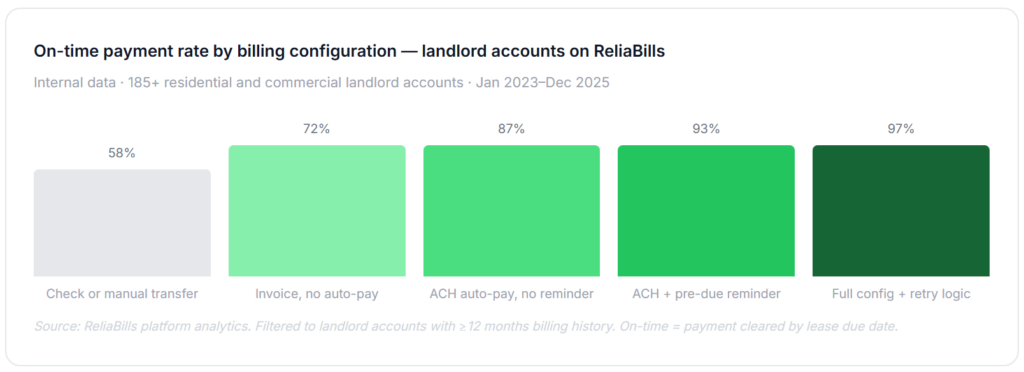
Setting up recurring billing for monthly rent payments is not the same as creating a repeating invoice. The configuration that actually works requires the right billing date for each tenant, a proration calculation for move-in and move-out months, ACH authorization before the first charge, and a failed-payment retry sequence that catches the 6–8% of payments that fail on the first attempt. Get those four elements right, and you’ll collect 94–97% of rent on or before the due date without a single follow-up call.
What is Recurring Billing for Monthly Rent Payments?
Recurring billing for monthly rent payments is a configured billing schedule where a tenant’s rent amount is automatically charged or invoiced on the same date each month, based on the terms of their lease agreement. It runs without manual intervention once set up, sending the tenant a reminder before the due date, processing the charge, sending a receipt, and triggering a retry or late fee if the payment fails. Key terms include ACH authorization, recurring billing, billing date vs. due date, proration for partial months, NSF retry logic, and invoicing software that handles lease-specific billing rules. It is the system that converts a signed lease agreement into collected rent every month, automatically, compliantly, and without the landlord having to think about it.
How Monthly Recurring Rent Billing Works
A properly configured recurring rent billing cycle runs the same sequence every month, triggered by the tenant’s billing date rather than by any manual action. Understanding what happens at each step and where common configurations go wrong is what makes the difference between a system that works and one that looks like it works until it doesn’t.

The billing date vs. due date distinction
Many landlords conflate billing date and due date, and it creates confusion in their system from day one. The due date is what the lease says, rent is due on the 1st. The billing date is when the ACH charge actually processes. Because ACH transactions take 1–3 business days to clear, the billing date should be 2–3 days before the due date if you want the funds available by the 1st. A landlord who sets both to the 1st and expects same-day payment is building in a structural 2-day delay that will make every month feel like a late payment, even when the tenant is doing everything correctly.
Proration: the first month exception
When a tenant moves in on the 15th of a month with rent due on the 1st, the first invoice should cover only the remaining days of that month at the daily rent rate (monthly rent ÷ days in the month × remaining days). The second invoice should be the full monthly amount. Generic billing systems default to charging the full amount on the configured billing date regardless of when the tenant actually moved in, which means either the landlord manually overrides the first invoice or the tenant gets an unexpected double-charge when the first full month’s payment arrives 15 days later. Recurring rent billing that handles proration correctly stores the move-in date at the unit level and calculates the first-month invoice automatically. Every month after that is the standard recurring charge with no adjustments needed.
The NSF retry sequence
Every portfolio experiences failed payments. A payment fails for one of four reasons: insufficient funds, a changed account number, a bank-side hold, or a closed account. The billing system’s job is to distinguish between temporary failures (insufficient funds, bank hold) and permanent ones (closed account, changed number) and respond accordingly. The most effective configuration is a 3-attempt retry sequence: retry on day 3, retry on day 7, and send an automated notification with a card update link after the first failure. This sequence recovers 55–65% of initial failures without any landlord involvement. What the retry sequence doesn’t do is send increasingly aggressive collection messages, that approach tends to accelerate cancellations rather than recoveries.
The Billing Date Decision: The Most Important Configuration Choice
The single most consequential decision in recurring rent billing is which date to use as the billing date for each tenant. There are three approaches, each with different operational and cash flow implications.
Option A: Universal 1st-of-month billing
All tenants billed on the 1st. Simple to manage but creates a massive batch of charges, failures, and admin tasks on the same day every month.
Option B: Recommended: Per-tenant join date billing
Each tenant is billed on their move-in anniversary date. Distributes workload evenly, simplifies proration logic, and produces fewer batch failure events.
Option C: Tenant-preferred date
Tenant selects their preferred billing date (e.g., the day after payday). Highest satisfaction but complex to manage across a large portfolio.
For portfolios under 20 units, the join-date approach (Option B) is the most operationally reliable. It means that a tenant who signed on the 12th gets billed on the 12th every month, proration only affects month one, and failures are distributed across the month rather than hitting all at once on the 1st. Larger portfolios may standardize on the 1st for accounting simplicity but should invest in robust failure handling to manage the volume spike.
Real-World Use Cases for Recurring Rent Billing
Small residential landlords
1–10 units with individual tenant records. Monthly ACH auto-pay on join dates, prorated first month, and late fee on day 5. Zero manual billing steps after setup.
Multi-family property managers
Portfolio dashboard showing all units’ payment status. Customer management organized by building and unit, not a flat contact list. Batch processing with failure segregation by property.
Commercial lease landlords
Base rent recurring monthly, with variable CAM line items added before each send. Annual rent escalations are set as scheduled rate changes in the billing record, no manual updates are needed.
HOA and condo associations
Monthly assessments auto-billed to all unit owners. Special assessments split via installment billing over 3–6 months rather than one large invoice.
Student housing operators
Academic-year billing cycles (9 or 12 months), co-signer payment splits, and guarantor invoicing when primary tenant’s ACH fails. Billing schedules that match the academic calendar, not a standard 12-month loop.
Mixed residential and commercial
Ground-floor retail on NNN leases billed separately from residential units above, even when owned by the same entity. Different billing templates, terms, and escalation schedules under one account.
Key Benefits of Recurring Billing for Monthly Rent
The financial case for recurring rent billing is straightforward: collecting 97% of rent on time versus 58% is not a marginal improvement, it’s the difference between a stable investment property and one that requires constant attention. But there are secondary benefits that are equally important for landlords managing more than a few units.

Cash flow predictability as a portfolio management tool
A landlord who knows that 93–97% of rent will arrive within 2 days of the due date can plan maintenance schedules, budget for capital improvements, and service mortgage obligations without needing a line of credit to cover the gap. That predictability is worth more than the administrative hours saved, especially for landlords who are scaling a portfolio and need reliable cash flow visibility to make acquisition decisions. Recurring billing also produces a clean payment history for every tenant, a record that’s increasingly useful at lease renewal time when deciding whether to offer a rate increase or a renewal at all.
Late fee enforcement without the conversation
One of the most undervalued benefits of automated recurring billing is that it removes the landlord from the late fee enforcement process. When the billing system applies a late fee automatically on day 5 based on the lease terms, the landlord doesn’t have to decide whether to charge it, remember to add it to the next invoice, or have an awkward conversation about it. The fee is applied, documented, and included in the outstanding balance. Tenants who want to contest it can reach out directly, but most don’t, because the late fee policy was in the lease and the billing system simply executed what was agreed.
Risks and What to Configure Correctly Before Going Live
State law compliance for automated rent charges
Automated ACH rent collection is legal in all 50 states, but the requirements for valid authorization vary. Most states require written ACH authorization that specifies the amount, frequency, and account to be debited. Some states require the authorization to be in the lease itself rather than a separate addendum. A handful of jurisdictions have specific notification requirements before the first automated charge. Before enabling ACH auto-pay for any tenant, verify the authorization requirements in your state, and use the authorization form your billing platform provides, which is typically drafted to meet standard NACHA requirements even if it doesn’t cover every state-specific nuance.
Lease renewal rates increase, and the billing record
When a lease renews with a higher rent amount, the billing record needs to update on the renewal date, not the day you remember to change it. Recurring billing systems that don’t support scheduled rate changes require a manual update to the billing record before the renewal date. If that update is missed, the tenant continues being charged the old amount, and the discrepancy accumulates until someone catches it during a rent roll audit. Configure rate increases as scheduled changes in the billing system at the same time you send the renewal notice, not as a reminder on your calendar for later.
Security deposits and the billing system boundary
Security deposits should never be processed through your recurring rent billing system. They are legally separate funds with their own holding requirements, interest rules (in some states), and return timelines. Running a security deposit through a system designed for recurring charges creates accounting confusion and can trigger compliance issues if the deposit is co-mingled with operating funds in a state that requires segregated escrow. Handle security deposits in a dedicated workflow, separate from rent billing entirely.
Recurring Billing Method Comparison for Rent Payments
| Method | Proration support | NSF retry logic | Late fee auto-apply | Rate change scheduling | Tenant self-service | Best for |
|---|---|---|---|---|---|---|
| Recurring billing software Best fit | ✓ | ✓ | ✓ | ✓ | ✓ | Any landlord, any portfolio size |
| Zelle / Venmo / PayPal | ✗ | ✗ | ✗ | ✗ | ✗ | Not suitable, no audit trail or automation |
| Recurring bank transfer (tenant-initiated) | ✗ | ✗ | ✗ | ✗ | ~ | Small portfolios; no failure handling |
| Property management platforms (AppFolio, Buildium) | ✓ | ✓ | ✓ | ✓ | ✓ | Larger portfolios needing full PM features |
| Generic invoicing or subscription software | ✗ | ✗ | ✗ | ~ | ~ | Not built for lease-specific billing rules |
Common Mistakes and What We Got Wrong at First
1. Setting the billing date equal to the lease due date
This is the first mistake almost every landlord makes. The lease says rent is due on the 1st, so they set the billing date to the 1st. ACH transactions take 1–3 business days to settle. The payment processes on the 1st but doesn’t clear until the 3rd or 4th, which shows as “late” in the landlord’s ledger and sometimes triggers an unnecessary late fee for a tenant who actually paid on time. The billing date should be 2–3 business days before the lease due date. If rent is due on the 1st, the ACH should initiate on the 28th or 29th of the prior month.
2. Skipping the proration configuration for month-one move-ins
A tenant who moves in on the 18th should be charged for 13 days in the first month, not a full month. Most landlords know this conceptually but don’t configure it in their billing system, they plan to “handle it manually for the first invoice.” That manual override then gets forgotten or done incorrectly, and the tenant gets overcharged. The billing system should store the move-in date and calculate the prorated first month automatically. If your platform doesn’t support this natively, create a reminder in your calendar for every new tenant’s first billing date and block time to verify the invoice before it sends.
3. Not scheduling rate increases at lease renewal time
The most common recurring billing error in multi-year portfolios: a lease renews in March with a 4% rent increase, the landlord sends the renewal notice, and plans to update the billing record “before the new rate kicks in.” April arrives and the billing system charges the old rate because the landlord forgot to update it. Some landlords catch this on the day the charge processes; others don’t catch it until mid-month. Schedule the rate change in your billing system the same day you send the renewal notice, not as a separate task for later. Most recurring billing platforms let you set a future effective date for a rate change; use it.
4. Enabling recurring billing without collecting signed ACH authorization
Verbal consent is not sufficient for ACH authorization. A tenant who says “yes, go ahead and set up auto-pay” on the phone hasn’t legally authorized an ACH debit. If they later dispute the charge with their bank, the bank will request an authorization form, and if you don’t have a signed one, the dispute will likely go in the tenant’s favor. Before the first automated charge runs for any tenant, collect a signed ACH authorization that specifies the bank account, the recurring amount, and the frequency. Most billing platforms provide a standard form; some send it as part of the tenant onboarding flow and collect a digital signature automatically.
5. Treating all failed payments as collection problems
A tenant whose ACH fails because their bank account number changed last week is a very different situation from a tenant who genuinely can’t pay this month. Treating both with the same automated retry and late fee sequence is operationally efficient but sometimes relationship-damaging. When a payment fails, look at the failure code before deciding on the next step. “Account not found” usually means a changed account, reach out directly rather than sending three automated retry attempts to an account that no longer exists. “Insufficient funds” is a different category entirely and may warrant a direct conversation before the late fee fires.
Step-by-Step Setup Guide for Recurring Rent Billing
The four phases below are built for landlords setting up recurring billing for the first time or migrating from manual or check-based collection. Phase one’s lease verification step is the most important and the one most people skip in their rush to go live.
1. Gather and verify lease data (week 1)
For every active lease, document the monthly rent amount, the lease-defined due date, the move-in date (for proration), any scheduled rate increases, the late fee amount and trigger date, and the tenant’s preferred email for billing notifications. Also check your state’s ACH authorization requirements and late fee law before configuring those parameters. Pull your AR aging at this stage, any outstanding balance needs to be handled separately before the automated system goes live, or it will create confusion when the first recurring charge arrives alongside an existing unpaid balance. Clean your customer management records to ensure one account per tenant, accurate contact information, and correct unit assignment.
2. Configure each tenant’s billing record (week 2)
Enter each tenant’s unit record with the exact lease terms: monthly amount, billing date (set 2–3 days before the lease due date), proration amount for month one if applicable, late fee amount and trigger day, and any scheduled rate change dates. Set up the pre-due reminder (3–5 days before the billing date). Configure the NSF retry sequence, at minimum a 3-day and 7-day retry with a notification email after the first failure that includes a payment method update link. If you’re using ReliaBills, the recurring billing setup walks through each of these parameters per-tenant with validation to catch common configuration errors before the first charge runs.
3. Collect ACH authorizations and send transition notice (weeks 3–4)
Send each tenant a transition notice explaining that rent will now be collected automatically via ACH, when the first charge will run, and how to update their payment method if needed. Include the ACH authorization form or a digital enrollment link. Give tenants at least 14 days notice before the first automated charge. For tenants who are reluctant to enroll in ACH, continue offering an invoice-based option and follow up on enrollment after the second billing cycle. For HOAs using installment billing for special assessments, configure those payment schedules separately from the monthly recurring assessment.
4. Run the first cycle manually supervised, then step back (month 1+)
For the first automated billing cycle, watch each charge as it processes: verify the amount matched the lease, the billing date was correct, any proration was applied accurately, and receipts went to the right email addresses. Check that the retry sequence fired correctly for any failures. After the first clean cycle, step back and let the system run. Schedule a quarterly audit to verify that rate increases have been applied on schedule and that any mid-lease changes (early move-outs, lease modifications) have been reflected in the billing records. The goal is an ongoing process that requires active attention only for exceptions, not for the standard monthly run.
Frequently Asked Questions
1. What is the difference between the billing date and due date for recurring rent?
The due date is what the lease specifies, the date by which rent must be received. The billing date is when the ACH transaction initiates. Because ACH takes 1–3 business days to clear, the billing date needs to be 2–3 days before the due date for funds to arrive on time. Setting both to the same date (e.g., the 1st) means the payment processes on the 1st but doesn’t clear until the 3rd or 4th, which may trigger late fees for tenants who are technically paying on time.
2. How do I calculate prorated rent for a tenant who moves in mid-month?
The standard proration formula is: (monthly rent ÷ number of days in the move-in month) × number of days remaining in the month starting from the move-in date. A tenant who moves in on October 18th in a month with 31 days gets charged for 14 days (18th through 31st). If monthly rent is $1,500, the prorated amount is ($1,500 ÷ 31) × 14 = $677.42. The following month they pay the full $1,500. A good recurring billing platform calculates this automatically from the move-in date and the monthly rent amount.
3. What happens if a tenant’s ACH payment fails?
A well-configured system runs a retry after 3 business days, sends the tenant an immediate notification with a link to update their payment method, and applies any NSF fee defined in the lease. If the retry also fails, a second retry on day 7 is the standard practice. After the third attempt, the outstanding balance moves to a manual follow-up queue. This sequence recovers 55–65% of initial failures within 7 days without any landlord involvement. The failure code from the bank determines whether the issue is likely temporary (insufficient funds) or permanent (account closed/changed), which should inform whether you contact the tenant before or after the retry sequence completes.
4. Do I need written ACH authorization from each tenant?
Yes, written ACH authorization is required before initiating any automated debit from a tenant’s bank account. The authorization should specify the bank account to be debited, the recurring amount, the frequency, and the company initiating the debit. Verbal authorization is not sufficient and will not protect you if a tenant disputes the charge with their bank. Most recurring billing platforms provide a standard NACHA-compliant authorization form as part of their tenant onboarding flow. Collect signed authorization before the first charge runs, not after.
5. How do I handle a rent increase when the lease renews?
Configure the rate change as a scheduled update in your billing system at the same time you send the renewal notice, not as a task to complete before the renewal date. Most recurring billing platforms let you set a future effective date for a rate change: enter the new amount and the renewal date, and the system automatically applies the new rate starting on that date. If your platform doesn’t support scheduled rate changes, put a calendar reminder for 5 days before the renewal date to update the billing record manually, and verify it was applied correctly on the first invoice at the new rate.
6. Can I use recurring billing for a lease with variable monthly charges (like CAM)?
Yes, recurring billing platforms that support variable line items let you set a fixed base rent that auto-bills monthly and add variable charges (CAM estimates, utility pass-throughs, and parking fees) before each invoice is sent. The base amount is fully automated; the variable charges require a review step before the invoice goes out. For annual CAM reconciliation charges that can be substantial, offering a split via installment billing over several months reduces the likelihood of a disputed or delayed payment from the tenant.
Recent Articles:
- Digital Marketing Agency Billing Software: The Complete Guide
- IT and Tech Company Billing Software: Automate Invoicing for Managed Services