
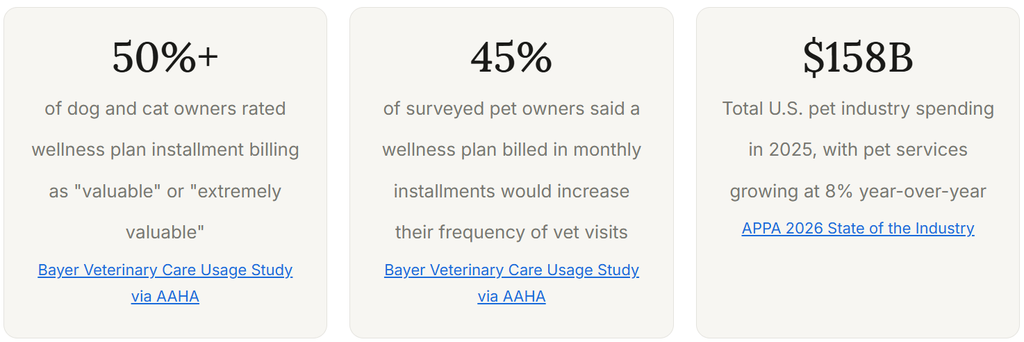
More than 50 percent of dog and cat owners rate wellness plan payment plans as “valuable” or “extremely valuable” when the plan is explained as a year of preventive care paid in monthly installments. That finding from the Bayer Veterinary Care Usage Study means the demand for pet care installment billing already exists in your client base. The gap is almost always on the provider side: the billing system is not set up to offer installments cleanly, collect them reliably, or recover payment failures automatically. This guide covers the complete setup, from plan design to failed payment recovery, for veterinary clinics, grooming businesses, boarding facilities, and multi-service pet care practices.
What Is Pet Care Installment Billing?
Pet care installment billing is a payment structure in which the full cost of a pet care package, wellness plan, or annual service agreement is committed by the client at enrollment and then collected in a series of fixed, scheduled payments over a defined period. The client agrees to the total amount upfront. The installments are the collection mechanism for that commitment, not independent monthly renewals that the client can cancel freely. A 12-month wellness plan for a dog at $420 per year, collected in 12 monthly installments of $35, is an installment plan. A month-to-month grooming subscription that the client can cancel any time is a recurring subscription. They are different structures with different billing logic, different contract terms, and different failure-handling rules.
This distinction matters operationally for pet care businesses because it determines what happens when a client misses a payment, wants to cancel mid-plan, or has a card declined. On a subscription, a missed payment is a potential cancellation. On an installment plan, it is a collection event within an existing contract, and the correct response is to recover the installment rather than treat the client as having exited the plan.
Pet care installment billing connects directly to installment billing principles, recurring billing for the automatic charge cadence, and customer management for tracking each pet owner’s plan status, payment history, and service delivery alongside billing records.
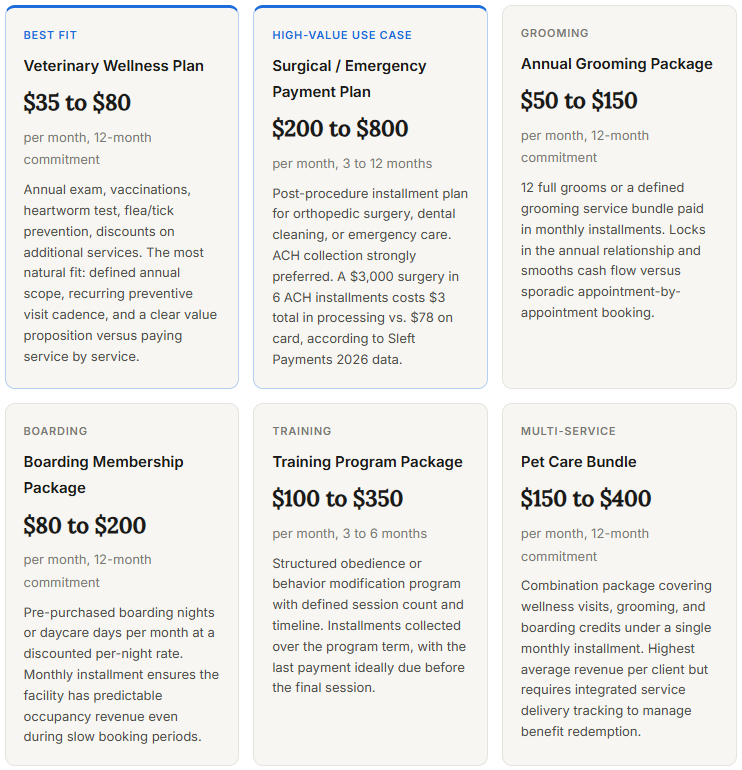
Which Pet Care Packages Work with Installment Billing
Not every pet care service benefits from installment billing. Single-visit grooming appointments and drop-in consultations are point-of-sale transactions. Installment billing has a specific sweet spot: any package with a defined annual or multi-month scope, a price point high enough that the lump-sum cost creates real friction, and a service delivery pattern that encourages the client to stay engaged through the full plan period.
How the Billing Cycle Works
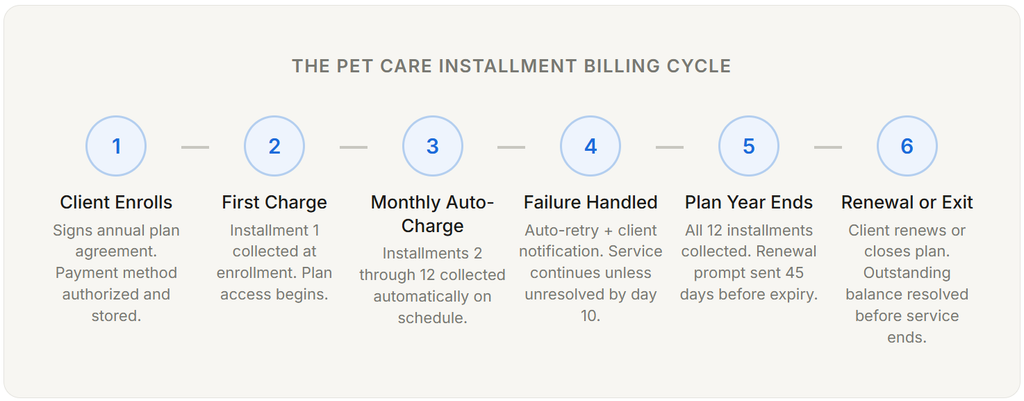
The billing cycle for a pet care installment plan has specific trigger points that differ from a standard subscription. Getting these right at setup prevents the most common problems: charging before the plan year starts, continuing to charge after it ends, and failing to recover a missed installment within the plan’s collection window.
Why the First Installment Must Be Collected at Enrollment
This is the most consequential timing decision in pet care installment billing and the one most often handled incorrectly. When the first installment is deferred to the following month’s billing date rather than collected at enrollment, there is a window between when the client verbally commits to the plan and when they make their first financial commitment. During that window, dropout rates are meaningfully higher, because no payment has converted the intent into a contractual obligation. Clients who pay installment 1 at the time of signing are enrolled. Clients who are told “your first charge will be next month” are prospects who have not yet paid anything.
For wellness plans specifically, collecting the first installment at enrollment also protects the practice from clients who enroll to use the first-month benefits (the annual exam, the vaccines) and then cancel before the second charge. The first installment does not cover the services delivered on day one, but it signals a financial commitment that meaningfully reduces this pattern.
The Math: ACH vs. Card for Pet Care Installment Plans
For high-value installment plans, the payment routing decision between ACH and card is a financial decision with a specific dollar amount attached. The data from Sleft Payments’ 2026 veterinary payment analysis makes the calculation explicit: a $3,000 surgical payment plan split into six monthly installments costs $3 total in processing via ACH versus approximately $78 on card at standard interchange rates.
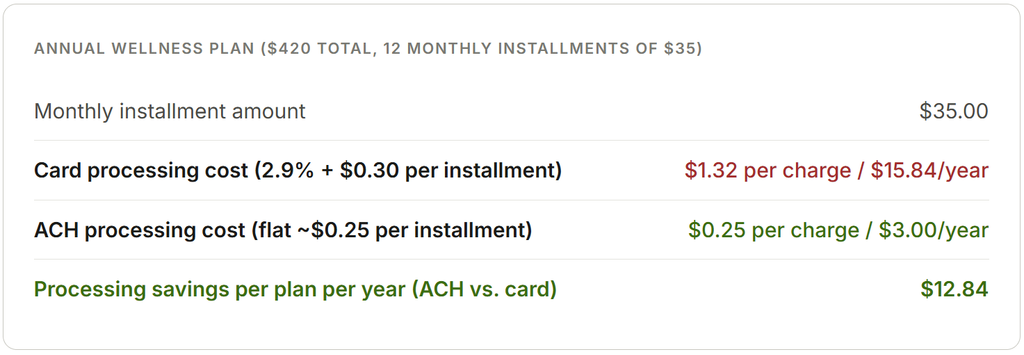
At 200 active wellness plan enrollees, the processing cost difference between ACH and card collection adds up to over $2,500 per year in direct savings, with no change to plan pricing or service delivery. Beyond cost, ACH has a structural advantage that matters even more for installment plans: bank accounts do not expire. Card expirations are the single largest source of failed installment payments in pet care wellness plans. When a client’s card is reissued after expiry, every recurring charge to that old card fails until the client updates it. On ACH, the bank account and routing number remain valid indefinitely unless the client changes banks.
Real-World Use Cases by Pet Care Business Type
Veterinary Clinic: Annual Wellness Plan with Tiers
The Banfield model, branded as Optimum Wellness Plans, is the most widely recognized example of veterinary installment billing at scale. Banfield’s structure bundles comprehensive exams, recommended vaccinations, diagnostic testing, and preventive access into annual plans paid monthly. The AAHA confirms that when this structure is explained clearly to pet owners, more than 50 percent classify it as “valuable” or “extremely valuable.” The barrier to adoption is almost never client resistance. It is the absence of a billing infrastructure that can manage annual installment plans with the right contract logic, failure handling, and renewal prompting.
For an independent veterinary practice, tiered wellness plans by life stage work especially well: puppy or kitten plans covering the first year’s full preventive schedule, adult pet plans covering routine annual care, and senior pet plans incorporating the additional diagnostic screenings appropriate for older animals. Each tier has a different monthly installment amount and a different included services list, but all three run on the same installment billing infrastructure.
Dog Grooming Salon: Annual Grooming Package
For a grooming salon, the installment plan structure converts sporadic appointment-by-appointment bookings into a committed annual relationship. A client who signs an annual grooming package for 12 monthly full grooms at $75 per session, collected in 12 installments of $75, has a very different relationship with the salon than one who books one groom at a time. The installment structure creates a scheduling commitment on both sides: the client expects a monthly appointment, and the salon can plan its schedule and staffing around confirmed annual bookings rather than unpredictable walk-in volume.
The edge case worth planning for in grooming installment billing is the client whose dog has a significant coat change between enrollment and later appointments. A puppy enrolled at 4 months whose grooming needs at 18 months are materially more intensive than anticipated creates a service delivery cost mismatch with the contracted rate. The plan agreement should include language about how grooming complexity changes affect pricing, whether that is a renegotiation trigger at the 6-month mark or a fixed-scope definition of what the monthly installment covers.
Pet Boarding and Daycare Facility
Monthly boarding membership packages with a defined number of overnight stays or daycare days per month are a natural fit for installment billing. A client who commits to 8 boarding nights per month at a member rate, collected automatically, provides the facility with predictable occupancy revenue that is not dependent on seasonal booking patterns. The facility can price the package at a meaningful per-night discount compared to the standard rate, making the value proposition clear to the client while still generating more reliable revenue per enrolled client than the same client booking ad hoc at full rate.
Veterinary Practice: Surgical or Emergency Payment Plan
Post-treatment installment plans for high-cost procedures represent a different type of installment billing than wellness plans. The service has already been delivered when the installment schedule is agreed upon. This changes both the contract structure (the client owes a specific amount for services already rendered rather than committing to future services) and the collection dynamic (the leverage of service delivery that exists during wellness plan collection is absent here). For surgical payment plans, ACH collection via a formally signed installment agreement is the most secure structure. The agreement should specify the total amount, the installment schedule, any interest or administrative fee, and the consequences of missed payments, including potential referral to a collections process for larger outstanding balances.
Key Benefits of Installment Billing for Pet Care Businesses
Higher Treatment and Plan Acceptance Rates
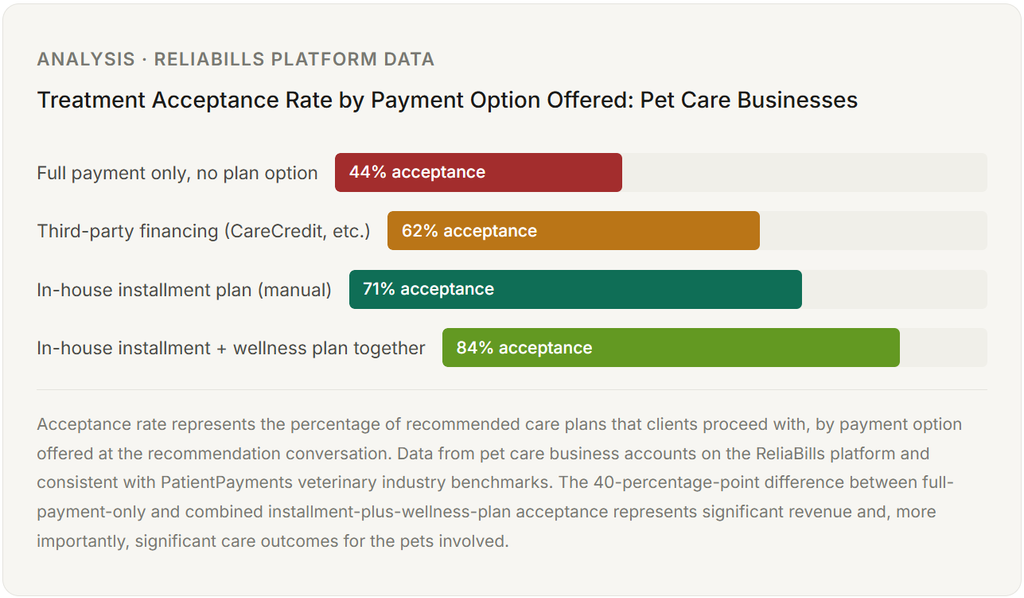
The primary reason pet care businesses adopt installment billing is the direct effect on treatment and plan acceptance. When a client is told that an annual wellness plan costs $420 per year, some percentage will decline based on the upfront cost. When the same plan is presented as $35 per month automatically collected, a meaningfully larger share of clients enroll. The Bayer Veterinary Care Usage Study is explicit on this point: the installment payment structure itself, not the plan content or pricing, is the factor that increases enrollment intent among pet owners who were previously not participating in wellness plans.
Predictable Monthly Revenue That Does Not Depend on Booking Volume
A veterinary clinic with 300 active wellness plan enrollees at $45 per month has $13,500 in predictable monthly revenue that arrives automatically regardless of how many appointments are scheduled. A grooming salon with 80 annual package holders at $75 per month has $6,000 in committed monthly revenue before the first walk-in client of the day. This predictability is qualitatively different from appointment-driven revenue and enables a level of staffing, equipment, and operational planning that variable revenue cannot support with the same reliability.
Higher Annual Revenue Per Client
Clients on wellness plans and annual care packages consistently generate higher annual revenue per account than clients who book services individually. The installment structure keeps the client engaged with the practice throughout the year, creates regular touchpoints at each service visit, and positions the practice as the primary provider for that pet’s care rather than one option among several. Plan clients also tend to have higher accessory purchase rates (flea and tick prevention, dental care products, and prescription food) because they are in the practice more regularly and have an established billing relationship that makes additional purchases feel natural.
Lower Client Attrition
A client who has committed to a 12-month installment plan is, by definition, committed to maintaining the relationship through the end of the plan period. The contract structure itself is a retention mechanism. For grooming and boarding businesses in competitive markets, the annual installment commitment creates switching friction that a month-to-month subscription does not: a client who wants to switch providers mid-plan still owes the remaining installments unless the plan agreement allows early exit. That friction reduces the rate of impulsive attrition triggered by a single negative experience or a competitor’s promotion.
Comparison: Installment Plan vs. Monthly Subscription vs. Third-Party Financing
| Factor | In-House Installment Plan | Monthly Subscription | Third-Party Financing (CareCredit, Scratchpay) |
|---|---|---|---|
| Client commitment | Annual commitment. Full balance owed. | Month-to-month. Can cancel any time. | Loan term with lender. Client owes the lender, not practice. |
| Practice cash flow | Distributed monthly over plan term. Practice carries the receivable. | Distributed monthly. No defined end date. | Practice receives payment upfront from the lender. The client pays the lender over time. |
| Default risk | Practice bears collection risk. Mitigated by ACH + dunning. | Payment failure ends the service relationship. | Lender bears collection risk. Practice is paid regardless. |
| Processing cost | $0.25 per installment via ACH. Near-zero annual cost. | Varies by method. | Lender discount (2 to 7% of transaction; practice absorbs this cost). |
| Client credit check required | No. Agreed at enrollment without credit underwriting. | No. | Yes. Some clients decline care if they do not qualify. |
| Best use case | Annual wellness plans, grooming packages, training programs with a defined year-long scope | Ongoing access services without a defined annual commitment: boarding membership, monthly grooming without a fixed term | Large one-time costs: emergency surgery, specialist referral, where the practice needs immediate full payment and the client needs an extended term |
The typical recommendation for established pet care businesses is to use in-house installment plans for all annual wellness and care packages and third-party financing as a fallback option for large emergency or surgical bills where the practice prefers not to carry the collection risk. Offering both options from the same enrollment conversation maximizes acceptance rates because different clients respond to different structures: some prefer the simplicity of the in-house plan, while others prefer a third-party financing arrangement because it separates the financial obligation from the care relationship.
Key Risks and What to Watch For
Early Termination Without a Written Policy
What happens when a pet dies mid-plan? When a client moves out of the area? When a client is simply unhappy with the service after month 3 of a 12-month grooming package? If the installment plan agreement does not specify the early termination terms, this conversation happens without any written basis, and the outcome is inconsistent across clients and difficult to enforce. A clear early termination policy written into the enrollment agreement before the first installment is charged protects both parties and makes the conversation significantly less uncomfortable when it needs to happen.
Common early termination structures for pet care installment plans include a full remaining balance due upon early exit (appropriate for high-value plans where services were bundled and delivered partly on credit), a prorated refund or credit for services not yet delivered (appropriate for prepaid service packages), or a flat cancellation fee that acknowledges both parties’ costs. For wellness plans specifically, the total value of services already delivered is relevant: a client who received $380 in preventive services on a $420 annual plan after paying only $105 in three installments has received more in value than they have paid, which affects how the early termination is structured.
State Veterinary or Health Club Statutes
Some states require specific disclosures for auto-renewal payment plans related to health or wellness services. California’s auto-renewal law, for example, requires conspicuous disclosure of automatic renewal terms before the client is charged, as well as specific cancellation procedures. Several states that have health club statutes may also apply to wellness memberships offered by veterinary practices or fitness-related pet care businesses. Reviewing applicable state law before finalizing the enrollment agreement is a one-time legal investment that prevents compliance exposure as the plan grows.
Service Delivery Records and Benefit Tracking
An installment plan that includes a defined number of services requires tracking which services have been delivered against the plan, not just whether the installments are being collected. When a grooming package client says they have a remaining groom included in their plan but the billing system shows only payment records rather than service records, the dispute is unresolvable without manual reconstruction. Connecting service delivery records to installment plan records in a unified customer management system prevents this class of dispute entirely.
Common Mistakes Pet Care Businesses Make with Installment Billing
1. Using a subscription billing platform for annual wellness plan installments
A subscription platform treats each monthly charge as an independent renewal event. An installment plan treats all monthly charges as payments against a fixed annual contract. The practical difference appears the first time a client misses a payment: a subscription platform may treat the failure as a potential cancellation; an installment billing platform treats it as a collection event within an existing contract and triggers the dunning sequence to recover the specific missed installment. It also appears at the end of the plan year: a subscription platform will continue charging unless manually cancelled; an installment platform stops automatically after the configured number of charges. Using a subscription platform for installment plans requires manual intervention at both the failure event and the plan completion, which eliminates most of the efficiency gain from automation.
2. No dunning sequence configured for failed installment payments
A failed installment payment on a pet wellness plan that is handled by a staff member manually calling the client is a process that does not scale and produces inconsistent recovery rates. A properly configured dunning sequence retries automatically at day 2, sends the client a notification with a payment update link at day 3, retries again at day 5, and flags the account for review at day 10. This sequence recovers 70 to 80% of initially failed payments without any staff involvement. The industry standard for pet care businesses without a dunning sequence is a recovery rate of 30 to 40% on failed installments, which means 60 to 70% of missed payments simply go uncollected.
3. No early termination clause in the plan agreement
Every pet care installment plan will eventually have a client who wants to exit before the plan year ends. Without a written early termination policy, the conversation defaults to whatever the staff member feels is fair in the moment, which produces inconsistent treatment of clients and occasional financial losses when services already delivered exceed the installments collected. The early termination clause does not need to be punitive, but it does need to exist and be signed before the first installment is charged.
4. Enrolling clients on card-on-file for high-value plans without offering ACH
For a wellness plan at $45 per month over 12 months, the difference between card and ACH processing costs is approximately $12 per plan per year, as calculated earlier. At 200 enrolled plans, that difference is $2,400 per year in avoidable processing fees. More importantly, cards expire. A client whose card expires in September of a 12-month plan starting in January creates a failed payment event in month 9 that requires a card update request, a retry sequence, and a potential gap in service access. On ACH, that failure mode does not exist.
5. Not connecting service delivery records to the installment plan record
An installment plan that includes defined services (12 grooms, 4 wellness exams, 8 boarding nights) needs to track both the payment installments and the service delivery against the plan. When these records exist in separate systems, or when the installment record contains only payment data with no service log, disputes about remaining benefit entitlements cannot be resolved without manual reconstruction of the service history. Building the service log connection at plan setup is a one-time configuration that prevents a recurring source of client service disputes.
How to Get Started with Pet Care Installment Billing
The setup sequence matters. Pet care businesses that configure the billing platform before writing the enrollment agreement end up with plan terms that do not match what the system enforces. Start with the agreement, then configure the system.
Step 1: Design Your Plan Tiers and Annual Service Scope
Define what each plan tier includes, the total annual value, and the monthly installment amount. For each plan, write down the specific services included and how often each service is available, the monthly installment amount, the total plan value, what happens if a service is unused (rollover, forfeiture, or credit), and what the early termination terms are. This is policy design, not billing configuration. The billing system enforces what you write here.
Step 2: Write the Enrollment Agreement Before Enrolling Anyone
The enrollment agreement must include the annual plan commitment and total value, the monthly installment amount and charge date, the pre-authorization language for automatic collection, the scope of included services, the early termination policy, and the late payment or dunning disclosure. For practices in states with applicable auto-renewal or health services statutes, add the required disclosure language before the client signs.
Step 3: Configure ACH Collection at Enrollment
Set up your billing platform to collect ACH bank authorization at plan enrollment for any plan above $300 total value. A secure ACH enrollment link sent to the client via email allows them to authorize automatic bank collection without sharing account details directly with your staff. Configure the installment count and end date so the platform stops charging automatically when the plan year is complete.
Step 4: Build the Dunning Sequence Before Your First Enrollment
Configure the failed payment dunning sequence in your billing platform before any client is enrolled. Minimum sequence: auto-retry at day 2, client notification with payment update link at day 3, second retry at day 5, account review flag at day 10. Test the sequence end-to-end with a test payment failure before it goes live. ReliaBills supports this configuration natively within the same invoicing software layer that handles plan enrollment and installment generation, so all plan records and payment events are connected in one place.
Step 5: Build the Renewal Prompt Into the Plan Calendar
Configure an automated renewal prompt to send to each plan client 45 days before their plan year ends. The prompt should state the renewal date, the plan terms for the coming year (including any rate changes), and a simple way to confirm or modify renewal. Clients who receive a renewal prompt 45 days out have time to review, adjust, or decide to exit gracefully. Those who receive no prompt and then see a charge on their card on renewal day are far more likely to initiate a chargeback.
Frequently Asked Questions
1. What is the difference between a pet wellness plan and pet insurance?
A pet wellness plan is a prepaid bundle of defined preventive care services, typically including exams, vaccinations, and routine diagnostics, collected in monthly installments. The services are specified at enrollment, and the client pays for them in advance across the plan year. Pet insurance is a risk transfer product: the owner pays a monthly or annual premium to an insurance carrier, and the carrier reimburses qualifying claims for accidents and illnesses according to the policy terms. Wellness plans and pet insurance complement each other because they cover different categories of care: wellness plans cover routine preventive services with certainty, while insurance covers unpredictable illness and injury costs. A pet owner can hold both simultaneously, and practices that offer wellness plans often position them as working alongside, not competing with, insurance coverage.
2. What happens if a pet on a wellness plan dies or is rehomed mid-year?
This is the edge case that every wellness plan agreement needs to address explicitly. The most common policy is a compassionate early termination clause: if a pet dies or is surrendered to a rescue or new owner, the remaining installments are waived without penalty. The services already delivered are retained by the practice at standard value without additional charge. Some practices allow the plan to transfer to a new pet in the household at the same installment rate. The specific policy is less important than having a written policy at all. A client who loses a pet and then receives an automated installment charge while grieving, with no written policy to reference, is the most reliable path to a chargeback and a negative review. Clear written terms that the staff can reference quickly make these conversations much easier to handle.
3. Can I offer different installment plan tiers for different life stages of the same pet?
Yes, and tiering by life stage is the most clinically appropriate structure for veterinary wellness plans. A puppy or kitten plan typically includes a more intensive vaccine series in the first year, while an adult plan covers routine annual preventive care, and a senior plan includes additional diagnostic panels appropriate for aging pets. Each tier has a different total value and monthly installment amount, but all three run on the same installment billing infrastructure. When a pet ages out of one tier into the next, the transition should be handled as a plan renewal with a new enrollment agreement at the updated rate, not as a mid-year modification to the existing plan. This keeps the contract terms clean and avoids the proration complexity that mid-plan tier changes create.
4. Should I charge interest on pet care installment plans?
Most pet care wellness plans are offered as interest-free installment arrangements: the total annual plan value is divided equally across 12 months with no financing charge. This is the structure that maximizes enrollment because it presents the plan as a budgeting convenience rather than a financing product. If you are offering post-procedure payment plans for high-cost surgical or emergency cases, a modest administrative fee (rather than interest framed as a percentage rate) is more common in veterinary practice than a formal interest rate, partly for regulatory reasons around lending. If the payment plan extends beyond 12 months or involves a large enough amount that the practice is effectively extending significant credit, consult with a financial or legal advisor about whether your state’s consumer lending regulations apply to your specific structure.
5. How should I handle a client who wants to add a second pet to their existing wellness plan mid-year?
The cleanest approach is to create a separate installment plan for the second pet on its own 12-month term, starting from the enrollment date of the new pet, rather than modifying the existing plan. This keeps each pet’s service history, installment record, and plan term independent, which simplifies both billing and service tracking. Some practices offer a multi-pet discount that applies when a second plan is added, which is a useful enrollment incentive. The discount can be applied as a reduced monthly installment amount on the second plan, not as a change to the existing plan. Running two independent plan records that both reference the same client account gives you the correct relationship between owner, pets, and billing without creating the complications that mid-plan modifications introduce.
6. Is pet care installment billing appropriate for a solo mobile groomer or very small pet business?
Yes, and the economics are particularly favorable for solo operators because the revenue predictability from even a small number of annual package holders meaningfully reduces the income variability that makes running a solo business stressful. A mobile groomer with 20 clients on annual grooming packages at $75 per month has $1,500 in committed monthly revenue that arrives automatically, which changes what it means to have a slow booking week. The setup cost is the enrollment agreement (a one-time task) and the billing platform configuration. At 20 clients, the administrative overhead of managing annual installment plans is minimal when the billing is automated, and the revenue stability benefit is immediate. The breakeven on the billing software subscription is typically under 3 clients, which means any mobile groomer with more than 3 recurring clients benefits from the structure economically.
Recent Articles:
- How to Track Client Payments and Outstanding Balances as a CPA Firm
- Customer Data Management for Pool Maintenance: Organize Client Service Records