

MRR and ARR are not just financial scorecards. When tracked correctly through reporting software connected to your billing data, they become operational tools that show you where revenue is being built, where it is leaking, and what the business actually looks like at any point in time.
What is MRR ARR Reporting Software?
MRR ARR reporting software, such as ReliaBills, is a category of tool that connects to a company’s billing and subscription data, normalizes it, and produces real-time or near-real-time calculations of Monthly Recurring Revenue (MRR), Annual Recurring Revenue (ARR), and related metrics like Net Revenue Retention and churn. The software automates the revenue waterfall breakdown that would otherwise require manual spreadsheet work each month.
The Calculations Behind MRR and ARR
Monthly Recurring Revenue is the normalized recurring portion of active subscription revenue in a given month. A customer who pays $12,000 per year contributes $1,000 to MRR: annual contracts divide by 12, quarterly by 3. One-time fees, setup costs, and professional services are excluded entirely.
MRR formula
MRR = Sum of all active subscription values, normalized to a monthly amount
Annual Recurring Revenue is the annualized version of that number. The shortcut formula is ARR = MRR x 12, and it works as an approximation, but it is only reliable with a frozen customer base, which never exists. A more robust approach, especially at the growth stage, is to sum active contract values directly from your signed agreements. This is what a 16z General Manager Josh Lu refers to when he says that startups should be cautious about using the ARR = 12 x MRR identity, because early-stage companies have “spikier MRR” where a single month’s number can be an outlier rather than a run rate.
ARR roll-forward (more reliable at growth stage)
Ending ARR = Beginning ARR + New ARR + Expansion ARR – Churned ARR
The roll-forward requires knowing the ARR value of each contract that started, expanded, or ended during the period. It produces an ARR figure that reconciles cleanly to your contracts rather than inheriting any distortion in the current billing month.
What Belongs in MRR and What Does Not
The list of things that inflate MRR is longer than most founders expect.
| Item | Include in MRR? | Why |
|---|---|---|
| Monthly subscription fees | Yes | Core recurring revenue, already normalized. |
| Annual contract, divided by 12 | Yes | Recurring; normalize to monthly amount. |
| Usage fees (contractual minimum) | Yes | Committed and predictable portion only. |
| Variable usage above minimum | No (or separately) | Not contractually committed; include only when consistently stable. |
| One-time setup or onboarding fees | No | Not recurring; inflates MRR in the month of collection. |
| Professional services | No | Project-based, not subscription revenue. |
| Free trial users | No | Have not converted; counting them is projection, not measurement. |
| Discounted plans at net billed amount | Yes, at net | Use the amount actually billed, not the list price. |
The MRR Waterfall: The Most Useful Report You Are Probably Not Running
The waterfall breaks each month’s change in MRR into five distinct movements. Starting from opening MRR, it adds new business and expansion, subtracts contraction and churn, adds back reactivations, and lands on closing MRR. The totals must reconcile exactly. As the MRR movements glossary at Flexprice notes, “opening MRR plus new business plus expansion plus reactivation, minus contraction and churn, must equal closing MRR exactly. A gap means the report dropped a movement.”
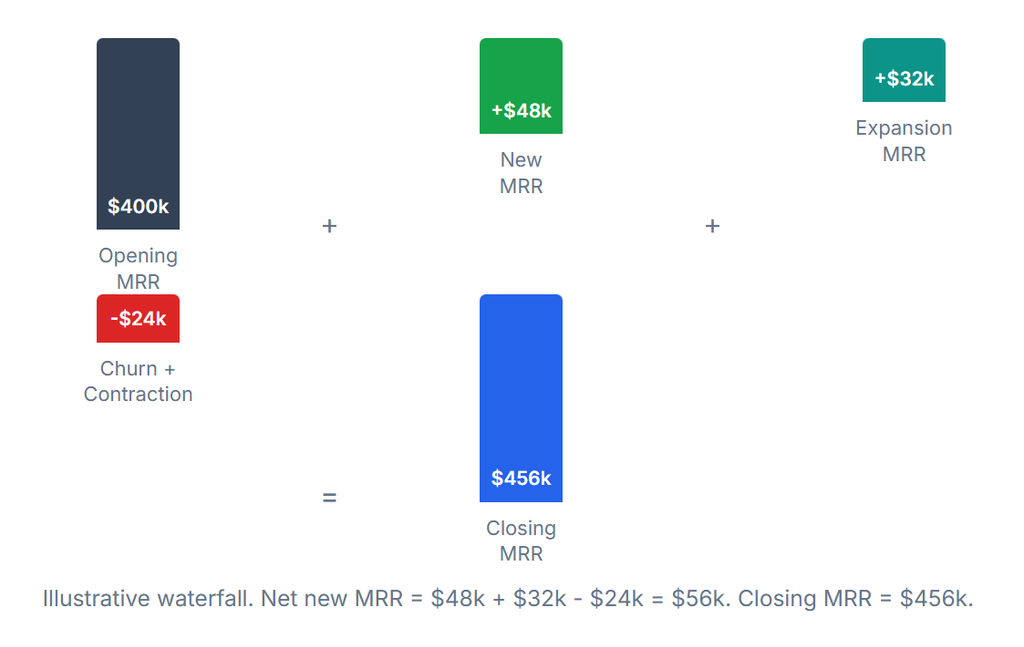
The difference between churn and contraction
Churn is the full loss of an account: the customer cancels and the balance goes to zero. Contraction is a partial loss from a customer still paying, just less. A seat reduction, a plan downgrade, or a negotiated renewal discount appears as a contraction. The two matter separately because they have different drivers: churn needs a retention program, and contraction often signals a product or expansion conversation.
Expansion MRR and why it compounds
Expansion MRR comes from existing customers adding seats, upgrading plans, or accepting price increases. It costs no acquisition spend. Benchmarkit’s 2025 benchmark survey found that expansion ARR represented 40 percent of total new ARR in 2024, rising above 50 percent for companies above $50 million in ARR. If expansion consistently outpaces churn and contraction, net new MRR grows without a single new customer.
Net Revenue Retention: The Metric Behind the Waterfall
Net Revenue Retention rolls expansion, contraction, and churn into one number: if you stopped acquiring new customers today, would your existing book grow or shrink? An NRR above 100 percent means it would grow. Below 100 percent, new customer acquisition is covering a leak rather than building on a stable base.
NRR formula
NRR = (Starting ARR + Expansion – Contraction – Churn) / Starting ARR x 100
SaaS Capital’s 2026 survey of 1,000+ private B2B SaaS companies reports a median NRR of 103 percent for bootstrapped companies with $3 million to $20 million in ARR, with 90th-percentile performers reaching 117.9 percent. The same research shows that companies with the highest NRR reported median growth 173 percent higher than the population median.
MRR vs. ARR: Which to Run Your Business On
The honest answer is that most teams need both, but for different purposes. The choice of which to lead with depends largely on your stage, your contract structure, and your audience.
The answer depends on your stage and contract structure. Early-stage companies with volatile monthly numbers should lead with MRR: one large customer can move an MRR-times-twelve ARR figure significantly without representing a real trend. Growth-stage companies benefit from tracking both: MRR tells you internally whether next year’s ARR is being built or eroded, while ARR is the language boards and investors use. Once most revenue comes from annual or multi-year contracts, ARR is the primary metric because it reflects actual committed value rather than a monthly billing event.
There is also a naming trap worth calling out. Annual Recurring Revenue and Annual Run Rate share the acronym ARR. Run rate is a forecast extrapolated from recent revenue. Recurring Revenue is built from contracted subscriptions. Conflating the two in investor communications is a material misrepresentation. Always specify which definition you are using.
What MRR ARR Reporting Software Actually Does
The core job of any reporting software in this category is to sit between your billing system, where contracts and payments live, and your decision-makers, who need clean numbers. The software reads raw transaction data, applies normalization rules, classifies each revenue movement into the waterfall categories, and produces dashboards and exports that update automatically.
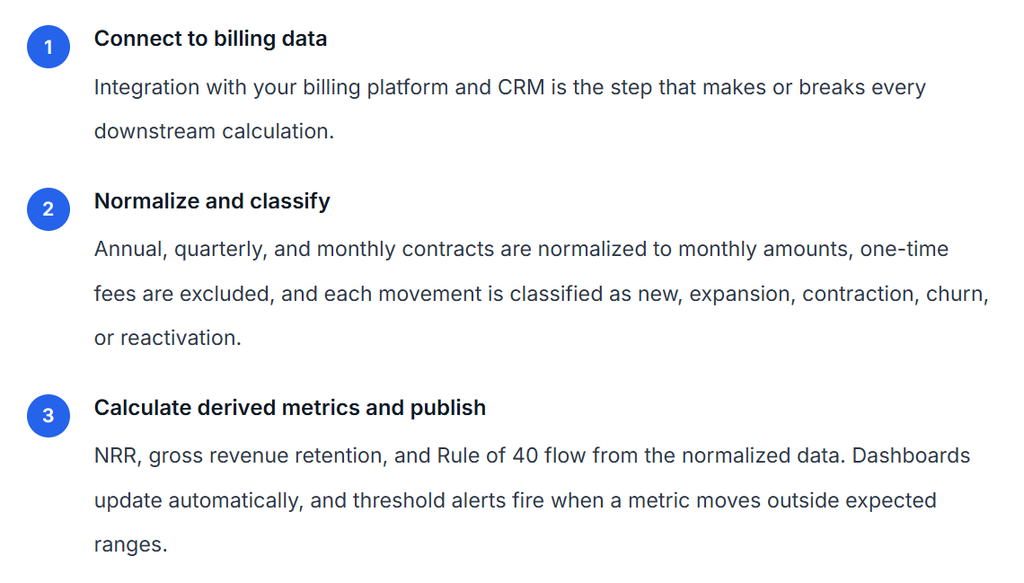
Where recurring billing platforms handle collection and invoicing, reporting software handles the analysis. The two work together: accurate billing data in, accurate MRR data out. When the layers disagree, the discrepancy almost always lives in an exclusion rule or a payment timing issue where an annual contract was recognized in the month of collection rather than normalized across twelve months. Setting up invoicing software that records correct contract dates and amounts is therefore a prerequisite for accurate MRR reporting.
Real-World Examples and Use Cases
Early-stage SaaS: getting off spreadsheets
The typical inflection point is around 50 to 100 active subscriptions. Below that, a disciplined spreadsheet works if someone owns it and updates it monthly. Above it, the combinations of upgrades, downgrades, pauses, and cancellations accumulate faster than manual tracking can handle. The first sign of trouble is usually a discrepancy between what finance reports as MRR and what the CRM shows as closed ARR, because both teams are measuring something different and nobody has reconciled the definitions.
Mid-market: using NRR to unlock a growth decision
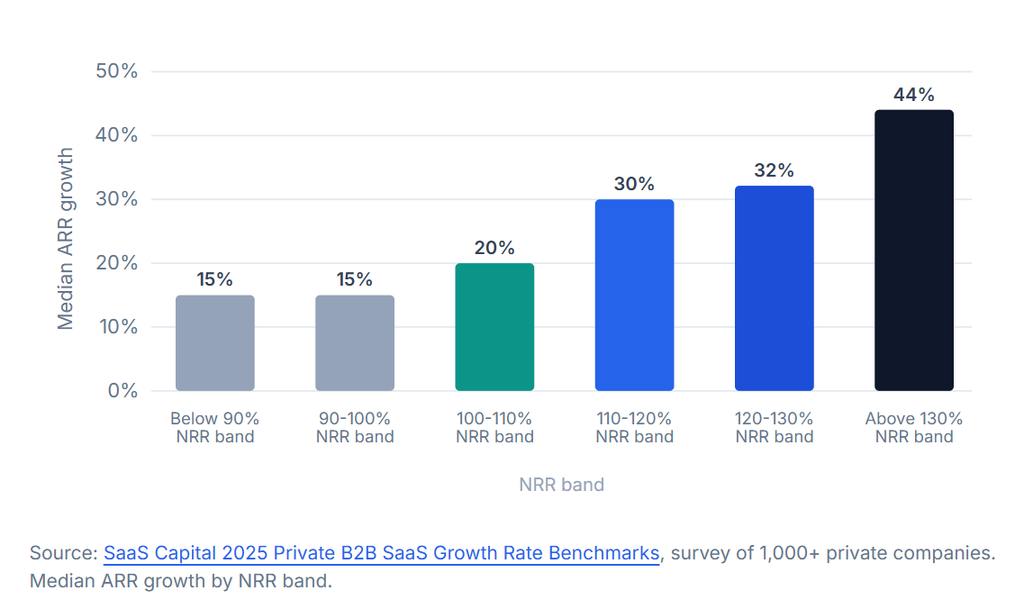
A company with $8 million in ARR and an NRR of 96 percent is on a slow bleed. New ARR looks healthy in isolation, but the existing base is shrinking. Without a waterfall report that dynamic is invisible. With one, the contraction and churn lines are clearly larger than expansion, and the diagnosis shifts from “keep selling” to “fix retention first.” The SaaS Capital 2025 benchmark data makes this concrete: moving NRR from the 90-100 percent band to the 100-110 percent band adds 5 percentage points of median growth rate.
Usage-based and crypto infrastructure products
Protocol tooling and developer API products run on subscription models structurally identical to traditional SaaS. The waterfall applies directly. The nuance is usage billing: the contractual minimum enters MRR, and variable overage above it stays separate until it proves stable across two or three consecutive months. Including all billed usage regardless of commitment is one of the fastest ways to overstate MRR in high-variance businesses.
Key Benefits of Dedicated MRR ARR Reporting Software
Accuracy that scales
A spreadsheet MRR model degrades as the business grows. Every edge case (a mid-month upgrade, a partial refund, a prorated annual plan) requires a manual rule. Reporting software encodes those rules once and applies them consistently. The output is an MRR number your finance team can defend in due diligence.
Speed of insight
When MRR recalculates automatically, the finance team starts each month looking at what happened rather than spending the first week building the report. The customer management layer that surfaces payment trends and account health then acts as an early warning system, not a trailing indicator.
Investor and board readiness is the third benefit. If your reported ARR cannot be reconciled to your contracts, the gap becomes a due diligence issue. Software that produces an auditable, contract-connected ARR roll-forward closes that gap before it opens. As a16z’s speedrun newsletter puts it, ARR should “reconcile, with a sensible lead/lag, to the way your model actually becomes GAAP revenue.”
Key Risks and Things to Watch for
The ARR = 12 x MRR trap
Multiplying a single month’s MRR by 12 and calling it ARR works as a rough approximation in a stable business. It fails badly when one large contract signs or churns in the current month, when billing timing creates lumps, or when a usage spike inflates MRR in one period. Build ARR from the roll-forward method based on actual contracts for any communication that matters.
Including one-time revenue in MRR
Setup fees, implementation projects, and one-time add-ons inflate MRR in the month they are billed and then disappear. If these are large relative to subscription revenue, the distortion can make month-over-month MRR look much more volatile than it actually is. The fix is a firm exclusion rule in your reporting configuration, not a manual adjustment each month.
Misclassifying contraction as churn
If your reporting software does not distinguish between a customer who cancelled completely and a customer who downgraded but is still paying, your churn rate will look worse than it is and your contraction rate will be invisible. This is a configuration issue in most tools, not a fundamental limitation, but it requires someone to set the classification rules deliberately rather than accepting defaults.
Disconnected billing and reporting layers
When billing data is corrected retroactively, reporting software that does not resync correctly will show a gap between actual collections and reported MRR. Check how your reporting tool handles retroactive changes before committing to it: tools that require a manual trigger are more prone to stale data than tools that pull from a live billing API.
How MRR ARR Reporting Software Compares With Related Approaches
The main alternative to dedicated reporting software is a spreadsheet, and it works reliably up to about 50 subscriptions with a single billing model and one currency. Above that threshold, manual classification of new, expansion, and churn movements becomes error-prone and slow. General-purpose BI tools like Looker or Tableau can produce accurate MRR reports but require a data engineer to build and maintain the subscription data model. Billing platform native reporting handles transactional accuracy well but typically lacks waterfall depth and ARR roll-forward capability. A custom CFO or RevOps model offers the highest accuracy for complex billing but creates knowledge concentration risk when the builder leaves.
Dedicated MRR ARR tools sit between those extremes. They connect to billing data directly, apply subscription-specific normalization rules out of the box, and update automatically. The tradeoff is that they require clean billing data as input: a reporting tool cannot fix a billing setup that does not record contract dates and values correctly. Get the billing layer right first.
What the Top Guides on This Topic Miss
Most guides on MRR and ARR cover the formulas and the definitions. Very few cover the operational problems that make those formulas wrong in practice. After reviewing what ranks for this topic, four gaps stand out consistently.
The first is payment timing versus recognition. A customer who pays a $12,000 annual invoice on March 1 contributes $1,000 per month, not $12,000 in March. Most spreadsheet models and some native dashboards record the collection month, not the service period, producing an MRR spike in March and an artificially low number for the other eleven months.
The second gap is multi-currency handling. If the conversion rate used by your billing platform differs from the one in your reporting tool, MRR will never reconcile. Pick one source of truth for exchange rates and pull it into both systems on the same schedule.
The third gap is subscription-level versus customer-level reporting. A customer who downgrades one plan and upgrades another in the same month produces either two movements or one net movement depending on your reporting level. Board decks built on subscription-level data will show different churn and expansion figures than those built on customer-level data, even with identical underlying contracts.
The fourth gap is the effect of installment billing on MRR. When a customer pays an annual plan in quarterly installments, the MRR contribution should be the annual value divided by twelve. Many billing platforms record the payment date, not the contract. A reporting layer that reads payments rather than contracts will misclassify this every quarter.
Common Mistakes to Avoid
| Mistake | What it causes | Better approach |
|---|---|---|
| Using billed amount instead of contracted amount | Annual contracts inflate MRR in the billing month and create artificial valleys in other months. | Configure your reporting tool to read contract start and end dates, not payment dates. |
| Including setup fees and professional services | MRR overstates recurring potential. Investors will strip these out in diligence anyway. | Create a separate revenue category for non-recurring items and exclude it from the MRR calculation. |
| Multiplying a spike month’s MRR by 12 for ARR | ARR overstates the business. This is especially dangerous in early-stage fundraising. | Use the ARR roll-forward: sum active contract values, not a monthly multiple. |
| Treating all losses as churn | Contraction is invisible. You cannot diagnose or fix what you cannot measure. | Require your reporting tool to produce separate churn and contraction lines in the waterfall. |
| No reconciliation between billing and reporting | Numbers drift apart over months. By the time you find the gap, it covers many periods. | Run a reconciliation check monthly: total collected cash versus total reported MRR. Any gap triggers an audit. |
How to Get Started With MRR ARR Reporting Software
Audit your current billing data first.
Before connecting any reporting tool, confirm that your billing platform records contract start dates, contract end dates, and plan values separately from payment amounts. If it records only payments, the reporting layer will inherit the payment timing problem, not solve it.
Write your MRR definition before touching any tool.
Decide what is included and excluded, document it, and apply the same definition everywhere. Every team member and every tool should use the same rules or the numbers will never agree. Multiple plans, currencies, or installment options typically require a dedicated tool rather than native billing reports.
Configure the waterfall categories explicitly.
Do not accept default classification rules. Define what counts as churn versus contraction, how mid-month changes are handled, and what reporting level (subscription or customer) you will use.
Connect your reporting to your customer management layer.
MRR data without context about which accounts are at risk is only half the picture. Customer management tools that surface payment trends and account health alongside the revenue waterfall let you act on the numbers, not just read them.
Run a reconciliation check in month one.
Compare total MRR in your reporting tool against total collected recurring revenue from billing. Document any gap and trace it to its source before trusting any number from the new system.
Frequently Asked Questions
1. What is the difference between MRR and ARR?
MRR is a point-in-time monthly snapshot of normalized recurring revenue. ARR is the annualized picture, calculated as MRR times 12 or summed from active contract values. MRR drives day-to-day operations; ARR is the language investors and acquirers use.
2. Should early-stage startups track MRR or ARR?
MRR is more useful at early stage. As a16z General Manager Josh Lu notes, early startups have “spikier MRR” and their customer base is too small for ARR to be a stable signal. Track MRR first; report ARR once monthly figures are consistent.
3. What should not be included in MRR?
One-time setup fees, professional services, hardware, implementation fees, and free trial users are all excluded. Including them overstates MRR in a way that unwinds at the next reporting cycle.
4. What is a good NRR for a private SaaS company?
SaaS Capital’s 2026 survey of 1,000+ private B2B SaaS companies reports a median NRR of 103 percent for bootstrapped companies at $3M-$20M ARR, with 90th-percentile performers at 117.9 percent. NRR above 100 percent means the existing base grows without any new acquisition.
5. What is the MRR waterfall and why does it matter?
The waterfall breaks each month into five movements: new, expansion, contraction, churn, and reactivation. Opening MRR plus new plus expansion plus reactivation, minus contraction and churn, must equal closing MRR exactly. A gap means the report dropped a movement. The waterfall shows not just whether MRR went up, but why.
6. Is ARR the same as 12 times MRR?
Only approximately, and only in a stable business. The identity holds only if the customer base does not change within the month, which never happens. For a reliable ARR figure, sum active annual contract values from signed contracts rather than multiplying a monthly snapshot.
Recent Articles:
- Customer Data Management for Fitness Studios: Organize Member Profiles and Billing
- Customer Data Management for Restaurant Catering: Managing Event Client Records