

Fitness studio member management is not an administrative back-office function. It is the operational layer that connects what you know about each member to how you bill them, how you communicate with them, and how early you notice when they are about to leave. Studios that treat member data as a strategic asset consistently outperform those that treat it as a filing requirement. The difference shows up first in churn rate, then in revenue.
What Is Fitness Studio Member Management?
Fitness studio member management is the system by which a studio collects, organizes, and acts on information about each member across the full membership lifecycle: from the initial sign-up and waiver through class attendance, billing activity, membership changes, freeze requests, and eventual cancellation or renewal. When it functions correctly, member management is invisible to the member and transformative to the business. When it functions poorly, it generates missed payments, uncommunicative churn, billing disputes, and the kind of administrative chaos that keeps studio owners at their desks past midnight instead of building their business.
The definition matters because most guides collapse “member management” into a software category: pick a platform, set it up, done. In reality, the platform is the fourth decision you make, not the first. The first three are: what data you need to capture at enrollment and why, how that data connects to your billing and communication workflows, and what you will watch in member behavior to identify at-risk accounts before they cancel. Get those three right, and almost any platform will serve you adequately. Get them wrong, and the most sophisticated software on the market will generate expensive, well-organized confusion.
What Poor Member Data Actually Costs
The cost of inadequate member data management in fitness studios shows up in four places, and most studio owners are only aware of one of them.
The obvious cost is administrative time. A studio without centralized member records spends hours per week fielding questions that a complete member profile would answer instantly: “When does my membership renew?” “Did you get my payment?” “I thought I was on the unlimited plan.” Every one of those interactions is a staff time cost, a member friction point, and a missed opportunity to spend that time on something that actually grows the studio.
The less obvious cost is involuntary churn from billing failures. A failed payment that generates an immediate cancellation notice, rather than a recovery sequence, is a member lost to administrative process rather than dissatisfaction. The research is consistent on this point: the majority of payment failures in fitness are recoverable if contacted within 48 hours, but without a system that identifies failures instantly and triggers a structured outreach workflow, that window closes fast.
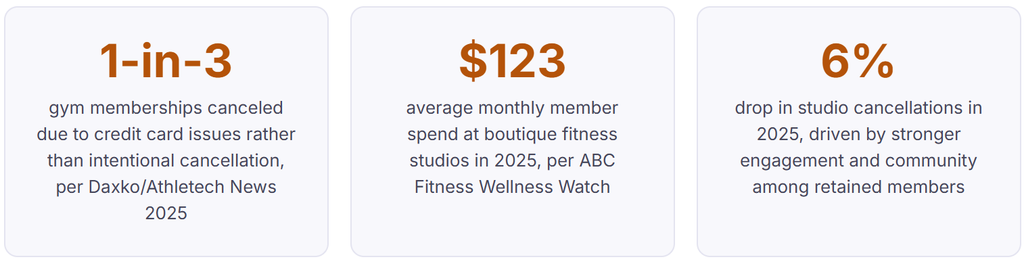
The third cost is missed reactivation. A member who cancels and is never contacted again is a lost revenue opportunity that compounds over time. A studio that knows why a member left, what tier they were on, and what their attendance history looked like has everything it needs to make a targeted reactivation offer. A studio that only knows the cancellation date has nothing to work with.
The fourth cost is the hardest to quantify: pricing and programming decisions made without data. When you do not know which membership tiers retain the longest, which class formats correlate with higher visit frequency, or which months generate the most at-risk behavior, you are making strategy decisions by instinct. Studios that use member data to drive programming and pricing decisions consistently outperform those that do not, because they are adjusting to real member behavior rather than assumptions about it.
What a Complete Member Profile Must Contain
The member profile is the foundation of everything else in your management system. A complete profile is one that any staff member can open for a member they have never interacted with and immediately understand the full picture of that person’s relationship with the studio. Below is a realistic profile for an active boutique fitness studio member, showing the data fields that actually matter and how they connect to each other.
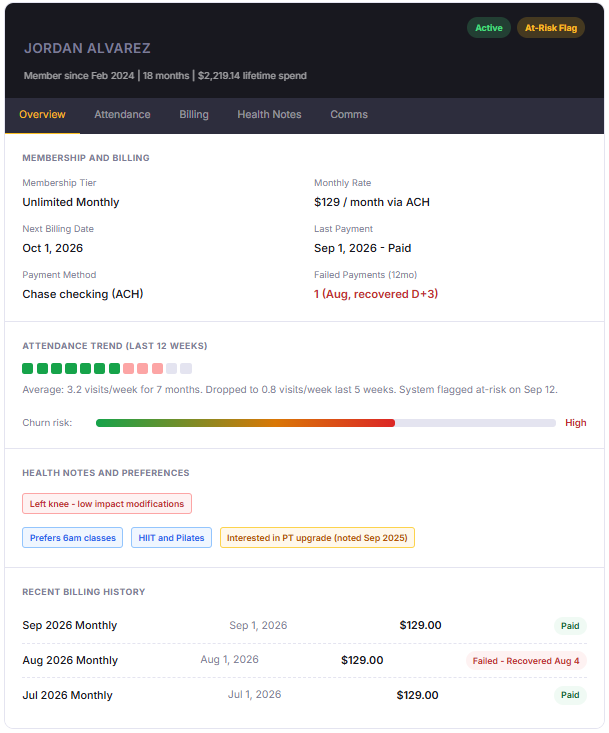
Two things in that profile deserve specific attention. First, the at-risk flag is triggered by a behavioral signal, the drop in visit frequency from 3.2 to 0.8 visits per week, not by a payment failure or a cancellation request. The member is still paying. They are still technically active. But their behavior pattern is the standard precursor to cancellation, and the window to intervene constructively is now, not after they submit the cancellation form.
Second, the health notes field is separated from service preferences, and both are separated from billing information. This structure matters for the same reason it matters in catering: a gym instructor who checks a member’s profile before a class and sees “left knee – low impact modifications” can make a proactive accommodation that the member never had to request. That kind of detail-awareness is what turns a transactional gym relationship into a community one, and community is what the ABC Fitness data identified as the primary driver of studio retention in 2025.
The Member Lifecycle and How Data Flows Through It
Member data does not exist in a static file. It accumulates, updates, and signals at every stage of the membership lifecycle. Understanding how information flows through that lifecycle is what allows you to build a system where the right people see the right data at the right time.
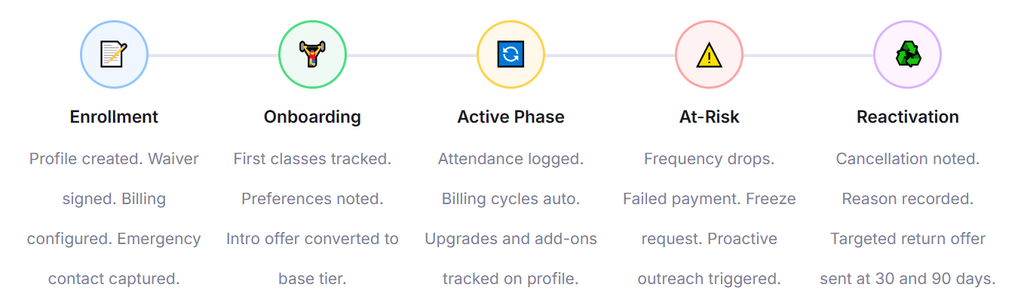
The stage that receives the least investment in most studios is the at-risk phase. By the time a member submits a cancellation form, the decision is made. The intervention window is in the weeks before that, when visit frequency drops below the member’s personal baseline. A system that flags this in real time, and routes the flag to a staff member who can make a personal outreach call, recovers a meaningful percentage of those members before they decide to leave.
Billing Configuration: Where Most Studios Get It Wrong
The billing layer of your member management system is where most operational problems originate, and where the gap between how studio owners think billing works and how it actually works is widest.
Every membership tier requires its own billing configuration: the charge amount, the billing frequency, the grace period for failed payments, the freeze terms (how many days per year, whether the billing cycle pauses or the member is credited), the cancellation notice period, and what happens to any unused prepaid value if the member cancels mid-cycle. When these configurations are defined clearly and enforced automatically, disputes are rare. When they are vague or inconsistently applied, every edge case becomes a staff time cost and a member satisfaction problem.
Failed payment handling: the sequence that matters most
A failed payment should trigger a defined sequence, not a human decision about what to do next. The sequence that consistently performs best based on recovery data is: automatic retry on day 2, email notification to member on day 1 with a payment update link, text notification on day 3 if not resolved, staff outreach call on day 5, and access restriction on day 7 with a clear reinstatement path. This sequence recovers the majority of recoverable failures without making the member feel like they are being pursued for a debt. It treats the failure as a technical issue to resolve, not a policy violation to enforce.
For studios with a mix of monthly and annual memberships, setting up the billing structure correctly within a platform that supports recurring billing for monthly members and installment billing for members who want to pay an annual membership in quarterly installments is a configuration decision that has significant cash flow implications. Annual memberships collected upfront are excellent for cash position but can create large one-time refund exposure if the member cancels. Installment structures spread that risk while still offering the member a price incentive over month-to-month.
Real-World Use Cases by Studio Type
Boutique group fitness (Pilates, yoga, barre, HIIT)
Boutique studios operate on tight margins and high retention dependency. A studio charging $129 per month needs members to stay for at least 6 to 8 months before the acquisition cost of that member is recovered through membership revenue. The at-risk detection function of member management is therefore directly tied to profitability. Studios in this category that use visit frequency as an early warning signal, and make proactive outreach part of their member service model, consistently achieve lower churn than those that wait for cancellation requests.
The billing complexity in boutique studios often comes from intro offers: a 30-day unlimited trial for $39 that converts to a $129 monthly, or a 5-class pack that needs to convert to a membership before it expires. Managing this conversion flow without a structured member profile means relying on staff memory or manual calendar reminders, both of which fail consistently at volume.
Personal training and small group training studios
Studios built around personal training have a different data challenge: the client relationship is highly individual, the billing is often tied to sessions purchased in blocks rather than a recurring monthly membership, and the trainer who holds the client relationship is sometimes a contractor whose departure creates a client retention risk. Tracking session balances, package expiry dates, and trainer assignment within the member profile is the operational foundation for managing these risks. When a trainer leaves, a studio that knows which clients were assigned to them, what their remaining session balance is, and when they last attended can make a coordinated transition plan. A studio that tracks sessions in the trainer’s personal notes has nothing.
Multi-location fitness brands
For studios operating two or more locations, the member management challenge is ensuring that a member’s profile is accessible and current at every location they visit, and that billing and membership status are synchronized across the entire system. A member who transferred to a new location in March but whose profile was never updated at the new location creates both a service experience failure and a potential billing discrepancy. Centralized member data with location-level access is a non-negotiable for multi-location operations.
Key Benefits of Structured Member Management
Revenue protection through involuntary churn recovery
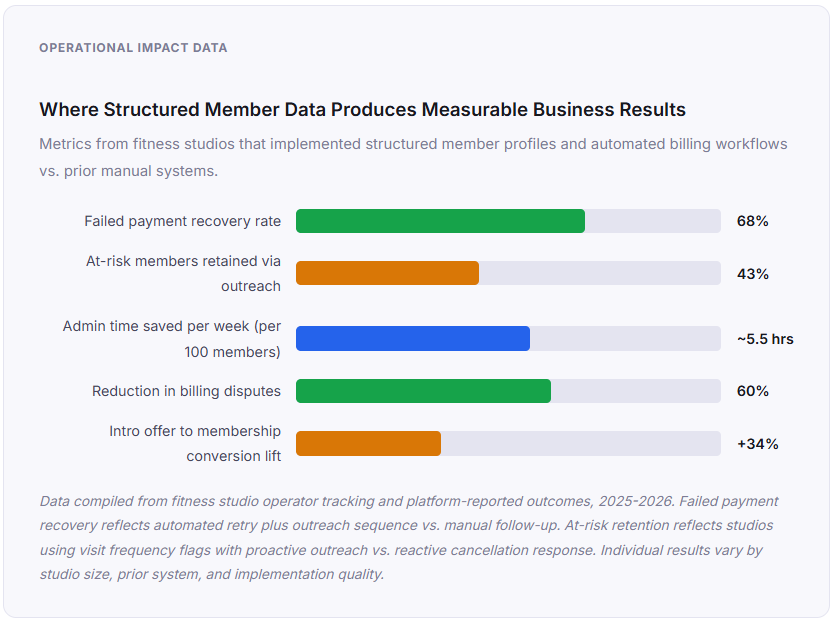
At $129 per month average, recovering one failed payment per month across a 200-member studio is $25,800 in annual revenue that would otherwise be lost. At a studio that recovers 68 percent of failed payments through a structured sequence rather than 30 percent through inconsistent manual follow-up, the difference is roughly $9,800 per year in recovered revenue, for no additional member acquisition cost. That is one of the highest-return investments available to a fitness studio, and it is entirely a data management and billing process improvement.
Churn prediction that enables proactive retention
The most valuable output of a well-structured member profile system is the ability to identify which members are likely to cancel before they do. Visit frequency data is the most reliable leading indicator: a member who normally attends four times per week and drops to once per week over a three-week period is exhibiting the behavioral pattern that precedes most voluntary cancellations. A system that flags this in real time, and a staff member who makes a personal outreach call within a week of the flag, retains a meaningful subset of those members through a combination of re-engagement and problem-solving that would never happen if the studio waited for the cancellation form.
Risks and Things to Watch For
Health and waiver data compliance
Member profiles that contain health notes, injury history, or medical conditions trigger data sensitivity requirements that vary by jurisdiction. In the United States, fitness studios that store health information digitally should verify whether their data handling practices align with applicable state privacy laws. Studios that accept HSA or FSA payments may have additional documentation requirements. The safest practice is to store health notes in a clearly designated field that is access-controlled to training staff only, not visible to front desk or billing personnel.
Payment credential security
A member management system that stores card or bank account information must be PCI-DSS compliant. Most reputable fitness platforms handle this through a certified payment processor, with your system storing only a token reference rather than the raw payment credentials. Verify this explicitly with any platform you evaluate. A system that stores card data directly, rather than tokenizing through a compliant processor, creates liability that far exceeds the cost of switching platforms.
Data portability when switching platforms
One of the most underestimated risks in fitness studio management is vendor lock-in at the member data level. Before committing to any platform, verify that you can export your full member dataset, including billing history, attendance records, and stored health notes, in a format that another system can import. A studio that cannot export its member data is dependent on its platform provider in a way that limits your negotiating position on pricing and creates operational exposure if the platform is discontinued or acquired.
Comparison: Member Management Approaches
| Approach | Profile Completeness | Billing Automation | At-Risk Detection | Failed Payment Recovery | Best For |
|---|---|---|---|---|---|
| Paper files and manual spreadsheet | Minimal | None | None | Fully manual | Solo personal trainers, under 15 clients |
| Shared Google Sheet with payment processor | Basic contact and tier | Payment only, not integrated | None | Manual notification | Early-stage studios, under 30 members |
| General CRM with billing add-on | Good for contact management | Requires integration | Possible with custom setup | Workflow-dependent | Studios with strong CRM fluency and integration resources |
| Fitness-specific platform (Mindbody, Glofox, Wodify) | Purpose-built | Native, tier-aware | Built-in reporting | Automated retry sequences | Established studios, 50+ members |
| Billing platform with customer management layer | Contact and billing focus | Native recurring and installment | Requires supplemental tool | Dunning and retry built in | Studios where billing complexity is primary pain point |
| Custom-built member system | Fully configurable | Configurable | Configurable | Configurable | Multi-location brands with complex tier and reporting needs |
The most common transition path for growing studios is from a shared spreadsheet plus payment processor to a fitness-specific platform, made somewhere between 50 and 100 active members. Below that threshold, the platform subscription cost is hard to justify relative to the administrative time it saves. Above it, the cost of manual management, measured in staff time, billing errors, and missed retention signals, exceeds the platform cost by a meaningful margin.
For the billing layer specifically, studios that want robust recurring membership billing, failed payment handling, and installment options for annual memberships can use a dedicated platform like ReliaBills alongside their fitness operations tool, with each handling the workflow it is optimized for. The integration question, whether the two systems share member data automatically or require periodic sync, is worth answering before committing to either.
What I Got Wrong at First: Common Fitness Studio Data Mistakes
Mistake 1: Treating the intro offer conversion as an automatic process
The assumption was that members who sign up for a 30-day intro offer will naturally convert to a full membership when it expires. Some do. A significant percentage do not, not because they want to leave but because the conversion requires an action that nobody reminded them to take. The systems that perform best on intro conversion do three things: send a conversion offer email at day 21, make the conversion one tap from the email, and have a staff member make a personal call on day 28 to anyone who has not converted. Without tracking intro offer enrollment dates in the member profile and triggering those touchpoints automatically, the conversion rate is entirely a function of how recently someone on your team remembered to follow up.
Mistake 2: Treating failed payments as a billing problem rather than a retention problem
The first response to a failed payment used to be sending a firm “your payment has failed” email that read like a collections notice. The churn rate for members who received that communication was significantly higher than for members who received an empathetic “we noticed your payment didn’t go through, here is a quick link to update your details” message. Failed payments are mostly technical issues, not intent-to-leave signals. The communication around them should reflect that. A member who feels accused of not paying is more likely to cancel than a member who feels helped through a technical problem.
Mistake 3: Storing health notes as free text without access controls
A notes field that any staff member can read and edit is a liability, particularly for health information. A front desk staff member who casually mentions a member’s knee injury during check-in, having read it in an open notes field, creates a privacy expectation violation that erodes trust. Health notes should be visible to training staff and studio management only, with the front desk seeing only that health notes exist and that the instructor has been informed. This is a system configuration decision that is worth making at setup, because retrofitting access controls onto an existing data set is significantly more complex.
Mistake 4: Not defining what triggers an at-risk flag before implementing it
The at-risk flag is only useful if it is consistently defined. “Member has not attended in two weeks” sounds like a reasonable trigger, but it catches members who are on vacation as readily as it catches genuinely disengaging members, which generates false positives that exhaust outreach capacity and train staff to ignore the flag. The flag that actually predicts cancellation is a drop below a member’s personal attendance baseline, typically flagging when someone who normally attends three or more times per week drops below once per week for two consecutive weeks. Define this before you configure it. Generic thresholds produce noise; personalized thresholds produce actionable signals.
Mistake 5: Not capturing the cancellation reason in the member profile
When a member cancels, capturing the stated reason in the profile is the step that makes reactivation possible at 30 and 90 days. A member who cancelled because of a temporary financial constraint responds well to a “we have a reduced rate option available” offer. A member who cancelled because they moved out of the area will not. And a member who cancelled because they felt the studio had become too crowded has feedback that should influence operations decisions. Without capturing the reason at cancellation and attaching it to the profile, the cancellation is just a data point. With it, it is a roadmap for a targeted reactivation strategy.
How to Get Started
The right starting point depends on where your studio is today. If member information currently lives across a booking platform, a separate billing tool, a waiver app, and a staff member’s email inbox, the first step is an audit, not a software purchase. Document every place member data currently lives, what type of data is in each location, and which staff members have access to each system. That audit will reveal the gaps faster than any feature comparison chart.
If you are building member profiles from scratch, prioritize five data fields above everything else in your initial template: membership tier with exact billing configuration, emergency contact, health notes with injury flags, payment method and failure history, and attendance trend for the past 90 days. Those five fields, kept current, give you everything you need to serve a member well in any interaction and identify them as at-risk before they decide to leave.
For the billing layer, the decision between a fitness-specific all-in-one platform and a specialized billing tool connected to a simpler operations system often comes down to how complex your membership tier structure is. A studio with two or three straightforward tiers will be well-served by most fitness platforms. A studio with a mix of monthly, annual installment, class pack, drop-in, family, and corporate membership types may find that a dedicated invoicing software platform with robust recurring and installment billing handles the financial complexity better than a fitness-specific tool optimized for simpler tier structures.
Whatever system you implement, build the post-cancellation outreach workflow before you need it. Define the touchpoints at 30 days and 90 days post-cancellation, what offer goes to which segment based on their cancellation reason, and who is responsible for executing the outreach. The studios that recover the most cancelled members are not the ones with the best discount offers. They are the ones that make the outreach call at 30 days before the member has fully committed to a competitor.
Frequently Asked Questions
1. What is fitness studio member management?
Fitness studio member management is the process of organizing and managing member information, memberships, billing, attendance, bookings, communication, and engagement throughout the member lifecycle. It helps studios manage everything from new member onboarding and payments to membership changes, freezes, renewals, and cancellations while giving staff a centralized view of each member.
2. What information should a fitness studio member profile include?
A fitness studio member profile should include essential information such as the member’s name and contact details, membership type and status, start and renewal dates, billing and payment history, attendance and booking activity, membership freezes or changes, cancellation history, communication preferences, and any required waivers or consents. Studios should only collect information that is necessary for managing the member relationship and should follow applicable privacy and data-retention requirements.
3. What is the difference between voluntary and involuntary churn in fitness studios?
Voluntary churn occurs when a member actively chooses to cancel their membership, often because of factors such as cost, relocation, changing goals, or dissatisfaction. Involuntary churn happens when a membership ends without the member intentionally deciding to leave, commonly because of failed payments, expired cards, or unresolved billing issues. Understanding the difference helps studios address the underlying causes and create appropriate retention or payment-recovery processes.
4. How should a fitness studio handle a failed membership payment?
When a membership payment fails, the studio should record the failed transaction, notify the member promptly, provide an easy way to update their payment details, and follow a defined payment-retry process. The system should track each recovery attempt and outstanding balance while clearly defining when membership access or status changes if payment remains unresolved. This allows studios to recover legitimate payment issues without immediately treating them as cancellations.
5. How do I identify at-risk members before they cancel?
Studios can identify at-risk members by monitoring changes in behavior such as declining attendance, increased no-shows or cancellations, reduced bookings, long periods without visits, repeated payment failures, upcoming renewals with little recent engagement, or frequent membership freezes. Comparing current activity with each member’s normal behavior can help identify meaningful changes early and allow the studio to respond with appropriate outreach before the member decides to cancel.
6. What are the best billing structures for fitness studio memberships?
Common billing structures include monthly recurring memberships, annual or fixed-term memberships, class packs, pay-as-you-go options, and tiered memberships with different access levels. The right structure depends on the studio’s services, pricing strategy, and member preferences, but the underlying system should clearly track the membership plan, price, billing frequency, payment dates, payment status, and member entitlements separately.
7. How should fitness studios handle membership freezes in their data systems?
Membership freezes should be recorded as a distinct status or event rather than being treated as a cancellation or simply deleting the active membership. The system should track the freeze start and expected end dates, actual end date, reason where relevant, billing treatment, access status, and the member’s status before and after the freeze. Keeping this history ensures that freezes are not incorrectly counted as churn and allows the system to correctly resume billing, access, and membership entitlements when the freeze ends.
Recent Articles:
- Customer Data Management for Restaurant Catering: Managing Event Client Records
- Installment Billing for Large Landscaping Projects: How to Break Up Big Jobs