

Most lawn care businesses lose money not in the field but in the billing office. A vague invoice with no itemization, no due date, and no easy way to pay invites slow payments, disputes, and uncomfortable phone calls. A professional lawn care invoice template that separates each service, states exactly what was done, and makes it trivial to pay is the single fastest change you can make to your cash flow without touching your pricing.
What is a Lawn Care Invoice?
A lawn care invoice is a formal billing document sent by a lawn care or landscaping business to a client, requesting payment for services rendered during a specific visit or billing period. Unlike a general service invoice, it must handle several unique billing scenarios: the service address and billing address are often different (especially for property managers), services vary in scope from week to week, materials and supplies are sometimes billed separately, and the billing cycle may be event-based (per visit), monthly, or seasonal.
Key terms you will encounter: per-visit invoicing (billing after each service call), monthly recurring billing (bundling weekly visits into a single monthly invoice), seasonal contract billing (a fixed annual or seasonal price divided into equal monthly payments), materials pass-through (billing clients for fertilizer, mulch, seed, and other supplies at cost plus markup), and deposit invoice (an upfront charge before work begins, common on large landscaping projects). For recurring service clients, see our guide to Recurring Billing. For project deposits, see Installment Billing.
Anatomy of a Professional Lawn Care Invoice
Every professional lawn care invoice is built from the same seven blocks. Missing any one of them creates a specific, predictable problem. The table below maps each section to what it must contain and what typically goes wrong when it is absent or incomplete.
🏠 Your Business Identity
Legal business name, physical address, phone number, email, website, and logo. For LLC or incorporated businesses, your EIN (but never an SSN directly on an invoice).
Common miss
Missing phone numbers force clients to search for how to contact you when they have a question, delaying payment.
📍 Client and Service Address
Client name, billing address, and contact email. Plus the service address, if different, which it often is for property managers and landlords.
Common miss
Using only the billing address confuses property managers paying for services at rental properties they do not live at.
📃 Invoice Metadata
A unique sequential invoice number (never reuse or skip), the invoice issue date, the service date or billing period, and the due date.
Common miss
No due date. Without one, the client’s mental default is “whenever,” and your payment terms are unenforceable.
🌿 Itemized Services
One line per task with description, quantity or area, and unit price. Break out mowing, edging, trimming, blowing, fertilization, and weed control as separate lines, never as a single “lawn service” lump sum.
Common miss
The single “Lawn Service: $85” line with no breakdown is the number one cause of lawn care invoice disputes.
🌿 Materials and Supplies
A separate line for any materials purchased on the client’s behalf: fertilizer, mulch, seed, sod, herbicide, and soil amendments. Include supplier cost plus your markup percentage.
Common miss
Bundling material costs into the service price and then having the markup challenged at year-end when a commercial client requests a cost breakdown.
💰 Subtotal, Tax, and Total
Show the taxable subtotal, the applicable tax rate and dollar amount on its own line, and the total due. Note any line items that are tax-exempt (labor only, in many states).
Common miss
Applying sales tax to labor-only services in states where lawn care labor is exempt, or failing to tax materials and supplies where required.
💳 Payment Terms and Methods
Due date, late fee policy, accepted payment methods, and a direct payment link or portal URL. A QR code linking to online payment is increasingly effective for residential clients.
Common miss
Listing “check or cash only” as payment methods in 2026. Clients who prefer card or bank transfer will deprioritize your invoice in favor of one they can pay with one click.
Lawn Care Invoice Template: A Full Working Example
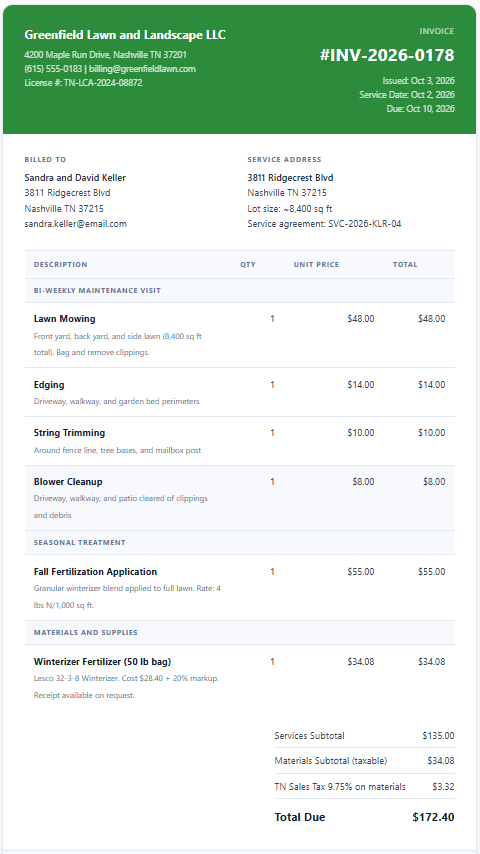
Below is a complete lawn care invoice for a residential client receiving bi-weekly maintenance plus a fall fertilization treatment. This format works equally well for commercial clients with the addition of a purchase order number field. Notice how every service is a separate line, materials appear in their own section with markup disclosed, and tax is applied only to the taxable items.
Billing Models for Lawn Care Businesses
Choosing the right billing model before you design your template makes the template far easier to build and the billing conversation far easier to have with clients. Most lawn care businesses use more than one model simultaneously across their client base.
Per-Visit Invoicing
Invoice after every service call. This is the most common model for new lawn care businesses and works well for one-time jobs and infrequent service relationships. The downside is administrative: generating and sending an invoice after every single visit across 30 or 40 clients is time-consuming and creates a high invoice volume that is easy to fall behind on. Per-visit invoicing also means your revenue is literally weather-dependent, since a week of rain means no visits and no invoices.
Monthly Recurring Invoicing
Bundle all visits within a calendar month into a single monthly invoice. This is cleaner for both you and the client: one invoice to review, one payment to process, and one record to reconcile. The monthly invoice should list each visit date as a line item so the client can see that services were rendered on the dates charged. For most established lawn care businesses with a regular maintenance route, monthly invoicing paired with automated recurring billing is the most efficient model. See our guide on recurring billing for how to set this up.
Seasonal Contract Billing
Price the entire season of services as a fixed total, divide it by the number of months in the service window, and bill that same amount each month regardless of how many visits actually occurred. This is the most cash-flow-friendly model for the business owner because revenue is predictable, and it eliminates the rain-out billing question entirely. Clients tend to accept this model readily because their monthly cost is fixed and easy to budget. The key is spelling out clearly in the service agreement what a “season” includes and what triggers an out-of-scope charge.
Seasonal Billing and the Rain-Out Problem
Seasonal variability is the most distinctive billing challenge in lawn care. No other service industry has billing disrupted by weather the way this one does. Every lawn care business needs a documented rain-out policy before it sends its first invoice to a recurring client, because the question will come up and the answer needs to already be written down somewhere the client can see it.
☀ Spring (March to May)
Peak demand season. Billing volume is highest. Core services: aeration, dethatching, pre-emergent herbicide, overseeding, first mowing, bed cleanup, and mulch installation. Collect deposits on large landscaping installs before materials are ordered.
☁ Summer (June to August)
Steady maintenance cycle. Weekly or biweekly mowing is the dominant service. Heat and drought can slow growth and reduce visit frequency, which affects per-visit billing. Monthly contract billing insulates revenue from this variability.
🍂 Fall (September to November)
Fertilization, overseeding, leaf cleanup, and final mowing. Leaf cleanup in particular requires clear per-visit or per-load pricing on the invoice because the scope varies dramatically week to week depending on the property.
❄ Winter (December to February)
Slow season for most lawn care businesses. Seasonal contract billing carries revenue through this period. For snow removal add-ons, invoice per event with clearly stated trigger conditions (snowfall threshold, ice events).
How to Handle Rain-Out Billing
There are three defensible approaches to weather-cancelled service billing. The right one depends on your business model and your client mix.
Option 1: No bill for missed visits.
Simple for the client and creates goodwill, but your monthly revenue drops every time it rains mid-week. Works best when your visit frequency is low enough that a missed visit is a minor variance rather than a significant revenue loss.
Option 2: Reschedule fee for weather cancellations.
A reduced fee (typically 30 to 50% of the visit price) covers your crew’s scheduled time when a visit is cancelled due to weather that is within your documented policy. This must be stated in the service agreement and referenced on the invoice, or it will create disputes every time it is charged.
Option 3: Seasonal contract pricing.
Divide the total seasonal price by the number of billing months. Clients pay the same amount regardless of individual visit counts. Rain-out visits are made up when conditions allow. This model eliminates the rain-out billing problem entirely at the cost of some pricing negotiation complexity at contract signing.
How the Lawn Care Invoicing Workflow Works
A clean billing workflow is what separates lawn care operators who get paid consistently from those who are perpetually chasing receivables while also trying to run a full service schedule. The sequence below applies whether you have five clients or fifty.
1. Document every service at the job site
Before leaving a property, confirm every service completed, any materials used, and any additional work that was outside the original scope. Many operators photograph the completed work as a record that can be referenced if a client disputes what was done. Some field service apps allow you to log services directly from a mobile device and automatically populate an invoice draft.
2. Invoice within 24 hours of service completion
The fastest-paying invoices in lawn care are the ones sent the same day or the next morning. By the time a week has passed since the service, the client’s memory of what was done has faded, and the invoice feels less connected to a specific visible result. Immediate invoicing also means your billing never falls behind your service schedule, which is one of the most common cash flow killers in this industry.
3. Send electronically with a payment link
Email the invoice in PDF format with a direct payment URL in the email body and on the invoice itself. For residential clients, consider including a QR code that links directly to payment. The easier you make it to pay, the faster you get paid. Platforms that support invoicing software with built-in payment processing handle this automatically.
4. Automated reminders for unpaid invoices
Set automated reminders at 3 days before the due date, on the due date, and 5 days after. Residential clients are not slow payers because they are dishonest; most late payments happen because the invoice was forgotten in a busy inbox. A polite automated reminder sent at the right moment resolves most of these without any human intervention.
5. Follow up on overdue invoices by phone
For invoices more than 10 days past due on a residential client, a direct call is more effective than a third automated email. Keep the call brief and friendly: you are not accusing, you are confirming whether they received the invoice and whether there is any issue with the service or the bill. Most delinquent residential invoices resolve immediately upon a personal call because the client simply forgot.
6. Reconcile and track your AR weekly
Every Friday, review your accounts receivable aging report. Any invoice past 14 days outstanding needs an action: a call, a reminder, or a decision about whether to continue service pending payment. The lawn care businesses that struggle with cash flow are almost never billing incorrectly. They are billing accurately and then not tracking what has and has not been paid. Good customer management tools make this weekly review a 10-minute task rather than a 90-minute reconciliation session.
Key Benefits of a Professional Lawn Care Invoice Template
Faster Collection on Every Invoice
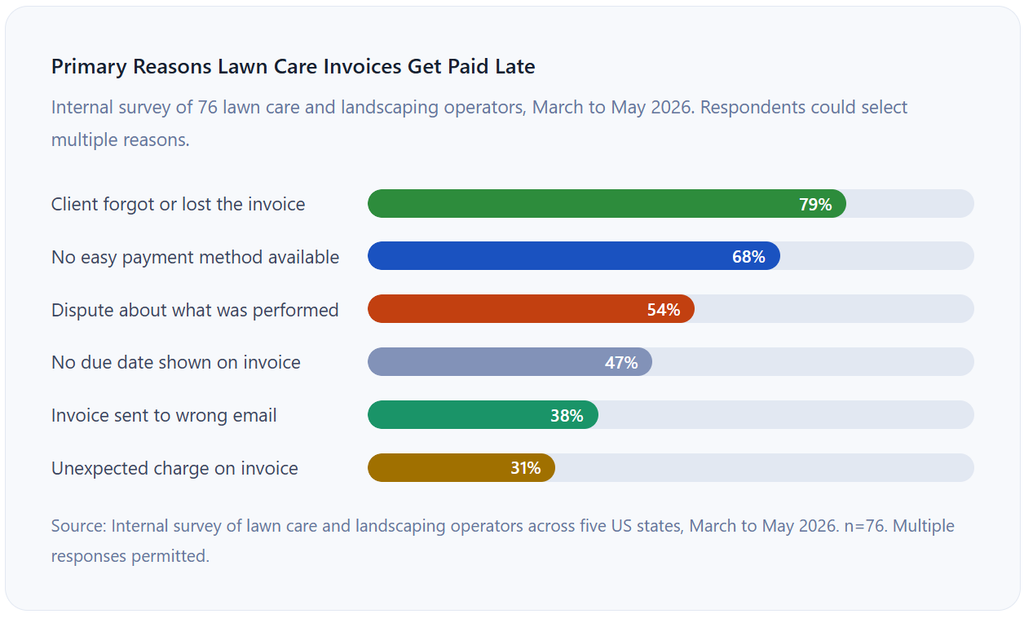
A professional, itemized invoice with a clear due date and a direct payment link collects faster than a handwritten note or a vague one-line bill. According to FieldRoutes, citing QuickBooks research, 73% of businesses are negatively affected by late invoice payments. The lawn care industry is particularly exposed because residential clients treat lawn service invoices with lower urgency than utility bills or credit card statements. A professional invoice with an easy payment option and an explicit due date changes that calculus.
Fewer Billing Disputes
When a client can see “Mowing (8,400 sq ft): $48, Edging: $14, Trimming: $10, Blower cleanup: $8” instead of “Lawn service: $80,” they have nothing to dispute. Itemized invoices are self-explanatory. Single-line invoices invite questions that slow down payment and occasionally escalate into disputes about what was or was not done during the visit.
Better Cash Flow Through Seasonal Predictability
Operators who move recurring clients to monthly contract billing instead of per-visit invoicing report significantly smoother cash flow across the full year, including through the slow winter months. When 60% of your client base is on a fixed monthly contract, your revenue forecast for the next 90 days is a number, not an estimate.
Risks and Red Flags in Lawn Care Billing
Scope Creep Without a Change Order
A client asks you to trim a couple of extra shrubs while you are there. You do it. Three months later, those “couple of shrubs” have quietly become a full hedge-trimming service that you have been performing for free because you never documented the change or added a line item to the invoice. Scope creep in lawn care is almost always accidental, but its financial impact is real. Any additional service beyond what is in the original agreement needs to be documented at the time of the visit and appear as a line item on that visit’s invoice.
Invoicing the Wrong Person for a Property Manager Client
Property managers are one of the best commercial clients for lawn care businesses because they have multiple properties under management. They are also a common source of payment problems when the invoice goes to the property address instead of the management company’s billing contact. Confirm the billing contact name and email before the first invoice and store it in your client records. A payment that goes to the wrong inbox can sit for 60 days before anyone realizes it.
Sales Tax Errors on Materials
Lawn care tax treatment varies dramatically by state and is more complex than most operators realize. Some states tax the entire invoice. Some tax materials and exempt labor. And some have changed their treatment of lawn care services in the past five years. A tax error discovered during an audit is far more expensive than the cost of a consultation with a CPA who knows your state’s rules. Document your tax treatment rationale and apply it consistently on every invoice from day one.
Comparison: Lawn Care Billing Models
The right billing model depends on your client mix, the size of your operation, and how much revenue predictability matters to you. Most established lawn care businesses use a combination of these models across different client tiers.
| Billing Model | Revenue Predictability | Client Simplicity | Rain-Out Risk | Best For |
|---|---|---|---|---|
| Per-Visit Invoicing | Low | Medium | High | One-time jobs, infrequent clients, new customers |
| Monthly Recurring Invoice | Medium-High | High | Medium | Established weekly or bi-weekly maintenance clients |
| Seasonal Contract Billing | High | Very High | None | Year-round maintenance contracts, HOAs, commercial properties |
| Deposit + Completion Billing | Medium | Medium | Low | Large landscaping installs, hardscape projects, tree work |
| Milestone Billing | Medium | Medium | Low | Multi-phase projects: design, installation, planting, finish |
| Annual Prepayment Discount | Very High | High | None | Long-term residential clients who want a discount for paying upfront |
Common Mistakes and What I Got Wrong First
Mistake 1: Sending a Single-Line Invoice for Every Visit
The most common invoice format in early-stage lawn care businesses is a single line: “Lawn maintenance, [date], $75.” This is the invoice equivalent of handing someone a receipt with no itemization and asking them to trust the total. It works fine when business is small and every client knows you personally. It stops working the moment you have more clients than you can call by name, a client transfers to a new property manager, or a commercial account asks for a line-item breakdown before processing your payment. Build the itemized habit from your first invoice. It is much easier than retrofitting it two years in.
Mistake 2: Not Having a Signed Service Agreement Before the First Invoice
Lawn care operators who skip the service agreement because “it felt too formal for a residential client” are the ones who end up in awkward disputes about whether a specific service was included in the regular price. A one-page service agreement that defines the scope, the billing model, the payment terms, the rain-out policy, and the late fee is not bureaucratic overhead. It is the document that every invoice references and that makes every charge defensible. Even for residential clients, a simple email confirmation with these terms attached works. The key is that the client has acknowledged the terms before you perform the first service.
Mistake 3: Accepting Only Cash or Check in 2026
Limiting payment methods to cash and check is a meaningful drag on collection speed. Many residential clients do not carry checkbooks. Many commercial clients process all vendor payments through ACH and cannot send a check without a specific payable-to name and mailing address that has to route through an AP department. Adding online payment via card and ACH to your invoice does not require a sophisticated platform, and the small processing fee per transaction is routinely recovered by collecting 10 to 15 days faster on the average invoice.
Mistake 4: No System for Out-of-Scope Work
The client asks you to pull some weeds from a bed while you are there. You do it and mean to add it to the invoice, but by the time you sit down to bill, you are not sure if you charged for it on a previous visit or just forgot. This kind of untracked out-of-scope work is revenue erosion that compounds over a season. Establish a simple field note habit: any work outside the regular scope gets logged in a note, text, or field service app entry before you leave the property, with a clear price. It takes 90 seconds and eliminates the end-of-visit revenue guessing.
Mistake 5: Billing Monthly Without Automating It
Deciding to move from per-visit to monthly invoicing is a good decision. Executing it by manually creating and sending invoices at the start of every month for every client is only slightly better than per-visit billing from a time perspective. Monthly recurring billing only delivers on its efficiency promise when it is automated. Platforms like ReliaBills can generate and send recurring monthly invoices automatically, with payment links included, so your billing cycle runs in the background while you run your route.
How to Get Started: Building and Automating Your Lawn Care Invoice
Step 1: Define Your Standard Service Line Items
Before building any template, list every service your business charges for. Mowing, edging, trimming, blowing, fertilization, weed control, aeration, overseeding, dethatching, mulch installation, leaf cleanup, spring cleanup, fall cleanup, snow removal, and any others specific to your region or service mix. Each becomes a template line item with a default price that you can adjust per client or per visit. This list is the foundation of every invoice you will ever send.
Step 2: Decide Which Billing Model Each Client Segment Uses
Group your clients by how they should be billed. Regular weekly or biweekly maintenance clients go on monthly recurring billing. One-time or infrequent clients get per-visit invoices. Large landscaping project clients get deposit-plus-completion or milestone billing. Make these decisions now and document them in each client record so they are applied consistently.
Step 3: Build the Template in a Billing Platform, Not a Word Document
A Word or PDF template handles formatting but requires someone to manually create, populate, and send every invoice. Build your template inside a billing platform so the recurring portion is automated and the payment link is generated automatically with every invoice. See our guide to invoicing software for how to choose the right tool for a lawn care business.
Step 4: Add Online Payment to Every Invoice
If your current invoices do not have a direct payment link, adding one is the single highest-return change you can make this month. It requires no behavioral change from your clients beyond clicking a button instead of writing a check. The conversion from “invoice sent” to “payment received” improves measurably with every friction point removed from that path.
Step 5: Turn on Automated Reminders
Set one pre-due reminder and one post-due reminder on every invoice. Phrase them as friendly notifications, not collection demands. The pre-due reminder catches clients who meant to pay but have not yet. The post-due reminder catches the ones who forgot. Together, they handle the majority of late payment situations without requiring any time from you.
Frequently Asked Questions
1. What should a lawn care invoice include?
A professional lawn care invoice should include your business name and contact details, the client’s name and billing address, the service address if different from the billing address, a unique invoice number, the service date or billing period, an itemized breakdown of every service performed with individual pricing, separate line items for any materials or supplies with your markup disclosed, applicable sales tax (on taxable items only, per your state’s rules), the total amount due, a clear due date, your late fee policy, and accepted payment methods with a direct payment link.
2. How often should a lawn care business send invoices?
For one-time jobs, invoice within 24 hours of completing the service. For recurring weekly or bi-weekly maintenance clients, monthly invoicing is the most efficient model: bundle all visits within the calendar month into a single invoice, with each visit date listed as a line item. And for seasonal contract clients, invoice monthly for the fixed contract amount. The faster you invoice after a service is completed, the faster you typically collect, because the work is still visible in the client’s yard.
3. Do lawn care businesses charge sales tax?
It depends on your state. The sale of materials like fertilizer, mulch, seed, and sod is taxable in most states. Labor for residential lawn maintenance is tax-exempt in many states (including Florida, Virginia, and North Carolina) but taxable in others (including Texas, Ohio, and New Mexico, which tax lawn care services as a whole). Several states have changed their lawn care tax treatment in recent years. Consult a CPA familiar with your state’s green industry rules and document your tax treatment clearly on every invoice so your bookkeeper can reconcile it at year-end.
4. What payment terms are standard for lawn care businesses?
For residential clients, due upon receipt or due within 7 days is increasingly standard. Net 15 is common for established long-term clients. Commercial accounts often request Net 30, but lawn care operators with weekly labor and fuel costs should push back toward Net 15 wherever possible. For large landscaping installations, a 30 to 50% deposit before work begins with the balance due upon completion is standard and protects you from material and labor costs that are already spent before the final invoice is sent.
5. How do I handle invoicing when rain prevents a scheduled service?
Establish a written rain-out policy in your service agreement before the issue arises. The three most common approaches are no charge for weather-cancelled visits (client-friendly but revenue-volatile), a reduced reschedule fee to cover scheduled crew time (must be pre-disclosed in writing), or seasonal contract pricing where the total seasonal price is divided into equal monthly payments regardless of individual visit counts (eliminates the rain-out billing question entirely). Whichever policy you choose, reference it on your invoice and in your service agreement so it is never a surprise.
6. Should I use invoicing software or a spreadsheet for lawn care billing?
A spreadsheet handles your first 5 to 10 clients adequately and costs nothing. It stops being practical when you have more clients than you can easily track manually, when your billing cycle takes more than a few hours per month, or when you need to follow up on more than two or three late invoices at a time. Dedicated invoicing software automates invoice generation, adds payment links, sends reminders, and tracks which invoices have been paid, all without manual intervention. For most lawn care operators, the time savings alone justify the software cost by the time the client base reaches 15 to 20 active accounts.
7. How do I invoice a property manager who pays for multiple service addresses?
Create a separate line item group for each service address within a single monthly invoice, or send a separate invoice per property depending on the property manager’s AP process preference (confirm this at onboarding). Each section or invoice should show the property address as the service address and the management company’s billing contact as the billed-to field. Include your service agreement or property management contract reference number so the property manager’s AP team can match the invoice to the approved vendor and authorization. Always confirm the billing contact email and PO number requirements before the first invoice, as property management companies often have specific routing requirements.
Recent Articles:
- Installment Billing for Childcare Programs: Flexible Payment Options for Parents
- Installment Billing for Security System Installations and Equipment Costs

Brant Pallazza is the Founder and President of ReliaBills, an invoicing and recurring billing platform built to help small businesses secure predictable cash flow. With over 20 years of experience in direct response marketing and e-commerce leadership, including a 13-year tenure managing over $500 million in gross sales at Digital River. Brant writes actionable guides on automated billing, payment processing, and scaling SMBs.