
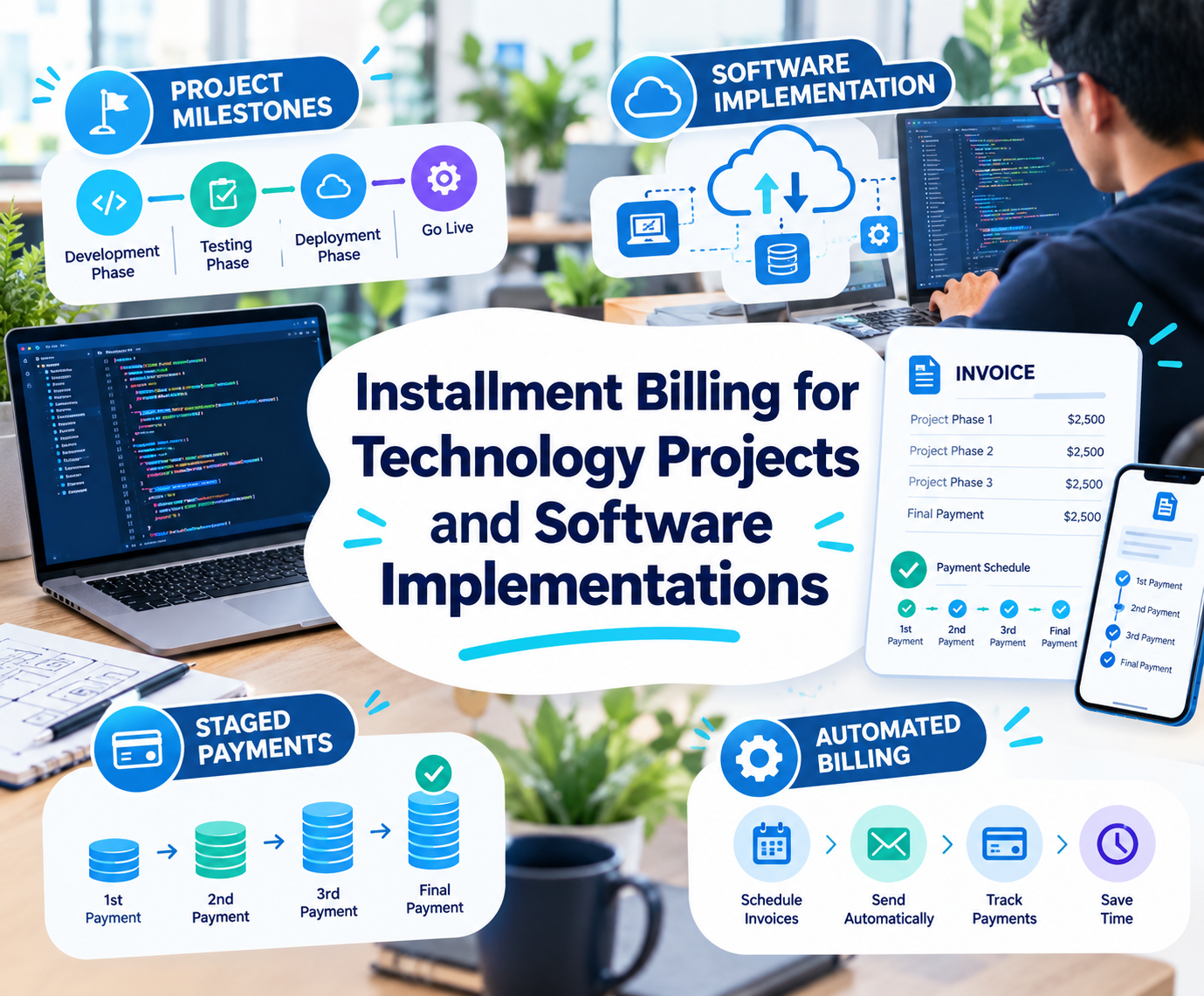
IT project installment billing solves two problems simultaneously: it gives clients budget predictability across a long implementation and gives the vendor cash flow throughout the project rather than only at completion. But it only works as advertised when three things are in the contract before the project begins: milestone definitions specific enough that completion is objectively verifiable, client acceptance language with a defined response window so deliverables cannot be held in permanent limbo, and change order procedures that require written approval before any out-of-scope work starts. Without these three clauses, every installment payment becomes a negotiation rather than an automatic billing event.
What is an IT Project Installment Billing?
IT project installment billing is a payment structure that divides the total contract value of a technology project or software implementation into scheduled partial payments, each tied to a defined project milestone, deliverable phase, or calendar date. The vendor receives payment progressively as the project advances rather than waiting for full payment at the end. It combines elements of installment billing (a defined total paid in parts) with milestone tracking (payments triggered by project events rather than purely by time). When milestone completion follows a predictable schedule, installment billing can be managed through recurring billing automation, with the billing platform generating invoices at defined intervals. In longer or more complex implementations, milestone-triggered billing requires a human sign-off step before each invoice fires. Both models depend heavily on how the statement of work defines what constitutes completion, which party has authority to confirm it, and what happens when a client disputes a milestone status while work on the next phase has already begun.
What Standard Guides on IT Project Billing Consistently Get Wrong
Search for guidance on milestone billing for technology projects and you will find two categories of content. The first explains that milestone billing is a good idea because clients pay progressively. The second lists generic project phases (discovery, development, testing, go-live) and assigns rough percentage payments to each. Neither one covers what happens in the spaces between milestones, and that is exactly where the cash flow problems live.
The gaps that consistently cause IT project billing to break down are vague milestone definitions so that clients can argue indefinitely about whether completion has occurred, no contractual deadline for client acceptance of a deliverable, and change order procedures that exist on paper but are skipped in practice because the client relationship feels too important to risk by asking for a signature. Each of these gaps converts a billing event that should be automatic into a manual negotiation, and at the scale of a six-month software implementation, those negotiations compound into delays that affect the entire project’s cash flow.
The Two Types of IT Project Installment Billing (and Why the Distinction Matters)
Not all IT project installment billing works the same way, and using the wrong structure for a given project type is one of the earliest decisions that creates downstream billing problems.
Time-based installment billing
The contract defines a fixed payment schedule: 25 percent at signing, 25 percent on the first of the third month, 25 percent on the first of the fifth month, and 25 percent at project close. Payments are tied to calendar dates rather than milestone events. This structure is simpler to administer and easier to automate because recurring billing can fire each invoice on schedule without a human trigger. The tradeoff is that time-based installments give clients less visibility into what they are paying for at each payment date, which can generate questions about whether work is on pace with the payment schedule.
Milestone-triggered installment billing
A software implementation contract might require 30 percent payment after delivery of a prototype, another 30 percent after system integration, and the remaining 40 percent upon final delivery and sign-off. Each completed phase triggers its own payment. This structure gives both parties a clear link between payment and progress, which reduces the “what am I paying for?” question significantly. The complexity is that each payment requires confirmation that the milestone has been met and accepted, which introduces a human step between milestone completion and invoice generation. That human step is where most IT installment billing delays occur in practice.
Many IT firms use a hybrid structure: fixed dates for the early phases where the schedule is predictable and milestone-triggered payments for later phases where delivery timing depends on client feedback cycles, integration complexity, or external dependencies like third-party API access. The hybrid works well when the contract explicitly states which installments follow which trigger mechanism, so there is no ambiguity about what drives each payment event.
A Standard Milestone Payment Structure for a Software Implementation
The allocation below reflects common practice for a mid-complexity software implementation, drawing from Intuit Enterprise Suite guidance that progress payments for software development typically range from 10 to 25 percent per phase, tied to the completion of specific phases. The exact percentages should be negotiated based on the vendor’s cost structure in each phase and the client’s risk tolerance.
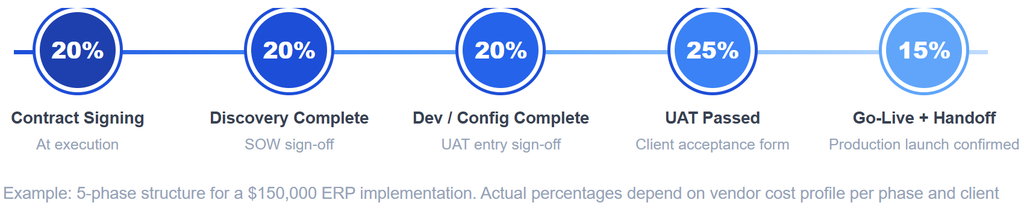
The final payment at 15 percent is intentionally modest. Either a retainer or an initial milestone payment should cover the upfront discovery or strategy work. The remainder of the project fee is then allocated in increments to subsequent milestones, including a final completion payment. A final payment above 25 percent creates a misaligned incentive where the client holds disproportionate leverage at the end of a project when the vendor has already delivered most of the value. Keeping the final installment between 10 and 20 percent reduces that leverage without eliminating the client’s reasonable interest in having some payment outstanding until go-live is confirmed.
The Statement of Work Language That Determines Whether Installments Collect Automatically or Get Stuck
The statement of work is the operational document that either makes milestone installment billing work smoothly or turns every payment into a negotiation. Most SOW templates do a reasonable job of defining the project scope and deliverables. They consistently underperform on the billing enforcement clauses that determine what happens when a client is slow to accept a deliverable, disputes a milestone’s completion, or requests work that falls outside the agreed scope.
Milestone completion criteria must be objective and named.
A milestone defined as “Phase 2 Development Complete” is an invitation to a dispute. A milestone defined as “Development phase deliverables delivered per Appendix A specifications, confirmed in writing by client project lead [Name] or designated alternate, with all P1 and P2 defects resolved” is a billing trigger. The difference is specificity: who confirms, what they confirm, and what the standard for confirmation is. Ambiguous milestones create collection disputes and extend days sales outstanding. ‘Phase complete’ means different things to the delivery team and the client’s finance department. The SOW needs to define what constitutes completion, who confirms it, and what the client acceptance process looks like before any billing event triggers.
The client acceptance window clause.
Without a defined acceptance window, clients can hold a completed milestone in limbo indefinitely by neither accepting nor formally rejecting the deliverable. This is not always intentional. Busy clients sometimes simply do not prioritize acceptance review until the next project meeting. But the effect on vendor cash flow is the same whether the delay is strategic or administrative.
The acceptance window clause solves this by stating that the client has a defined number of business days, typically five to ten, from delivery of a milestone to either accept it in writing or provide a written list of specific deficiencies that prevent acceptance. If no written response is received within that window, acceptance is deemed automatic, and the invoice for that milestone becomes payable. This clause is standard in well-drafted technology contracts and should be non-negotiable from the vendor’s perspective.
Change order authorization before work begins.
Tech companies facing scope creep encounter disputes over milestones and payments and changes to project scope that impact milestone achievements and payment schedules, triggering disagreements over contractual obligations. Prevention requires a formal change control process with client sign-off before any out-of-scope work begins. The change order clause in the SOW should require a written change order executed by an authorized client representative before any out-of-scope work starts. The change order specifies the additional work, timeline impact, and additional fee. Work performed without a signed change order cannot be billed as a change order later, and any attempt to do so is one of the four primary billing dispute patterns in technology consulting engagements.
What a Milestone Installment Invoice Should Show
A well-structured milestone invoice does more than state the amount due. It references the milestone, the acceptance documentation, and the contract, which makes it self-evidencing in a dispute and eliminates the most common questions that delay payment approval in client accounting departments.
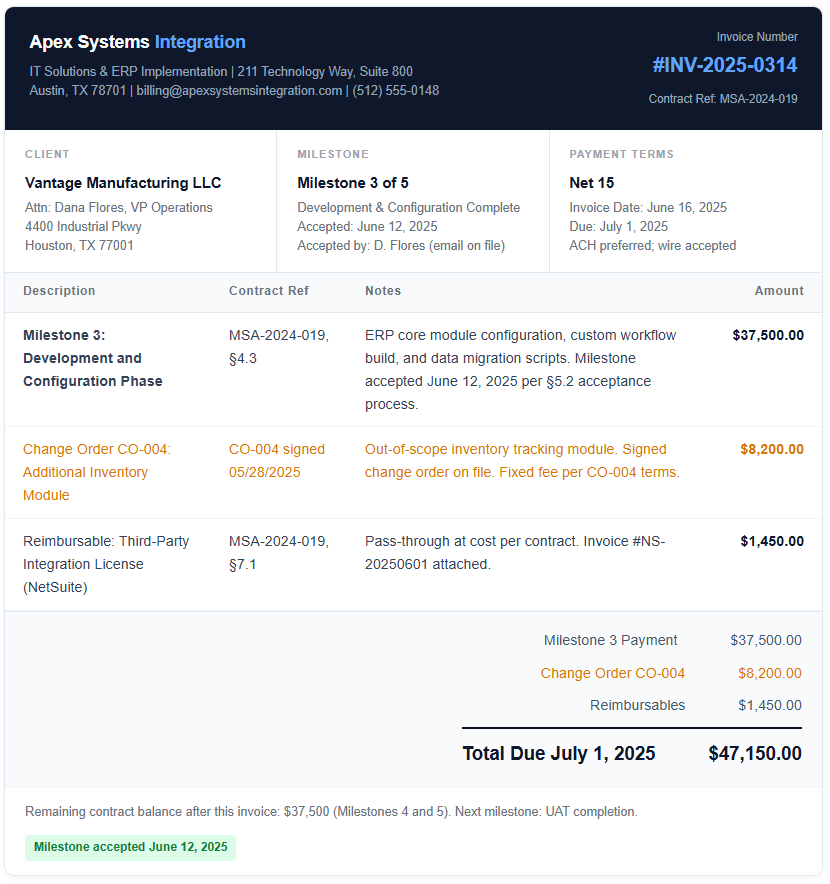
Several elements in the invoice above are worth highlighting. The milestone acceptance date and acceptor name appear in the billing period field, not buried in a notes section. That placement tells the client’s accounts payable team immediately that this payment has already been authorized by the project lead and does not need to go back through approval. The change order has its own signed reference number, which means it cannot be disputed as unauthorized work. The remaining contract balance shown in the footer orients both parties on where they are in the payment schedule without requiring them to refer back to the original contract.
Where IT Project Billing Breaks Down: Data From the Field
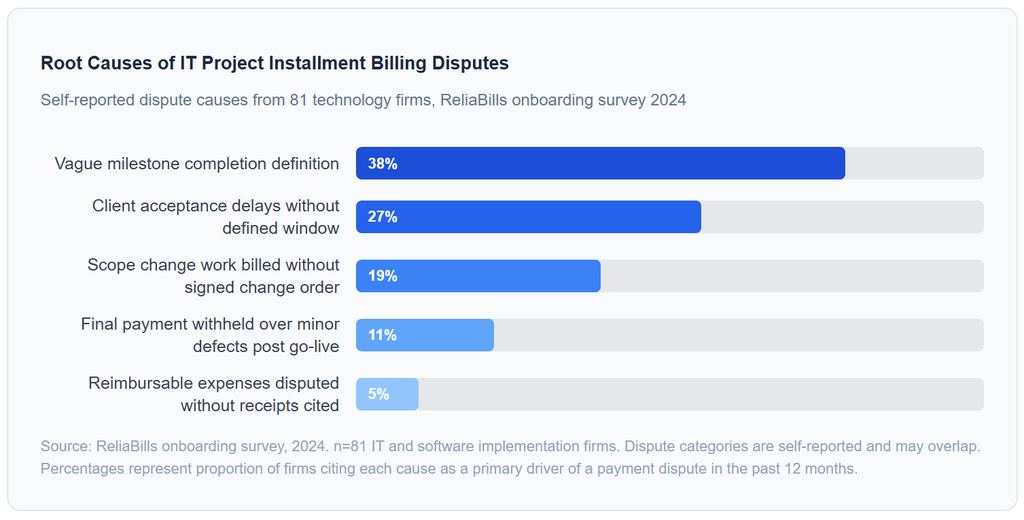
The top two categories, vague milestone definitions and undefined acceptance windows, together account for 65 percent of IT project billing disputes and are both entirely preventable through SOW language. These are not technical problems or delivery failures. They are contract drafting failures that translate directly into unpaid invoices.
IT Project Installment Billing vs. Related Billing Structures
| Billing Model | Payment Trigger | Best For | Dispute Risk | Automation Fit |
|---|---|---|---|---|
| Milestone installment billing | Defined project event or deliverable accepted by client | Software implementations, ERP rollouts, custom development | High without precise milestone definitions and acceptance clauses | Partial: human milestone confirmation required; invoice auto-fires after |
| Time-based installments | Fixed calendar dates defined in contract | Predictable-schedule implementations, managed services transitions | Low per invoice; higher if client disputes value delivered by date | Full: recurring billing handles entirely |
| Hourly / time and materials | Hours worked and approved, billed weekly or monthly | R&D projects, evolving requirements, agile sprints | Medium: timesheet disputes and rate misclassification are common | Partial: timesheet approval is manual; invoice generation can auto-fire |
| Fixed-fee lump sum | Single payment at project completion or in two tranches | Small implementations, well-defined short engagements | High: vendor carries full cost risk until payment; client holds leverage | Simple: one or two invoices, no scheduling needed |
| Hybrid (fixed phases + hourly overflow) | Fixed amounts at milestones plus T&M for out-of-scope additions | Complex implementations where scope may evolve | Medium: requires clean separation between fixed and T&M line items | Split: fixed phases automated; T&M invoiced separately via invoicing software |
| Recurring retainer + project add-ons | Monthly retainer automated; project work invoiced separately | MSPs, ongoing IT partnerships with periodic project sprints | Low for retainer; medium for project work scope disputes | Good: retainer on recurring billing; project invoices on installment billing |
Handling Scope Changes Without Derailing the Billing Schedule
Scope creep is the most common source of budget overruns and billing disputes in technology projects, and it almost always starts as a reasonable-sounding request. A client asks the implementation team to add a custom reporting view. Then a workflow needs an extra approval step. Then the data migration scope expands to include historical records that were originally excluded. Each request seems minor individually. Cumulatively, they add weeks of work to a project whose fixed installment schedule does not reflect the expanded scope.
The practical change order process for IT installment billing works as follows. When a client requests something that falls outside the agreed SOW deliverables, the project manager documents it as a potential scope change, estimates the cost and timeline impact, and prepares a written change order for client signature before any work on that item begins. The change order references the original contract, describes the additional work precisely, states the additional fee, and identifies its effect on the project timeline and on subsequent milestone dates if any.
The change order fee is billed either as an addition to the next milestone invoice, clearly labeled as a change order with its reference number, or as a standalone invoice for larger scope additions. Either approach works as long as the change order document exists before the work happens and is signed by someone with contract authority on the client side. A project manager’s verbal approval to “go ahead” is not authorization for billing purposes.
The Cash Flow Gap in IT Project Billing and How Installments Solve It
Firms using an automated billing process along with e-payments see 30 percent faster payment cycles, with 41.6 percent of invoices being paid within 30 days. For a technology firm running a six-month implementation on a fixed-fee contract with payment only at completion, that 30-day improvement barely dents the fundamental problem: the firm is funding months of delivery before any revenue arrives. At a $200,000 contract value with three staff members and $40,000 in monthly costs, a backend-heavy payment structure creates a $200,000 receivable that takes six months to materialize while $240,000 in costs have already been incurred.
Milestone installment billing corrects this by distributing cash inflows across the project timeline rather than deferring them to the end. A front-loaded structure where 40 percent is paid before the bulk of delivery work begins, and subsequent milestones cover costs as they are incurred, produces a significantly different cash flow profile for the same project. The total revenue is identical. The timing is the variable that determines whether the firm needs a working capital line of credit or not.
Setting Up Installment Billing for a Technology Project: Step by Step
1. Map the project phases to billing events before the SOW is drafted
Identify each phase of the implementation and assign a payment percentage that reflects the vendor’s cost concentration in that phase. Front-load enough to cover the highest-cost early phases without creating a prohibitively large upfront demand for the client. Discuss the milestone structure with the client during SOW negotiation so payment expectations are aligned before the contract is signed, not discovered when the first invoice arrives.
2. Write each milestone definition to be objectively verifiable
For every milestone that triggers a payment, write the completion definition as if you were writing it for a judge who has never seen the project. Name the deliverable, name the standard it must meet, name the person authorized to accept it on the client side, and specify what form that acceptance takes. Test the definition by asking: if the client refuses to accept this milestone, could we prove in writing that it was complete? If the answer is no, the definition needs more specificity.
3. Add the acceptance window clause to the SOW
State clearly that the client has a defined number of business days from delivery to provide written acceptance or a written list of specific deficiencies. State that failure to respond within that window constitutes deemed acceptance. This clause is often the most contested during SOW negotiation, but it is the one that most directly protects the vendor’s ability to bill on schedule. Be prepared to explain its purpose: it protects the client too, because it creates a defined review window rather than leaving milestone acceptance open-ended.
4. Configure the billing platform for milestone-triggered invoicing
Set up each milestone as a billing event in your invoicing software. For time-based installments, configure recurring billing on the defined dates. For milestone-triggered installments, configure the invoice template and amount in advance so that when the milestone is confirmed, the invoice generates and delivers automatically without manual assembly. ReliaBills supports this kind of client-account billing configuration, allowing each project’s installment schedule to be defined at the client level and tracked against the overall contract value.
5. Send the milestone invoice the same day acceptance is confirmed
The most common cash flow delay in IT project billing is the gap between when a milestone is accepted and when the invoice is sent. Project managers confirm milestone acceptance in a meeting, note it in their project system, and then the invoice gets generated three days later when the billing team processes it. Those three days multiply across five milestones and become fifteen days of unnecessary delay across a six-month project. Automate invoice generation from the milestone acceptance event so that the invoice fires the same day the acceptance is recorded.
6. Set up a payment reminder sequence from the invoice date
Configure automated reminders at defined intervals after the invoice due date. A common reminder cadence for late invoices starts with a soft automated email one day overdue, a firm and formal personally written notice at seven days, a direct call at fourteen days, and a project delivery hold at thirty or more days outstanding. For IT projects where the next phase may already be underway, the thirty-day hold conversation is particularly important: most contracts permit the vendor to suspend further work pending payment of overdue invoices, and that clause should be referenced in the thirty-day notice to make the consequence clear without ambiguity.
Common Mistakes and What I Got Wrong at First
Defining milestones by phase name rather than by deliverable and acceptance
Early SOW templates used phrases like “Development Phase Complete” and “Testing Complete” as milestone triggers. Every single one of those eventually became a conversation about what “complete” meant when a client wanted to withhold payment over a feature they decided they wanted changed after the milestone had been delivered. Rewriting milestone definitions to include specific deliverables, specific defect thresholds, and a named client signatory eliminated those conversations almost entirely.
Not having an acceptance window clause in the first year of project billing
Without a defined acceptance window, the largest payment dispute in a five-milestone project lasted six weeks. A milestone that had objectively been delivered per every specification in the SOW sat in client review while the next phase was already underway. The delay was not malicious. The client’s project lead was traveling and had not scheduled the review meeting. A five-business-day deemed acceptance clause would have converted that six-week delay into a five-day review window. That clause has been in every SOW since and has never generated a client objection when explained properly.
Accepting verbal change order approvals
The most expensive billing dispute pattern in IT project work is performing scope expansion based on a client’s verbal instruction and then billing for it later. Clients often genuinely do not remember authorizing changes verbally, especially when their project team has rotated or when months have passed between the request and the invoice. Every change order must be written, specific about the work and the fee, and signed by someone with contract authority before a single hour of out-of-scope work begins.
Setting the final milestone payment too high
A 40 percent final payment on a software implementation creates a situation where the client controls nearly half the contract value at the point when the vendor’s leverage is lowest, which is after they have delivered the working system and are now in support mode for go-live. Clients sometimes use that leverage to negotiate retroactive discounts for minor post-launch issues. Keeping the final installment at 15 to 20 percent of contract value eliminates most of that leverage while still giving the client meaningful incentive to process the final acceptance in a timely way.
Using a generic invoicing tool that cannot track milestone status alongside contract value
Generic invoicing tools send invoices. They do not track which milestones have been invoiced, what the remaining contract balance is, or flag when a milestone has been accepted but the invoice has not been sent. For a firm running 10 or more concurrent IT projects, that gap means someone manually reconciles project status against billing status every billing cycle, which is a significant overhead and a common source of missed billing events. Choose a client management and billing platform that can hold the full contract structure and surface billing events automatically when milestones are confirmed.
Why IT Firms That Switch to Installment Billing Do Not Go Back
The benefits of milestone installment billing for technology projects divide into financial and operational categories, but the two are more connected than they initially appear.
Predictable cash flow across a multi-month engagement
The most immediate benefit is the elimination of the backend cash flow problem. When payments arrive at defined points throughout a project rather than only at the end, the firm’s cash position during delivery reflects actual revenue recognition rather than a growing receivable. That predictability directly affects the firm’s ability to hire, invest in tooling, and take on additional projects without credit dependency.
Built-in project accountability for both parties
Milestone installment billing creates natural accountability checkpoints for both the vendor and the client. The vendor must deliver to the milestone standard to trigger the billing event. The client must engage in the acceptance process on the defined timeline. This bilateral accountability is one reason milestone-billed projects tend to stay closer to schedule than fixed-fee end-payment projects, where the client has little incentive to prioritize timely feedback until go-live is approaching.
Reduced end-of-project payment risk
73 percent of small businesses report customer delinquency numbers increased over the past year, and 31 percent of businesses say late payment problems worsened in the past year. For IT firms billing primarily at project completion, that trend represents a meaningful risk to individual project profitability. Milestone installment billing converts a single large end-of-project payment risk into multiple smaller payment events. Even if a client is slow to pay the final installment, the majority of the contract value has already been collected across earlier milestones.
Frequently Asked Questions
1. What is IT project installment billing?
IT project installment billing is a payment structure that divides the total contract value of a technology project or software implementation into scheduled partial payments, each tied to a defined milestone, deliverable phase, or calendar date. The vendor receives payment progressively as the project advances rather than waiting until completion. It differs from hourly billing in that each installment amount is fixed regardless of hours worked, and from subscription billing in that the engagement has a defined endpoint. The structure benefits both parties: vendors receive cash flow throughout delivery, and clients pay for verified progress rather than an unverified promise of future completion.
2. How should IT project milestones be defined for billing purposes?
Each billing milestone must include four elements to be enforceable and dispute-resistant: a specific deliverable or completion event, objective acceptance criteria agreed upon before the project begins, a named client contact with authority to sign off on completion, and the payment amount tied to that milestone. Vague milestones like “Phase 1 Complete” are the most common source of IT project billing disputes. Specific milestones that define what was delivered, what standard it must meet, who confirms it, and in what form create billing triggers rather than negotiation starting points.
3. What percentage should each milestone payment be in a software implementation?
Standard practice allocates 20 to 30 percent at contract signing or kickoff, 10 to 25 percent per development or implementation phase, and 10 to 20 percent as a final go-live or acceptance payment. Intuit Enterprise Suite guidance suggests progress payments of 10 to 25 percent per phase for software development. The key principle is that the final payment should not exceed 20 to 25 percent of the total contract, because larger final payments give clients disproportionate leverage after the vendor has already delivered the working system. Front-loading enough to cover early discovery and planning costs prevents the vendor from funding the most intellectually intensive project phase on their own account.
4. What happens when a client delays approving a milestone?
Client acceptance delays are one of the most common cash flow problems in IT project billing and are prevented by a single contract clause: an acceptance window that requires the client to either accept in writing or provide a written list of specific deficiencies within a defined number of business days from delivery. If no written response arrives within that window, acceptance is deemed automatic and the invoice becomes payable. Without this clause, a client can delay payment indefinitely by simply not scheduling the review meeting. The clause is standard in well-drafted technology contracts and should be present in every SOW before the first milestone is delivered.
5. How should scope changes be billed in a milestone payment structure?
Every scope change requires a written change order executed by an authorized client representative before that work begins. The change order specifies the additional work, the timeline impact, and the additional fee. Billing for scope expansion without a signed change order is one of the four primary billing dispute patterns in technology consulting engagements. Change order fees are billed either as a line item on the next milestone invoice with the change order reference number clearly cited or as a standalone invoice for larger additions. Never begin out-of-scope work based on verbal approval, regardless of how established the client relationship is or how minor the request appears.
6. How do IT firms automate installment billing for technology projects?
For time-based installments where payment dates are fixed in the contract, full automation through a recurring billing platform is straightforward: configure the invoice amount and date, and the platform handles generation and delivery without manual intervention. For milestone-triggered installments, the human step is confirming milestone acceptance; the invoice generation and delivery should be automatic from that confirmation point. The most effective setup integrates project management milestone tracking with the billing platform so that marking a milestone accepted triggers invoice generation automatically, eliminating the delay that occurs when billing depends on someone remembering to generate an invoice after receiving acceptance confirmation.
Recent Articles:
- Installment Billing for Fitness Programs: Offer Payment Plans to Members
- How to Automate Follow-Ups on Unpaid Restaurant Catering Invoices