

Landscaping installment billing turns a single large project invoice into a structured payment schedule tied to real work milestones. Done correctly, it protects your material costs from day one, keeps clients invested in project completion, and eliminates the cash flow gaps that cause landscaping businesses to fund their clients’ projects out of pocket.
What Is Landscaping Installment Billing?
Landscaping installment billing is a payment structure in which the total cost of a large project is divided into two or more scheduled payments, each tied either to a project milestone, a calendar date, or a percentage of work completed. Rather than invoicing the full amount at the end of a job that may run for several weeks, you collect smaller amounts at defined intervals throughout the project lifecycle.
The concept sits at the intersection of two billing disciplines that are often confused with each other. Installment billing, in the pure sense, refers to dividing a fixed total into equal periodic payments regardless of project progress. Milestone billing (sometimes called progress billing) ties each payment to a specific, verifiable deliverable, such as site excavation complete, hardscape installed, or planting finished. In large landscaping projects, the most effective structures combine elements of both, with equal installments anchored to visible phases of work.
The Cash Flow Problem Installment Billing Solves
Large landscaping and hardscape projects have a structural cash flow problem that most other trades do not share to the same degree: you spend money before you earn it, and the gap between those two events gets wider as projects get larger.
Consider a $22,000 backyard hardscape and planting project. Before your crew sets foot on the property, you have already ordered pavers, aggregate, topsoil, and plant material. The supplier invoice for those materials might be $7,000 to $9,000, due in 30 days. If you collected nothing at contract signing, you are funding that material’s cost entirely from your operating account while the client’s money sits untouched. On a single project that might be manageable. Across three or four simultaneous projects, it is a cash position that pushes even well-run landscaping businesses into short-term credit dependency.
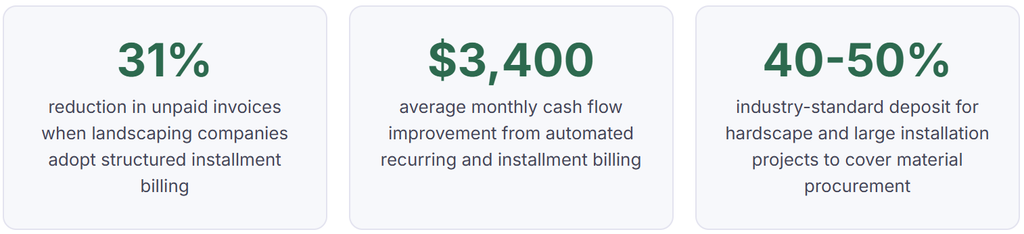
The problem is compounded by the timeline of a large project. A backyard renovation that runs four to six weeks puts your crew on site every day while income does not arrive until the end. If the client is slow to approve the final invoice, or if there is a dispute over a punch-list item, that end-of-project payment can slip by weeks. Meanwhile, payroll does not slip. Equipment financing does not slip. Supplier accounts do not slip.
Installment billing does not eliminate these dynamics. But it fundamentally reshapes them. When you collect 35 to 40 percent at signing, another 30 percent at a midpoint milestone, and the final 25 to 30 percent on completion, your worst-case scenario shifts from “waiting for full payment while the job is done” to “waiting for the final tranche while 65 to 75 percent of revenue is already in your account.” That is a qualitatively different operating position.
Payment Structures: Milestone vs. Time-Based vs. Equal Installments
There are three primary ways to structure installment payments for a landscaping project. Each has a legitimate use case, and the choice should follow the project type and duration rather than personal preference or what seemed to work last time.
Milestone-based billing
Each payment is triggered by completing a specific, visible phase of work. The client pays when they can see that something concrete has been accomplished: excavation is done, hardscape is installed, and planting is complete. This is the most transparent structure from the client’s perspective and the most defensible in a dispute, because the payment trigger is a physical condition of the site, not a calendar date.
The drawback is that milestones can slip due to weather, material delays, or subcontractor scheduling. When a milestone slips, the payment tied to it slips with it. If you have committed to supplier invoices on a 30-day terms basis and your milestone payment is two weeks late because of rain delays, you absorb the gap. The fix is building weather-related delay clauses into your contract and setting milestone payment due dates as “within 3 business days of milestone notification” rather than on a specific calendar date.
Time-based (calendar) billing
Payments are scheduled on specific dates regardless of project progress: week 1, week 3, project completion. This structure is simpler to administer and easier for clients to budget around because the payment dates are fixed. The risk is that a calendar-based payment may fall before or after the work that logically justifies it, which can create friction if a client who has not seen visible progress in week 3 receives an invoice on schedule.
Time-based billing works best on projects where work is continuous and spread evenly across the timeline, such as a large planting installation or an ongoing landscape refresh rather than a hardscape build with distinct phases.
Equal installment billing
The total project cost is divided into equal payments at defined intervals: for example, three payments of $7,333 each for a $22,000 project, paid at contract signing, at the midpoint, and on completion. This is the easiest structure for clients to understand and requires no milestone definition or calendar complexity.
The limitation is that equal installments may not align with your actual cost curve. If 60 percent of your material costs hit in the first week, an equal three-payment structure still leaves you funding a significant gap between your first payment and your actual spend. For projects with front-loaded material costs, a front-weighted installment structure (higher initial payment, smaller subsequent payments) is usually more appropriate than perfectly equal splits.
A Real-World Installment Schedule for a $22,000 Project
The sample below reflects the payment structure used on a residential backyard project involving excavation, flagstone patio installation, retaining wall, drainage work, and perimeter planting. The project timeline was approximately five weeks with a four-person crew.
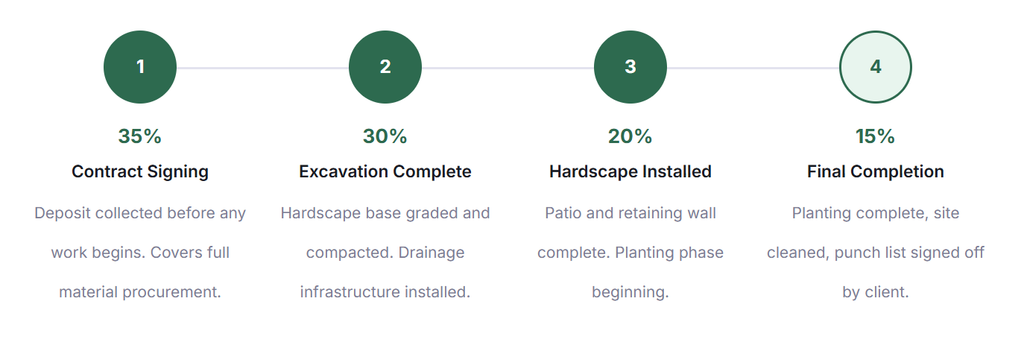
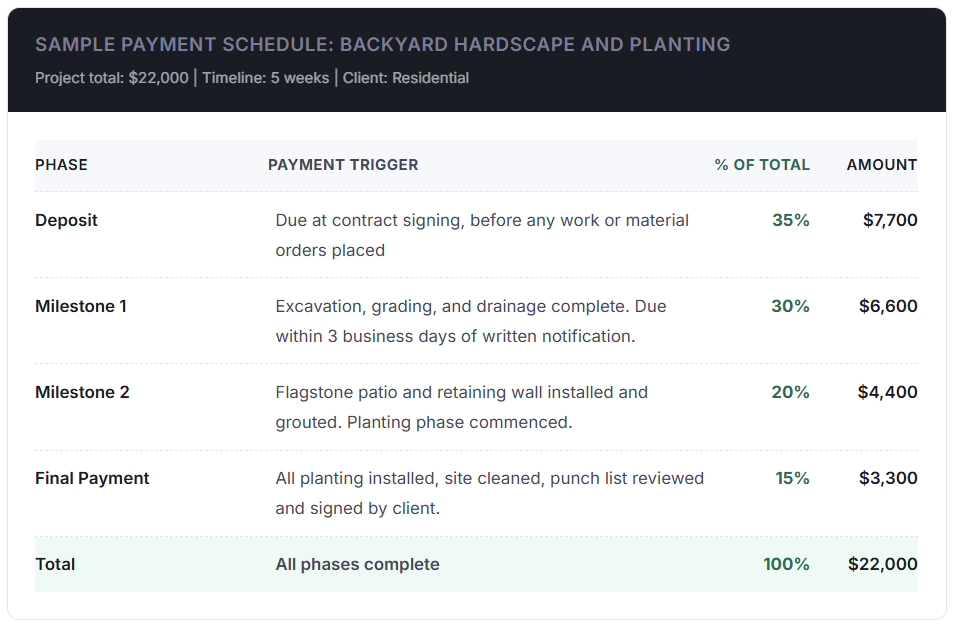
Notice that the final payment is intentionally kept small at 15 percent. This is a deliberate positioning choice. A small final payment is easy for a client to release because it does not feel like a large financial decision. A large final payment (40 to 50 percent of total) creates a powerful incentive for clients to find punch-list items and delay sign-off, because holding the final payment gives them leverage. Front-loading your payment schedule protects your cash position and removes that incentive.
How to Run the Billing Cycle, Step by Step
1. Build the payment schedule into the contract before signing
Every installment amount, trigger condition, and payment due date must appear in the signed project agreement before work begins. Verbal payment schedules are not enforceable. The contract must specify what “milestone completion” looks like for each phase so there is no ambiguity about when a payment obligation is triggered.
2. Collect the deposit before ordering materials
Do not place material orders until the deposit has cleared. This is not a policy the client needs to argue with; it is a standard practice that any professional contractor follows. Frame it as your standard process: “Our materials get ordered once the deposit is received, which holds your project on the schedule.” Any client who objects to a deposit is a risk signal worth taking seriously.
3. Document milestone completion before sending the invoice
When a milestone is reached, send the client a written notification, by email at minimum, with photos of the completed phase and a statement that the next payment is now due. This documentation serves two purposes: it triggers the client’s payment obligation clearly and it creates a timestamped record that the milestone was completed and acknowledged before the invoice was issued.
4. Issue the milestone invoice with a defined due window
Your contract specifies payment due within a set number of days of milestone notification. Your invoice should restate that due date explicitly and match the payment amount precisely to what the contract schedule shows. Discrepancies between contract amounts and invoice amounts are the most common trigger for client payment holds and are entirely avoidable.
5. Automate reminders and track payment status
For multi-invoice projects, manual payment tracking gets complicated quickly, especially when you are running multiple jobs simultaneously. Using a platform that supports installment billing with automated reminders means your system sends a due-date reminder without you remembering to do it and flags overdue invoices before they become delinquent accounts.
6. Process the final payment and issue a project close-out
On completion, collect the final payment, issue a paid-in-full receipt that references the original contract, and send a brief written confirmation that the project is complete and the warranty period has begun. This close-out documentation matters if a warranty claim arises months later and you need to establish the timeline.
What Your Contract Must Say
A payment schedule without enforceable contract language is a suggestion. The following clauses are not optional if you want installment billing to actually protect you when a client decides to stop paying at milestone 2 of a 4-payment project.
The payment schedule clause
State each payment amount, the percentage it represents of the total contract value, and the specific trigger condition that makes the payment due. Avoid vague language like “upon substantial completion of the excavation phase.” Define instead: “Payment 2 is due within 3 business days of written notification from contractor that excavation, grading, and drainage installation are complete, accompanied by photographs of the completed work.”
The work stoppage clause
This is the clause most landscaping contracts omit, and its absence is what creates the situation where a crew continues working on a project while an overdue invoice from a prior milestone sits unpaid. State explicitly: “Contractor reserves the right to suspend work if any scheduled payment is not received within [X] days of the due date, without penalty to contractor.” This clause is what gives you the ability to stop a job without breaching the contract yourself.
The change order clause
Any work beyond the original contract scope requires a written change order signed by both parties before the additional work begins. The change order specifies the additional work, the additional cost, and the payment terms for that cost, which may be separate from the existing installment schedule. Without this clause, scope additions become verbal agreements that are unenforceable and typically unpaid.
The weather and force majeure clause
Timeline delays due to weather, material supply disruptions, or other conditions outside your control should be explicitly acknowledged in the contract as non-breach events that extend the project timeline without triggering penalties. Without this language, a client whose project is delayed by three weeks of rain has potential grounds to claim breach if your contract specifies a delivery date you cannot meet.
Key Benefits for Landscaping Operators
Material cost protection from day one
A deposit sized to cover material procurement means you never finance a client’s materials from your operating account. On a $22,000 project, a 35 percent deposit ($7,700) typically covers the full materials cost with a buffer for overages. If the client cancels after materials are ordered, you are covered. If material prices spike between estimate and order date, you have margin to absorb it.
Client disengagement detection
This benefit is underappreciated and almost never mentioned in generic billing guides. When a client misses a milestone payment, it is almost always an early signal of a problem that will get worse, not better, by the time you reach final invoice. A missed payment at milestone 2 tells you something important while 65 percent of the project value is still uncollected and you still have leverage to stop work and have a conversation. A missed final invoice tells you the same thing after you have nothing left to withhold.
Stronger client commitment to completion
Clients who have made two or three payments on a project have a financial stake in seeing it through to completion. The sunk cost dynamic works in your favor: a client who has paid $15,000 of a $22,000 contract is highly motivated to pay the remaining $7,000 and receive a finished project rather than abandon the relationship. A client who has paid only a $5,000 deposit has less skin in the game.
Risks and Things to Watch For
Vague milestone definitions create disputes
The most common installment billing problem in landscaping is not client non-payment. It is disagreement about whether a milestone has been reached. “Excavation complete” sounds clear until the client argues that the drainage wasn’t part of that phase. “Planting finished” is ambiguous if some plant material was backordered. Each milestone definition in your contract should describe a condition that both parties can independently observe and confirm without interpretation. If your milestone description requires you to explain what it means, rewrite it.
Seasonal payment timing issues
A project that spans a seasonal transition, such as a late-summer planting that runs into fall, may encounter payment timing issues if the billing cycle extends further than planned. A client who agreed to a 5-week payment schedule in August may push back on a progress payment in week 8 if the project has been affected by weather delays. Build explicit weather and delay language into your contracts so that extended timelines do not create payment obligation ambiguity.
Over-front-loading the payment schedule
Requiring 60 percent or more upfront will deter clients, particularly residential clients who have been advised by contractors or consumer protection resources to be wary of large upfront payments. A deposit in the 30 to 40 percent range is defensible and common. Above 50 percent, you will encounter significant resistance and may lose jobs you would otherwise win.
Incomplete change order management
When scope changes are managed verbally and not incorporated into the installment schedule, they create a billing conflict at project close. The client believes the change was included in the original price; you believe it is additional. Without a signed change order that specifies the dollar amount and whether it is added to an existing installment or billed separately, these disputes are very difficult to resolve in your favor.
Comparison: Billing Structures for Landscaping Projects
| Billing Structure | Best Project Fit | Cash Flow Protection | Client Acceptance | Admin Complexity | Dispute Risk |
|---|---|---|---|---|---|
| Deposit only, final at completion | Small jobs under $5,000 | Partial | High | Low | Moderate (final invoice exposure) |
| Equal installments (3-4 payments) | Medium projects, continuous work | Good | High | Moderate | Low |
| Milestone-based billing | Large phased projects (hardscape) | Very Good | Moderate | Higher (milestone documentation) | Low if well-defined, High if vague |
| Full payment upfront | Material-only or supply orders | Maximum | Low (client resistance) | Low | High (client has no leverage) |
| Net 30 single invoice | Established commercial clients | Poor | High | Low | Moderate (end-of-project exposure) |
| Monthly retainer (recurring) | Ongoing maintenance contracts | Very Good | High | Low (automated) | Low |
The table above clarifies something that is not always obvious: installment billing and recurring billing solve different problems for landscaping businesses. Recurring billing is the right structure for ongoing maintenance work where the service repeats on a fixed schedule and the monthly amount is known in advance. Installment billing is the right structure for project work where the total is fixed but the timeline is extended. Many landscaping businesses need both, and they should be managed separately rather than forcing project billing into a recurring billing framework or vice versa.
What I Got Wrong at First: Common Landscaping Billing Mistakes
Mistake 1: Tying payment triggers to subjective language
The first few milestone billing contracts I built used phrases like “once the site looks ready for hardscape” and “upon client satisfaction with planting.” Those phrases are unenforceable. “Client satisfaction” is whatever the client decides it is at the moment they receive the invoice, which often changes depending on how much money they currently feel like spending. Every milestone trigger should describe a physical state of the site that can be photographed and documented without involving client opinion. “Excavation complete, sub-base compacted to grade, drainage pipe installed and backfilled” is a milestone. “Site prepared to client’s satisfaction” is not.
Mistake 2: Setting the deposit too low to cover materials
A 10 or 15 percent deposit feels easier to sell to a client, but on a materials-heavy project it leaves you funding the gap yourself. The psychology of a small deposit is appealing in the sales conversation but creates a real cash problem when your supplier invoice arrives 30 days into a job where you collected $2,200 upfront and spent $8,000 in materials. The correct deposit size is whatever covers your full materials procurement cost, which on most hardscape projects is 30 to 40 percent of the total contract value. Clients who understand what they are paying for rarely object to a deposit framed as covering the material order.
Mistake 3: Not sending milestone notification before the invoice
Sending a progress invoice without first notifying the client that the milestone is complete and asking them to confirm creates a jarring experience for the client, who receives an unexpected financial demand. The two-step process, notification with photos followed by invoice issuance, takes five additional minutes and produces a completely different client response. The notification is the conversational handshake; the invoice is the paperwork that follows it. Running them together removes the handshake, and the invoice feels adversarial.
Mistake 4: Continuing to work when a milestone payment is overdue
This is the most expensive mistake on the list, and it is the one that is hardest to learn without experiencing it. The reasoning is understandable: you do not want to confront the client, you have a crew on site, stopping work is operationally disruptive. But continuing work on an unpaid milestone is funding the next phase of the project from your operating account and sending a clear message to the client that payment deadlines are suggestions rather than obligations. The work stoppage clause in your contract exists precisely for this situation. Use it.
Mistake 5: Managing installment schedules across multiple projects with a spreadsheet
A spreadsheet works for one project. It breaks down fast across three or four simultaneous projects with different milestone dates, different payment amounts, and different clients. The moment you miss a milestone invoice because you forgot which project was at what stage, you have lost a payment that was ready to be collected. Using billing software that tracks installment schedules, sends automated reminders, and shows you a project-by-project receivables view is not a luxury at that scale. It is an operational requirement, and the time savings alone justify the cost within the first billing cycle. The customer management layer, which keeps all client history and payment status in one place, is what makes the difference between chasing payments and receiving them.
How to Get Started with Landscaping Installment Billing
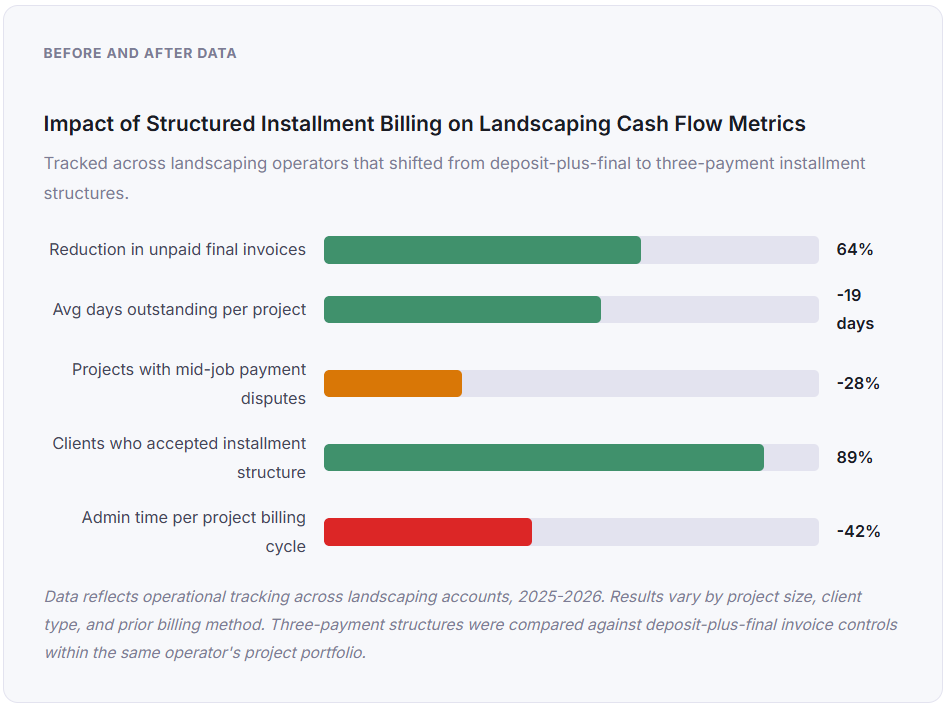
The transition to installment billing is simpler than most landscaping operators expect. The most common concern is that clients will resist the structure. In practice, the 89 percent client acceptance rate shown in the data above reflects a reality that most operators who make the switch confirm: clients understand that a large project requires a structured payment plan. The resistance is usually at the sales stage before they know you well, and it evaporates when the payment schedule is framed as professional standard practice rather than a demand.
Start with your next project above a defined threshold. A common starting point is any project over $8,000 or $10,000. Below that threshold, a simple deposit-plus-final structure is usually adequate. Above it, the cash flow benefits of a three-payment installment structure are worth the additional contract work.
Audit your current contract template and add the four clauses described in this guide: the payment schedule clause, the work stoppage clause, the change order clause, and the weather and force majeure clause. These additions take about an hour of your time and a review by a contract attorney familiar with contractor law in your state is a worthwhile investment for businesses doing significant project volume.
For the billing and tracking side, a platform that supports installment billing natively, where you configure the full payment schedule for a project once and the system issues each invoice and reminder automatically at the right time, reduces the administrative overhead of the entire system to near zero. This is particularly valuable when you are running multiple large projects simultaneously and need to track milestone status and payment status across all of them without relying on a manually maintained spreadsheet.
If your business also runs ongoing maintenance contracts alongside project work, platforms like ReliaBills allow you to manage both recurring billing for maintenance clients and installment schedules for project clients within the same system, so your full accounts receivable picture is in one place rather than split across separate tools.
Frequently Asked Questions
1. What is landscaping installment billing?
Landscaping installment billing is a payment arrangement where the client pays for a large landscaping project in several scheduled installments rather than paying the entire project price upfront or at completion. Payments may be tied to specific dates, percentages of work completed, project phases, or milestones such as site preparation, hardscaping, planting, and final completion.
A written payment schedule should clearly state the installment amount, due date or completion condition, work covered, and any applicable deposit or retention. Progress-based payment systems are commonly structured around the value of work actually completed.
2. How much should I charge as a deposit for a large landscaping project?
There is no universal deposit percentage that applies to every landscaping project. The appropriate amount depends on the project’s size, material requirements, equipment, labor, local laws, and the terms agreed upon with the client.
For a large project, the deposit should generally be enough to cover reasonable startup costs such as mobilization, initial materials, permits, and site preparation without requiring the client to pay most of the contract price before significant work is performed. The remaining balance can then be divided into progress installments.
For example, a contractor might structure a project as an initial deposit followed by installments tied to agreed project stages. In Philippine construction guidance, the amount of an advance payment is described as something mutually agreed upon by the owner and contractor, with the advance intended for mobilization and materials and recouped through progress billings.
3. What is the difference between milestone billing and installment billing in landscaping?
Milestone billing bases payments on the completion of specific stages or milestones, while installment billing generally refers to dividing the total price into multiple scheduled payments.
For example:
- Milestone billing: 20% after site preparation, 30% after hardscaping, 30% after planting, and 20% at completion.
- Installment billing: Four equal payments due at agreed intervals, regardless of whether each payment corresponds exactly to a completed project phase.
For large landscaping projects, milestone billing can provide clearer alignment between payments and actual progress. However, either approach can work if the contract clearly defines when each payment becomes due.
4. Can I stop work if a client does not pay a progress installment on time?
Potentially, but you should follow the contract before stopping work. The landscaping agreement should specify what happens when an installment becomes overdue, such as a written notice, grace period, late-payment charges where legally permitted, suspension of work, or termination.
Do not assume that an overdue payment automatically gives you the right to abandon the project. Check the contract and applicable local law first. For example, Philippine construction contract guidance provides circumstances under which a contractor may suspend or terminate work because of unpaid approved billings.
A practical contract should therefore explain the notice required before work can be suspended and how the schedule will be adjusted if the suspension occurs.
5. How do I handle change orders when using an installment payment schedule?
Handle change orders in writing before performing the additional or revised work whenever possible. The change order should identify the requested change, additional or reduced cost, effect on the payment schedule, and any effect on the completion date.
For example, if a client adds a retaining wall after the original contract is signed, you can issue a change order showing the additional price and specify whether part of that amount is due when the change is approved or when the related work begins.
A formal change-order process is important because changes can affect both the contract price and completion time. Philippine construction guidance similarly provides for written change orders and adjustments when changes alter the contract price or time.
6. What happens to the payment schedule if the project is delayed by weather?
The answer should be established in the contract. Weather-related delays may justify moving project deadlines and corresponding progress milestones when the weather makes the work impractical or unsafe, but the exact financial effect depends on the agreement.
For example, if heavy rain prevents excavation or concrete work, the contractor can document the affected days and revise the projected completion date. If an installment is tied to completion of the delayed phase, its due date may also need to move.
The contract should distinguish between excusable weather delays and ordinary weather conditions that were reasonably expected when the schedule was created. Philippine construction guidance specifically recognizes unsuitable weather conditions as a potential basis for an extension of completion time.
7. How many installment payments should I use for a large landscaping project?
There is no fixed number of installments that works for every landscaping project. The number should reflect the project’s size, duration, cash-flow requirements, material purchases, and number of major phases.
For a large project, a practical structure might include:
- Initial deposit: to cover mobilization and initial materials.
- Site preparation installment: after clearing, grading, drainage, or excavation.
- Hardscape installment: after substantial completion of patios, walls, walkways, or other structures.
- Planting/landscape installation installment: after major planting and installation work.
- Final payment: after completion, inspection, and agreed punch-list items.
The important principle is to make each payment schedule clear, measurable, and proportional to the work being performed. A construction payment schedule can be based on the value of work accomplished rather than simply dividing the total price into arbitrary amounts.
Recent Articles:
- Parent Payment Portal: Why Childcare Centers Need Online Payment Options
- Security Guard Services Invoice Template: What to Include