
Catering installment billing structures the total event cost into scheduled partial payments tied to key planning milestones, booking confirmation, menu finalization, and final guest count confirmation, rather than collecting a single deposit and a single final payment. The three-phase installment model reduces no-show risk at each milestone, gives caterers cash flow for food procurement and staffing deposits, and creates a contractual paper trail that makes guest count disputes and late cancellations far easier to resolve in the caterer’s favor. The structure is already standard in the venue industry. Most catering businesses have not yet adopted it.
What Is Catering Installment Billing?
Catering installment billing is a payment structure in which the total cost of a catering event is divided into two or more scheduled partial payments, each tied to a specific milestone in the event planning process, rather than collected as a single deposit followed by a single final payment. The schedule is defined at contract signing, disclosed to the client in the catering agreement, and enforced through automated billing or manually tracked payment requests.
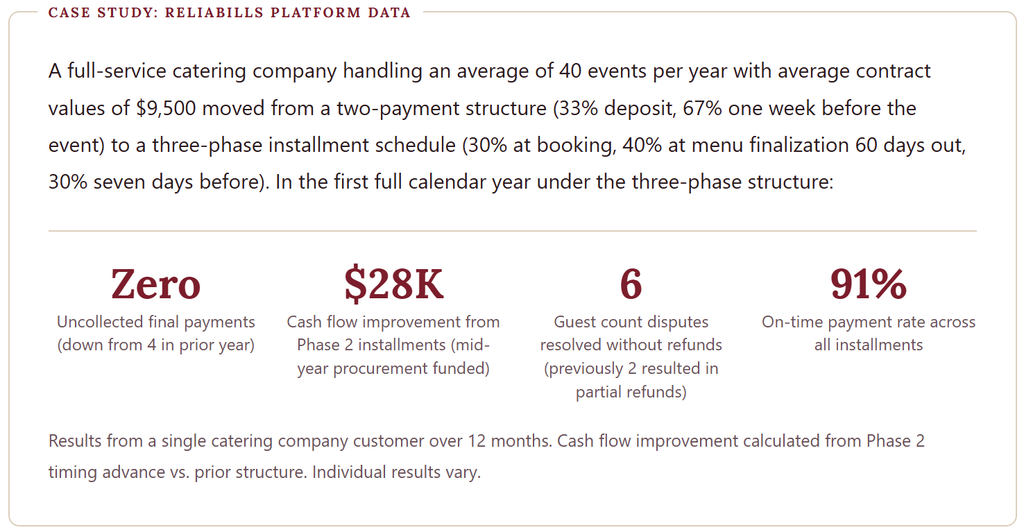
The distinction from simple deposit-plus-final billing is that installment billing creates multiple financial commitments from the client throughout the planning process. Each installment serves a function: the booking deposit secures the date, the mid-planning installment funds early procurement and vendor deposits, and the final installment captures the confirmed guest count before the caterer begins final preparation. This is not merely a cash flow convenience. It is a risk management tool that changes the client’s behavior at each stage of the planning process.
For catering businesses with recurring corporate clients on annual event contracts, this connects directly to recurring billing infrastructure, where installment schedules repeat across multiple events within the same client relationship. For individual events, the installment structure is a form of installment billing applied to a single, time-bound service engagement. Both cases benefit from a billing system that tracks the outstanding balance and sends automated payment reminders as each milestone date approaches.
The Three-Phase Installment Schedule: How It Works
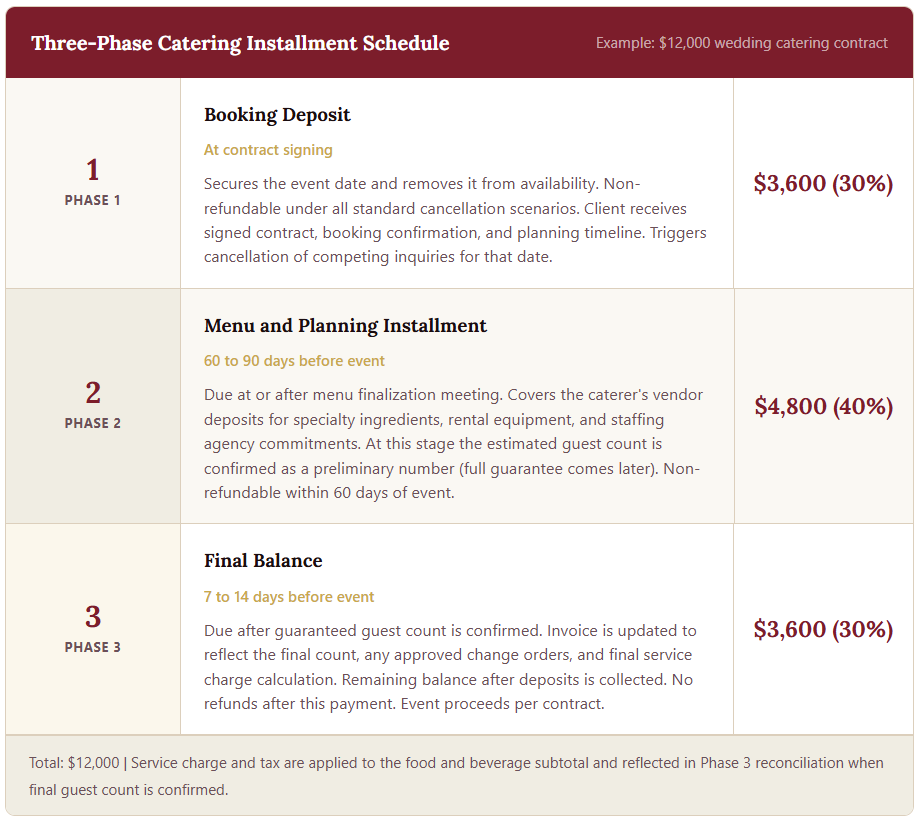
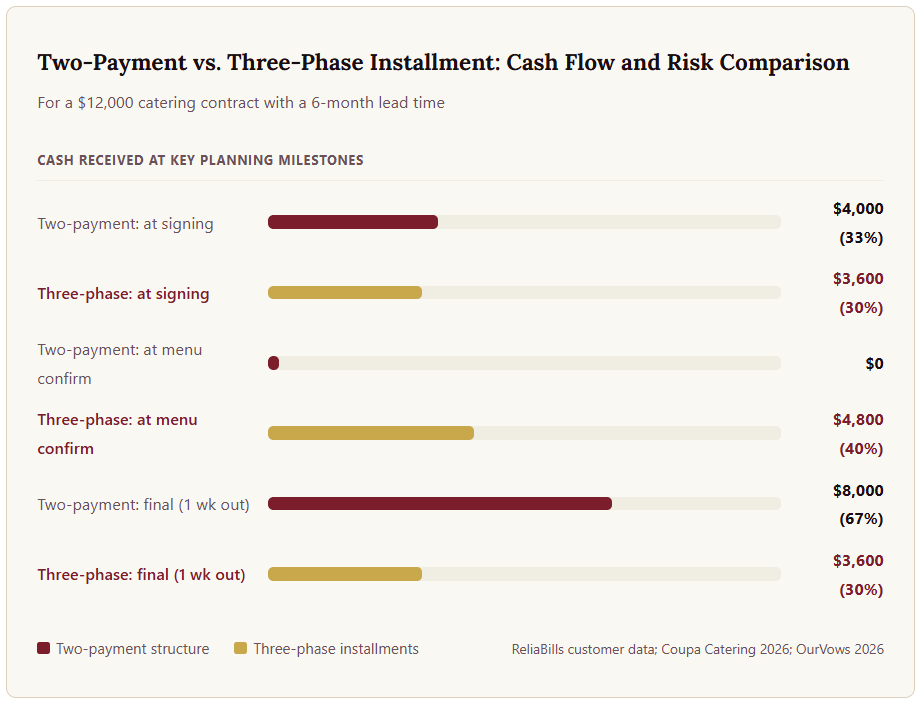
The standard two-payment structure (deposit at booking, balance before the event) leaves a gap of months between the caterer’s financial security and the client’s last opportunity to change their mind. The three-phase model fills that gap with a milestone tied to the moment the event plan solidifies. Here is what the schedule looks like for a $12,000 wedding catering contract:
Why milestone-linked installments outperform arbitrary payment dates
A payment schedule that says “50% due at booking, 50% due 30 days before the event” is calendar-based. A schedule tied to milestones is event-logic-based. The difference matters because the menu finalization meeting is the natural moment at which the caterer needs the Phase 2 payment: vendor deposits for specialty ingredients are placed after that meeting. If the client misses the Phase 2 payment, the caterer knows before placing orders rather than discovering the problem while holding inventory. The milestone structure aligns financial commitments with operational decisions, which is the underlying reason it performs better than arbitrary date schedules for both parties.
The Guest Count Adjustment Problem Most Guides Miss
Why guest count adjustments are the most common billing dispute in catering
The guest count guarantee is the specific clause that generates the most catering billing disputes. CaterCamp’s 2026 catering contracts guide identifies it directly: “Clients sometimes argue that fewer guests attended than the final count they provided. Your contract should make clear that you produce and staff based on the confirmed count, and billing is based on that count regardless of actual attendance. This is the clause most caterers get wrong.”
The scenario: a client confirms 180 guests 10 days before the event. The caterer purchases food, schedules 12 servers, and arranges 180 place settings. On the day of the event, 155 guests attend. The client’s first instinct is to request a refund for the 25 guests who did not appear. The caterer’s contract says billing is based on the guaranteed count, not actual attendance. But if the contract language is ambiguous, or if the caterer never explained this at booking, the client feels legitimately wronged even though the caterer’s position is financially correct.
The guest count adjustment window and its billing implications
Industry-standard practice, documented by LegalGPS’s 2025 catering contract analysis, allows guest count modifications up to a defined cutoff, typically 7 to 14 days before the event, with the final guaranteed count locked after that deadline. Within the installment billing structure, this creates a practical billing workflow: Phase 3 (the final balance) is calculated only after the guest count deadline passes, incorporating the confirmed count into the final invoice. Clients who increase their count after Phase 3 is issued receive a change order invoice for the additional guests at a per-head rate specified in the original contract.
Service Charges, Gratuity, and the Invoice Transparency That Prevents Disputes
The service charge structure in catering is the second most common source of billing disputes, almost always because clients conflate the service charge with gratuity and believe they have already tipped the staff. They have not. OurVows’ 2026 wedding vendor payment guide flags this directly: “Service charges are typically 20 to 24% for catering and venues. Small fees that add up when multiplied by 150 guests.” That 20 to 24% represents real labor cost, not a tip distribution. Invoices that show only “Service Charge: 22%” without explanation will generate questions every time.
What the service charge covers should appear on every invoice and in the contract: staffing (servers, setup crew, breakdown crew), equipment transport and setup, event coordination time, and post-event cleanup. Gratuity, if offered as an option, is a separate line. A client who understands that the service charge funds operations rather than server tips does not dispute it. A client who discovers it for the first time on the final invoice at 22% of a $12,000 catering bill, which is $2,640, will almost always call to question it.
Real-World Use Cases by Event Type
Wedding catering (the highest-value, highest-risk event category)
Wedding catering contracts are typically the largest individual catering engagements a full-service caterer takes on: average total values range from $8,000 to $40,000 depending on guest count and service style. OurVows’ 2026 vendor payment research documents the standard payment architecture: “Payment 1 at contract signing: 25 to 30% of estimated total as a deposit. Payment 2 approximately 6 months before the wedding: 25 to 35% as a second installment, often coinciding with menu selection. Final balance: 2 to 4 weeks before the wedding based on confirmed guest count.” The three-phase structure described in this guide maps directly to this industry-standard model. Caterers who have not adopted it are the outliers, not the ones who have.
Corporate event catering (recurring relationships and annual contracts)
Corporate catering clients, particularly those contracting for annual conferences, product launches, and recurring quarterly events, represent the opportunity to move from event-by-event installment billing to an ongoing recurring billing relationship. A corporate client who runs four annual events and confirms them in a single annual contract can be billed on a recurring monthly schedule with each event’s installments incorporated into the annual billing calendar. This structure benefits the caterer (predictable monthly revenue throughout the year), the client (simplified budgeting), and the event planning process (all deadlines pre-established in a single agreement). See customer management for how to structure annual corporate client records to support this approach.
Social events: milestone birthday parties, anniversary celebrations, and fundraisers
Social events in the $3,000 to $10,000 range benefit from a simplified two-phase installment (50% at booking, 50% 14 days before) rather than the full three-phase structure used for weddings. The planning timeline is shorter, menu customization is less complex, and the client relationship is typically single-event rather than ongoing. The critical billing element remains the same: the final installment must be collected before the event, not at or after the event. Kaspar’s Catering’s 2026 payment policy guide states the operational rationale simply: “Final payment is usually due one to two weeks prior to the event.” Once the event has occurred, the caterer has lost most of the financial leverage that existed before the event, and collections become significantly more difficult.
Chargeback Protection: Why Payment Method Matters for Catering Deposits
The chargeback risk in catering that most billing guides ignore
A catering deposit forfeited for legitimate reasons (client cancellation within the non-refundable window) can still be reversed by the client’s bank through a chargeback. When a client tells their bank “I didn’t get the service I paid for,” the bank initiates a dispute process. The caterer must provide evidence that the deposit terms were disclosed and agreed to at the time of payment. Without documented evidence of the agreed terms, the bank sides with the cardholder most of the time.
ACH and bank transfer for large final payments
For final payments on large events (over $5,000), ACH bank transfer is the payment method that produces the best outcome for caterers: processing fees are dramatically lower than card rates (typically 0.5 to 1.5% capped versus 2.9% plus $0.30 per transaction uncapped), and the payment is not subject to chargebacks in the same way credit card transactions are. On an $8,000 final payment, the difference between ACH at a capped $5 fee and card at 2.9% plus $0.30 is $227. Over 40 events per year, that difference is nearly $9,000 in processing cost. Offering ACH as the preferred payment method for final balances, with a credit card option that passes the processing fee to the client, is standard practice for caterers billing above $5,000 per event.
What I Got Wrong at First: Common Catering Billing Mistakes
Mistake 1: Collecting deposits without a signed digital agreement on non-refundable terms
A catering company that collects a deposit verbally, over the phone, or through a payment link without a signed contract has collected money without chargeback protection. When the client cancels and their bank issues a chargeback, the caterer has no evidence that the non-refundable terms were disclosed and accepted. The chargeback succeeds, the deposit is returned plus a dispute fee, and the date that was held for months is now unrecoverable revenue.
Fix: Every deposit payment must follow a signed digital contract that includes the specific non-refundable terms. The contract should require the client’s initials next to the cancellation and refund policy clause, not just a signature at the bottom of the full document. Retain the signed contract and the payment confirmation email in the same client record. When a chargeback arrives, both documents are your defense.
Mistake 2: Collecting the final payment at or after the event
Collecting final payment at event check-in, or issuing a final invoice after the event is over, eliminates the caterer’s financial leverage entirely. Once the event has occurred, the client has received the service. The caterer has no remedy for non-payment beyond collections, which is slow, expensive, and damages a client relationship that the caterer valued enough to serve. The caterer who collects final payment after the event is also the one who discovers, too late, that the client’s card was declined and there is no payment method on file to retry.
Fix: Collect the full remaining balance 7 to 14 days before the event, after the guaranteed guest count has been confirmed. This is the industry standard. Kaspar’s Catering’s 2026 policy confirms: “Final Payment is usually due one to two weeks prior to the event.” Configure automated payment reminders 14 days out, 10 days out, and 7 days out. If the final payment is not received by 5 days before the event, the event should be considered financially at risk and addressed directly, not assumed to be coming.
Mistake 3: Allowing guest count reductions after the guarantee deadline without charging the contracted minimum
The most financially expensive catering billing mistake is systematic: a caterer who books 150 guests, prepares for 150 guests, and agrees to rebill for only 130 because “that’s how many actually came” is absorbing the food and staffing cost for 20 people with no revenue to cover it. Multiplied across 10 events per season where the same informal policy applies, this represents thousands of dollars in uncollected revenue that the caterer believes is a client service gesture but is actually a structural billing failure.
Fix: The guaranteed guest count clause must state explicitly that billing is based on the guaranteed count or actual attendance, whichever is higher, and apply it consistently. CaterCamp’s 2026 guide is direct: “Your contract should make clear that you produce and staff based on the confirmed count, and billing is based on that count regardless of actual attendance.” A caterer who explains this policy clearly at contract signing will encounter almost no resistance. A caterer who tries to enforce it for the first time at post-event billing will face a dispute every time.
Mistake 4: Bundling service charges into the total without itemizing them
A final invoice that shows “Catering Services: $14,640” without breaking out the food and beverage subtotal, the 22% service charge, and applicable taxes gives the client a total they cannot verify and creates confusion about what the service charge represents. Clients who see a service charge for the first time on the final invoice, rather than in the original contract proposal, feel surprised regardless of whether it was disclosed in the contract. The surprise triggers a dispute conversation that takes time and creates relationship friction even when it resolves in the caterer’s favor.
Fix: Every invoice at every phase of the installment schedule should show the structure of the total: estimated food and beverage, estimated service charge at the applicable rate, estimated tax, total estimated, and the amount due at this phase. When the Phase 3 invoice reconciles to the actual guest count, show the updated food and beverage, the updated service charge calculation, and the prior payments credited, leaving the final balance clearly visible. There should be no number on the invoice that the client cannot trace to its source.
How to Get Started: Setting Up Catering Installment Billing
Define your installment structure for each event category
Set the standard three-phase structure for events above $5,000 and a two-phase structure for smaller events. Document the percentage for each phase, the milestone that triggers each payment, and the cancellation consequence at each stage. This becomes your standard catering contract template rather than a case-by-case negotiation.
Update your catering contract to include the installment schedule explicitly
The contract should show each payment amount and percentage, the specific trigger date or milestone, the payment method for each phase, and the cancellation and non-refundability terms at each milestone. Require client initials next to the cancellation policy and the guaranteed guest count clause. For ongoing corporate clients, link the contract to your customer management records so installment schedules are visible alongside client event history.
Configure automated payment reminders for each installment
Set up reminders 14 days, 7 days, and 3 days before each installment due date. For Phase 3 (the final balance), add an additional 21-day reminder to give the client advance notice of the upcoming total. In ReliaBills, both the installment schedule and the automated reminders can be configured once per event and run without manual follow-up for each payment cycle.
Establish ACH as the preferred method for final payments above $3,000
Set up ACH bank transfer as the preferred option for Phase 2 and Phase 3 payments on large events. Offer a card payment link as the alternative with a disclosed processing fee surcharge (typically 2.9% to 3.5%). Most clients on large events will choose ACH when the fee difference is explained. Your billing platform should support both options from the same invoice.
Build the final invoice template to show itemized reconciliation
The Phase 3 invoice should be a reconciliation document: starting from the original estimated total, showing the guest count adjustment (if any), the updated food and beverage total, the service charge calculated on the updated total, applicable taxes, prior payments received (Phase 1 and Phase 2 credits), and the final balance due. This format makes the math transparent and eliminates every “why is the total different from what we expected?” question before it can be asked. See invoicing software guidance for how to build this template efficiently.
Comparison: Standard Two-Payment vs. Three-Phase Installment Billing
| Factor | Two-Payment (deposit plus final) | Three-Phase Installments |
|---|---|---|
| Cash flow for vendor deposits | Gap between signing and final payment | Phase 2 funds procurement at menu confirmation |
| Client commitment reinforcement | One touchpoint between booking and event | Two additional commitment touchpoints |
| Guest count dispute risk | Final payment is often before the count is confirmed | Phase 3 calculated after guaranteed count is locked |
| Late cancellation financial protection | Deposit only (25 to 33%) | Phase 1 and 2 collected before cancellation risk peaks |
| Client experience | Large final payment is stressful | Smaller, predictable installments are easier to budget |
| Contract complexity | Simpler to explain | Requires clear milestone definitions |
| Final payment amount | 67% at the end (high risk if declined) | 30% at the end (low risk if declined) |
Frequently Asked Questions
1. What is a standard catering deposit percentage?
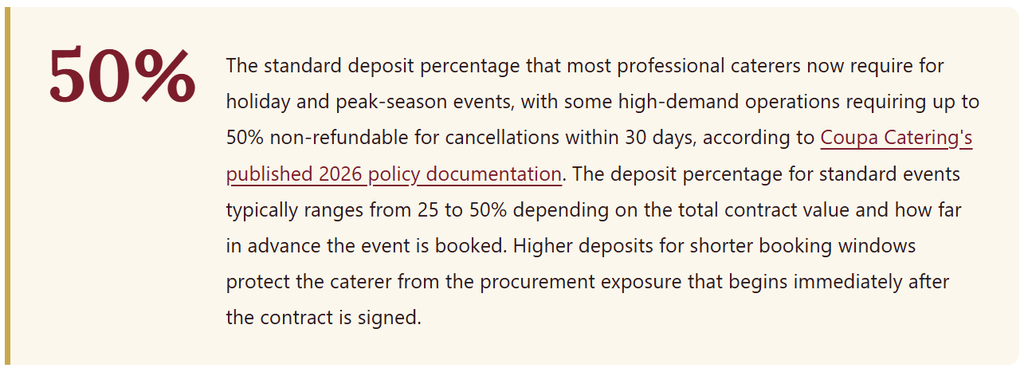
For standard events, a catering deposit of 25 to 33% of the estimated total is the most common range. For peak-season events (holiday weekends, major wedding dates, and graduation season), 50% deposits are increasingly standard. The deposit percentage should reflect the caterer’s actual financial exposure at the point of booking: if securing the date requires turning away other inquiries and placing early vendor reservations, the deposit needs to cover at least those committed costs. Most professional caterers now require the booking deposit to be non-refundable under standard cancellation circumstances, with the specific terms stated explicitly in the contract rather than implied.
2. When should caterers collect the final payment?
7 to 14 days before the event is industry standard and operationally optimal. At 7 to 14 days, the guaranteed guest count has been confirmed, the caterer can reconcile the invoice to the actual count, and there is still time to address a declined payment before the event date. Collecting final payment at the event, or after the event, removes all financial leverage the caterer has and creates the most difficult collections environment: the client has received the service, the caterer has spent the money on food and staffing, and the only remedy for non-payment is collections or legal action. Final payment must be collected before the event proceeds.
3. Can a client reduce their guest count after confirming it?
Per the guest count guarantee clause in a properly written catering contract, no. The guaranteed guest count locks the billing minimum, meaning the client is invoiced for the guaranteed count or actual attendance, whichever is higher. A client who confirms 180 guests and then has 155 attend is billed for 180 because the caterer purchased food, scheduled staff, and arranged service for 180. This policy should be explained clearly at contract signing and reiterated when the guest count deadline approaches. Clients who understand the rationale (the caterer has already committed costs based on the guaranteed count) almost always accept it. Clients who encounter it for the first time on the final invoice will dispute it.
4. What is the difference between a service charge and a gratuity in catering?
A service charge is a mandatory fee added to the catering subtotal, typically 18 to 24%, that covers operational costs including staffing, setup, equipment transport, event coordination, and breakdown. It is not a tip. It is revenue to the catering company that funds the labor and operational costs of executing the event. Gratuity is an optional additional payment given directly to service staff for excellent performance. Some catering contracts include an optional gratuity line; others leave it entirely to the client’s discretion after the event. The service charge should be itemized on every invoice and explained in the contract so clients understand that it funds operations, not individual staff compensation. This explanation eliminates the most common service charge dispute before it occurs.
5. How should caterers handle a cancellation mid-installment plan?
The catering contract should define the cancellation consequence at each stage of the installment plan. A typical structure: cancellation before Phase 2 forfeits the booking deposit (Phase 1) but has no further obligation. Cancellation after Phase 2 but more than 60 days before the event forfeits both Phase 1 and Phase 2. Cancellation within 60 days of the event forfeits all payments received. Cancellation within 30 days forfeits all payments and may require payment of the remaining balance as a cancellation fee if the caterer cannot rebook the date. The specific terms should be disclosed at signing, with the client initializing next to the cancellation policy. Consistent enforcement is what makes the policy meaningful. Caterers who waive cancellation fees on a case-by-case basis lose the deterrent effect for future bookings.
6. What payment methods should caterers accept for installments?
ACH bank transfer is optimal for Phase 2 and Phase 3 payments on large events due to significantly lower processing fees (typically 0.5 to 1.5% capped versus 2.9% plus $0.30 uncapped for cards). For a $6,000 Phase 2 payment, that is the difference between a $5 fee and a $174.30 fee. A credit card is appropriate for booking deposits (Phase 1) because the payment amount is smaller, and the client may want the chargeback protection that card offers as a buyer. A check is acceptable but creates a delay in confirming payment that can complicate the milestone timeline if a check takes 5 to 7 days to clear and the caterer needs to confirm the Phase 2 receipt before placing vendor deposits. Accept multiple methods with a preference structure disclosed to the client at booking.
Recent Articles:
- Collection Automation for Lawn and Landscape: How to Reduce Overdue Accounts
- How to Handle Late Childcare Payments Without Uncomfortable Conversations