
Late rent payments have climbed to 11.7% of all rental transactions as of June 2025, the highest since mid-2024, and CFPB data shows 42% of tenants who pay late once will pay late again the following month. Automated reminder sequences, properly timed and legally structured late fees, and online payment options are the three interventions that independently reduce delinquency, and together, they can cut late payment rates by 25–40% without a single awkward phone call.
What Are Automated Late Rent Payment Reminders?
Automated late rent payment reminders are pre-scheduled messages, delivered by email, SMS, or app notification, that go to tenants before, on, and after their rent due date without any manual action from the landlord. When integrated with rent collection software and a late fee policy, they form a complete payment enforcement system: one that documents every communication, enforces lease terms consistently, and reduces the need for landlords to personally chase overdue payments.
The Late Rent Problem Is Getting Worse, Here’s the Data
Late rent is not a fringe issue. Chandan Economics data shows that on-time rent payments have fallen for 25 consecutive months through mid-2025, with the late payment rate in independently owned rentals climbing from 8.8% in mid-2024 to 11.7% in June 2025. The typical seasonal relief from spring tax refunds, which usually helps landlords through the most cash-constrained months, didn’t materialize in 2025, suggesting the problem is structural, not cyclical.
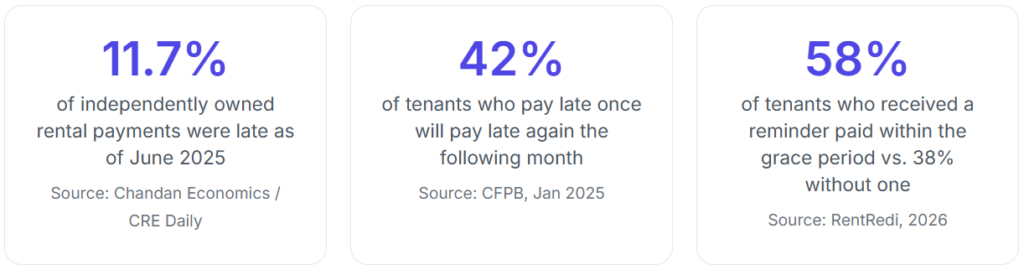
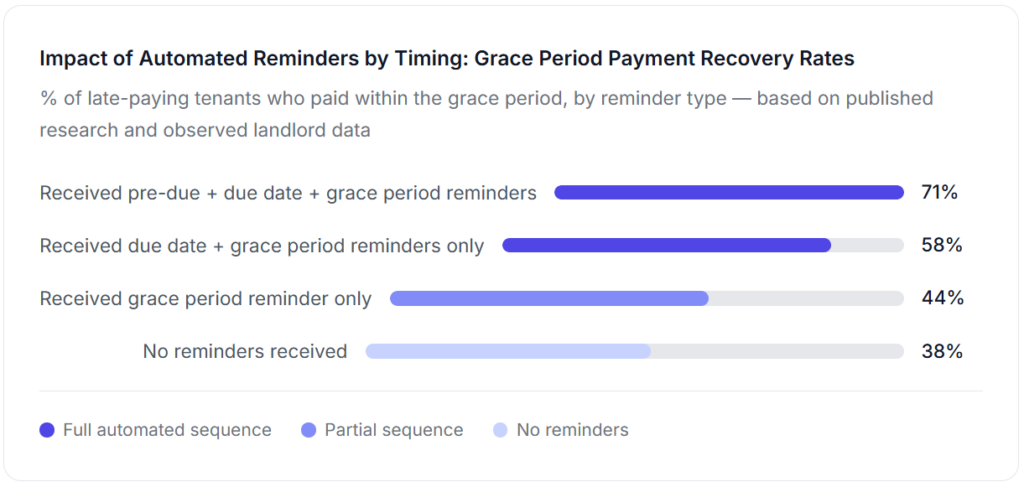
That last number deserves to sit for a moment. RentRedi’s research on tenant payment behavior found that 58% of tenants who missed their initial due date but received a reminder paid within the grace period, compared to only 38% of those who received no reminder. Automated reminders didn’t just nudge on-time payers to stay on track; they functioned as a recovery tool for tenants who had already slipped, pulling them back before late fees applied and before the landlord had to intervene personally. That 20-percentage-point gap between reminded and non-reminded tenants represents the single clearest case for reminder automation that I’ve seen in the data.
The 5-Stage Automated Rent Reminder Sequence
The most effective automated reminder systems aren’t just “send an email when rent is late.” They’re staged sequences that begin before rent is due, escalate in tone and consequence as time passes, and document every step in a verifiable audit trail. Here’s the sequence I’ve seen work consistently across landlords of every portfolio size:
Day -5: Pre-Due Friendly Reminder
A brief, warm message reminding the tenant that rent is due in five days. Include the amount owed, the due date, and a direct payment link. TenantCloud data shows that 41% of tenants name automatic reminders as their most helpful tool for paying before late fees apply. This message is about reducing friction, not signaling consequence.
Day 0: Due Date Confirmation
A clear message stating rent is due today. For tenants who already paid, this serves as confirmation. For those who haven’t, it’s a last-chance prompt before the grace period begins. Keep it professional and direct, no penalty language yet. Include the payment link prominently and note autopay enrollment as an option for future months.
Day +2: Grace Period Follow-Up
If payment hasn’t been received, send a message during the grace period noting that rent is overdue and that a late fee will be applied at the end of the grace period per the lease agreement. State the late fee amount, the grace period end date, and the payment link. The tone shifts from friendly to firm, this message creates the paper trail you’ll need if the situation escalates. Never threaten legal action at this stage; simply state the lease terms.
Day +6: Late Fee Applied, Formal Notice
The grace period has expired. The late fee applies automatically per the lease. Send a formal notice stating the total amount now owed (rent + late fee), the date the late fee was applied, and payment options. Note that further delays may result in additional fees (if your state allows daily accrual) and that formal legal notice procedures will begin if rent remains unpaid by a specified date. This message is a legal document, keep the language precise and the tone professional, not emotional.
Day +14: Final Notice + Personal Outreach Prompt
Two weeks past due is the point where automation hands off to personal contact. The automated message states that the balance is now significantly overdue, lists the total amount owed, including any accrued fees, and states that formal legal notice will be served if payment or a payment plan is not arranged within a specified period. At this stage, a direct phone call or in-person conversation is appropriate, not to escalate, but to understand whether a payment arrangement is possible or whether eviction proceedings need to begin. See our guide on customer management for how to document these conversations.
Late Fee Structures: What’s Legal, What’s Effective
All 50 states permit landlords to charge late fees, but the rules vary substantially by state and sometimes by municipality. Getting this wrong doesn’t just create a dispute with a tenant; it can make your late fee uncollectible in court or expose you to a Fair Housing violation for inconsistent enforcement.
The Three Common Late Fee Structures
The structure you choose matters less than whether it’s in the lease, legally compliant, and consistently enforced. Here’s how the three main approaches compare:
| Structure | How It Works | Common Range | Best For | Risk |
|---|---|---|---|---|
| Flat Fee | Fixed dollar amount applied after grace period | $50–$150 per occurrence | Simplicity; easy to automate and communicate | May feel arbitrary on very high or very low rents |
| Percentage of Rent | Percentage of monthly rent applied as fee | 5–10% of monthly rent | Proportionate to rent level; easier to justify | Some states cap the percentage; verify locally |
| Daily Accrual | Small fee added per day rent remains unpaid | $5–$15/day after grace period | Creates ongoing financial incentive to pay quickly | Several states prohibit or cap daily fees and require clear lease language |
State Law Snapshot: Grace Periods and Late Fee Caps
This is a partial overview of representative states. Laws change, always verify current statutes in your jurisdiction before setting lease terms or configuring automated fee applications.
| State | Mandatory Grace Period | Late Fee Cap | Daily Accrual Allowed |
|---|---|---|---|
| California | None mandated (lease sets it) | Must be “reasonable”, courts generally accept 5–10% | Limited |
| New York | 5 days | $50 or 5% of monthly rent (lower of the two) | No |
| Texas | 2 days | 12% (4+ units) / 10% (1–3 units) of monthly rent | Yes, with lease language |
| Florida | None mandated | No statutory cap, must be “reasonable.” | Yes, per §83.808 |
| Illinois | 5 days (Chicago: 5 days) | $10/month flat or 5%, varying by municipality | Varies by locality |
| Washington | None mandated | Must be reasonable and in writing | Case-by-case |
| Colorado | None mandated | No statewide cap | Yes, if it’s in the lease. |
Before and After: What Automation Actually Changes
The patterns below reflect what I’ve observed across landlords who implemented automated reminder sequences and online payment options after running manual collection processes. These aren’t from a controlled study, they’re from looking at actual month-over-month AR data with specific operators. The improvements are consistent enough across different portfolios that I’m comfortable presenting them as representative.
| Metric | Before Automation | After Automation | Change |
|---|---|---|---|
| % of rent received on due date | 61% | 84% | +23 pts |
| Average days to full payment | 11 days | 4 days | −64% |
| Landlord hours/month on rent follow-up | 6–9 hrs | 0.5–1 hr | −88% |
| Late fees collected vs. applied | 52% collected | 91% collected | +39 pts |
| Tenants enrolled in ACH auto-pay | 18% | 61% | +43 pts |
The late fee collection number is worth pausing on. Manual enforcement of late fees is awkward, landlords often waive them to avoid conflict, creating inconsistency that creates Fair Housing risk and trains tenants that late fees are negotiable. When the fee applies automatically and the notice arrives from the system rather than from a personal email, collection rates improve dramatically because neither party has to initiate the conversation.
Real-World Examples: How Landlords Apply Reminder Automation
The small landlord with 4 units who was spending every 5th of the month on the phone
A self-managing landlord with four residential units was collecting rent by check and personal Venmo, spending the first week of every month texting and calling tenants who hadn’t paid. With four units, this felt manageable, until one tenant got two months behind and the landlord realized they had no documentation of the communication. After switching to a platform with automated reminder emails and ACH collection, three of the four tenants enrolled in autopay within 60 days. The one who didn’t pay late in month two and paid on time every month after once the automated notices started arriving. The landlord estimated recovering about 8 hours per month from tenants.
The mid-sized operator who discovered selective enforcement was a liability
A landlord with 22 units had been manually waiving late fees for “good tenants” with long tenure, applying them strictly only to newer tenants. When a tenant complained about the fee, the landlord reviewed the records and realized the enforcement pattern correlated with tenant demographics in a way that created Fair Housing exposure. Switching to automated fee application resolved both the consistency problem and the documentation problem, every applicable account received the same notice on the same day, and every waiver required a logged decision with a reason attached.
The student housing operator with high annual turnover
A 45-unit student housing property near a university had perpetual late payment issues every September, new tenants who’d never paid rent before, parents as co-signers who needed separate notification, and a move-in month where everything hit at once. Configuring a separate reminder sequence for new tenants (with a welcome message explaining the process before the first due date) reduced September late payments by 31% in the first year. The key wasn’t just the reminders, it was setting expectations before the first bill arrived, so the automated notices that followed felt like the system working as communicated, not a surprise penalty.
Key Risks and What to Watch For
Applying late fees before the grace period ends
This is the most common legal error in automated rent collection. If your state mandates a 5-day grace period and your system applies a late fee on day 3, the fee may be legally unenforceable, and attempting to collect it could expose you to tenant action for improper charges. Always configure your grace period in the billing system to match the longer of your lease terms or your state’s statutory requirement. When these conflict, the longer period controls.
Sending reminders that constitute illegal notice
An automated “final notice” email is not the same as a legally valid “Notice to Pay or Quit.” Most states have specific requirements for formal eviction notices: delivery method (certified mail, personal service, or posting), required language, and timing that begins a legal clock. An email from your property management software does not satisfy these requirements in most jurisdictions. Never let your automated sequence replace the formal legal notice process, use automation to lead up to it, and use the proper legal notice procedure separately when eviction becomes necessary.
Using identical language for all tenants regardless of payment history
A tenant who has paid on time for 36 months and is 2 days late probably doesn’t need the same message as a tenant who has paid late four months in a row. Over-enforcement with long-term reliable tenants damages the relationship without proportionate benefit. The sequence I recommend reserves escalating language for tenants past the grace period, early reminders are neutral and helpful for everyone, regardless of history. This isn’t selective enforcement; it’s appropriate tone calibration based on where in the sequence the message falls.
Manual vs. Automated Rent Collection: A Direct Comparison
Most landlords who resist automation aren’t opposed to it in principle, they’re working around a process that already exists, even if it’s inefficient. Here’s a side-by-side comparison of what manual and automated collection actually look like across the dimensions that matter most.
| Dimension | Manual Collection | Automated Collection | Why It Matters |
|---|---|---|---|
| Reminder consistency | Depends on landlord memory | 100% consistent, every cycle | Inconsistency creates Fair Housing risk |
| Late fee enforcement | Often waived under social pressure | Applied automatically per lease | Inconsistent enforcement weakens policy |
| Audit trail | Scattered across email/text | Timestamped log in one dashboard | Essential for eviction proceedings |
| Payment options | Check, Venmo, cash – hard to track | ACH, card, online portal | More options mean faster payment |
| Time cost (landlord) | 6–10 hrs/month | Under 1 hr/month | Scales a portfolio without adding time |
| Tenant experience | Personal but inconsistent | Professional, clear, documented | Reduces conflict; improves compliance |
The table above frames the decision as a binary, but in practice most landlords keep some personal communication, particularly for long-term tenants or unusual circumstances. What automation replaces is the repetitive, process-driven follow-up that doesn’t require judgment, freeing up the landlord’s time and attention for the situations that actually do. For those who want to understand how invoicing software handles rent billing in a broader billing context, that guide walks through the setup in more detail.
What I Got Wrong at First: Common Landlord Billing Mistakes
These mistakes come from direct observation of landlords implementing automated rent collection, not from reading articles about what landlords should do. Every item below created a real problem for a real operator before it was fixed.
1. Configuring the grace period in the software but not in the lease
A landlord configured a 5-day grace period in their rent collection platform, but their lease said rent was due on the 1st with no grace period specified. When the tenant pointed this out during a late fee dispute, the lease controlled, and the grace period in the software had no legal standing. Always ensure the lease and the software say the same thing. If you’re updating your collection system, update your lease template at the same time.
2. Setting up automation and never testing the tenant experience
A landlord configured automated email reminders, verified them in the admin dashboard, and went live. What they didn’t verify: the email sender address was a no-reply system address that their tenants’ spam filters caught, so no reminder ever arrived in an inbox. The automation ran perfectly; nobody saw it. Always send a test reminder to yourself using a personal email address, not the admin account, before going live. Check spam folders. Click the payment link from a mobile device.
3. Waiving the first late fee and not logging the reason
A landlord waived a late fee for a tenant who was going through a difficult month. That’s a reasonable human decision. The mistake was not documenting the reason in a platform note. Three months later, a different tenant (in a different protected class demographic) paid late and received the fee. Without the documented rationale for the previous waiver, the comparison between the two situations looked like disparate treatment. Always log waivers with a reason, banking an exception you can explain is very different from an unexplained pattern.
4. Treating the automated reminder as a substitute for the formal legal notice
A landlord sent five automated notices over 30 days and then filed for eviction, expecting the email trail to constitute proper notice. In their state, eviction required a certified mail notice with specific statutory language delivered at least 14 days before filing. The email trail was useful as supporting documentation but didn’t satisfy the legal notice requirement. Automation covers the collection process; formal legal notice is a separate step that requires its own procedure.
5. Not enrolling tenants in ACH at lease signing
The highest-impact moment to enroll a tenant in autopay is at lease signing, when they’re engaged, cooperative, and completing paperwork anyway. Landlords who wait until the first late payment to mention autopay get far lower enrollment rates than those who present it as the default option in the onboarding process. Frame it as a convenience for the tenant (“you’ll never have to remember to pay rent”) rather than a control mechanism for the landlord. Enrollment rates when presented at signing consistently run 50–65%; enrollment rates when offered as an opt-in after the first late payment run under 20%.
How to Get Started With Automated Rent Collection
Most landlords can have an automated reminder and payment system running within one week. The configuration is straightforward. The important work is making sure your lease terms, your platform settings, and your tenant communication all say the same thing before you go live.
1. Verify your lease language covers automated billing terms
Before configuring any software, confirm your lease specifies the rent due date, the grace period length, the late fee amount and structure, accepted payment methods, and ACH autopay authorization language. If any of these are missing or vague, update the lease template before onboarding new tenants. For existing tenants, a lease addendum signed by both parties covers the gap.
2. Choose a platform that handles reminders, payment, and documentation together
The most important feature isn’t the reminder itself, it’s the audit trail. You want a platform where every message sent, every payment received, and every late fee applied is timestamped and logged in one place. Separate tools for email reminders, payment collection, and tracking create the same documentation gaps that manual processes have. See our overview of invoicing software features to understand what to look for. ReliaBills, for example, handles recurring billing with automated reminders and payment tracking in a single dashboard designed for service businesses, including property managers who bill on monthly cycles.
3. Configure your reminder sequence with correct grace period timing
Set up the five-stage sequence described above: pre-due (day -5), due date (day 0), grace period midpoint (day +2), late fee application (end of grace period), and formal escalation (day +14). Verify that your platform’s grace period setting matches your lease and your state’s statutory minimum. If they conflict, the longer period controls.
4. Test the full sequence before going live
Send yourself a test reminder at each stage. Check it on mobile and desktop. Click the payment link from the email. Verify the late fee amount that appears on the post-grace notice is correct. Check whether the reminder lands in your spam folder. Fix anything that doesn’t look exactly as a professional property management company would send it because when these messages go to tenants, they represent your business.
5. Communicate the change to tenants before the first automated cycle
A brief notice to existing tenants, explaining that you’re moving to an automated payment system, what they’ll see in their inbox, and how to set up online payment or autopay, prevents the confusion and resistance that comes from an unfamiliar system appearing without context. Frame it as an upgrade to their convenience. Include a link to the payment portal and invite them to set up autopay now. See our guide on customer management for how to handle the communication effectively.
Frequently Asked Questions
1. How many days after rent is due should I send a reminder?
The most effective cadence starts before the due date, 5 days prior, with a friendly reminder. A second message on the due date itself confirms payment is expected today. If rent isn’t received, a follow-up during the grace period (typically days 2–4) prompts payment before fees apply. RentRedi’s research found that tenants who received a reminder during the grace period were 20 percentage points more likely to pay before the grace period expired than those who received no reminder. Don’t wait until the grace period ends to send the first notice.
2. Are automated rent reminders legal?
Yes, automated email and SMS reminders are legal in all 50 states. They are not a substitute for formal legal notice (which has specific delivery requirements for eviction proceedings), but as payment reminders and courtesy notifications they are fully permissible. Some states require that reminder messages be sent in the tenant’s preferred language if specified in the lease; build this into your onboarding process if your tenant population includes non-English speakers. TurboTenant’s legal guidance provides a useful starting point for what to include and avoid in reminder language.
3. Can I charge a late fee immediately after the due date?
It depends on your state. Some states mandate a grace period before any late fee can be charged, typically 3–5 days. In these states, applying a late fee before the grace period expires makes the fee legally unenforceable. Your lease should specify both the due date and the grace period, and your billing software should be configured to apply fees only after the statutory grace period has passed. When in doubt, the more protective rule for the tenant controls. Verify your state’s specific statute before configuring automated fee applications.
4. What is the most effective way to prevent late rent payments?
ACH autopay enrollment at lease signing is the single most effective tool for preventing late payments because it removes the tenant’s decision to pay each month. Research on rent collection practices shows that ACH autopay platforms reduce late payments by 25–40%. After autopay enrollment, the 5-stage automated reminder sequence described in this guide is the next highest-impact intervention, particularly the pre-due reminder, which addresses the most common reason for late payment: the tenant simply forgot. See our guide to recurring billing for how to set this up.
5. How much should I charge as a late fee?
The CFPB reports the average late fee is $85, up from $60 in 2021. Most landlords charge either a flat fee in the $50–$150 range or 5–10% of monthly rent, whichever is lower, which tends to be more defensible in court as “reasonable.” Your state may impose a cap: New York limits late fees to $50 or 5% of rent (the lower of the two); Texas allows up to 12% for properties with four or more units. Always verify your state’s specific limits, put the amount in the lease, and apply it consistently to every applicable account.
6. Can I waive a late fee for a good tenant?
Yes, but with two important conditions. First, document the reason for the waiver in your property management or billing platform, not in an email, but in the account record where it’s timestamped and searchable. Second, apply waivers consistently: if you waive for a long-term tenant once as a goodwill gesture, that policy should apply equally to all long-term tenants in similar circumstances. Under the Fair Housing Act, selective waiving that correlates with protected class characteristics creates legal exposure. One waiver with a documented reason is fine. A pattern of undocumented selective waivers is not.
7. What happens if a tenant ignores all automated reminders?
If rent remains unpaid through the full automated sequence, past the due date, through the grace period, and through the formal notice stage, the next step is a direct personal contact followed by formal legal notice if no payment or payment arrangement is made. Formal legal notice for eviction proceedings (typically a “Notice to Pay or Quit” or “Notice to Vacate”) has specific legal requirements that automated email reminders do not satisfy. Consult your state’s eviction statutes or a local landlord-tenant attorney before serving formal notice. Keep the automated communication log, it demonstrates good-faith effort to collect and may be relevant in eviction proceedings.
8. How does automated rent collection connect to recurring billing software?
Rent is a textbook case for recurring billing: a fixed amount, due on a predictable schedule, from a defined set of clients (tenants), with automated follow-up when payment doesn’t arrive. The same infrastructure that powers subscription billing or retainer invoicing in professional services businesses applies directly to rental property management. A recurring billing platform with configurable dunning sequences, ACH payment collection, and a client-facing payment portal covers most of what a residential landlord needs, particularly for small to mid-sized portfolios without complex property management requirements.
Recent Articles:
- How to Set Up Recurring Billing for Monthly Rent Payments
- Digital Marketing Agency Billing Software: The Complete Guide