
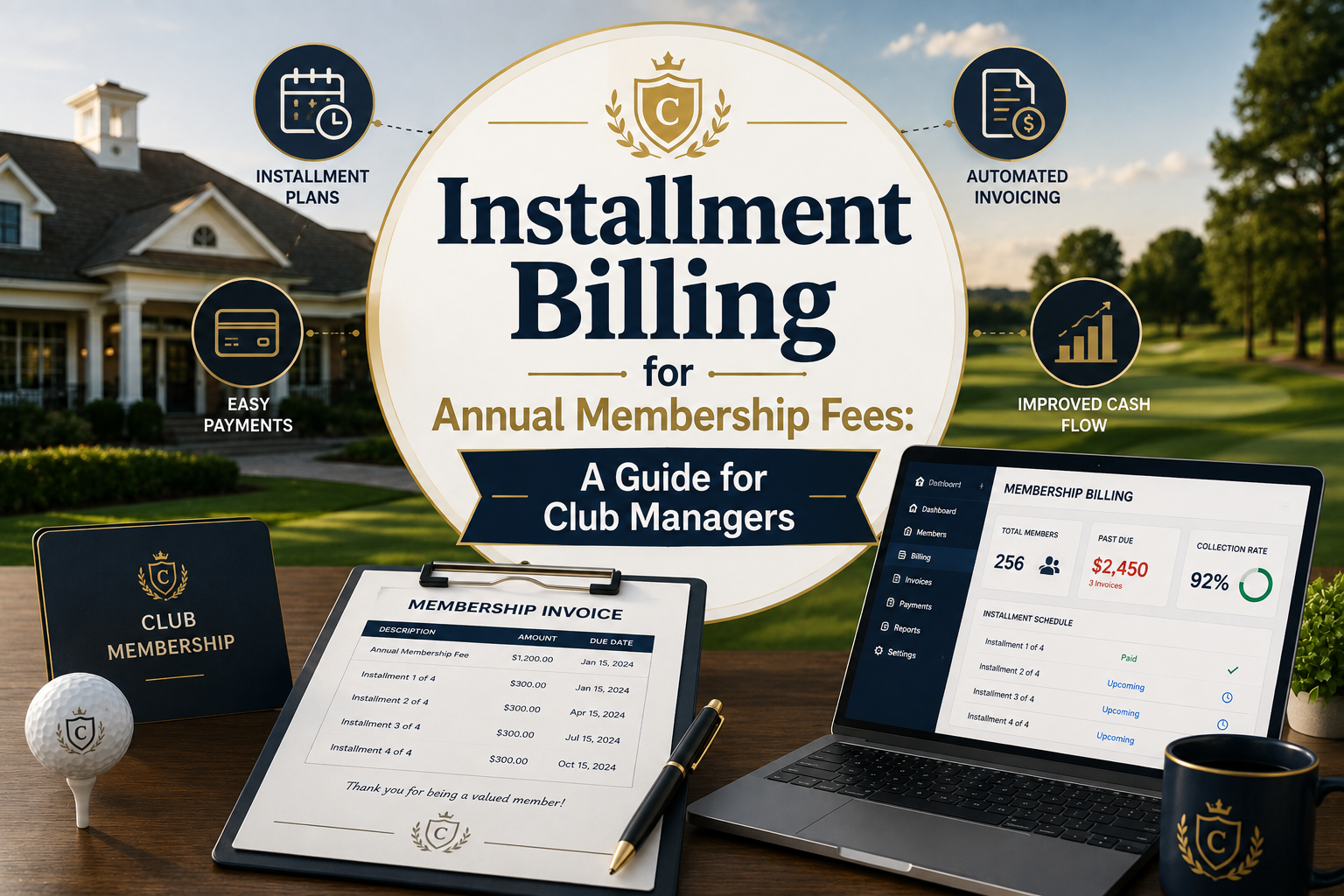
Annual membership installment billing lets clubs collect yearly dues in smaller, scheduled payments without converting members to month-to-month subscriptions. When set up correctly, it reduces upfront price resistance, lowers involuntary churn from payment failures, and gives your club a predictable revenue stream throughout the year. The difference between doing it right and doing it poorly comes down to three things: how you structure the payment schedule, how you handle failed payments, and whether your billing system is built to manage installment plans rather than generic subscriptions.
What is Annual Membership Installment Billing?
Annual membership installment billing is a payment structure in which a club or organization collects a member’s full yearly dues across a series of fixed, scheduled payments rather than as a single lump sum. Unlike a recurring monthly membership that renews each month, an installment plan covers a predetermined annual commitment broken into equal increments, typically monthly or quarterly, charged automatically to a stored payment method. The total obligation is set at enrollment, and each payment reduces the outstanding balance until the membership year is complete.
This structure sits at the intersection of installment billing and recurring billing, borrowing the automated charge cadence of the latter while maintaining the fixed-term contract logic of the former.
How Annual Membership Installment Billing Works
The mechanics are simpler than most club managers expect. When a member joins on an annual installment plan, the software does not create twelve independent monthly memberships. Instead, it creates a single annual agreement worth, say, $1,200, and then schedules twelve charges of $100 each against that agreement. The member’s access rights remain tied to the annual contract, not to whether last month’s specific payment succeeded.
That distinction matters more than it sounds. With a true installment structure, a missed payment triggers a recovery sequence within the existing contract. With a month-to-month subscription, a missed payment can read as a cancellation. The former is recoverable. The latter often is not.
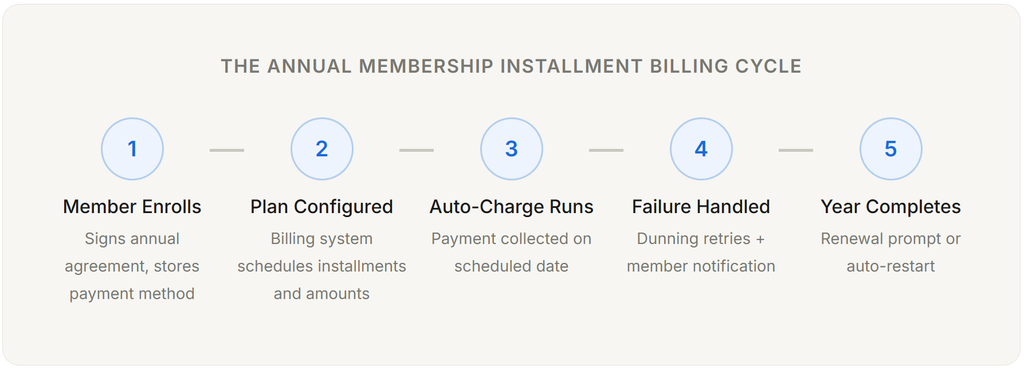
The Five Stages in Detail
Enrollment is where the contract is set. The member agrees to a total annual fee and a payment schedule. This agreement should be explicit, not buried in terms of service. Clearly state the total amount, the number of installments, the charge date, and what happens if a payment fails. This protects the club legally and sets member expectations correctly.
Plan configuration happens inside your invoicing software. You assign the member to an installment template that specifies charge amount, frequency, start date, and end date. A well-built system will also attach the dunning sequence at this stage, not as an afterthought.
Auto-charge is the straightforward part. The system processes the stored payment method on the scheduled date. Most platforms send a pre-charge notification 3 to 5 days in advance, which meaningfully reduces failed payments caused by insufficient funds.
Failure handling is where most clubs lose money. Industry data from ProfitWell puts the first-attempt failure rate for recurring charges at roughly 10% across subscription businesses. For clubs specifically, that rate tends to be higher because membership fees are often larger than streaming or software charges, and members are more likely to have a fixed budget that fluctuates seasonally. The dunning sequence (automated retries and escalating notifications) is what separates a recoverable failure from an involuntary cancellation.
Year completion triggers either an automatic renewal or a manual renewal prompt, depending on how your billing system is configured. Clubs with automatic renewal should verify their state or country disclosure requirements well before renewal season, as consumer protection laws in several U.S. states and most European jurisdictions require explicit advance notice.
Real-World Use Cases
Annual membership installment billing is not one-size-fits-all. The specific structure that works for a country club with $8,000 annual dues looks very different from a community swim club with $400 annual dues. Here is how the model applies across four common club types.
⛰ Golf & Country Clubs
High annual dues ($3,000 to $15,000+) make lump-sum payments unrealistic for many members. Quarterly installments with a modest processing surcharge are standard. The bigger risk here is early-termination policy: what happens if a member resigns mid-year after paying only two of four installments?
🏈 Fitness & Tennis Clubs
Monthly installments on an annual commitment reduce upfront friction without converting members to a true month-to-month plan. The distinction in the member agreement is critical: “monthly installments on an annual membership” is contractually different from “monthly membership.”
🏋 Swim & Recreation Clubs
Seasonal access creates a wrinkle. Members who pay in installments through the winter may feel they are paying for something they are not using. A pre-season lump sum with a small discount often outperforms monthly installments in member satisfaction surveys for seasonal clubs.
🎓 Professional & Alumni Associations
Annual installment billing pairs well with tiered membership levels. A professional association can offer full, associate, and student tiers on the same installment platform, with different amounts and charge frequencies per tier, all managed through a single customer management system.
Key Benefits of Annual Membership Installment Billing
Lower Barrier to Joining
A $1,200 annual membership is a materially different psychological ask than a $100 monthly installment, even when the math is identical. Psychological research on payment framing consistently shows that people evaluate large upfront costs more critically than smaller periodic ones. For clubs trying to grow their membership base, installment options lower the activation energy for prospective members who would otherwise need to justify a large single expenditure.
Predictable Cash Flow Without Seasonal Spikes
Clubs that rely on annual lump-sum payments see cash flow that peaks at renewal season and flattens for the rest of the year. Installment billing smooths that curve. Your operating expenses do not spike in March because dues came in during March; they are distributed across the year in a way that mirrors the actual cost of running the club month to month.
Higher Annual Value Per Member
Members who commit to an annual installment plan have a higher lifetime value than those on true month-to-month plans, for a straightforward reason: they have already committed to the year. The data from ReliaBills customers consistently shows that members on annual installment plans cancel at lower rates than equivalent members on monthly rolling subscriptions, even controlling for club type and dues level. The act of signing an annual agreement creates an anchoring effect that monthly subscriptions do not.
Reduced Administrative Load
Manual dues collection, whether by check, wire transfer, or informal card-on-file processes, requires someone to track who has paid and who has not. Automated installment billing handles that tracking automatically. The right invoicing software will surface outstanding installments, flag failed payments, and generate statements without requiring manual intervention.
Key Risks and What to Watch For
Involuntary Churn from Payment Failure
A club processing 500 monthly installments at a 10% failure rate (a realistic figure in any given month) is looking at 50 failed transactions. Each one requires either automated recovery or manual follow-up. Without a configured dunning sequence, most of those members will not proactively update their payment method, and clubs are left chasing overdue balances weeks or months later.
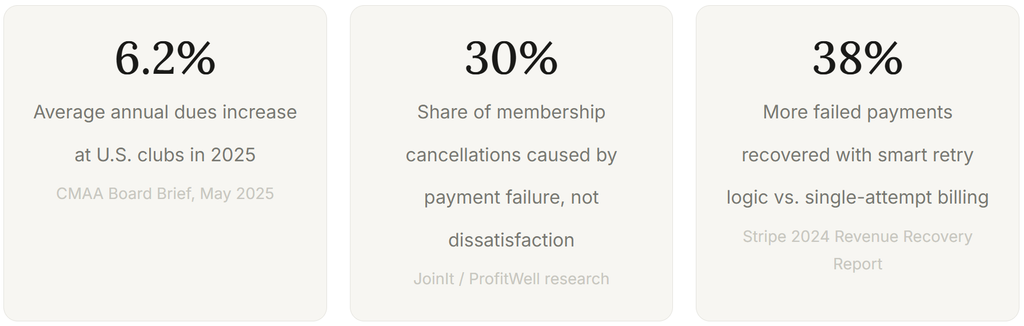
The industry benchmark from ABC Fitness and ClubIntel puts average annual member churn at 28%, and up to 30% of that figure is involuntary, meaning the member was willing to stay but the payment failed and the club did not recover it in time. That is a recoverable problem with the right system. It is an unnecessary loss without one.
Ambiguous Early Termination Policies
What happens when a member leaves six months into a twelve-payment annual plan? If your membership agreement does not specify this clearly, you will face chargebacks, disputes, and uncomfortable conversations. The policy can be anything you choose: full balance immediately due, no refund for installments paid, prorated refund, or a cancellation fee. What matters is that it is written, disclosed at enrollment, and enforceable under applicable consumer protection law.
State Health Club Act Compliance
In the United States, 29 states have specific health club statutes that govern membership contracts, cancellation rights, refund obligations, and automatic renewal disclosures. These apply to fitness clubs, gyms, and often recreational clubs. If you operate in California, New York, Texas, or Illinois, in particular, your installment plan structure must comply with specific statutory requirements. This is worth a legal review before you launch, not after your first dispute.
Mismatched Billing Systems
The most technically frustrating risk is trying to run an installment plan on a billing platform built only for subscriptions. A subscription system treats each period independently. An installment system treats all periods as part of a single contract. If your platform cannot distinguish between the two, you will find yourself patching over the gap with manual processes, spreadsheets, and workarounds that scale poorly as your membership grows.
Comparison: Installment Plan vs. Monthly Subscription vs. Annual Lump Sum
Club managers frequently confuse these three structures because all three involve recurring payment processing. They are meaningfully different in terms of member commitment, cash flow timing, administrative complexity, and churn risk.
| Factor | Installment Plan (Annual Commitment) | Monthly Subscription (Rolling) | Annual Lump Sum |
|---|---|---|---|
| Member commitment | Full year, contractually bound | Month-to-month, can cancel anytime | Full year, paid upfront |
| Cash flow | Distributed evenly across year | Distributed, but volatile (churn) | Concentrated at renewal season |
| Member acquisition friction | Low (no large upfront ask) | Very low | High (large single payment) |
| Churn risk | Low (contractual commitment) | High (passive cancellation easy) | Very low (already paid) |
| Failed payment risk | Moderate (12 charge events per year) | High (12 opportunities to churn) | None after initial charge |
| Admin complexity | Moderate (requires installment tracking) | Low to moderate | Low (few transactions) |
| Early termination policy needed | Yes, critical | Rarely | Yes, for refunds |
| Best for | Clubs wanting annual commitment with accessible payments | Clubs prioritizing ease of joining over retention | Clubs with short renewal windows or high-net-worth members |
The MGI 2025 Membership Marketing Benchmarking Report notes that multi-year and annual installment memberships correlate with substantially higher renewal rates than month-to-month plans. The data makes intuitive sense: a member who has already committed to a year is far less likely to be weighing whether to leave.
Common Mistakes (And What I Got Wrong at First)
Setting up installments as subscriptions in the billing system
This is the most common and most damaging mistake. When a billing platform is configured with monthly subscriptions instead of annual installment plans, a failed payment reads as a potential cancellation rather than a recoverable charge event. The member’s contract status and access rights are then misaligned with the actual agreement. Every club manager I have spoken with who made this mistake eventually rebuilt their billing structure from scratch after discovering the mismatch during a dispute.
No dunning sequence configured at all
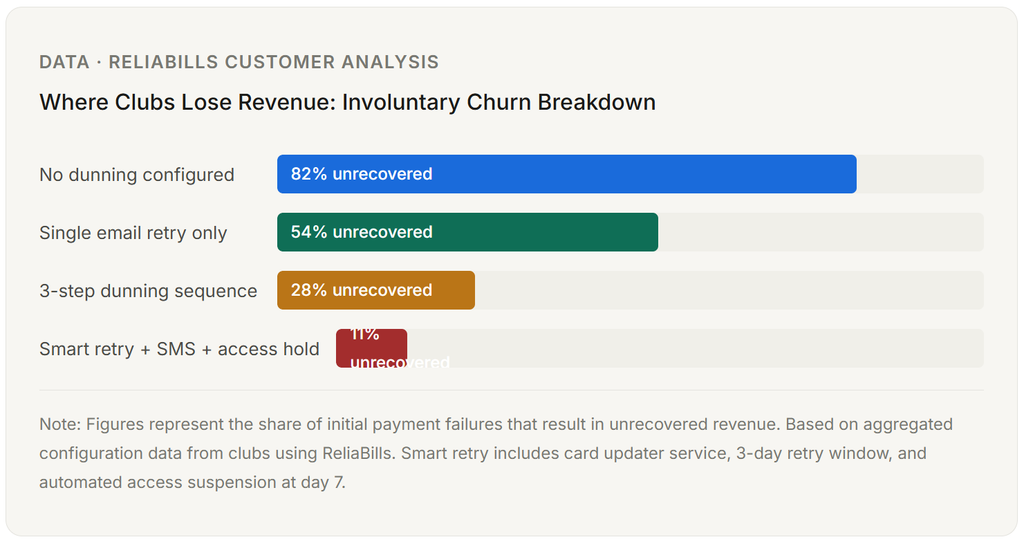
More clubs than you would expect launch installment billing with payment failure handled by a single automated email and then manual follow-up. The email-only approach recovers approximately 18% to 22% of failed payments in the first billing cycle. A properly configured dunning sequence with automated retries, text notifications, and a temporary access hold recovers 70% to 85% of the same failures without any staff involvement.
Vague or absent early termination language in the member agreement
The first time a member requests to leave mid-year, you want an answer to that question already written down and signed. Clubs that have not drafted this policy discover it during the conversation, which puts them in a position of improvising a financial policy on the spot. The result is inconsistent treatment of members and, occasionally, chargebacks that the club loses because the contract did not clearly establish the obligation.
Launching without pre-billing notification
Sending a notification 3 to 5 days before each installment is charged dramatically reduces the volume of failed payments related to insufficient funds. It also reduces chargebacks, because members who recognize the upcoming charge are far less likely to dispute it when it appears on their statement. The fix is a single setting in most billing platforms, and it costs nothing to enable.
Treating the billing system as the membership record
A billing system tracks charges and payments. A customer management system tracks who the member is, what tier they hold, their communication preferences, and their relationship with the club. Running installment billing without connecting these two creates situations where a member can pay their installments reliably but still have incorrect access, receive wrong communications, or be classified incorrectly at renewal. The two systems need to be integrated, not parallel.
How to Get Started with Annual Membership Installment Billing
The implementation sequence matters as much as the tools. Clubs that configure the billing platform first and write their membership policies second consistently end up with mismatches between what the system does and what the agreement says. Start with policy, then build the system to match it.
Step 1: Define Your Membership Structure in Writing
Before opening any billing software, document the specific terms for every membership tier you offer. For each tier, write down: the annual dues amount, the number of installments, the charge frequency, the charge date (specific date of month or day-of-week relative to enrollment), the early termination policy, the failure grace period, and what happens to access during a failed payment window. These decisions are policy decisions, not billing system decisions. The billing system enforces what you write down here.
Step 2: Review State and Local Compliance Requirements
If your club operates under a state health club statute, verify that your installment structure complies before launch. At minimum, confirm your cancellation notice requirements, any mandatory cooling-off period for new members, how prepaid amounts must be handled if the club closes, and automatic renewal disclosure rules. This is a one-time review that is substantially cheaper than a post-launch correction.
Step 3: Configure Your Billing Platform for Installment Plans
This is where ReliaBills fits into the workflow. Configure one billing template per membership tier. Each template should specify the total contract amount, the installment schedule, the dunning sequence (at minimum: pre-charge notification at day minus 5, automated retry at day 3, member notification at day 5, access restriction at day 10), and the renewal behavior. Build the dunning sequence before you import a single member record.
Step 4: Connect Billing to Your Customer Management System
Your member records and your billing records should sync automatically. When an installment fails, the member’s record should reflect that status. When the full annual amount is collected, the member’s record should show the year as settled. Manual reconciliation between two separate systems is where errors accumulate. The customer management tools inside ReliaBills are designed to keep these two views synchronized without a separate integration step.
Step 5: Communicate the Change to Members
If you are transitioning existing members from a different billing structure, do not assume the system change is self-explanatory. Send a plain-language communication that explains what is changing, why, what they should expect to see on their statements, and who to contact with questions. Member confusion about billing is one of the primary drivers of chargebacks and cancellation requests.
Frequently Asked Questions
1. What is the difference between an installment billing plan and a monthly subscription?
A monthly subscription is an open-ended agreement that renews each month until cancelled. A member can leave at the end of any billing period without penalty, and each month is an independent transaction. An installment plan is a fixed-term contract for a set annual amount, broken into smaller payments. The member commits to the full year at enrollment. The installments are not individual monthly memberships; they are scheduled payments against a single annual obligation. This distinction affects how payment failures are handled, what happens if a member leaves mid-year, and how the membership shows up in your reporting.
2. Can I charge a fee for the installment option?
Yes, and many clubs do. A common structure is to offer a small discount for annual lump-sum payment (typically 5% to 10%) and treat the installment option as the standard rate. This makes the discount feel like a reward for the lump-sum payer rather than a surcharge on the installment payer, which member surveys consistently show is more positively received. Some clubs add a modest administrative fee per installment (typically $5 to $15), though this adds friction and is better suited to clubs where processing costs are genuinely significant relative to dues amounts.
3. What happens if a member wants to cancel mid-year on an installment plan?
This is governed by your membership agreement, not your billing software. The most common policies are: (1) the remaining installments become immediately due upon cancellation, (2) no refund on installments paid and remaining installments are forgiven, (3) a prorated refund or credit based on months remaining, or (4) a flat cancellation fee. The policy must be stated clearly in the agreement signed at enrollment. If your state has a health club statute, it may impose minimum requirements on your cancellation terms, including mandatory cooling-off periods and constraints on how much you can collect for early termination. Check those requirements before setting your policy.
4. How many installments should I offer?
For most clubs, monthly installments (12 per year) are the default because they match the natural budgeting cadence of most members. Quarterly installments (4 per year) reduce the number of charge events and therefore the number of potential failure events, which simplifies administration for smaller clubs. Some clubs offer both options at different price points. Fewer than four installments per year, such as two semi-annual payments, begin to lose the psychological benefit of installment billing because the individual payment amounts remain large. More than 12 is unusual and adds unnecessary complexity.
5. Does installment billing require a specific type of billing software?
Not necessarily, but your billing platform needs to be able to distinguish between installment logic and subscription logic. Platforms built purely for subscriptions will treat each installment as an independent renewal event, which creates the mismatches described in the common mistakes section above. A platform like ReliaBills that is designed for both recurring billing and installment billing can handle the distinction natively, meaning you can configure a single annual contract, attach a payment schedule to it, and have the system manage failures within the context of that contract rather than treating each failure as a potential cancellation.
6. How do I handle a member who wants to switch from a lump-sum payment to installments mid-year?
Mid-year billing structure changes are generally easier to handle than clubs expect. If a member paid a lump sum and wants to switch to installments, the cleanest approach is to apply the change at their next renewal date rather than retroactively restructuring a completed payment. If the request comes partway through the year and the member has a genuine hardship, you can calculate the remaining months of the current year as an installment plan while noting in their record that the change was made mid-cycle. Document the change in writing and have the member sign an amended agreement. Most billing platforms can accommodate mid-cycle plan changes with some manual configuration.
Recent Articles:
- Property Management Invoice Template: What to Include for Rent, Fees, and Deposits
- How to Choose the Right Billing Software for Your Service Business

Brant Pallazza is the Founder and President of ReliaBills, an invoicing and recurring billing platform built to help small businesses secure predictable cash flow. With over 20 years of experience in direct response marketing and e-commerce leadership, including a 13-year tenure managing over $500 million in gross sales at Digital River. Brant writes actionable guides on automated billing, payment processing, and scaling SMBs.