
Fitness installment billing splits the cost of a program, package, or annual membership into scheduled payments collected automatically over a defined term, making high-value offerings accessible to members who would walk away from a lump-sum price. The right structure is not simply offering a payment plan as a sales tool. It is configuring a system where the full program value is contractually committed at signup, the payments are collected automatically without staff chasing, and failed payments are recovered through a dunning sequence rather than manual follow-up. Fitness businesses that set this up correctly sell more expensive programs, collect more of what they sell, and lose fewer members to the payment failures that look like voluntary cancellations but are not.
What Is Fitness Installment Billing?
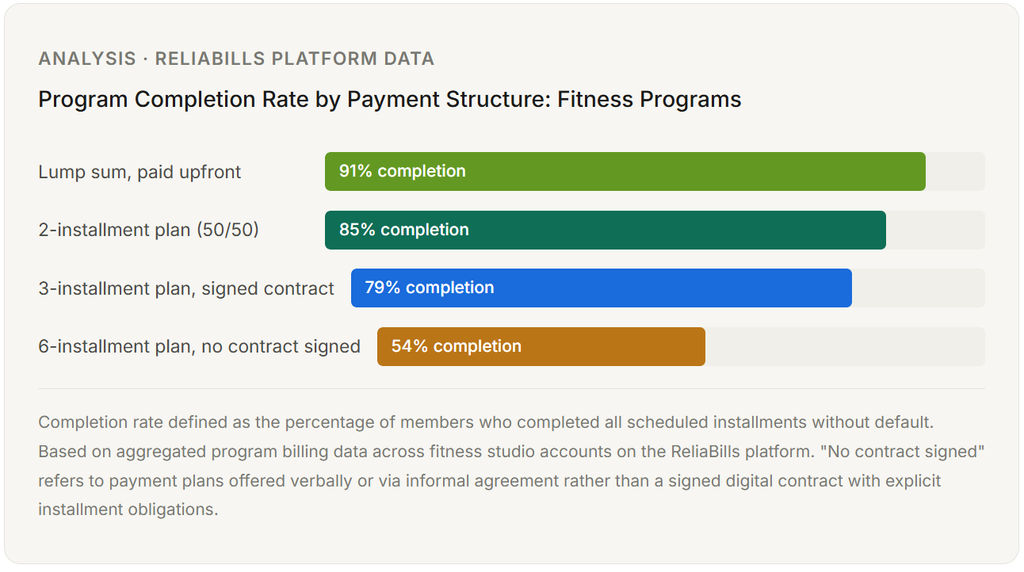
Fitness installment billing is a payment structure in which the full cost of a fitness program, training package, or annual membership is committed by the member at enrollment and then collected in a series of fixed, scheduled payments over a defined period. Unlike a month-to-month membership, which the member can cancel at any time, an installment plan carries the full contract value as a committed obligation: the member agrees to pay the total amount, and the installments are the collection mechanism for that commitment, not individual monthly renewals.
The distinction matters operationally. A 12-session personal training package sold as a monthly installment plan over three months is not a subscription that can be cancelled after month one. It is a fixed contract for a defined service, collected in three parts. If a payment fails in month two, the correct response is to recover that specific installment while delivering the training sessions, not to treat the failure as a cancellation event. Most fitness businesses that offer “payment plans” without this contractual foundation are effectively offering subscriptions they cannot enforce, which is why their collection rates on high-value packages are far lower than they should be.
Fitness installment billing connects to installment billing for fixed-term program obligations, recurring billing for ongoing membership fees, and customer management for tracking member program history, payment status, and session delivery alongside billing records.
Which Fitness Programs Work with Installment Billing
Not every fitness offering belongs on an installment plan. Month-to-month memberships are better served by recurring billing with no defined end date. Single drop-in classes are point-of-sale transactions. Installment billing has a specific use case: any fitness program with a defined scope, a defined start and end point, and a price point high enough that the upfront cost creates real friction at the point of sale.
🏋 Personal Training Packages: $500 to $3,000+
12 to 36-session packages split across 3 to 6 months. The most natural fit for installment billing. Contract value is clear, session delivery is trackable, and the installment period aligns with the training block.
🏫 Transformation Programs: $800 to $2,500
8 to 16-week structured programs with a defined outcome. High price points make lump-sum sales difficult. A 3-part installment plan with the first payment at signup and two more during the program is a proven structure.
🏆 Annual Memberships: $600 to $2,400/year
Annual commitment split into monthly installments. Keeps the full-year commitment without requiring a large upfront payment. Distinct from a month-to-month membership: the full year is owed regardless of usage.
🥊 Online Coaching Programs: $300 to $1,500
3 to 6-month online coaching commitments. Installment plans work especially well here because there is no physical access component to restrict during a payment failure, making contract enforcement the primary collection lever.
🤼 Specialized Class Series: $200 to $800
Multi-week course formats: yoga teacher training intensives, martial arts belt programs, dance classes with a defined curriculum. Lower price points mean simpler 2-payment structures (half at signup, half at midpoint) work well.
🏈 Performance or Sports Programs: $1,000 to $5,000
Seasonal athletic development programs for youth or adult athletes. Installment billing aligns with sports seasonality and is often more practical for parents managing multiple activity expenses across a season.
Programs below approximately $150 total generally do not benefit enough from installment billing to justify the added configuration. At that price point, a payment link is more appropriate than a multi-payment plan. The sweet spot for installment billing in fitness is programs priced between $300 and $3,000, where the installment plan meaningfully changes whether a prospect says yes while the contract value is large enough to warrant the collection infrastructure.
How the Fitness Installment Billing Cycle Works
The billing cycle for a fitness installment plan has more steps than a standard membership charge, and each step has a specific purpose. Skipping one creates the problems that cause fitness businesses to abandon installment billing as “too complicated” when the real issue is that the setup was incomplete.
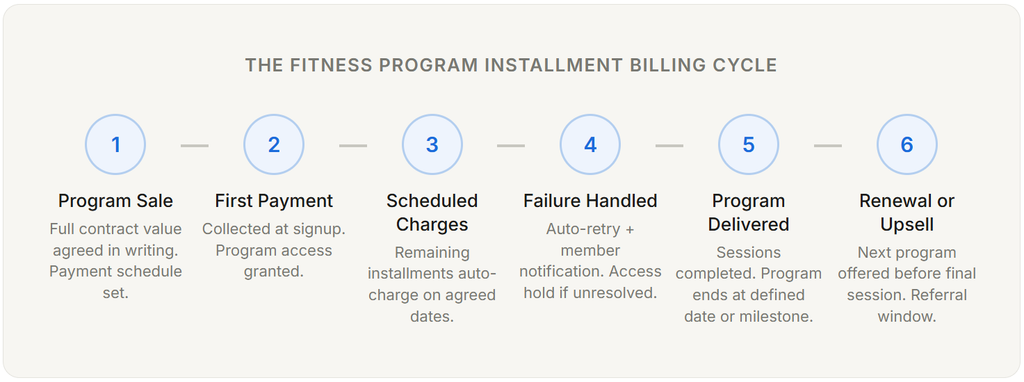
Step two, collecting the first payment at the moment of sale rather than on a future date, is the most important operational decision in the billing cycle. A fitness program sale without an immediate first payment is a verbal commitment that has a meaningful dropout rate between the conversation and the first scheduled charge. Collecting the first installment at signup converts the intent into a financial commitment, changes how the member relates to the program before they start, and dramatically reduces pre-start dropout.
How Failed Installments Should Be Handled
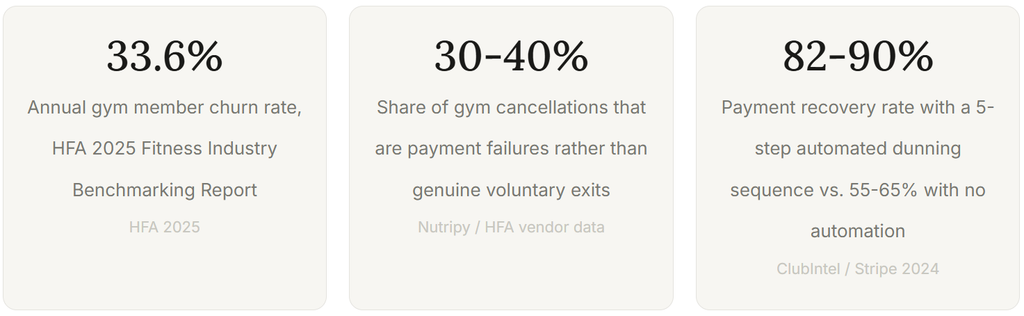
A failed installment payment is not a cancellation. It is a collection event within an existing contract, and the response should be proportionate. The industry data from ClubIntel and ABC Fitness is consistent: fitness clubs without automated dunning lose 4 to 7% of their active membership base annually to involuntary churn, and businesses that implement smart retry logic and dunning automation recover 38% more failed payments. A properly configured dunning sequence for fitness installment billing looks like this: automatic retry at day 2, pre-written member notification with a payment update link at day 3, second retry at day 5, and access restriction at day 8 to 10 if still unresolved. That sequence recovers the large majority of failed installments without any staff involvement.
Structuring Your Installment Plans: The Math That Matters
Most fitness businesses set up installment plans without doing the math on what they actually cost. A payment plan that loses 15% of members before the final installment is not a growth tool. It is a discount program with extra steps. Getting the structure right means pricing the plan so the commitment is real, the installment amounts are manageable, and the collection rate across the full term is high enough that offering the plan is profitable.
A 12-Session Personal Training Package: Three Ways to Structure It
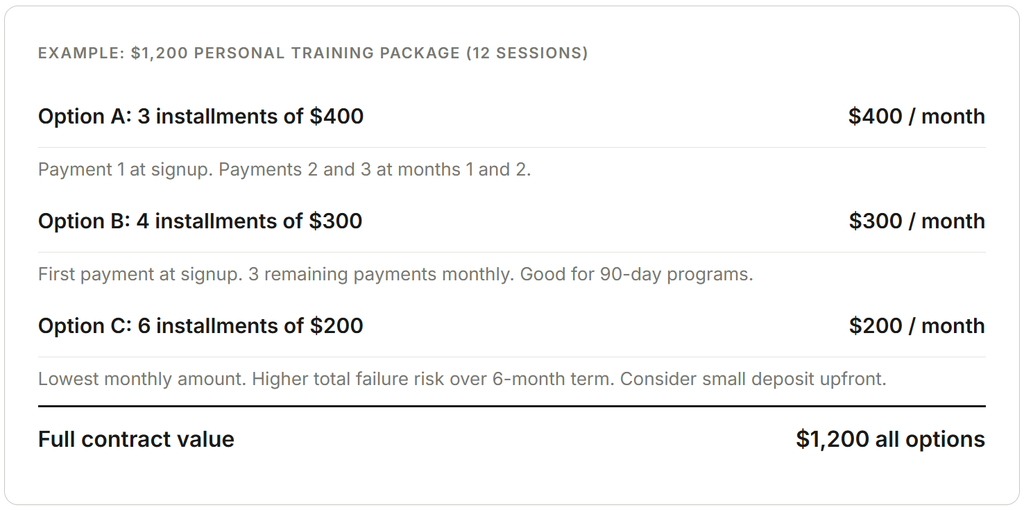
Option A with three installments is the safest structure for most fitness businesses. The payment term is short enough that the contract is collected before the program ends, the monthly amount is real enough to feel like a commitment, and the number of charge events (three) limits the failure surface. Option C spreads payments far enough that the final installment falls after most clients have finished their sessions, at which point motivation to pay the remaining balance drops significantly. Sessions already delivered are leverage you can no longer use.
The Deposit Question
Collecting a non-refundable deposit at signup, separate from the first installment, serves a different function. The deposit signals commitment and covers the fixed cost of the first session or program setup without relying on the installment system. For high-ticket programs above $1,500, a $100 to $250 non-refundable deposit at booking, with the installment plan beginning at the program start date, is a structure that reduces ghost bookings without raising the first-day payment to an uncomfortable level.
Real-World Use Cases by Studio Type
Installment billing behaves differently across fitness business models. The right configuration for a personal trainer billing individual clients is not the same as the right configuration for a boutique studio selling transformation programs or a gym offering annual membership installments.
Independent Personal Trainer
For a solo trainer, installment billing is primarily a sales tool and a cash flow smoothing mechanism. A 20-session package at $2,000, collected in four monthly installments of $500, converts prospects who would decline a $2,000 upfront ask and creates a 4-month training relationship that is far more likely to produce results than ten sporadic sessions. The practical setup for a solo trainer: a simple digital agreement with the installment schedule, card or ACH authorization at signing, and an automated reminder before each charge date. ReliaBills can manage this without requiring any separate gym management software.
Boutique Fitness Studio (Yoga, Pilates, Barre)
Boutique studios typically sell a mix of class packs, memberships, and specialty programs. Installment billing is most valuable for the specialty programs: teacher training courses, intensive series, and seasonal workshops with a defined curriculum. A 200-hour yoga teacher training priced at $2,400, collected in four payments of $600 at enrollment, month one, month two, and month three, is a structure that has a dramatically higher enrollment rate than a $2,400 upfront ask without materially increasing the collection risk, because the program commitment and community accountability are high.
Gym with Annual Membership Installments
For gyms converting from month-to-month memberships to annual installment plans, the central challenge is the member agreement language. An annual installment plan member has committed to 12 months of payments regardless of usage. That commitment needs to be explicit in the agreement, disclosed clearly at enrollment, and supported by a cancellation policy that specifies what happens if the member wants to leave before the year is up. Current industry data from HFA puts annual gym churn at 33.6%, and vendor data suggests 30 to 40% of raw gym cancellations in the US and UK are payment failures rather than member-initiated cancellations. Converting more members to annual installment plans directly reduces the voluntary churn component of that number.
Online Fitness Coaching
Online coaching programs have a unique collection dynamic: there is no physical access to restrict during a payment failure, which means the only collection leverage is the contract itself and the coaching relationship. For this reason, online coaching installment plans benefit from shorter terms (2 to 3 installments rather than 6) and a first-payment-at-sale policy that makes the commitment real before the coaching work begins. Coaches who start delivering services before collecting the first payment are in a significantly weaker collection position than those who require the first installment before the first session.
Key Benefits of Fitness Installment Billing
Higher Program Sales at the Same Price Point
A $1,500 transformation program sold as three installments of $500 converts at a meaningfully higher rate than the same program presented as a single payment, even when the total is identical. The installment structure does not lower the price; it changes the psychological moment of decision from “can I afford $1,500 right now?” to “can I manage $500 a month?” For most prospects, the answer to the second question is yes when the first is no. Fitness businesses that add installment billing to high-ticket programs consistently report conversion rate improvements without reducing the program price.
Longer Member Relationships
Members who commit to a 3-month or 6-month installment plan spend more time in your studio than members on month-to-month plans, simply because the commitment extends the relationship. Longer time in the studio correlates with better results, and better results produce word-of-mouth referrals and renewal rates that no marketing budget can replicate. The installment plan is a retention tool as much as it is a billing structure.
Predictable Revenue Over the Program Term
A studio with 30 members on active installment plans knows exactly what revenue to expect on each billing date for the duration of those plans. That predictability supports staffing decisions, equipment purchases, and growth planning in a way that point-of-sale class pack revenue cannot. For studios combining installment programs with recurring memberships, the result is a layered revenue structure where a significant share of each month’s income is predictable well in advance.
Comparison: Installment Plan vs. Monthly Membership vs. Class Pack
Fitness businesses typically offer several payment structures across their programs, and each serves a different member type and business objective. Understanding where installment billing wins and where it does not prevents misapplication.
| Factor | Installment Plan | Monthly Membership | Class Pack / Punch Card |
|---|---|---|---|
| Member commitment | Full program value committed at enrollment | Month-to-month. Can cancel with notice. | Sessions purchased, no ongoing obligation |
| Cancellation risk | Low. Contract obligation creates friction on exit. | High. Easy to cancel after one or two months. | No cancellation. Sessions simply go unused. |
| Revenue predictability | High. Known installment schedule per member. | Medium. Predictable until cancellation. | Low. Point-of-sale only. No forward visibility. |
| Best use case | High-value programs with a defined timeline: personal training, transformation programs, coaching packages | Ongoing access to classes or facilities where no defined program endpoint exists | Drop-in or casual members who do not want a commitment or a fixed schedule |
| Collection complexity | Moderate. Requires contract, dunning setup, and clear cancellation terms. | Low. Standard recurring billing. | Very low. Single transaction at purchase. |
| Member acquisition friction | Moderate. Installment plan reduces upfront cost but requires agreement signing. | Low. Easy to start month-to-month. | Very low. No commitment required. |
| Outcome alignment | High. Member commits to a full program, improving completion and results. | Low. Month-to-month members are not committed to a program arc. | Very low. Sessions are used when convenient, not as part of a structured plan. |
The right fitness business uses all three structures for different purposes: installment plans for high-value programs and annual memberships, recurring billing for ongoing access memberships, and class packs for casual members or as a trial entry point. The mistake is using only one structure for everything, which either over-commits casual members or under-commits serious ones.
Key Risks and What to Watch For
State Health Club Act Compliance
Twenty-nine U.S. states have health club statutes that govern membership contracts, cancellation rights, and, in some cases, installment plan structures. For fitness businesses selling programs on installment plans, the most common requirements are a mandatory cooling-off period (typically 3 to 5 business days), specific disclosure of the total contract value and payment schedule, limits on how much can be collected before services begin, and defined refund policies for unused services. California, New York, Florida, Texas, and Illinois all have specific provisions. Operating without reviewing applicable requirements is a compliance risk that becomes expensive when a member files a complaint.
Scope Creep in Personal Training
Personal training installment packages have a specific edge case: clients who have purchased a 12-session package often request additional sessions mid-program, which creates an ambiguous billing situation. The trainer delivers sessions beyond the contracted scope while waiting to address billing, and by the time the conversation happens, the leverage is gone. The cleaner structure: any sessions beyond the contracted number are billed as an add-on at the agreed session rate before they are delivered, not after. This requires a moment of discipline in the client conversation, but it is far less uncomfortable than a retroactive billing conversation at the end of the program.
Failed Payment Without Recovery Logic
Industry estimates suggest 7 to 12% of monthly dues transactions fail due to expired cards, insufficient funds, blocked accounts, and risk-related declines. For installment plans with three to six payment events, a 10% failure rate on any individual charge means a meaningful share of your members will experience at least one failed payment over the program term. Without automated retry and notification logic, those failed payments require manual follow-up that is inconsistent, time-consuming, and frequently results in the payment simply not being collected. Configuring automated dunning before you sell your first installment plan is not optional; it is the infrastructure that makes installment billing financially viable at any meaningful scale.
Common Mistakes Fitness Businesses Make with Installment Billing
1. Offering a “payment plan” without a signed contract
A payment plan without a signed contract committing the member to the full program value is a subscription, not an installment plan. The member can walk away after month one and owe nothing more, because there is no documented obligation to the contrary. Every installment plan must be backed by a written agreement that states the total program value, the payment schedule, the total number of payments, and what happens if a payment is missed or the member wants to withdraw. Without this, your “installment plan” is effectively a month-to-month membership priced like an annual program.
2. Collecting nothing at the point of sale
Allowing a member to sign up for a program and schedule the first payment for a future date creates a 2-to-7-day window in which the member can reconsider without any financial consequence. Pre-start dropout during this window is a consistent revenue leak for fitness businesses that offer deferred first payments. Collecting the first installment at the moment of agreement signing converts the intent into a commitment immediately. The first payment does not have to be the full first installment; even a $50 to $100 non-refundable deposit at signing is enough to change the behavioral economics of the decision.
3. Setting installment terms longer than the program delivery period
A 12-session personal training program delivered over 10 weeks should not have installment payments stretching to month 6. Once the sessions are delivered, the member’s motivation to pay for something they have already received drops substantially. Schedule the final installment to fall at or before the final session. This is the single structural change that most consistently improves collection rates on fitness installment programs without requiring any change to the program itself.
4. No dunning sequence for failed payments
A failed installment payment handled by a staff member sending an individual email is a process that does not scale and produces inconsistent recovery rates. Some staff follow up the same day. Others wait a week. Some clients are contacted multiple times; others are not contacted at all. The recovery rate from manual follow-up typically falls in the 28 to 35% range. An automated dunning sequence with retry logic, pre-written notifications, and a self-serve payment update link consistently recovers 76 to 82% of initially failed payments. The difference, compounded across a year of installment programs, is significant revenue that requires no additional staff time.
5. Using a subscription platform for installment plan logic
A subscription platform does not know when a program ends. It charges indefinitely until you manually cancel the billing. An installment plan has a defined number of payments, after which the obligation is complete. When fitness businesses use subscription billing for installment plans, they routinely charge members past the end of the contracted program, which generates chargebacks, disputes, and the kind of membership experience that produces negative reviews. Using a billing platform that natively supports fixed-term installment plans, with a defined payment count and automatic termination, prevents this class of error entirely.
How to Set Up Fitness Installment Billing: Step by Step
The setup sequence matters. Fitness businesses that configure their billing platform first and write their contract language second consistently end up with a billing structure that does not match what the member signed. Start with the contract, then configure the system to enforce it.
Step 1: Define Your Program Tiers and Installment Structures
Before touching any billing software, decide which programs will offer installment plans and what the structures will be. For each program: the total price, the number of installments, the installment amount, the charge dates, whether there is a deposit at signing, and what happens if a member wants to exit the plan early. Write these down as your standard terms. Having three to four standard installment structures makes both the sales conversation and the billing configuration faster and more consistent.
Step 2: Write the Member Agreement Before Your First Sale
Your member agreement for installment programs should clearly state the total program value, the payment schedule (specific amounts and dates), the pre-authorization language that allows automatic collection, the cancellation and early termination policy, and the late payment and dunning disclosure. A digital agreement that members sign at the point of sale, before the first payment is collected, is the foundation that makes everything else enforceable. Using an invoicing software platform that supports digital agreements and electronic signatures keeps this in the same system as the billing, which simplifies record-keeping and dispute resolution.
Step 3: Configure Installment Billing in Your Platform
Create a billing template for each program tier. Each template should specify the total contract amount, the number of installments, the charge frequency, the charge dates, and the automatic termination at payment count completion. Configure the dunning sequence before you activate any member on a plan: minimum retry at day 2, notification at day 3, second retry at day 5, and access restriction at day 8 for programs where physical or digital access can be controlled. ReliaBills supports this configuration within the same system that manages member records, keeping service delivery and billing history linked automatically.
Step 4: Train Your Sales Process Around the First-Payment-at-Sale Rule
The first installment must be collected at the moment the member signs the agreement. This is a sales process discipline, not just a billing configuration. Whoever is enrolling members needs to understand that “we’ll charge you next week” is not available as an option and needs to be comfortable walking through the digital payment method enrollment as part of the agreement signing. For most fitness businesses, this is a one-time behavior change that, once habituated, becomes invisible to both staff and members.
Step 5: Track Program Completion and Renewal Opportunities in Your Customer Management System
Your customer management system should show, for each member on an installment plan, how many installments remain, what the next charge date is, and how far through the program they are in terms of sessions or weeks. This visibility is what allows you to time the renewal or upsell conversation correctly: not at the end of the program when the member is deciding whether to continue, but at the midpoint, when they are engaged, seeing results, and have the rest of the current program ahead of them.
Frequently Asked Questions
1. What is the difference between a fitness installment plan and a monthly membership?
A monthly membership is an open-ended recurring payment that the member can cancel at any time with appropriate notice. Each month stands alone as an independent obligation. A fitness installment plan is a fixed-term contract for the full value of a defined program, collected in scheduled payments. The member commits to the total at enrollment. Missing a payment does not end the obligation; it creates a collection event within the existing contract. The practical difference is significant: a monthly membership member who stops coming can cancel without owing anything more, while an installment plan member who stops attending still owes the remaining installments under the terms they agreed to.
2. Can I offer installment plans for personal training packages without a billing platform?
You can manage a small number of installment plans manually using calendar reminders and manual card charges, but this approach does not scale and consistently produces lower collection rates than automated billing. Manual billing requires remembering to charge each client on the right date, following up individually when a payment fails, and tracking remaining installments in a spreadsheet or similar system. At five or more concurrent installment plans, the administrative load from manual management typically exceeds the cost of a billing platform. At ten or more, the error rate from manual management becomes a material revenue leak. A purpose-built billing platform with automated charging, dunning, and installment tracking pays for itself quickly at any meaningful program volume.
3. What happens if a member disputes an installment charge after their sessions are completed?
A post-completion installment dispute is best resolved with your signed member agreement and session delivery records. The signed agreement establishes that the member committed to the full contract value and payment schedule. Your session records demonstrate that the services were delivered as agreed. If you use digital agreements with timestamps and electronic signatures, these records are typically sufficient to resolve a credit card chargeback in the fitness business’s favor. The most important protection is ensuring that your member agreement explicitly states the full payment schedule and that the member authorized automatic collection. Without that documentation, post-delivery installments are difficult to defend against chargebacks.
4. Should I charge more for installment plans to cover the additional collection risk?
Many fitness businesses add a small administrative fee to installment plans, typically 5 to 10% of the program price, to cover the processing cost and collection risk. This is a reasonable practice if disclosed transparently at the point of sale. An alternative approach is to frame the upfront lump-sum price as carrying a discount rather than the installment plan as carrying a surcharge: “Pay in full and save 8%” is received more positively than “installment plan adds 8%,” even when the math is identical. If your automated dunning sequence is properly configured, the actual collection risk from installment plans is low enough that a surcharge may not be necessary at all.
5. How do I handle a member who wants to cancel an installment plan midway through the program?
This should be answered by your member agreement before the conversation happens. The most common structures are no refund and remaining installments still due, a prorated refund for unused sessions with remaining installments cancelled, or a flat cancellation fee with remaining installments cancelled. Your state’s health club statute may impose minimum requirements on any of these. Whatever your policy, state it in the member agreement, refer to it by name in the cancellation conversation, and apply it consistently across all members. Inconsistent application of cancellation policies is the fastest way to generate disputes and negative word of mouth, regardless of the policy’s actual content.
6. What payment method works best for fitness installment plans: card or ACH?
For fitness installment plans, card-on-file is generally more practical for most member relationships because it is faster to enroll at the point of sale and more familiar to members. ACH bank account authorization is better for high-value programs above $500 per installment because it eliminates card expiration as a failure source, which accounts for 30 to 40% of installment payment failures according to industry data, and carries lower processing fees per transaction. For personal training packages and transformation programs at higher price points, building an ACH enrollment step into the agreement process adds a few minutes to onboarding and meaningfully improves payment recovery rates over a multi-month installment term.
Recent Articles:
- How to Automate Follow-Ups on Unpaid Restaurant Catering Invoices
- Lawn Care Invoice Template: What to Include to Look Professional and Get Paid