
Childcare installment billing works well for families and creates stable cash flow for programs, but only when two foundations are in place: an enrollment agreement that explicitly authorizes automatic collection and defines what happens when a payment fails, and a billing setup that reflects the difference between what a family owes and what a subsidy covers. Without both, flexible payment options become a collection problem rather than a retention tool. Most guides on this topic explain how to set up a payment schedule. This one explains what to do when it does not go according to plan.
What is Childcare Installment Billing?
Childcare installment billing is a payment structure that divides a family’s total tuition obligation into scheduled partial payments spread across a program term, rather than requiring full payment at enrollment or each billing period in a single charge. The total tuition is fixed by the program; the installment plan is a collection method that makes that fixed cost more manageable for families. It differs from a month-to-month subscription in that the family is committed to the full term and the center charges for the reserved enrollment slot regardless of daily attendance. Most childcare programs pair installment billing with automated recurring billing that charges each installment to the family’s stored payment method without manual follow-up. When the program also manages government subsidies, the installment reflects only the family’s co-payment, with the subsidy tracked as a separate funding stream. All of this lives inside a broader family account management system that keeps tuition records, payment history, and FSA documentation accessible in one place.
What Most Guides on Childcare Payment Plans Miss
Every guide on childcare flexible payments covers the same ground: offer multiple payment methods, send invoices on time, have a late fee policy. Useful baseline advice, but it sidesteps the three situations that actually create problems in childcare billing. The first is what happens when a government subsidy and a family co-payment need to be billed separately from the same family account. The second is how split billing works when divorced or separated parents share a child’s tuition obligation. The third is what the written enrollment agreement needs to say to make automatic installment collection legally defensible when a family disputes a charge.
These situations are not edge cases. They are common enough in any program with more than fifteen enrolled families that every childcare director should have a documented process for each one before offering installment billing, not after the first incident forces the conversation.
The Real Cost of Childcare in 2025 and Why Installment Billing Matters
Childcare costs have reached a level where a lump-sum payment option, even for a single month of care, represents a significant financial event for most families. According to Child Care Aware of America, the average annual cost of center-based childcare in 2025 ranged from $8,500 to $22,000 depending on the child’s age and region, with infant care in high-cost areas like Massachusetts, California, and D.C. metro area exceeding $2,000 per month.
At those figures, asking a family to pay a semester or quarter in full upfront is a meaningful financial barrier. Installment billing lowers the enrollment threshold by spreading that cost across the program period, which directly affects whether families choose your program over one with a less flexible payment structure.
That preference creates an opportunity and a responsibility. Families want automated installment billing, which means setting it up well makes your program more attractive. Setting it up carelessly means you are automating a collection system that will generate disputes, failed charges, and difficult conversations at a rate that scales with enrollment.
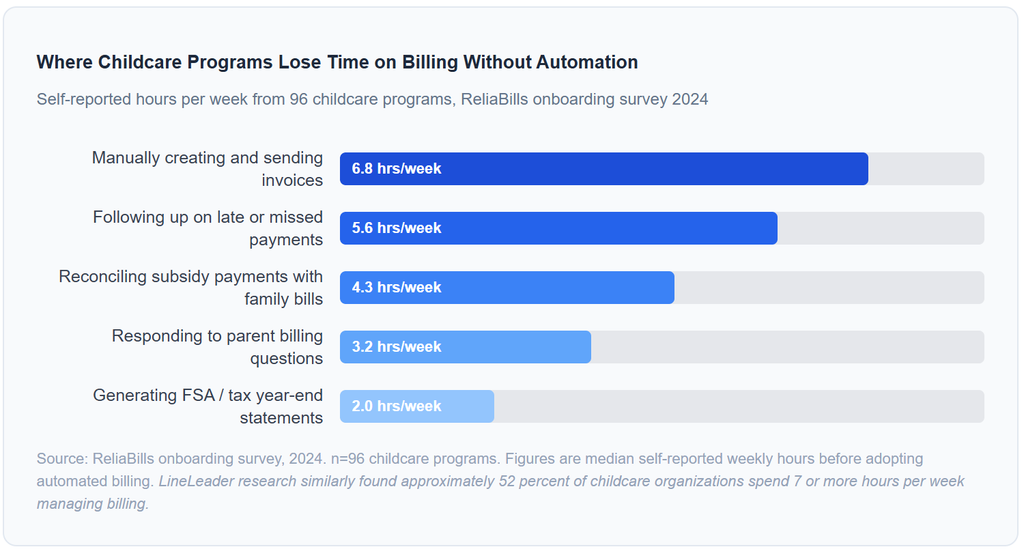
The subsidy reconciliation hours are what separate childcare billing from most other service billing contexts. A fitness studio or a tutoring center can treat every family the same way in their billing system. A childcare program managing a mix of private-pay families, subsidy-assisted families, and split-billing co-parenting situations needs a system that handles each family’s payment structure individually, which is why generic invoicing software consistently falls short for childcare operators at scale.
The Enrollment Agreement: What It Must Say Before the First Charge
The enrollment agreement is the legal and operational foundation of installment billing. Every automated charge the program makes flows from the authorization contained in this document. Charging a parent’s card or bank account without explicit written authorization is an unauthorized transaction under Nacha rules for ACH and under card network rules for credit and debit cards. Verbal consent is not sufficient. The authorization must be in writing, signed before the first charge, and specific enough to describe what will be charged, when, and to which payment method.
Beyond the authorization language, the enrollment agreement for a program offering installment billing needs to be clear on several additional points that generic childcare contracts often skip.
Enrollment-based versus attendance-based tuition
The agreement must state whether tuition is charged based on the child’s enrollment in the program or based on actual attendance. Courts generally uphold charging for the reserved slot regardless of attendance as long as it is clearly stated in the signed agreement. A parent who misses two weeks of care and then disputes the full month’s invoice because “my child wasn’t there” has a legitimate grievance if the enrollment agreement is silent on this point. It has no ground to stand on if the agreement says clearly that tuition covers the reserved enrollment slot, not daily attendance.
Late fee policy with specific amounts and grace periods
The agreement should name the grace period in days, the late fee amount or percentage, and whether late fees are applied per installment or per billing cycle. Vague language like “late payments will incur fees” invites disputes about whether the fee applies after the due date, after a business day, or after the grace period the center informally practices. Specificity removes the ambiguity that creates those conversations.
Failed payment and disenrollment procedures
The agreement must define what happens after a payment fails: the retry timeline, the family notification process, and the point at which the program may suspend care or initiate disenrollment for non-payment. Most state regulations permit disenrollment for non-payment as long as reasonable notice is given, though notice requirements vary by state. The agreement should reference the program’s state licensing requirements and specify the notice period the program commits to providing before any access change takes effect.
What a Childcare Installment Invoice Should Show
The invoice for a childcare installment billing cycle needs to show more than the amount due. Families need to see which installment they are on, what the total program tuition is, and what portion any subsidy covers. That transparency reduces questions and ensures the invoice functions as documentation for FSA reimbursement claims and the Child and Dependent Care Credit at tax time.
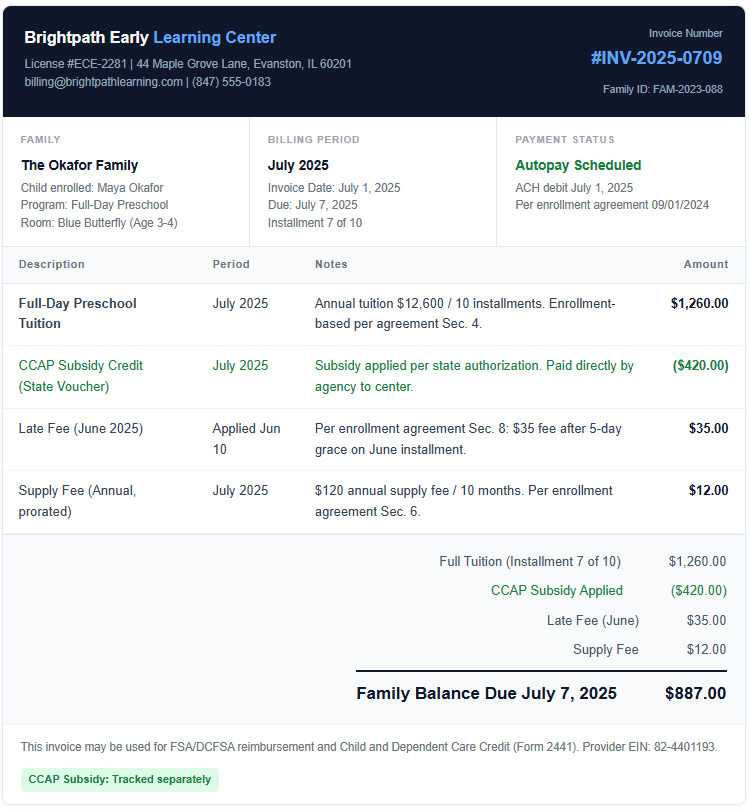
Several elements in that invoice deserve attention. The installment counter (Installment 7 of 10) gives families a clear picture of where they are in the payment schedule without requiring them to call the office. The subsidy credit appears as a separate line, clearly labeled as agency-paid and excluded from the family balance, which prevents the confusion of families thinking their full tuition has been reduced when only their portion has. The late fee cites the enrollment agreement section, exactly as an accounting firm’s invoice would cite an engagement letter, because the documentation principle is the same: if you can point to the signed agreement, the dispute has nowhere to go.
Childcare Installment Billing vs. Related Payment Structures
| Payment Structure | How It Works | Family Commitment | Best For | Primary Risk |
|---|---|---|---|---|
| Installment billing (term-based) | Fixed annual or semester tuition divided into scheduled payments | Full term; slot charged regardless of attendance | Preschools, full-day programs, summer camps | Family treats installments as cancellable subscriptions |
| Monthly recurring tuition | Fixed monthly fee charged automatically each month | Month-to-month or annual, depending on agreement | Daycares with open enrollment and 12-month programs | Inconsistent monthly amounts when fees change |
| Weekly attendance billing | Bill generated each week based on days/hours enrolled | Week-to-week; most flexible for families | Part-time care, drop-in programs, before/after school | Revenue unpredictability; high invoice volume |
| Semester lump-sum | Full semester tuition paid upfront at enrollment | Full semester; no collection risk during term | Preschools serving higher-income families | High upfront cost limits enrollment pool |
| Subsidy co-payment only | Center billed by subsidy agency; family pays only their co-payment | Per enrollment agreement and subsidy program terms | Programs with high subsidy-assisted enrollment | Agency payment delays 30 to 60 days; rate gaps below market tuition |
| Sliding scale tuition | Tuition set by income tier at enrollment; payment frequency varies | Per enrollment tier; may be revised at annual review | Nonprofit and Head Start affiliated programs | Complex billing setup; different amounts per family |
Handling Subsidies and Co-Payments Without Creating Double-Billing
Government childcare subsidies are the most complicated element of childcare installment billing and the one most guides completely skip. A family receiving a state childcare subsidy, such as CCAP, Child Care and Development Fund vouchers, or Early Head Start co-payments, does not pay the full tuition themselves. They pay only their assigned co-payment. The state or county agency pays the remaining portion directly to the center, often on a different schedule and at a rate that may not match the program’s full private-pay tuition.
The billing system must reflect this clearly at the family account level. If the billing platform is configured to charge the family the full tuition and then credit the subsidy as a separate transaction, the family will see a charge that looks larger than what they understood they owed, which generates calls. If the platform is configured to charge only the net co-payment without showing the gross tuition, the family loses visibility into what the program’s full cost is and how much the subsidy covers, which is information they need for tax documentation.
Subsidy documentation also has specific record-keeping requirements. Successful subsidy billing operations depend heavily on maintaining precise documentation, including clear delineation between parent co-payment responsibilities and program coverage, consistent attendance tracking aligned with program requirements, and organized record-keeping systems for audit purposes. Most states conduct periodic audits of subsidy-receiving childcare programs, and the billing records are a primary audit target. A billing system that clearly tracks each family’s gross tuition, subsidy amount, co-payment amount, and payment history creates the audit trail automatically.
Split Billing Between Two Parents: The Setup That Most Platforms Get Wrong
Co-parenting families are common in childcare programs, and split billing, where two parents share a child’s tuition installment obligation, is a scenario that sounds simple but creates real problems when the billing system is not configured correctly. The most common error is setting up both parent email addresses on the same account and sending both of them the full installment invoice, leading to duplicate payments that the program then spends time reversing.
The correct approach is to configure the family account with two separate payment profiles, each with their own payment authorization, their own payment method, and their own share of each installment. The invoice each parent receives should show only their portion and reference the other party’s share as a separate billing line not charged to them. Both parents need to have signed their own authorization in the enrollment agreement or a supplementary billing authorization form.
ACH vs. Credit Card for Childcare Installment Billing
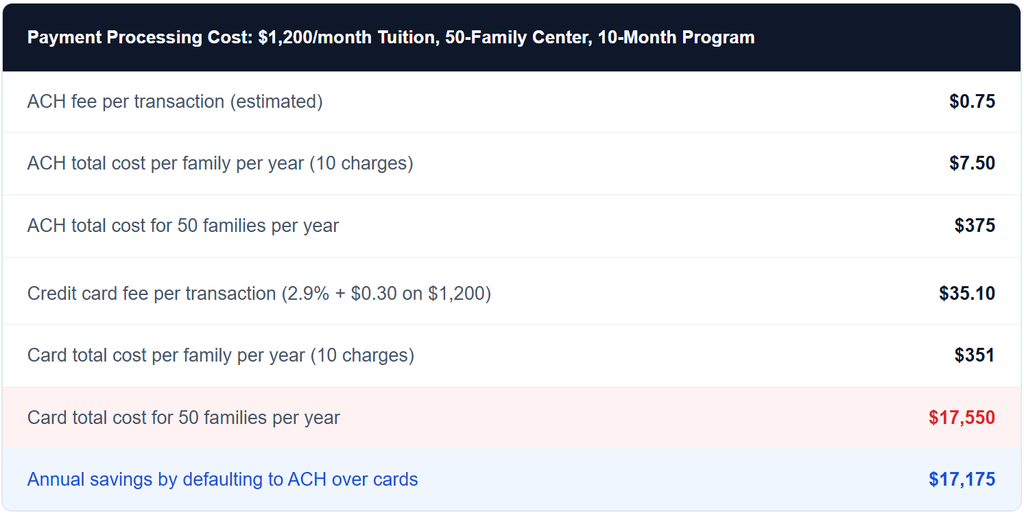
That cost differential is why most childcare programs that automate billing default to ACH and only offer card payment as a secondary option, often with a convenience fee passed to the family. The ACH cost structure also benefits families: a program absorbing $17,000 annually in processing fees either passes that cost through higher tuition for everyone or accepts lower operating margins. Defaulting to ACH, with transparent disclosure of why, is the approach most favorable to both parties.
The practical advantage of ACH over cards is also reliability. A parent who enrolled in September may have a card that expires in January. Without proactive expiry alerts sent 30 days in advance, the January tuition fails, and the director discovers it on a Monday morning. Good billing software sends automated expiry notices before the charge attempt. ACH bank account details, by contrast, rarely change and do not expire on a fixed schedule, making ACH the more stable recurring collection method for programs that bill on a 10 or 12-month installment cycle.
Setting Up Childcare Installment Billing Step by Step
1. Update your enrollment agreement before the next enrollment season.
Add explicit written authorization for automatic recurring charges, define enrollment-based tuition clearly, specify the late fee amount and grace period, document the failed payment and disenrollment procedure, and address co-payment versus subsidy billing for assisted families. Have a local childcare licensing consultant or attorney review the updated language, as some states require specific clauses in childcare fee agreements as a condition of licensure.
2. Collect payment authorization at enrollment, not after.
The ACH authorization or card authorization form should be completed at the same time the family signs the enrollment agreement, not as a follow-up step. Programs that send the agreement first and then chase payment authorization separately create a gap between the legal commitment (signed agreement) and the billing mechanism (incomplete authorization). Many families complete the agreement promptly and delay the payment setup indefinitely, which means the first installment arrives with no payment method on file.
3. Configure each family account with their individual billing structure
For private-pay families, this is straightforward: program tuition divided by installments, billed to the authorized payment method on the due date. For subsidy families, configure the gross tuition, the subsidy amount, and the family co-payment separately at the account level. And for split-billing families, set up each parent’s payment profile individually with their respective share. Use your client management platform to store each family’s authorization documentation alongside their billing profile so it is retrievable if a dispute arises.
4. Set up automated payment reminders and expiry alerts.
Configure the billing system to send families a payment confirmation on the day each installment is charged, a reminder two to three days before each due date, and a card expiry alert 30 days before a stored card expires. These three automated touchpoints replace the majority of billing-related inbound calls and emails the office would otherwise receive. A parent who gets a clear confirmation that payment processed is not going to call the director asking if it went through.
5. Define and configure your failed payment response sequence.
When an installment charge fails, the system should notify the family on the same day with clear instructions for updating their payment method, retry the charge two to three days later rather than immediately, and alert a staff member if the retry also fails. Define at the policy level how many failed installments trigger a care suspension conversation, and make sure that threshold is reflected in your enrollment agreement so the family was informed of it at enrollment, not at the moment of the conversation.
6. Generate FSA and tax documentation automatically at year-end.
Annual childcare payment statements for FSA reimbursement and the Child and Dependent Care Credit generate automatically from the billing platform, eliminating a major January administrative burden. Configure this as a year-end automated output rather than a manually produced document. Every family that uses a Dependent Care FSA needs a statement showing total childcare expenses paid to the program, the program’s name, address, and EIN. Producing this for 50 families manually in January is a significant time sink that good billing software eliminates entirely.
Common Mistakes and What I Got Wrong at First
Not distinguishing installment billing from a month-to-month subscription in the enrollment agreement
The most expensive mistake is using language in the enrollment agreement that allows families to interpret their installment plan as a cancellable monthly subscription. A family who enrolled for a 10-month preschool program on an installment plan, paid through month six, and then decided to disenroll, claiming they could cancel at any time because they had been paying month to month, creates a collections situation the program cannot win without clear term-commitment language in the agreement. The fix is a single clear sentence: “Enrollment in this program constitutes a commitment to the full program term. Monthly installments are a payment schedule for that commitment, not a month-to-month arrangement.”
Charging the full tuition to subsidy families and applying the credit later
Programs new to subsidy billing often configure the family account to charge the full gross tuition and then apply the subsidy credit as a separate transaction. This means the family sees a charge for $1,260 when they expected to see $420. Even if the net balance is corrected, the initial charge triggers NSF fees on their bank account, a panicked call to the office, and a damaged relationship. Configure the billing system to charge the co-payment amount from day one and track the subsidy as a separate funding stream that never hits the family’s invoice as a charge.
Sending both parents the full invoice in a co-parenting situation
The first time a split-billing setup goes wrong because both parents received the full invoice and both paid it, the program spends three staff hours reversing a double payment and managing two angry parents who each think the other is trying to avoid their share. Set up co-parenting accounts with individual billing profiles from enrollment. Do not put both parents on the same invoice. Do not split the invoice in the email body. Configure the billing system to generate two separate invoices for two separate amounts to two separate payment methods.
No retry logic and no family notification on failed charges
A failed installment charge that generates no automatic notification to the family and no retry attempt is a collection problem the program discovers days later, usually when reviewing the billing dashboard or when the family calls about something else. By then the window for a low-friction resolution has passed. Configure retry logic for two to three days after initial failure, not the same day, and configure the notification to go to the family immediately. The family almost always responds quickly when they receive a clear, non-accusatory message that explains what happened and how to fix it.
Using a generic invoicing tool instead of one that handles childcare-specific billing
Generic invoicing software can send a recurring invoice on a schedule, but it cannot distinguish between a subsidy payment and a family payment at the account level, manage split billing between co-parents, or generate a year-end FSA statement automatically. The first year using a generic tool to manage these scenarios requires substantial manual workaround. Most childcare programs discover this at the worst possible time: during enrollment season or during January’s FSA documentation rush. Use a billing platform that understands the structure of childcare tuition, or configure a flexible billing system like ReliaBills to accommodate the family account structure your program actually has.
Key Benefits of Installment Billing for Childcare Programs
The benefits of childcare installment billing fall into three categories that affect different stakeholders in the program.
For families
Installment billing converts a large annual or semester expense into predictable monthly or weekly payments that align with how most families manage their household budgets. It removes the upfront payment barrier that prevents some families from enrolling in programs they would otherwise choose, and automated collection removes the mental overhead of remembering to pay on time every month. Families who are not thinking about the next tuition payment are thinking about their child’s experience in the program, which is where the relationship should be focused.
For the program
Automated installment billing creates the revenue predictability that childcare programs need for staffing decisions, facility maintenance planning, and supply purchasing. A program that knows exactly which families are current on their installments and which have pending charges can make those operational decisions based on actual cash flow, not estimates of when checks might arrive. Combined with ACH collection, the typical delay between billing and receipt drops to one to two days rather than the week or more that check-based or manual-card billing produces.
For the family-program relationship
When billing is automated, consistent, and transparent, billing conversations are almost entirely eliminated from the director-parent relationship. The director is not asking about payment. The parent is not explaining why a check is late. The relationship stays focused on the child’s development, classroom activities, and program communication, which is exactly where both parties want it. This relationship quality difference is reported consistently by programs that have moved from manual billing to automated installment collection and is difficult to quantify but immediately recognizable by staff who have experienced both.
Frequently Asked Questions
1. What is childcare installment billing?
Childcare installment billing is a payment structure that divides a family’s total tuition obligation into scheduled partial payments across a program term rather than requiring full payment upfront or in large periodic amounts. The total tuition is set by the program; the installment plan is a collection method that makes it more manageable for families. It differs from a month-to-month subscription in that the family is committed to the full term, and the center charges for the reserved enrollment slot regardless of daily attendance. Most programs automate installment collection through a billing platform that charges the family’s stored payment method on each scheduled date.
2. What should a childcare installment billing enrollment agreement include?
The enrollment agreement must include explicit written authorization for automatic recurring charges, the installment schedule with each payment amount and due date, clear language that tuition covers the reserved enrollment slot and not just days attended, the late fee amount and grace period, the process for failed payments, the disenrollment policy for non-payment with notice requirements, and any subsidy co-payment provisions for assisted families. Split-billing arrangements for co-parenting families should be documented in a separate addendum specifying each party’s share and their individual payment method authorization.
3. How should childcare centers handle families receiving government subsidies?
The billing system should be configured to charge the family only their net co-payment, with the subsidy tracked as a separate funding stream at the account level. Charging the full gross tuition and then crediting the subsidy creates bank charges for families who see an unexpectedly large debit and generates avoidable disputes. Subsidy payments from agencies typically arrive 30 to 60 days after service delivery and should be tracked separately from family billing without affecting when the family’s co-payment is charged. Maintain detailed records of both payment streams for audit purposes, as subsidy-receiving programs are subject to state compliance reviews.
4. What is the best payment method for childcare installment billing?
ACH bank transfer is the most cost-effective method for childcare installment billing. The processing cost is typically $0.25 to $1.00 per transaction, compared to 2.5 to 3.5 percent for credit card processing. On a $1,200 monthly tuition for a 50-family center over a 10-month program, the difference between ACH and card processing is approximately $17,000 per year. ACH is also more reliable for recurring installments because bank account details rarely change, while credit card expiration creates failed charge cycles every one to three years per family. Offer card payment as a secondary option for families who specifically request it, ideally with a convenience fee that covers the processing cost difference.
5. Can families cancel a childcare installment plan mid-term?
This depends entirely on the enrollment agreement language. If the agreement clearly states that enrollment constitutes a commitment to the full program term and that installment payments are a collection schedule for that commitment, the family owes the remaining balance upon disenrollment, subject to any prorated refund policy the program has defined. If the agreement is silent on this or uses language that could be read as month-to-month, the program has no enforceable claim on the remaining installments. The most common source of midterm cancellation disputes is an enrollment agreement written for project- or session-based enrollment that was not updated when the program moved to installment billing. Update the enrollment agreement before the next enrollment season.
6. How do childcare programs handle failed installment payments?
The most effective sequence is automated family notification on the day of failure with clear instructions for updating their payment method, an automatic retry two to three days later rather than immediately, and a staff follow-up if the retry also fails. Care should generally continue through the first failed payment cycle for established families, as a single failed charge is almost always a temporary issue rather than an indication that the family is unable to pay. Define at the policy level, in the enrollment agreement, how many consecutive missed installments trigger a care suspension conversation so the family is informed of the policy at enrollment rather than at the moment of the conversation.
Recent Articles:
- Installment Billing for Security System Installations and Equipment Costs
- How to Automate Payment Collection for Dog Boarding and Kennel Services

Brant Pallazza is the Founder and President of ReliaBills, an invoicing and recurring billing platform built to help small businesses secure predictable cash flow. With over 20 years of experience in direct response marketing and e-commerce leadership, including a 13-year tenure managing over $500 million in gross sales at Digital River. Brant writes actionable guides on automated billing, payment processing, and scaling SMBs.