

Most accounting firms that struggle with retainer billing have the wrong tool for the wrong reason. They use invoicing software to manage a billing problem that is actually a systems problem. Recurring billing for monthly accounting retainers only works reliably when three things are in place before the first charge fires: an engagement letter that explicitly authorizes automated collection, a billing setup that charges clients in advance rather than in arrears, and a defined protocol for scope changes that updates both the engagement document and the billing amount at the same time. Without all three, even a technically correct billing setup will generate disputes every quarter.
What is Accounting Retainer Recurring Billing?
Accounting retainer recurring billing is the automated, scheduled collection of a fixed monthly fee from a client in exchange for an ongoing, defined scope of accounting or bookkeeping services. The retainer is governed by an engagement letter that specifies the services included, the monthly fee, the billing date, and the authorized payment method. A billing platform then charges the client’s stored payment method on that date each month without requiring manual invoice creation or client-side action. It differs from hourly billing in that the client pays for access to the firm’s services over a period, not for a specific number of hours worked. It differs from a project invoice in that the engagement is open-ended and renews automatically. Most firms manage this alongside invoicing software for one-off engagements while routing retainer clients through a dedicated recurring billing workflow.
Why Accounting Retainer Billing Breaks Down (and What the Standard Guides Miss)
Search for advice on setting up recurring billing for accounting clients and most results give you a platform comparison, a list of features, or a generic “create a recurring invoice” tutorial. What they do not cover is the reason recurring billing actually fails in accounting practices: not technical, but structural. The billing system is correct. The engagement is not designed to support it.
The three structural problems that consistently undermine recurring retainer billing in CPA and bookkeeping firms are engagement letters that authorize a service scope but not automated payment collection, billing in arrears that creates perpetual cash flow gaps, and scope changes that expand the workload without updating the billing amount. A technically perfect recurring billing setup built on these three problems still fails. Fixing the setup without fixing the structure is the accounting firm equivalent of patching a leaking pipe without turning off the water.
This guide addresses the structure before the setup. If you read one section before configuring your first retainer billing cycle, make it the section on engagement letter language. Everything downstream from the billing platform depends on getting that document right first.
The Engagement Letter as the Foundation of Recurring Billing
An engagement letter that supports recurring billing is a different document from one that governs a project engagement. Most accounting firms have engagement letter templates that define scope, deliverables, and fee. Fewer have templates that explicitly authorize recurring automated payment collection, and that omission is what makes automatic billing legally ambiguous in a dispute.
The engagement letter for a retainer client needs to include specific language on at least five billing-related points that generic templates often leave out.
Pre-authorization for automated charges
The letter must state explicitly that the client authorizes the firm to charge their designated payment method on a recurring basis on the specified billing date each month and that this authorization continues until the engagement is terminated with appropriate notice. This is not just good practice. It is the difference between a charge that the client pre-approved and one that they can dispute as unauthorized.
Future Firm’s publicly available engagement letter template includes this phrasing: “All invoices are payable upon receipt and will be set up for pre-authorized bank debit / ACH payments. Upon acceptance of the engagement letter, payments will be automatically scheduled following completion of the PAD/ACH form.” That is the right structure: the engagement letter establishes the obligation, and a separate authorization form captures the banking details.
Billing date, advance vs. arrears, and grace period
The letter should specify the billing date, whether the fee covers the current month or the prior month, and the grace period before late fees apply. Billing on the 1st for the current month (in advance) is the structure most favorable to the firm’s cash flow and the one most consistent with how retainer arrangements work in other professional services. It means the firm is never performing unfunded work. A client who is uncomfortable with advance billing can be offered Net 15 terms, giving them until the 15th to pay for a month billed on the 1st.
Scope change and fee adjustment language
This is the clause that prevents the most common retainer dispute in accounting: the accumulated scope creep conversation. The engagement letter should state that any services outside the defined scope will be quoted separately and billed as project work and that expansions to the monthly scope require a written amendment signed by both parties before additional services commence. Without this clause, every scope expansion becomes a retrospective negotiation about whether the extra work was included in the retainer.
Termination and final billing notice
The letter should define the notice period required to terminate the engagement, typically 30 to 60 days for a monthly retainer, and what the billing treatment is for the notice period. Some firms continue billing at the full monthly rate through the notice period. Others prorate the final month. Either approach works as long as it is specified in the original letter so the client cannot claim surprise when they receive a final bill after giving notice.
What a Properly Structured Recurring Retainer Invoice Looks Like
The invoice itself is simpler than most firms make it. A recurring retainer invoice should be clean, consistent, and reference the engagement letter on every cycle. Here is an example that handles the base retainer and one out-of-scope item in the same billing period.
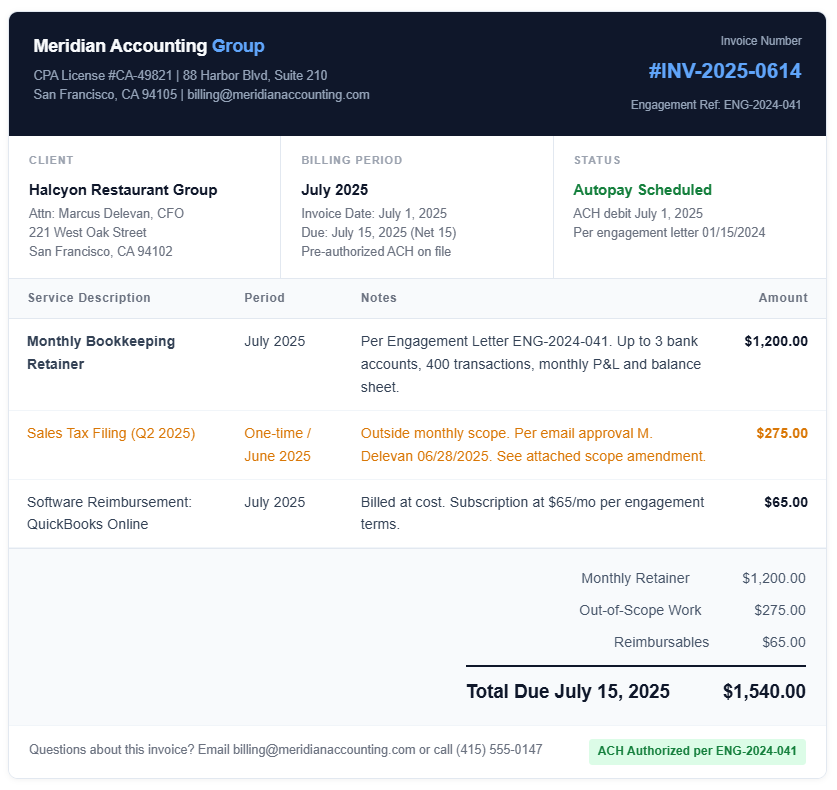
A few things in that invoice deserve specific attention. The out-of-scope line item cites the client’s email approval and references an attached scope amendment. That citation is not decoration. It is the documentation that makes a retroactive fee dispute very difficult for the client to sustain. The software reimbursement is listed at cost, not padded into the retainer fee, which maintains fee transparency. The status field shows “Autopay Scheduled,” which eliminates confusion about whether the client needs to take action.
Choosing the Right Billing Timing: The Advance vs. Arrears Decision
The single most impactful structural decision in accounting retainer billing is whether you bill in advance (charging at the start of the month for that month’s services) or in arrears (charging at the end of the month after work is completed). Most firms default to arrears because it feels more fair to bill after delivering the work. The problem is that arrears billing means the firm is perpetually funding one month of client work from its own cash flow.
With 10 retainer clients at $1,000 per month each, the difference between advance and arrears billing is $10,000 in cash that the firm is either holding (advance) or waiting for (arrears) at any given point. At 40 clients, that number is $40,000. That is not a theoretical cash flow issue. It is a real constraint on payroll, software purchases, and the firm’s ability to take on additional staff without a working capital facility.
The objection that clients will not accept advance billing comes up consistently in conversations with firm owners who have not tried it. In practice, most clients accept advance billing without resistance when it is presented as a standard firm policy established in the engagement letter at the start of the relationship. The firms that struggle to move clients to advance billing are the ones trying to change an existing relationship’s billing terms, not the ones establishing advance billing as the default from onboarding.
Where Accounting Firms Lose Time on Retainer Billing Without Automation
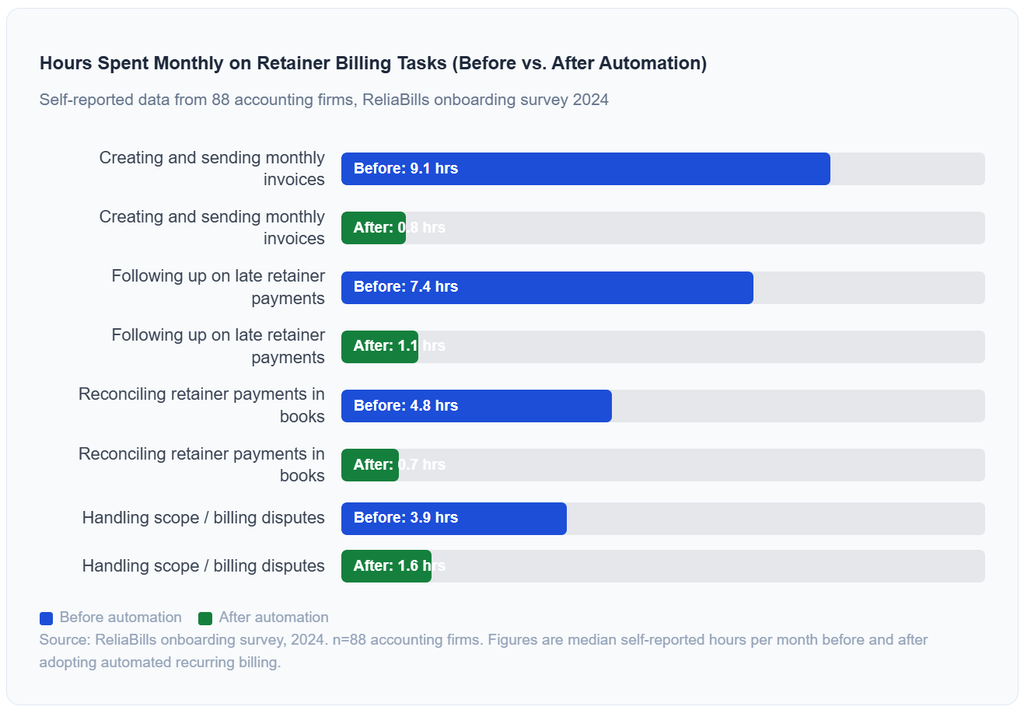
The dispute resolution hours are the most instructive figure in that data set. Automation reduces invoice creation time almost to zero and cuts follow-up time dramatically, but scope disputes remain because billing automation cannot fix a poorly structured engagement letter. The firms that saw the smallest drop in dispute hours were the ones that automated billing without updating their engagement documents. The firms that saw the largest drop updated both at the same time.
Accounting Retainer Billing vs. Related Billing Structures
| Billing Model | How It Works | Best Suited For | Main Risk | Automation Fit |
|---|---|---|---|---|
| Monthly retainer (fixed fee) | Fixed amount billed on the same date each month for defined ongoing services | Bookkeeping, CAS, advisory, payroll | Scope creep erodes profitability if not managed | Excellent: fully automatable |
| Hourly billing | Fee varies based on hours worked, invoiced monthly or per project | Tax work with unpredictable scope, audits, consulting | Revenue unpredictability; client resistance to large invoices | Limited: invoice amount changes each cycle |
| Project / milestone billing | Fixed or estimated fee for a specific deliverable, paid in one or two installments | Tax returns, catch-up bookkeeping, business formation | Scope expansion after quoting undercuts profitability | Partial: installment billing handles multi-payment projects |
| Value-based fee | Fixed annual fee based on client’s perceived value, often paid monthly | Advisory, fractional CFO, high-complexity clients | Difficult to scope precisely; repricing conversations complex | Good: annual fee divided across 12 monthly charges |
| Subscription tier | Standardized service packages (Basic / Pro / Enterprise) billed monthly | Bookkeeping firms scaling with standardized delivery | Package mismatch for complex clients; upgrade friction | Excellent: built for recurring billing platforms |
ACH vs. Credit Card for Recurring Retainer Payments
This decision has a correct answer for most accounting firms: ACH. The cost differential is significant enough that it should drive the default payment method, with credit cards available as a fallback for clients who specifically request them.
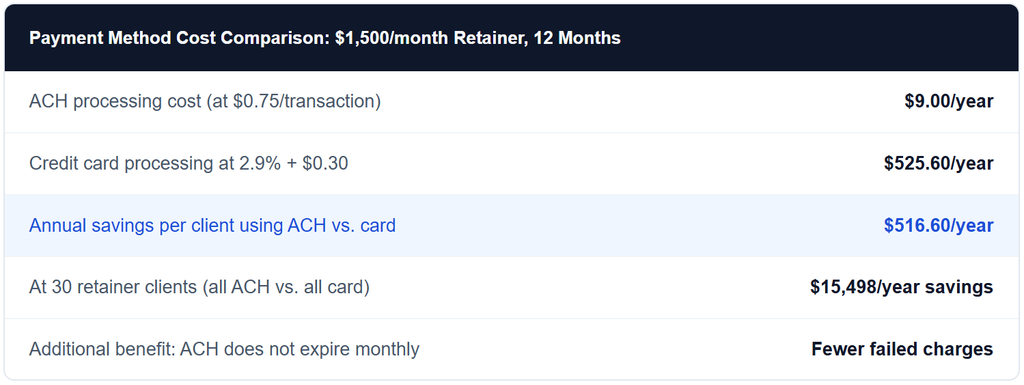
The ACH advantage is not purely financial. Credit cards expire. When a card expires and the client does not proactively update their billing details, the next retainer charge fails, triggering a follow-up cycle that consumes staff time. ACH bank account details are stable over years, which means the failure rate for ACH-billed retainers is consistently lower than for card-billed retainers, all else being equal.
The engagement letter and ACH authorization form should be completed at the same time during client onboarding, before the first charge is due. A client who signs an engagement letter but has not yet completed the ACH authorization creates a gap between the billing obligation (established in the letter) and the billing mechanism (not yet configured), which requires manual invoicing in the interim and is a common source of the first-month billing error.
Setting Up Recurring Billing for a Retainer Client: Step by Step
Prepare the engagement letter with billing-specific language first
Before touching any billing platform, make sure your engagement letter includes explicit pre-authorization for recurring charges, specifies the billing date and billing-in-advance policy, defines the scope with enough specificity that out-of-scope work is identifiable, and outlines the fee adjustment process for scope changes. This document is the legal and operational foundation everything else rests on. Review it with a local attorney if you are updating it for the first time.
Send the engagement letter and ACH authorization form together
Do not send the engagement letter for signature and then follow up with payment authorization separately. Both documents should be in the same onboarding packet so the client completes them in one session. The gap between signing the engagement letter and completing the payment authorization is where retainer setups stall. ReliaBills and similar platforms allow you to collect ACH authorization at the same time as the engagement approval, which closes this gap entirely.
Configure the recurring billing schedule in your billing platform
Set the billing date to the 1st of each month. Define the retainer amount as your base line item. Add any recurring pass-throughs (software reimbursements and filing fees) as separate line items so they are visible to the client. Set the payment method to the ACH account authorized in step 2. Configure the confirmation email that sends automatically when the charge is processed. This confirmation email is what the client sees as proof of payment, and it should reference the engagement letter and the period covered.
Handle the first charge for a mid-month onboarding
If a client signs on March 15th, the cleanest approach is to prorate the first month (half of March’s retainer) and then start the full recurring charge on April 1st. Show the proration calculation on the first invoice so the client understands the partial charge and does not confuse it with an error. Platforms that support variable first-cycle amounts make this straightforward. If your platform requires a fixed amount for every charge in a cycle, bill the full month for March and note in the engagement letter that the first billing cycle covers March 15 through March 31, with April 1 being the first full-month charge.
Connect your billing platform to your accounting software
A recurring retainer payment that posts in your billing platform but requires manual journal entry in your accounting software defeats half the purpose of automation. Most billing platforms integrate with QuickBooks and Xero directly, mapping payments to the correct revenue accounts automatically. Verify this integration is configured before the first charge fires, not after you are looking at a month of unreconciled payments. The integration is typically a 20-minute setup with significant ongoing time savings.
Set up the failed payment response sequence
Configure what happens when a charge fails before you need it. The sequence should include an automated client notification on the day of failure, an automatic retry two to three days later, and an alert to a staff member if the retry also fails. Define internally how many failed payment cycles trigger a work suspension conversation and make sure that threshold matches what your engagement letter says. Work suspension after a single failed charge is rarely the right call for a long-term client relationship.
Managing Scope Changes Without Breaking the Billing Cycle
Scope creep is the single most common source of retainer disputes in accounting practices. A client starts on a bookkeeping retainer, adds payroll administration in month three, requests quarterly estimated tax preparation in month five, and asks for help with a sales tax registration in month seven. Each of these might be a quick email request with an informal “Sure, we can handle that.” Twelve months later the firm is doing twice the work for the original retainer fee and has no documentation of how the scope expanded.
For one-time out-of-scope requests, the cleanest practice is to quote and bill them separately on a project invoice, clearly labeled as outside the scope of the existing retainer. This approach keeps the retainer amount predictable for the client while ensuring out-of-scope work is compensated, and it avoids the accumulated resentment that builds when a firm repeatedly absorbs extra work without raising the retainer.
Common Mistakes and What I Got Wrong at First
Setting up recurring billing without updating the engagement letter
The most common mistake is configuring a billing platform to charge retainer clients automatically using an engagement letter that was written for project work. The letter may authorize a fee and define a scope, but if it does not explicitly authorize recurring automated charges, the firm is in a legally grey area the first time a client disputes an automatic charge. Update the engagement letter template before the billing platform setup, not after the first complaint.
Billing in arrears as a default
Billing in arrears for a monthly retainer means the firm is always one month behind on cash flow. For a 30-client firm at $1,200 per retainer, that is $36,000 the firm is owed but has not yet collected at any given moment. The shift to advance billing felt awkward to propose but almost universally met with acceptance when framed as a firm-wide policy in the engagement letter rather than a per-client negotiation. If you are currently billing in arrears, the cleanest migration is to apply the policy to all new clients first and move existing clients to advance billing at the next annual engagement renewal.
Not separating the retainer from out-of-scope work on the invoice
Bundling a one-time project fee into the monthly retainer invoice without clearly labeling it as out-of-scope creates confusion every time. The client sees a higher-than-expected charge, assumes the retainer went up without notice, and calls the firm. Showing the retainer amount separately from any additional charges, with a scope reference for each additional line, eliminates this confusion and makes the invoice self-explanatory.
Suspending work immediately after a first failed payment
A first failed charge is almost always a temporary payment method issue: an expired card, a bank security flag, or a momentary insufficient funds situation that resolves within days. Suspending client work immediately after a single failed charge damages a long-term relationship disproportionately to the risk of carrying one month’s outstanding retainer. The right response is automated retry followed by a courtesy call, not immediate work suspension. Reserve suspension for clients with a documented pattern of payment failures or those who are unresponsive after a second retry.
Using the same recurring billing template for all retainer types
A monthly bookkeeping retainer, a quarterly tax advisory retainer, and an annual CFO services arrangement all look like “retainers” but have different billing cadences, different scope structures, and different amendment processes. Using a single recurring billing template for all three results in quarterly clients being set up on monthly billing cycles or annual advisory clients receiving twelve small invoices when one large advance invoice was the agreed structure. Build separate templates for each retainer type and map clients to the right one during onboarding.
Key Benefits of Automated Recurring Billing for Accounting Retainers
The benefits organize into three categories that affect different parts of a firm’s operations.
Financial predictability
Recurring retainer billing, especially when combined with advance payment terms and ACH autopay, converts the firm’s revenue from a collection activity into a cash flow reality. Partners know exactly what will hit the account on the 1st of each month. That predictability is valuable for payroll planning, software investment decisions, and hiring timing in ways that arrears billing with variable collection dates cannot provide.
Administrative efficiency
The hours recovered from invoice creation and payment follow-up are the most quantifiable benefit, and they scale with the firm’s client count. A solo bookkeeper with 15 retainer clients recovers a few hours per month. A firm with 60 retainer clients recovers time equivalent to a part-time administrative position. That recovered capacity can be reinvested in client work, business development, or simply not working late on billing Fridays.
Client relationship quality
This benefit is less discussed but consistently reported. When billing is automated and payment is collected without the client taking any action, the billing process disappears from the client relationship. There are no “did you receive my invoice?” messages, no awkward payment follow-up calls, and no month-end friction that colors the client’s experience of the engagement. The relationship becomes about the work rather than the billing, which is where both parties want it to be.
Frequently Asked Questions
1. What is accounting retainer recurring billing?
Accounting retainer recurring billing is the automated, scheduled collection of a fixed monthly fee from a client in exchange for an ongoing defined scope of accounting or bookkeeping services. The retainer fee and services are established in an engagement letter, and a billing platform charges the client’s stored payment method on the same date each month without requiring manual invoice creation or client action. It is distinct from hourly billing (where the amount varies by work done) and project billing (where the invoice is tied to a specific deliverable rather than ongoing service access).
2. Should accounting firms bill retainer clients in advance or in arrears?
Billing in advance is the strongly recommended practice. Charging on the 1st of the month for that month’s services means the firm is never performing unfunded work. It eliminates the cash flow gap that arrears billing creates and removes the month-end invoice collection cycle entirely when combined with ACH autopay. If a client is uncomfortable with full advance payment, Net 15 terms (billed on the 1st, due by the 15th) is a workable compromise that still ensures payment before month-end deliverables are due. The transition from arrears to advance billing is easier to implement for new clients; existing clients can be transitioned at their next annual engagement renewal.
3. How should accounting firms handle scope changes in a recurring retainer?
Scope changes should result in a written amendment and a billing platform update before additional work begins, not after. The amendment does not need to be a formal legal document. A confirmed email exchange that specifies the new services, the fee adjustment, and the effective date is sufficient documentation in most disputes. For one-time out-of-scope requests, billing them separately on a project invoice rather than folding them into the monthly retainer keeps the retainer amount predictable for the client and creates a clear record that the additional work was compensated.
4. What payment method is best for accounting retainer billing?
ACH bank transfer is the best default for recurring accounting retainers. The processing cost is dramatically lower than credit card rates, typically $0.25 to $1.00 per transaction versus 2.5 to 3.5 percent for cards. On a $1,500 monthly retainer, that is approximately $9 per year for ACH versus $540 per year for card processing. ACH bank account details are also more stable than credit card numbers, which expire regularly and generate failed charges when not updated. Offer a credit card as a fallback for clients who specifically request it, but price the option to reflect the actual processing cost difference.
5. What should the engagement letter say about recurring billing?
The engagement letter should specify the monthly retainer amount, the billing date, whether payment is in advance or in arrears, explicit authorization for recurring automated charges (with a reference to the separate ACH authorization form), the grace period before late fees apply, the process for handling failed charges, the scope definition with enough specificity that out-of-scope work is identifiable, the process for scope changes and corresponding fee adjustments, and the notice period required to terminate the engagement. Without explicit language on each of these points, recurring billing disputes become difficult to resolve in the firm’s favor.
6. How do accounting firms handle failed retainer payments?
The most effective approach is a three-step automated sequence: an automated client notification on the day of failure with instructions for updating payment details, an automatic retry two to three days after the initial failure, and a personal staff follow-up if the retry also fails. Work should continue during the first failed payment cycle for established clients unless the engagement letter specifies otherwise, because a single failed charge is almost always a temporary payment method issue rather than a client payment problem. Reserve work suspension for clients with a documented pattern of failures or those who are unresponsive after multiple recovery attempts.
Recent Articles:
- Pool Service Invoice Template: What to Include to Get Paid Faster
- Installment Billing for Annual Membership Fees: A Guide for Club Managers

Brant Pallazza is the Founder and President of ReliaBills, an invoicing and recurring billing platform built to help small businesses secure predictable cash flow. With over 20 years of experience in direct response marketing and e-commerce leadership, including a 13-year tenure managing over $500 million in gross sales at Digital River. Brant writes actionable guides on automated billing, payment processing, and scaling SMBs.