

Tax preparation fees are rising fast, and most firms are losing clients who can’t absorb the whole bill at once. Installment billing gives clients a structured way to pay over time while ensuring your firm collects in full and on schedule. Implemented correctly, it is not a discount mechanism. It is a retention strategy, a conversion tool for higher-fee engagements, and, when paired with automated billing software, an almost zero-overhead addition to your practice.
The Fee Conversation Problem That Payment Plans Actually Solve
Tax preparation fees have climbed sharply in recent years. According to the 2025 NATP Fee Study, the average fee for a base Form 1040 (with Schedules 1–3) now stands at $280 for CPAs and $228 for Enrolled Agents, up substantially from prior cycles, with 83% of preparers raising fees every one to two years by 6–10%. For business returns, the numbers climb considerably higher: the average S-corporation return now runs $600–$900 in many markets, and complex multi-state or multi-entity filings regularly exceed $2,000–$4,000.
These fees are justified. The expertise, liability, and time they represent are real. But for a significant portion of clients, particularly small business owners with lumpy cash flow, individual filers managing a year of financial change, and the growing segment of clients with crypto or alternative asset activity, a $900 or $2,500 invoice due immediately upon filing feels like a wall rather than a door.
The result, in practice: clients delay engaging. They bring disorganized files at the last minute, making the work harder and more expensive. Or they find a lower-cost preparer, leave the relationship, and return a year or two later with a compliance mess to clean up. None of these outcomes serve the client or the firm.

Payment plans do not change what you charge. They change when the client pays it, which turns out to matter enormously for conversion, retention, and the firm’s ability to take on higher-value engagements.
How Installment Billing for Tax Preparation Actually Works
The mechanics are simpler than most practitioners expect. The complexity sits not in the billing itself but in three surrounding decisions: how to structure the installment schedule, how to collect payment reliably, and what happens if an installment fails. Get those three right and the rest is largely automated.
Common Installment Structures for Tax Preparation
| Structure | Payment Timing | Best For | Risk Level |
|---|---|---|---|
| 50/50 Split | 50% at engagement signing, 50% at file delivery | New clients; any engagement over $400 | Low |
| Three-Part | 33% at signing, 33% at draft review, 34% at filing | Mid-complexity returns ($600–$1,500) | Low–Medium |
| Monthly Installments | Equal payments over 2–4 months from engagement date | Business clients; larger engagements over $1,500 | Medium (requires automation) |
| Deposit + Deferred Balance | 25–30% upfront, remainder at 60–90 days | High-fee engagements; advisory bundles | Medium |
| Pre-season Monthly (Retainer-style) | Equal monthly payments beginning in October for spring filing | Regular business clients on advisory plans | Low (collected before work peaks) |
A Sample Installment Plan: What It Looks Like in Practice
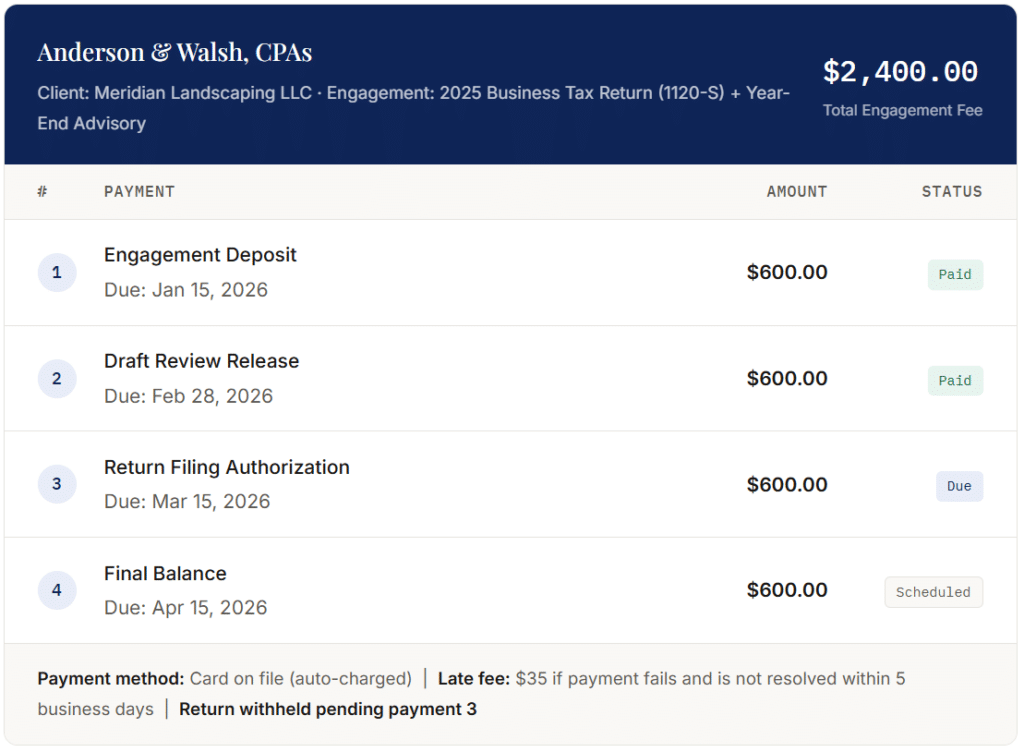
The sample above reflects a real-world pattern: milestones tied to deliverables rather than arbitrary calendar dates. This structure works because the client sees clear cause and effect, they authorize the next step by completing the payment associated with it. It also gives the firm natural leverage without an adversarial collection posture.
Setting Up Installment Billing: End-to-End
1. Define your installment tiers by fee range
Decide upfront which engagements qualify for payment plans. A common threshold: any engagement over $500 can be split into two payments; over $1,000 into three; over $2,000 into four. Document these thresholds in your firm’s billing policy so staff applies them consistently. Ad hoc decisions at the client level create inconsistency and perceived favoritism.
2. Capture the client’s payment method before work begins
This is the non-negotiable step. A payment plan without a card or ACH on file is a credit arrangement, not a billing structure. Require payment method capture as part of your engagement letter signing process. Platforms that support tokenized card storage make this seamless; the client enters their card once during onboarding, and subsequent installments charge automatically without the client needing to act. Proper customer management records should store the payment method alongside the engagement details.
3. Tie installment triggers to deliverable milestones
Calendar-based payment plans (charge on the 1st of each month) work for ongoing advisory retainers. For project-based tax work, milestone-based triggers are more defensible: payment 1 at engagement, payment 2 at draft review, payment 3 at filing. Milestone billing makes the payment feel logical to the client and reduces disputes about timing, since the client clearly receives something each time a payment is due.
4. Document the plan in your engagement letter
The installment schedule, amounts, due dates, payment method, late fee terms, and consequences for non-payment (e.g., work withheld pending payment, file not released) must appear in the signed engagement letter. This is not optional. A verbal payment plan arrangement is unenforceable and creates collection exposure later. Your engagement letter is the contract; the billing system is the execution layer.
5. Configure automated billing and reminders
Set up each installment as a scheduled charge in your billing software. Configure automated reminders 48–72 hours before each charge date so clients are not surprised. Set up failed-payment alerts and a retry policy (most platforms allow 1–2 retries before escalating to a manual notification). The goal is for the entire billing lifecycle to run without staff involvement except for exception handling. Installment billing software specifically designed for this workflow handles the scheduling, retry logic, and client communication automatically.
6. Monitor your installment dashboard monthly
Every installment billing setup needs a monthly review of the dashboard: which payments are on track, which are pending, which have failed and not resolved. This review takes 10–15 minutes and prevents small collection issues from becoming 90-day receivables problems. Track your installment-plan clients separately from single-payment clients so you can measure both collection rates and any difference in client retention between the two groups.
Real-World Examples: Who Benefits and How
The Solo CPA Adding Higher-Fee Services
A solo practitioner in a mid-size metro market was seeing consistent resistance when presenting proposals for tax advisory engagements with annual fees of $2,400–$3,600 that represented a step up from $350–$500 individual returns the same clients had been paying for years. Presenting the advisory fee as a monthly installment ($200–$300/month) changed the conversation entirely. The first year, three clients converted to advisory engagements they had previously declined. The revenue per client increased by 4–6x. The monthly charge, handled through automated billing, required no additional administrative work.
The Multi-Partner Firm Managing Business Client Receivables
A five-partner CPA firm preparing 400+ business returns annually had a receivables problem: 18% of their annual revenue was still outstanding 60 days after filing. Analysis of the delinquent accounts revealed a consistent pattern, clients who received single invoices over $1,500 were the source of nearly 80% of the aged receivables. Implementing a mandatory two-part payment plan for all engagements over $1,000 (50% at engagement, 50% at filing) reduced 60-day receivables to under 4% within one tax season. The change was met with almost no client resistance when framed as a firm-wide policy rather than a reaction to individual payment history.
The Tax Preparer Serving Crypto and High-Complexity Individual Filers
Individual clients with cryptocurrency transactions, rental income, or significant life changes (business sales, divorce, or inheritance) routinely generate return fees of $800–$2,500. These clients are often financially sophisticated but cash-flow constrained, particularly if they owe substantial tax liability on top of preparation fees. A three-part payment plan (at engagement, at draft, and at filing) separates the preparer’s fee from the tax liability question, making the engagement decision cleaner. Clients are less likely to delay engaging, and therefore less likely to file extensions or make errors, when the preparation fee is not competing with an anticipated tax payment in the same week.
Key Benefits of Offering Installment Payment Plans
The benefits fall into three categories that operate at different timescales.
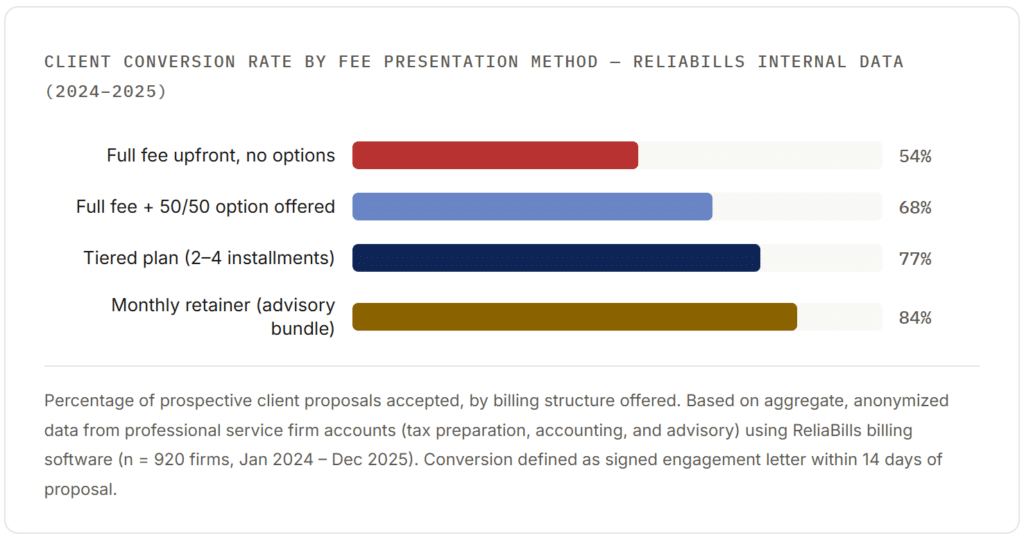
Immediate: Higher conversion on premium engagements. The data above is consistent across firm types, adding a payment plan option to a proposal increases the acceptance rate. For engagements over $1,000, the effect is most pronounced. Clients who would otherwise request a scope reduction, delay signing, or shop for a lower-fee alternative are more likely to proceed when the total feels manageable.
Short-term: Reduced receivables and collection friction. A payment structure with a deposit and automated subsequent charges has a fundamentally better collection profile than a single invoice sent after work is complete. You collect the first installment before the work begins. You collect subsequent installments while the client is actively engaged in the process. By the time the final charge is due, you have already collected 50–75% of the total, and the relationship is intact.
Long-term: Improved client retention. According to the 2025 Thomson Reuters Institute State of Tax Professionals Report, 75% of clients strongly desire more tax and business advice from their preparer, and firms that successfully transition clients to advisory relationships report meaningfully higher retention rates. Installment billing is often the mechanism that makes advisory pricing accessible enough to actually convert a compliance-only client into an ongoing advisory relationship. Using recurring billing software for annual or monthly advisory plans extends this benefit into a predictable revenue stream.
Key Risks and Things to Watch For
Risk: Releasing the return before collection is complete
The most common and costly mistake in installment billing for tax prep is filing the return, or releasing the signed copy, before the final payment clears. Once the client has the return, your leverage is gone. Policy should be explicit: the signed return is not delivered, and the IRS authorization form is not submitted, until payment 3 (or the final installment) has cleared. This is not adversarial; it is standard practice that should be stated clearly in the engagement letter.
Risk: Operating without a signed agreement
An installment plan without an engagement letter documenting the schedule, amounts, payment method, and consequences of non-payment is not a billing policy, it is a hope. When disputes arise, and occasionally they do, the engagement letter is the only document that matters. Every installment arrangement needs a signed agreement before work begins.
Watch: Fee financing vs. firm-managed installments
Third-party fee financing services (where a lender pays your firm upfront and collects installments from the client directly) are an alternative to firm-managed payment plans. They eliminate collection risk entirely but add cost, typically a processing fee of 3–8% of the financed amount, and introduce a third party into the client relationship. For high-fee engagements or clients with uncertain payment history, the fee may be worth it. For established clients or mid-range engagements, firm-managed installments with a card on file are almost always more economical.
Risk: Cash flow seasonality amplification
Tax preparation is already a highly seasonal business. If your installment plans defer significant revenue into months when your workload has already dropped, you can end up with a cash-flow gap in summer or fall that mirrors the one installment billing was supposed to solve. Structure your plans to collect the majority of each engagement’s fee during or before the filing window, not in the three months after it.
Billing Model Comparison: Installments vs. Alternatives
| Model | When Firm Gets Paid | Client Barrier | Collection Risk | Admin Overhead | Best For |
|---|---|---|---|---|---|
| Single invoice at filing | After all work is done | High (full amount due immediately) | High | Low | Simple returns, established clients |
| Deposit + balance | Partial before, rest after | Medium | Medium | Low | Any engagement over $500 |
| Firm-managed installments | Spread over engagement period | Low | Low–Medium | Low (with automation) | Mid-to-high fee engagements |
| Third-party financing | Immediately (lender pays upfront) | Very low | None for firm | Low (lender manages) | High-risk clients; large fees |
| Monthly retainer (advisory) | Monthly, in advance | Very low (predictable small amounts) | Low | Very low (recurring billing) | Year-round advisory clients |
| Hourly billing | After time is logged and invoiced | Unpredictable (client can’t budget) | High | High (time tracking, dispute-prone) | Being phased out at most progressive firms |
What I Got Wrong at First (Common Mistakes in Tax Prep Installment Billing)
Mistake 1: Offering payment plans as a favor rather than a policy
The first iteration I worked with treated installment plans as something offered selectively to clients who pushed back on pricing. That created two problems: inconsistency that felt like favoritism, and a signal that the fee was negotiable rather than fixed. Converting to a firm-wide policy, “all engagements over $X are structured with a deposit and subsequent installments,” removed the awkwardness entirely and actually made it easier to hold the fee line because the plan option was no longer a concession, it was just how the firm billed.
Mistake 2: Not capturing a payment method before work began
The early approach was to set up the installment schedule at engagement signing, then collect each payment manually, sending an invoice for each installment and waiting for the client to pay. The late payment rate on installment 3 was nearly 30%. Switching to a card-on-file model, where the client provides payment authorization at signing and installments are charged automatically, dropped that rate to under 3%. The difference is not client willingness; it is friction. Automatic charges eliminate the friction of remembering and acting.
Mistake 3: Setting all installments as equal amounts
Equal installments sound fair, but they create the wrong leverage structure. If installment 1 is $300 and the return costs $900 total, and you have already done $700 worth of work before payment 2 is due, you are effectively providing credit. Front-load the deposit, 35–40% of the total, and the math shifts in your favor. You are never more than one installment behind the value of work delivered.
Mistake 4: Failing to build failed-payment handling into the process
When a scheduled installment fails, and eventually some will, the lack of a pre-defined response is what creates the difficult conversation. Build the response into the engagement letter: “If a scheduled payment fails, we will attempt one retry within 48 hours and notify you by email. If unresolved within 5 business days, a $35 late fee applies, and work may be paused pending payment.” Having this language in writing means the conversation, when it happens, is a reminder of an agreed policy rather than an escalation.
How to Get Started: Practical Implementation Steps
Step 1: Update your engagement letter template
Before you configure any billing software, update your engagement letter to include a payment plan section. At minimum, it should specify: the total engagement fee, the installment schedule (amounts and due dates), the accepted payment method, the authorization for automatic charges, the late fee policy, and the consequences of non-payment on work delivery. If your current engagement letter does not have this, adding it is the highest-priority action in this guide.
Step 2: Choose a billing platform with installment-native support
Generic invoicing software can handle installment billing, but it requires manual invoice creation for each payment, which defeats the efficiency purpose. Look for a platform with installment-specific features: scheduled charge execution, automated client notifications before each charge, failed-payment retry logic, and a dashboard view of all outstanding installment schedules by client. ReliaBills was built specifically for this kind of structured recurring billing, making it well-suited for tax practices that want to offer flexible payment terms without adding back-office complexity. Your invoicing software and installment billing tools should ideally live in the same platform.
Step 3: Pilot with new clients before rolling out firm-wide
Before applying installment billing to your entire client base, pilot the structure with 10–20 new engagements. This lets you work out any process gaps, the client communication sequence, the failed-payment response, and the dashboard monitoring routine without disrupting existing client relationships. After one billing cycle, review: What was the collection rate? Were there any disputes? Did the process feel manageable to staff? Adjust, then roll out firm-wide for the next tax season.
Step 4: Connect installment billing to your client management system
Each client’s installment plan should link to their profile in your Customer Management system, so anyone on the team can see at a glance which installments are pending, which have cleared, and which need follow-up. This is particularly important in multi-preparer firms, where the person managing billing may not be the person preparing the return.
Frequently Asked Questions
1. Is it legal for a CPA or tax preparer to charge clients in installments?
Yes, installment billing for tax preparation services is legal and widely practiced. There are no federal regulations that prohibit tax professionals from structuring their own fee payment arrangements with clients. State CPA licensing rules govern professional conduct but do not generally restrict billing structure. The key compliance requirement is that the arrangement is documented in the engagement letter and that any credit-like features (interest charges on deferred balances, for example) comply with applicable state consumer credit laws. For most firms offering simple installment schedules with no interest, this is not an issue.
2. Should I charge interest or a fee for payment plans?
Most tax practitioners do not charge interest on installment plans, and for good reason, adding interest to a payment plan positions it as a financing product, which can trigger consumer lending regulations in some states and adds complexity to the client relationship. Instead, the more common approach is to price the engagement knowing that installment billing will be offered, so the fee already reflects the value of the work. If you want to recover the cost of delayed collection, a small administrative fee (flat $25–$50) for plans beyond two installments is simpler and more defensible than a percentage-based interest charge.
3. What happens if a client’s payment fails on a scheduled installment?
The response depends on the stage of work. If the failed payment is the deposit (installment 1), do not begin work until it resolves. For mid-engagement failures, pause work delivery, do not release the draft return, and do not file until the payment is resolved or a new arrangement is confirmed. Your billing software should attempt one automatic retry within 48–72 hours. If that also fails, send a direct notification and give the client 5 business days to resolve before any late fee is applied. Having this sequence documented in the engagement letter means no improvised decisions are needed when it happens.
4. How do I handle a client who wants to cancel mid-engagement while on a payment plan?
Your engagement letter should include a cancellation clause that specifies how fees are handled if the client terminates early. A reasonable approach: the client owes for work completed through the cancellation date, calculated as a proportion of the total fee. If installments already collected exceed that amount, the difference is refunded; if they fall short, the balance is due. Having this clause in writing eliminates the negotiation, the math is already defined. Refund the overage promptly; a clean exit protects the professional relationship and your reputation.
5. Can installment billing work for ongoing advisory clients, not just annual tax prep?
Absolutely, and this is arguably the highest-value application of the concept. Advisory clients on an annual fee of $3,000–$12,000 are the most natural candidates for monthly billing, which converts their annual engagement into a predictable monthly recurring charge. This is not technically “installment billing” in the project sense; it is a subscription or retainer model. But the mechanics are identical: the client authorizes recurring charges, the platform executes them automatically, and the firm collects steadily throughout the year rather than in a single large invoice. Using a recurring billing platform for this use case makes the setup straightforward and the collection reliable.
6. How should I present the payment plan option to clients without making it seem like I expect them not to pay?
Frame it as a feature of your billing system, not a special accommodation. “Our firm structures larger engagements with a deposit and scheduled payments, it makes the process predictable for both of us” lands very differently from “We can break this up if the total is a concern.” The first version signals that this is standard practice and that you are organized. The second signals that you noticed the client might have trouble paying. If you offer it as a firm-wide policy, most clients simply accept it as how you work, and many will appreciate the flexibility without reading anything into it.
Recent Articles:
- Seasonal Billing for Pool Service: Manage Start and Stop Dates Easily
- Pet Grooming Invoice Template: What to Include for Professional Billing