
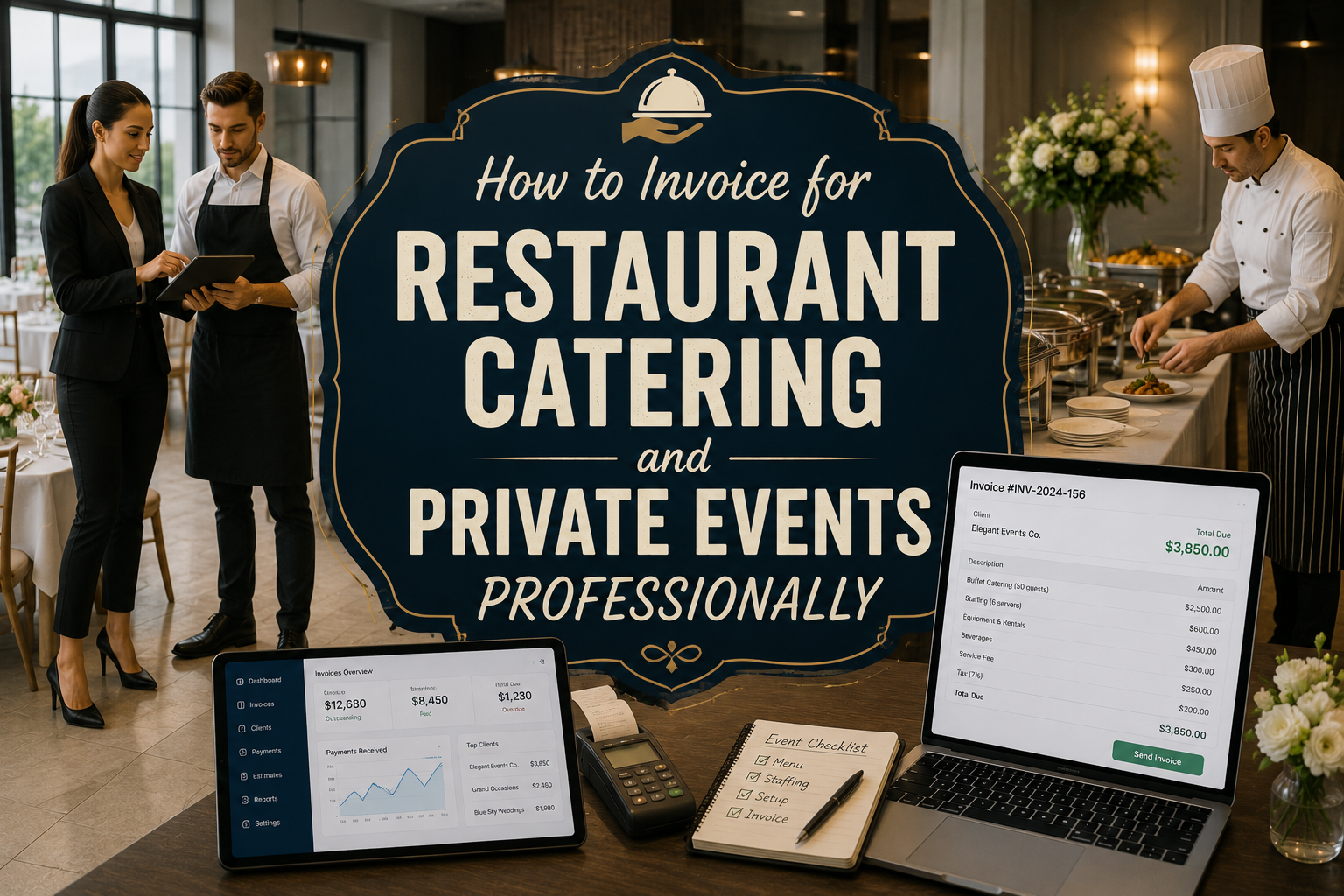
A professional restaurant catering invoice for private events does three things simultaneously: it matches the original quote exactly so clients have no grounds for dispute, it itemizes every charge, food, service, gratuity, and any post-event additions so the total makes intuitive sense, and it arrives within 12 hours of event completion so the client pays when the experience is fresh and the value is obvious. Miss any of those three and your collection timeline doubles.
What is a Catering Invoice?
A catering invoice is a financial document sent from a restaurant or catering company to a client that itemizes all charges for food, service, staffing, rentals, and fees associated with a catering engagement or private dining event. Unlike a standard product invoice, a catering invoice is part of a multi-document billing sequence: the original quote, the signed event proposal, the deposit invoice, the final invoice, and in some cases an installment payment schedule. Key terms include catering deposit invoice, per-head billing, service charge vs. gratuity, minimum spend invoice, and invoicing software with event-specific templates. A professional catering invoice is both a collection instrument and a legal record of what was agreed to and delivered, the same document protects the caterer in a payment dispute and gives the client the documentation they need for expense reimbursement or event budgeting.
Anatomy of a Professional Catering Invoice
Most catering invoice disputes don’t start with the total, they start with line items that don’t match what the client expected or charges that appear on the invoice for the first time without having appeared in the original quote. A well-constructed catering invoice is the quote, exactly, plus whatever post-event additions were approved. Every line item on the final invoice should have a predecessor in either the event proposal or a documented change order.
The service charge vs. gratuity distinction that clients dispute most
The most common source of catering invoice disputes, beyond headcount differences, is the service charge and gratuity structure. Clients frequently confuse the two or assume one covers the other. A service charge is a mandatory fee retained by the business to cover operational overhead, administration, and event management costs. Gratuity is a discretionary payment intended to compensate event staff and may or may not be legally required depending on your jurisdiction. Both must be disclosed in the original event proposal and event contract before they appear on the invoice. An invoice that introduces either charge for the first time will be disputed.
The day-of headcount adjustment line item
Guest counts change at virtually every event, sometimes upward (three colleagues who weren’t on the list walked in) and sometimes downward (fifteen RSVPs who didn’t show). Your invoice needs to reflect the actual guests served, with a clear reference to when and by whom the adjustment was approved. The sample invoice above shows this correctly: “3 guests over confirmed 48; approved by Sarah Chen 7/11.” That attribution matters. If the client disputes the additional charge, you have documentation that their own contact approved the overage at the event.
The Deposit-to-Final-Invoice Timeline
Catering invoice timing is as important as invoice content. The financial relationship with a catering client runs across multiple documents and multiple payment touchpoints, each of which shapes how the final invoice is received and how quickly it gets paid.
1. Event proposal and quote
Full itemized pricing, per-head food, beverage, staffing, rentals, service charge, gratuity, and tax, is presented before any money changes hands. This document is the source of truth for every line item on every subsequent invoice.
2. Deposit invoice (at contract signing)
Typically 30–50% of the estimated total. Sent within 24 hours of contract execution. References the contract section that defines the deposit terms and cancellation policy. Collected before any food ordering or staffing commitments are made.
3. Revised estimate at final headcount (7–14 days before event)
When the client confirms final guest count, issue a revised estimate showing the updated per-head totals. Client signs or confirms digitally. This sets the expected final invoice amount so there are no surprises post-event.
4. Final invoice (within 12 hours of event close)
Actual guests served, actual charges, and any day-of additions with approval references. Deposit credited. Balance due within 3–7 days. This is the invoice shown in the template above, sent while the event is fresh and the experience is positive.
Why same-day invoicing after events changes everything
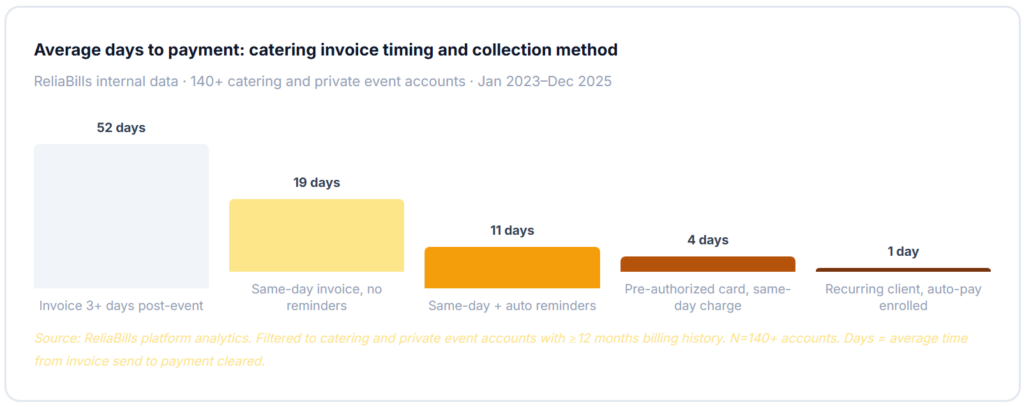
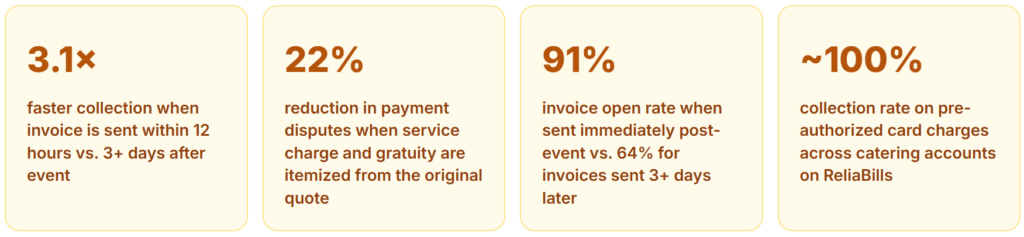
The data on catering invoice collection is stark. Invoices sent within 12 hours of event close collect an average of 3.1× faster than invoices sent 3 or more days later. The reason is emotional timing: at the close of a successful event, the client’s contact is energized, the experience is fresh, and payment feels like a natural conclusion. Three days later, they’ve moved on to their next project, the event is a memory, and the invoice competes with every other outstanding item in their inbox. ReliaBills account data across 140+ catering accounts shows that same-day invoicing combined with card pre-authorization reduces average collection time from 52 days to under 5 days for the same client base.
Pre-event card authorization, the most underused tool in catering billing
The most powerful collection practice in catering is also the least used: collecting a card authorization for the estimated final balance before the event begins, rather than issuing an invoice afterward. The client authorizes their card for up to the estimated total at final headcount confirmation. The authorization holds the funds without charging them. After the event, you charge the actual final amount against the authorization, typically within 24 hours. The collection rate on pre-authorized amounts approaches 100%. There is no invoice, no wait, and no follow-up. The food is served and the payment processes as cleanly as checking out of a hotel.
Real-World Catering Invoice Use Cases
Wedding catering
Multi-stage billing: a deposit at booking, a revised estimate at headcount lock, pre-event card authorization, and a post-event final invoice with any overage. High-value, emotionally charged, documentation prevents every dispute.
Corporate event catering
Recurring billing for companies with standing quarterly events. Single event invoices for one-off dinners. AP contact needs PO number on every invoice and net-30 terms.
Private dining room buyouts
Minimum spend guarantee tracked against food and beverage totals. Room buyout fee as a separate line item. Shortfall invoice if spend doesn’t reach the minimum.
Drop-off catering
Invoice at order confirmation, collected at delivery, or charged to card on file. Simpler structure, no staffing or equipment rentals, but the same per-head and service charge logic applies.
Institutional food service
Schools, hospitals, government clients on net-60. Installment billing for large annual contracts. Procurement requires specific invoice formatting including vendor ID numbers.
Festivals and large-format events
Multi-milestone billing: deposit at booking, second payment 60 days before, pre-event authorization 30 days before, final invoice post-event. Each milestone a separate invoice with clear reference to the contract schedule.
Key Benefits of Professional Catering Invoicing
The argument for professional catering invoicing is usually framed as “you’ll get paid faster,” which is true but misses the more important point. Professional invoicing protects the catering company legally, reduces disputes that consume staff time, and signals operational quality to clients at the final touchpoint of every event relationship. A catering company that sends a clean, itemized, same-day invoice after an event looks as organized and professional as the food they served. One that follows up three days later with a spreadsheet attachment does not.
Invoice documentation as legal protection
When a client disputes a charge, a headcount they claim was lower, a service they say wasn’t delivered, or a gratuity they think was excessive, the invoice is your primary legal document. An invoice that references the event proposal by document number, names the client contact who approved day-of changes, and shows the deposit credit with payment date is nearly unchallengeable in small claims court or a chargeback review. An invoice that shows a total with no supporting detail is a document that could be for anything. Your invoice quality is your dispute protection.
Recurring corporate client relationships and invoice consistency
Corporate clients who hold quarterly team dinners, annual holiday parties, and regular client entertainment events are the highest-value accounts in catering. They return because the food is good, but they stay because the billing is easy. A corporate event coordinator who receives the same clean, properly formatted invoice every time, with the correct PO number, on the agreed net terms, never needs to escalate a billing question to their AP department. That reliability is a competitive advantage that many catering companies don’t think about but that their corporate clients absolutely do.
Risks and What to Watch for
The gratuity disclosure requirement
Several states and jurisdictions require that mandatory gratuity be explicitly disclosed to customers before it’s charged, not just in fine print but in a clear, prominent communication at or before the point of service. For catering events, this means the gratuity line item must appear in the event proposal with the exact percentage or calculation method, not just on the final invoice. A mandatory gratuity that first appears on the invoice (rather than in the original proposal) may be legally unenforceable in some jurisdictions and is almost always disputed by clients. Check your state’s mandatory gratuity disclosure requirements before configuring your invoice template.
The minimum spend guarantee shortfall invoice
Private dining room buyouts and exclusive venue agreements often include a food and beverage minimum, the client commits to spending at least $X or pays the difference as a room fee. If actual food and beverage consumption doesn’t reach the minimum, the shortfall needs to appear as a clearly labeled line item on the final invoice. “Room buyout minimum guarantee shortfall: $340.00” is a charge that surprises clients when they haven’t been reminded about the minimum throughout the event. Reference the minimum guarantee in your pre-event reminder, note it in the revised estimate, and label it precisely on the final invoice.
Tax on gratuity, the mistake that creates IRS problems
Sales tax on catering events is one of the most state-specific billing issues in the industry. Whether food, beverage, service charges, and gratuity are taxable varies by state, and some states have different rules for mandatory vs. voluntary gratuity. Applying sales tax to your gratuity line item when your state exempts it (or vice versa) creates both client disputes and potential tax filing problems. Verify your state’s catering sales tax rules with a tax professional before finalizing your invoice template, especially if you operate in multiple jurisdictions or host events at off-site venues.
Catering Invoice Approach Comparison
| Invoice approach | Itemized line items | Deposit tracking | Day-of adjustment support | Card pre-authorization | Recurring event support | Best for |
|---|---|---|---|---|---|---|
| Purpose-built catering invoicing Best fit | ✓ | ✓ | ✓ | ✓ | ✓ | Any catering company, 10+ events/year |
| Generic invoicing software | ✓ | ~ | ✗ | ✗ | ~ | Very small operators, simple events |
| Event management platforms (Tripleseat, Caterease) | ✓ | ✓ | ✓ | ✓ | ✓ | Large caterers needing full event PM |
| POS system invoicing | ~ | ✗ | ✗ | ✗ | ✗ | In-restaurant dining only, not events |
| Spreadsheet or Word document | ~ | ✗ | ✗ | ✗ | ✗ | Not recommended, no audit trail |
Common Mistakes and What we Got Wrong at First
How we know this: The ReliaBills team has worked with restaurant catering operations and private event companies on invoicing setup since 2019. Every mistake below came from real account reviews, support conversations, and post-event billing audits with catering clients that experienced collection problems or client disputes. These are not generic warnings.
1. Sending the final invoice 3–5 days after the event
This is the most consistent and most avoidable billing mistake in catering. The event finishes at 10 PM on Saturday. The invoice goes out Tuesday morning after the weekend. By Tuesday, the client contact has moved on to the next week’s agenda, the CEO who attended has long forgotten the food, and the invoice arrives as an administrative task rather than a natural transaction. Our data shows this timing doubles average collection time. Final invoices should be sent before midnight on the event day, or at the absolute latest, first thing the following morning. Configure a post-event invoicing workflow that can be triggered from a mobile device while the crew is still breaking down the event.
2. Introducing service charges or gratuity on the final invoice for the first time
The invoice is not where new charges get introduced. Every charge on the final invoice should have a predecessor in either the event proposal, the revised estimate, or a documented day-of change order. Service charges and gratuity that appear for the first time on a final invoice, even if they’re industry standard, will be disputed by clients who weren’t expecting them. The fix is simple and one-time: add explicit service charge and gratuity line items (with percentage and calculation) to your event proposal template so they appear from the first document the client reviews.
3. Not getting written approval for day-of headcount or menu changes
Three extra guests walk in. The client contact, standing at the event, says, “Yes, of course, please accommodate them.” The catering team serves 51 people instead of 48. The invoice arrives with a three-person overage charge. The client’s CFO, who wasn’t at the event, disputes it, because there’s no written record of the approval. The fix is a 30-second text or email confirmation from the client contact at the moment of the day-of change: “Confirming: 3 additional guests at $110/head, approved by you at the event, total addition: $330.” That text message is all the documentation you need to defend the charge.
4. Not showing the deposit credit clearly on the final invoice
When a deposit has been paid and the final invoice doesn’t clearly show the credit, clients, especially those who had a different person manage the booking than the one reviewing the invoice, see only the total amount due and assume they’re being charged the full amount without the deposit deducted. The deposit credit line item should be prominent: “Deposit paid 5/14/2026 ($3,000.00)” in green text or with a clear negative indicator, followed by the actual balance due. Clients who can see exactly how their prior payment applies to the final invoice pay faster and dispute less.
5. Using a different per-head rate on the final invoice than on the proposal
This mistake happens more often than any caterer would admit: the original proposal quoted $78/head for the dinner package, but the final invoice calculates at $80/head because someone pulled the wrong rate card when building the invoice. The math difference for 51 guests is $102, small enough that many clients don’t catch it, but large enough that those who do become skeptical about everything else on the invoice. Every rate on the final invoice should trace directly to a signed document. If rates have legitimately changed since the proposal, the change must be documented in a formal revised estimate, not discovered by the client on the final invoice.
How to Get Started: Building Your Catering Invoice Workflow
The setup below is built for restaurant catering operations and private event companies, from solo operators to multi-site hospitality groups. The template work in phase one takes a few hours but prevents virtually every billing dispute that follows.
1. Build your event document set (week 1)
Create a master event proposal template that includes every potential charge your catering operation might bill: per-head food by menu tier, per-head beverage by package type, staffing by role and rate, equipment rentals as line items, service charge percentage, gratuity percentage, sales tax rate, and deposit terms with cancellation policy. Every charge should have a name, a calculation method, and a placeholder that carries through to every subsequent invoice. Your customer management system should store the signed proposal for every event so it’s accessible instantly when a billing question arises.
2. Configure invoice templates for each event type (week 2)
Build separate invoice templates for your main event categories: full-service seated dinner, drop-off catering, private dining room, and corporate recurring. Each template should automatically populate the service charge and gratuity percentages, reference the correct tax rates for your jurisdiction, and include your payment terms and accepted methods. For corporate recurring clients, add a PO number field and configure net-30 payment terms with a recurring billing schedule if they hold regular events. For large installation or festival events, configure installment billing milestones that match the contract payment schedule.
3. Set up the post-event invoicing trigger and card pre-authorization (week 3)
Configure a post-event invoicing workflow that generates the final invoice from the event record, pulling the confirmed headcount, the approved menu rates, and any day-of additions, and sends it automatically within 12 hours of event close. For high-value events ($5,000+), set up card pre-authorization at final headcount confirmation so the balance can be charged immediately post-event without waiting for invoice approval. ReliaBills supports both post-event invoice automation and card pre-authorization workflows, with event-specific templates that carry line items from the proposal through the final invoice. Test the full workflow on a pilot event before enabling it for all future bookings.
4. Run the first events on the new system and review disputes proactively
For the first 5–10 events using the new invoice workflow, review each final invoice before it sends against the signed event proposal. Verify that every rate matches the proposal, that the deposit credit is correctly applied, that day-of changes are documented with approval references, and that service charge and gratuity percentages match the contract. After the first clean billing cycle, the review can shift from every invoice to a spot-check of 3–5 per month. Set up automated payment reminders at 3 days past due and 7 days past due. Catering invoices past due by 7 days without contact should receive a direct call from the event coordinator, not an automated third reminder.
Frequently Asked Questions
1. What must be included on a professional restaurant catering invoice?
A complete catering invoice must include: your business name, address, and EIN or business registration number; the invoice number and issue date; the client billing contact and company; the event date, venue, and confirmed guest count; itemized line items for every charge (food per head, beverage per head, staffing, equipment, service charge, gratuity, and tax); the deposit credit with payment date; the balance due and due date; and accepted payment methods. For corporate clients, a PO number field is often required before their AP department will process the invoice.
2. What’s the difference between a service charge and gratuity on a catering invoice?
A service charge is a mandatory fee retained by the catering company to cover event management, administration, and operational overhead. It is not necessarily distributed to event staff. Gratuity is a payment intended to compensate the staff who worked the event, servers, bartenders, and event crew. Legally, the distinction matters: in some states, a mandatory charge labeled as gratuity must be paid to employees, while a service charge may be retained by the business. Both must be disclosed in the event proposal before appearing on the final invoice, and both are typically calculated as a percentage of the food and beverage subtotal.
3. When should a catering deposit invoice be sent?
The deposit invoice should be sent within 24 hours of contract signing, ideally triggered automatically when the contract is executed. Waiting longer reduces collection urgency and allows clients to feel the commitment is less formal than it is. The deposit invoice should clearly reference the event date, the total estimated event cost, and the cancellation policy that governs what portion of the deposit is refundable at each cancellation milestone. Most catering operations set deposits at 30–50% of the estimated total.
4. How do I bill for extra guests who show up on the day of the event?
Day-of headcount additions should be approved in writing by the client contact at the time of the addition, a text message, email, or digital confirmation is sufficient. The approval should reference the per-head cost for additional guests, which should have been established in the original event contract. On the final invoice, the additional guests appear as a separate line item with the number of guests, the per-head rate, and a reference to when and by whom the addition was approved. This documentation prevents disputes from other contacts at the client company who weren’t at the event and are reviewing the invoice for the first time.
5. Should sales tax apply to service charges and gratuity?
This varies significantly by state. Many states exempt mandatory gratuity from sales tax if it’s separately stated on the invoice and distributed entirely to employees. Service charges may be taxable in states where they’re treated as part of the price of the service. Some states tax all catering charges uniformly; others have complex rules about which elements of a catering invoice are taxable. Do not assume your state follows the majority rule, verify your state’s catering sales tax treatment with a local tax professional before finalizing your invoice template.
6. What net terms should catering invoices use?
For individual and social event clients (weddings, birthday parties, personal celebrations), the final balance should be due at or before the event, pre-event collection or card pre-authorization is ideal. For corporate clients, net-15 is standard for event invoices since the expense is typically reimbursable and already budgeted. Net-30 may be required for enterprise clients or those with formal AP processes. For government and institutional clients, net-60 is common. Set reminder sequences that respect each client tier’s payment window, a government client on net-60 should not receive a late notice on day 20.
Recent Articles:
- How to Set Up Recurring Billing for Lawn Care and Landscaping Services
- How to Automate Tuition Billing for Daycare and Childcare Centers