

The most important thing about a past-due invoice email is not the template, it’s the timing and the diagnosis. Send within 24 hours of the missed deadline, figure out why the invoice is unpaid before you decide what to say, and calibrate your tone to the stage and the relationship. A well-timed, well-targeted email outperforms the best-written generic template every time.
What Is a Past-Due Invoice Email?
A past-due invoice email is a professional message sent to a client after a payment deadline has passed without payment being received. It serves three functions simultaneously: it notifies the client that a payment obligation is overdue, it provides the specific invoice details needed to act on that obligation, and it makes payment as easy as possible by removing every barrier between the client reading the email and the payment being sent.
The term “past-due” is important because it signals a specific stage in the AR aging cycle, one where action is already overdue rather than merely pending. A past-due invoice email is different from a payment reminder (which goes out before or on the due date) and from a dunning letter (which is a formal escalation typically used after multiple email attempts have failed). It sits between those two: more urgent than a reminder, more conversational than a formal notice. It connects directly to your collection automation system, which should be sending these on a defined schedule whether you remember to write them or not.
If you search for “past due invoice email template,” you will find dozens of pages with copy-and-paste emails that all look nearly identical: a subject line with the invoice number, two sentences stating the amount is overdue, a payment link, and a sign-off. They all work sometimes. None of them explain why they fail sometimes, and they all fail sometimes, for completely predictable reasons.
The reasons are not mysterious. Most past-due invoice emails fail because they are sent too late, they make no attempt to diagnose why the invoice is unpaid, they calibrate tone incorrectly for the client relationship, or they create friction between the email and the payment instead of removing it. None of those problems are solved by the template. They are solved by the process around the template.
This guide covers both: the framework that determines what to write and the actual emails I have used and refined over four years of running a consulting practice with 10 to 20 active client engagements at any given time.
Why Most Past-Due Emails Fail Before They’re Read
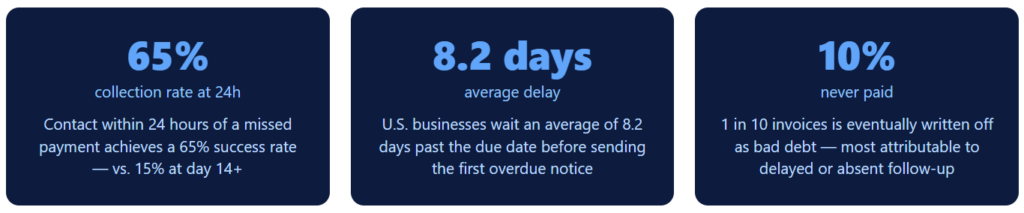
The 8.2-day average delay before sending the first overdue notice is the most significant statistic in the table above. It means the typical service business allows the collection window to narrow by more than half before making a first contact. By day 8, the probability of collection on a first contact has dropped from 65% to roughly 40%. By day 14, it is at 30%. Those numbers don’t recover, they compound in the wrong direction.
The second reason past-due emails fail is tone calibration. An email that treats a three-year client on their first-ever late payment the same way it treats a new client who has missed two consecutive invoices is not just ineffective, it is actively damaging. The tone appropriate for each situation is genuinely different, and templates that don’t account for this tend to over-index toward formality with established clients (which reads as cold) and under-index toward firmness with repeat offenders (which reads as permissive).
Diagnose Before You Write: The Three Reasons Invoices Go Unpaid
Before you open a template, spend 90 seconds answering a single question: Why is this invoice probably unpaid? The answer changes the email significantly. Based on my own tracking across four years of past-due situations, most late invoices fall into one of three categories.
1. The Forgotten Invoice (Most Common)
The client intended to pay, the invoice got buried in their inbox, and they simply haven’t gotten to it yet. This accounts for the majority of invoices that are 1–14 days past due for clients with otherwise solid payment histories. The right email for this situation is brief, benefit-of-the-doubt, and focused on making payment effortless. No language about consequences, no mention of late fees at this stage. Just the facts and a frictionless payment path.
2. The Silent Dispute (Underappreciated, Costly)
This is the one that no other guide addresses directly. The client has a question or concern about the invoice, a scope disagreement, an unexpected line item, or a charge they don’t recognize, but they haven’t raised it. Instead of emailing you about it, they’re just not paying. This situation will not resolve through reminder emails, no matter how many you send. The tell-tale sign is when an email produces no payment and no reply. At that point, a direct phone call with an open-ended question (“Is there anything about the invoice you’d like to walk through?”) surfaces the real issue faster than any follow-up email will.
3. The Cash Flow Problem (Most Sensitive)
The client genuinely cannot pay in full right now, for reasons that may or may not have anything to do with your relationship. This is where the instinct to escalate pressure backfires. A client who is struggling financially and receives an increasingly aggressive collection email sequence does not suddenly find money, they find avoidance strategies, or they stop responding entirely. The right approach here is an early, direct, non-accusatory conversation about whether a structured payment arrangement would help, offered as a genuine option, not as a consolation prize.
The Anatomy of a Past-Due Invoice Email That Works
Every effective past-due invoice email has the same five structural elements. What varies across stages and situations is the content of each element, not the structure itself.
| Element | What It Does | Common Mistake |
|---|---|---|
| Subject Line | Gets the email opened. Must signal purpose immediately and include the invoice reference. | Vague subjects (“Following Up”) or generic urgency (“URGENT”). Both reduce open rates. |
| Opening Line | Sets tone and establishes context without accusation. For early stages: assume oversight. For late stage: state facts directly. | “I hope this email finds you well.” Generic openers that signal automation, not relationship. |
| Invoice Block | States invoice number, amount due, due date, and days overdue in a scannable format. | Burying details in paragraph text. Clients should not have to read to find the amount. |
| Payment Path | A single, prominent click-to-pay link. Remove every possible barrier between reading and paying. | Listing bank details in paragraph form, asking the client to “refer to the attached invoice”, each extra step is an exit point. |
| The “Already Paid” Line | Tells the client to ignore the email if they’ve already sent payment. This line is not just courtesy, it prevents the client from feeling accused if payment is in transit, which keeps the tone non-adversarial. | Omitting it, especially at early stages, forces the client into a defensive reply mode instead of a payment mode. |
The 5-Touch Sequence: Timing, Templates, and My Response Data
The sequence I use has five touches. Each one escalates in tone, specificity, and consequence while maintaining professional language throughout. Here is the timing, the purpose, and the templates I’ve refined over four years of use.
Day -3: Pre-Due Reminder
Sent 3 days before the due date. This is not a past-due email, it’s a preemptive nudge that reduces the number of invoices that ever become past due.
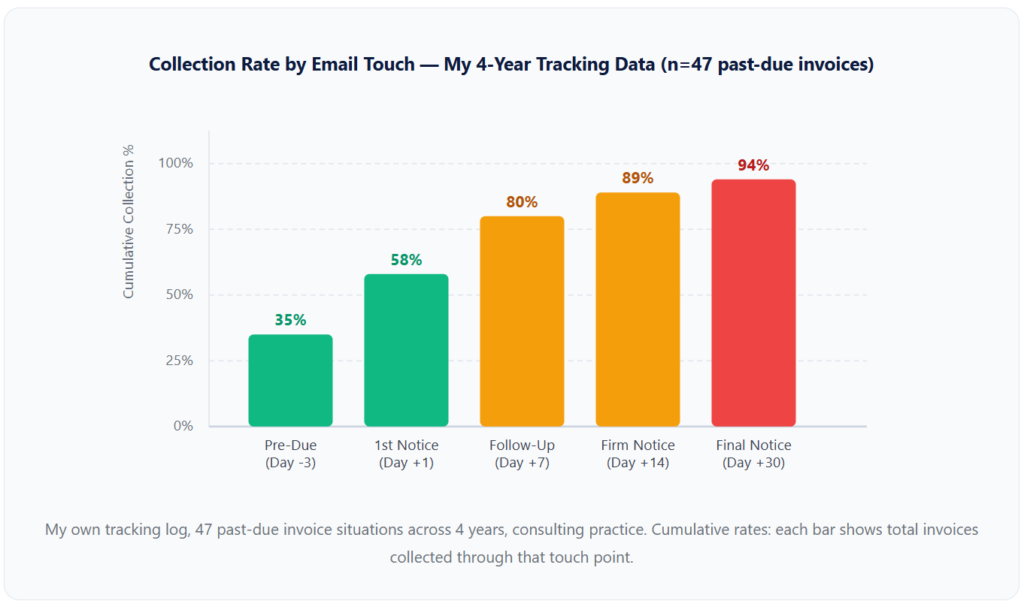
Prevents ~35% of late payments in my tracking
Day +1: First Past-Due Notice
Sent within 24 hours of the missed deadline. Friendly tone, benefit-of-the-doubt framing, prominent payment link. Resolves most forgotten-invoice situations.
~58% of overdue invoices paid after this email alone
Day +7: Follow-Up Notice
Sent 7 days after the due date. Tone becomes more direct. Mentions previous contact. Remains professional but removes the assumption of oversight.
Additional ~22% of invoices collected at this stage
Day +14: Firm Notice + Payment Plan Offer
Sent 14 days past due. States consequences clearly. Introduces the option of a structured payment arrangement if full payment is not possible. This stage resolves cash-flow-problem situations that earlier emails can’t.
Additional ~9% collected here, mostly via payment plan agreement
Day +30: Final Notice Before Escalation
Sent 30 days past due. Final written notice before a phone call, collections referral, or legal action. Tone is formal, factual, and specific about the next step and its timeline.
Remaining ~5% of invoices collected at this stage or via escalation
The math above adds up to roughly 94% of past-due invoices resolved through the email sequence and about 6% requiring escalation beyond email. That is not a vendor’s claimed statistic, it is my own tracking over 47 past-due invoice situations across four years. The single biggest driver of that rate is the Day +1 timing: starting the sequence within 24 hours of the missed deadline rather than waiting until “it seems awkward to bring it up.”
The Templates – 5 Emails You Can Use Today
Touch 1: Pre-Due Reminder Send: 3 days before due date
Subject: Invoice #[1047] – Due [June 15]
Hi [Sarah],
Quick note ahead of the due date, Invoice #1047 for $[2,400] is due on [June 15].
I’ve attached a copy for easy reference. You can also pay directly here: → [Pay Now – $2,400] If you have any questions about the invoice, just reply to this email.
Thanks,
[Brant]
🟢 Keep this one short and frictionless. Its only job is to surface the invoice before it gets buried. No urgency language, the due date itself provides the urgency.
Touch 2: First Past-Due Notice Send: 24 hours after missed due date
Subject: Invoice #[1047] – Payment Past Due
Hi [Sarah],
I noticed Invoice #1047 for $[2,400], which was due on [June 15], hasn’t been settled yet. These things get lost in the inbox, I know the feeling.
Invoice details:
Invoice #: 1047
Amount Due: $2,400
Due Date: June 15, 2025
Days Past Due: 1
→ [Pay Now – $2,400]
If you’ve already sent payment, please disregard this note, and thank you. If you have any questions or need to discuss the invoice, I’m easy to reach by reply or phone.
Thanks,
[Brant]
🟢 The “these things get lost in the inbox, I know the feeling” line is doing real work here. It acknowledges human reality without letting the client off the hook. The “already sent payment” line keeps the tone non-accusatory.
Touch 3: Follow-Up Notice Send: 7 days after due date
Subject: Invoice #[1047] – 7 Days Past Due
Hi [Sarah],
Following up on Invoice #1047 for $2,400, now 7 days past its June 15 due date. I sent a note last week and haven’t heard back.
Invoice #: 1047
Amount Due: $2,400
Original Due Date: June 15, 2025
→ [Pay Now – $2,400]
If there’s anything about the invoice you’d like to go over, I’m happy to jump on a quick call. Otherwise, please arrange payment at your earliest convenience. If payment has already been sent, please let me know and I’ll confirm on my end.
Best,
[Brant]
🟡 “I sent a note last week and haven’t heard back” is factual, not accusatory. The offer to discuss the invoice is your silent-dispute diagnostic, it gives the client an exit ramp to surface a concern rather than continue not responding.
Touch 4: Firm Notice + Payment Plan Offer Send: 14 days after due date
Subject: Invoice #[1047] – 14 Days Past Due / Payment Arrangement Available
Hi [Sarah],
Invoice #1047 for $[2,400] is now 14 days past due. I’ve reached out twice and haven’t received a response or payment.
Invoice #: 1047
Amount Due: $2,400
Outstanding Since: June 15, 2025
I want to resolve this quickly. If full payment isn’t possible right now, I’m open to discussing a structured payment arrangement, please reply and we can work something out.
If full payment is ready to go:
→ [Pay Now – $2,400]
Please respond by [June 30] so we can avoid further escalation. If I don’t hear from you by then, I’ll follow up by phone.
[Brant]
🟡 This is the first email to mention consequences. The payment plan offer prevents this from reading as purely adversarial, it signals that you want to resolve the situation, not just escalate it. The phone call mention is a real commitment, not an empty threat.
Touch 5: Final Notice Before Escalation Send: 30 days after due date
Subject: Final Notice – Invoice #[1047] – Action Required by [July 15]
Hi [Sarah],
This is a final notice regarding Invoice #1047 for $[2,400], now 30 days past due. I have attempted to reach you by email on [dates] without response.
Invoice #: 1047
Original Amount: $2,400
Late Fee (per our agreement): $[48]
Total Now Due: $[2,448]
Final Payment Deadline: July 15, 2025
If payment is not received by July 15, this account will be referred to [collections / my legal representative] for recovery. I would prefer to resolve this directly.
→ [Pay Total Now – $2,448]
To discuss this matter, contact me directly at [phone number] or reply to this email.
[Brant Pallazza]
[Business Name]
🔴 Tone is formal and factual. Include the specific late fee amount if applicable. “I would prefer to resolve this directly” signals that escalation is not your preference, which gives a client in difficulty one more reason to respond. Use your full name and business name here, it signals formality without needing aggressive language.
Subject Lines That Actually Get Opened
The subject line determines whether the email gets opened. No template performs well if it is never read. Based on my own tracking of which subject lines generated same-day responses versus days of silence, here is what I’ve learned.
| Subject Line | Stage | What Works About It | Avoid If… |
|---|---|---|---|
Invoice #1047 - Due June 15 | Pre-due | Specific, scannable, states the date without pressure | Never, this works universally |
Invoice #1047 - Payment Past Due | Day +1 | States the status clearly without emotional language or caps | Never, clear and professional |
Invoice #1047 - 7 Days Past Due | Day +7 | A specific day count creates urgency more effectively than vague language | If you haven’t mentioned the invoice number before, use it regardless. |
Invoice #1047 - 14 Days Past Due / Payment Arrangement Available | Day +14 | The “Payment Arrangement Available” phrase consistently improves open rates from cash-flow-constrained clients | For very small invoice amounts where a payment plan isn’t realistic |
Final Notice - Invoice #1047 - Action Required by [date] | Day +30 | “Final Notice” and a specific date both signal formal escalation without aggressive language | Never at earlier stages should “Final Notice” should mean final notice |
URGENT: Overdue Invoice (avoid) | Any | – | All-caps urgency triggers spam filters and reads as automated, not personal |
Following Up (avoid) | Any | – | Vague, gives no context, frequently buried in inboxes, the opposite of what you need |
Real-World Use Cases and Scenarios
The Long-Term Client Who Never Paid Late Before
A client who has paid reliably for two years and misses a payment for the first time deserves a different email than a generic template. My version for this situation removes the invoice block entirely and reads like a personal note: “Hey [Name], noticed Invoice #1047 didn’t come through, just wanted to make sure it didn’t get lost on your end. Here’s the link if you need it.” No urgency language, no day count, no consequences, just a brief, human message that assumes oversight rather than a problem. In my experience, this version gets faster responses from long-term clients than anything more formal.
The Repeat Late Payer
For a client who has been in the 31–60 day bucket on your aging receivables report for three consecutive months, the friendly reminder approach is actively counterproductive; it signals that late payment has no consequences. With repeat late payers, I skip the benefit-of-the-doubt framing from day one and move directly to the Day +7 tone at the first past-due contact. I also introduce autopay as a condition of continuing the engagement after the second consecutive late payment. Not as an ultimatum, but as a practical suggestion: “To make things easier for both of us, would you be open to setting up autopay for future invoices?”
The No-Reply Situation
An invoice that reaches Day +14 with no response to any email is almost always one of two things: a silent dispute or a client actively avoiding the conversation. The email alone will not resolve either. At this point I send the Day +14 email as written above and then call within 48 hours if there’s still no response. The phone call almost always surfaces the actual issue, either the client has a question they hadn’t raised, a payment method problem, or they’re dealing with their own cash flow situation. All three are solvable in a three-minute call in a way that no email, however well written, will solve.
Risks and Things to Watch For
⚠ Sending to the Wrong Person
At companies with accounts payable departments, the person you know is rarely the person who processes payments. An email sent to the project contact may sit unread while the AP team waits for an invoice that was never forwarded to them. Always confirm the billing contact separately from the engagement contact, and cc both on final notices.
⚠ Making Consequences You Won’t Follow Through On
“Failure to pay will result in legal action” is meaningless if you have no intention of pursuing legal action for a $400 invoice. Empty threats damage your credibility and signal to the client that your notices are performative rather than real. State only consequences you are actually prepared to take, and if you say the account will be referred on a specific date, follow through on that date.
⚠ Over-Automating Tone Without Relationship Segments
An automated collection sequence that sends the same email to your best long-term client and your newest client on the same schedule is a relationship liability. Segment by relationship age and payment history before automating. Most collection automation platforms allow you to configure separate sequences for different client categories, use that capability.
⚠ Attaching the Wrong Invoice
Attaching the wrong invoice, or an old version of the invoice, to a past-due email creates a fresh dispute that delays payment by days. Confirm the correct invoice number, the current amount including any late fees, and the attachment before sending at every stage. This sounds obvious; it is the source of more friction than most people acknowledge.
What I Got Wrong the First Time
I waited too long, consistently
For the first two years of my consulting practice, my default was to wait “a few days” before reaching out about a missed payment because it felt more professional than contacting immediately. The data I eventually tracked showed this cost me an average of 8 additional days of DSO per late invoice. The professional thing is not to wait, it’s to contact within 24 hours in a tone that assumes oversight rather than bad intent. Those are different variables. You can be both timely and non-accusatory.
I used the same tone for every client regardless of history
My early template was a single format, sent identically to a three-year retainer client and a new project client who had missed their first payment. I lost one long-term relationship over this, not because I was rude, but because the formal invoice-block format felt like I was treating a trusted partner as a stranger. The client told me as much in the reply that eventually came. I now maintain two distinct opening tones: personal for established clients and professional-neutral for newer ones.
I never offered payment plans until the relationship was already strained
For the first two years, I treated payment plan offers as a last resort, something you propose when a client has become a problem. What I eventually learned is that proactively offering a structured installment arrangement at the Day +14 stage, before the relationship is adversarial, resolves more cash-flow-problem situations and preserves more relationships than escalating reminders do. The client experiencing a temporary cash flow issue who receives a firm-but-collaborative offer to pay in installments is far more likely to stay a client than one who receives four increasingly formal notices before any flexibility is offered.
I didn’t track what actually worked
For the first year, I sent emails and observed what happened without recording it. I had general impressions, “Clients usually pay within a week of the first reminder,” that turned out to be significantly less accurate than the actual data showed when I finally started logging it. The 47-invoice dataset in this guide started as a frustration exercise: I wanted to know, specifically, which email stage was doing the most work. The answer surprised me: the pre-due reminder at Day -3 was preventing more late payments than the Day +7 follow-up was collecting.
Past-Due Email vs. Related Communication Types
| Communication Type | When to Use | Tone | Primary Goal | Escalation Trigger? |
|---|---|---|---|---|
| Pre-Due Reminder | 3–5 days before due date | Neutral / helpful | Prevent the invoice from becoming past-due in the first place | No |
| Past-Due Invoice Email (Day +1) | Within 24 hours of missed due date | Friendly, benefit-of-the-doubt | Collect payment from clients who forgot | No |
| Follow-Up Notice (Day +7) | 7 days past due | Direct, professional | Collect payment and surface silent disputes | Mild, mentions prior contact |
| Firm Notice (Day +14) | 14 days past due | Firm, factual, consequence-aware | Collect payment or establish a payment plan | Yes, mentions phone follow-up |
| Final Notice (Day +30) | 30 days past due | Formal, factual | Last written contact before phone/legal/collections | Yes, specific date and consequence |
| Dunning Letter (formal) | After email sequence is exhausted | Legal / formal | Establish written record before legal escalation | Yes, explicitly threatens legal action |
| Phone Call | After Day +14 with no response | Conversational, direct | Surface the actual reason for non-payment | Depends on conversation outcome |
How to Get Started: Building an Automated Sequence
1. Write Your Templates Before You Configure Automation
Copy the five templates from this guide and rewrite them in your own voice, your actual tone, your sign-off style, and your specific late fee language. Spend 20 minutes on this before you configure any automated workflow. The emails you configure in minute one will be running for months. Write them as if they’re going to your most important client, because eventually they will be.
2. Create Two Client Segments: Established and New
Define “established” however makes sense for your business, typically 12 months or three completed projects with a clean payment history. Build two versions of your sequence: one with warmer opening language for established clients and one with neutral-professional language for newer relationships. Most customer management systems allow you to tag clients by type for exactly this purpose.
3. Set Up the Pre-Due Reminder First
Before configuring the past-due sequence, set up the Day -3 pre-due reminder. In my own data, this single email prevented roughly 35% of invoices from ever becoming past-due. That is collection work you don’t have to do because the reminder did it preemptively. Most collection automation platforms trigger this automatically , you configure the email once and it runs for every future invoice.
4. Add a Payment Link to Every Email
Not a “please see attached invoice” instruction. A direct, hyperlinked “Pay Now” button or link in the email body itself. Every step a client must take between reading your email and paying is an exit point. Remove all of them. A frictionless payment path in every email is the single highest-ROI structural change you can make to an existing past-due email sequence.
5. Track Response Rates by Stage – Not Just Collection Rates
Know which touch is doing the most work for your specific client base. For some service businesses, the Day +1 email resolves the majority of situations. For others, the Day +7 follow-up is more effective because their clients tend to batch AP processing weekly. Tracking which stage generates the most responses tells you where to spend energy personalizing and where the automated version is working well enough without modification.
Related Reading on ReliaBills: The email sequence in this guide works best when it’s built on top of a solid foundational invoicing process. If your invoices are frequently questioned or disputed, the problem may start with the invoice itself. Our guide on how to write a service invoice covers the specific elements that prevent disputes before they start. And if your past-due email sequence is surfacing clients who genuinely can’t pay in full, the guide on how to offer payment plans covers how to structure an installment arrangement that protects your cash flow while giving the client a workable path to resolution.
Frequently Asked Questions
1. What is a past-due invoice email?
A past-due invoice email is a professional message sent to a client after a payment deadline has passed without payment being received. Its three jobs are to notify the client that the payment obligation is overdue, provide the specific invoice details needed to act, and make payment as easy as possible by removing every barrier between reading and paying.
2. When should I send the first past-due invoice email?
Within 24 hours of the missed deadline. Not a week later when it “feels like a good time to bring it up.” Research shows, and my own data confirms, that first contact within 24 hours of a missed payment achieves a collection rate roughly twice as high as first contact at 7 days. Timing is the single most impactful variable in past-due email performance.
3. How many past-due emails should I send?
Five touches is the right standard: a pre-due reminder at Day -3, a first past-due notice at Day +1, a follow-up at Day +7, a firm notice with payment plan offer at Day +14, and a final notice at Day +30. After five written contacts without response, email has done its job, the next step is a phone call, a formal dunning letter, or referral to collections.
4. What subject line works best for a past-due invoice email?
Specific ones. “Invoice #1047, 7 Days Past Due” consistently outperforms “Payment Reminder” or “Following Up” in my tracking. Include the invoice number so the client can immediately identify which obligation is overdue without opening the email body. Use a specific day count rather than vague language. Avoid all-caps urgency words, they trigger spam filters and read as automated.
5. How do I write a past-due invoice email without damaging the client relationship?
Three things: diagnose why the invoice is probably unpaid before choosing your tone, calibrate formality to both the stage and the relationship age, and always include a line that tells the client to disregard if they’ve already paid. The “already paid” line is not just courtesy, it keeps the tone non-accusatory even when the invoice is overdue, which makes it easier for the client to respond without defensiveness.
6. Should I mention late fees in the first past-due email?
No. At Day +1, the invoice is one day overdue and most likely forgotten rather than intentionally withheld. Introducing late fees in the first contact feels punitive for what is almost certainly a simple oversight, and it sets an adversarial tone that can poison a resolution that would have come anyway. Introduce late fees explicitly at Day +14, after the client has had multiple opportunities to pay and respond.
7. What should I do if the client doesn’t respond to any emails?
At Day +14 with no response to two emails, call. A phone call surfaces the actual reason for non-payment in three minutes, silent dispute, cash flow problem, wrong billing contact, or undelivered email, faster than any subsequent email will. If you’ve sent the full five-touch sequence with no response and no payment, the situation has moved past the email stage and requires either a formal dunning notice, referral to a collections agency, or a small claims filing depending on the amount involved.
The Bottom Line
The best past-due invoice email is not the best-written one, it is the one that arrives within 24 hours of the missed deadline, diagnoses the likely reason for non-payment correctly, calibrates its tone to the client and the stage, and makes payment effortless. The template is how you deliver that. The judgment is what makes it work.
Most service businesses never develop that judgment deliberately, they accumulate it accidentally over years of trial and error. Building a tracked, staged sequence and noting which emails resolve situations at which stage compresses that learning curve significantly. After four years and 47 past-due invoice situations, the pattern is clear: the timing matters more than the wording, the pre-due reminder matters more than the day-seven follow-up, and the hardest situations to resolve by email alone are almost always the ones with a silent objection at the core, which no template can surface, but a direct question or a phone call can.
Recent Articles:
- The Small Business Guide to Reducing Overdue Invoices
- How to Create an Aging Receivables Report (And Act on It)

Brant Pallazza is the Founder and President of ReliaBills, an invoicing and recurring billing platform built to help small businesses secure predictable cash flow. With over 20 years of experience in direct response marketing and e-commerce leadership, including a 13-year tenure managing over $500 million in gross sales at Digital River. Brant writes actionable guides on automated billing, payment processing, and scaling SMBs.