
Main Takeaway
Most subscription businesses lose 5–10% of revenue to failed payments, not because customers want to leave, but because card declines go unrecovered. A well-designed payment retry strategy can recapture up to 70% of those failed transactions, often without the customer even noticing a disruption.
Every month, subscription businesses execute billions of payment attempts. Most go through without a hitch. But for a meaningful slice, industry data consistently puts it between 5% and 15% of recurring transactions, the charge fails on the first attempt. What happens next determines whether that customer quietly churns or never notices the hiccup at all.
This is the core problem of involuntary churn: revenue and customer relationships are lost not through any deliberate decision, but through the mechanics of payment processing. Unlike voluntary churn, you cannot fix it with better product-market fit or a stronger retention email. You fix it with smarter billing infrastructure.
This guide explains how to reduce billing churn by building or implementing payment retry logic that recovers failed transactions intelligently, timing retries correctly, classifying decline reasons accurately, and pairing automation with well-crafted customer communication.
What Is Payment Retry Logic? (Definition)
Payment retry logic is a set of rules that govern how and when a billing system reattempts a failed transaction. Rather than immediately marking a payment as failed and suspending a customer’s account, the system waits a defined interval and tries again, sometimes several times, before escalating to a customer notification or account suspension.
Smart payment retry logic goes a step further: it reads the decline reason code returned by the payment processor and uses that information to decide whether to retry, when to retry, and which payment method or processor to route to. The goal is to recover the payment with as little friction as possible for the customer.
Related disciplines include dunning management (the broader process of communicating with customers about failed payments), churn prevention, and revenue recovery.
The phrase “reduce billing churn” is often used interchangeably with “reduce involuntary churn”; both refer to recapturing customers who were on the verge of losing access not because they cancelled, but because a payment failed and no one caught it in time. If your business runs on recurring billing, this is one of the highest-leverage levers available to you.
How Smart Payment Retry Logic Works
At its most basic, payment retry logic is a loop: attempt a charge, read the result, decide what to do next. But the intelligence layer, and the difference between a basic retry and a smart one, lives in that decision step.
Here is the sequence as it typically unfolds in a well-configured billing system:
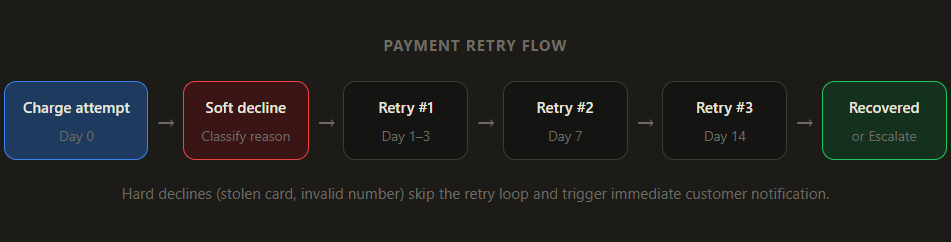
The step that separates smart retry from naive retry is the classification step after the first decline. Modern payment processors return a machine-readable reason code with every declined transaction. A smart billing platform reads that code and routes the transaction accordingly. Retrying a stolen card is pointless and may trigger fraud flags; retrying a temporarily unavailable card on a different day has a high probability of success.
Timing and cadence
When you retry matters as much as whether you retry. Retrying too soon after a decline, especially for an insufficient funds failure, is unlikely to succeed and may look like an unauthorized attempt to the customer’s bank. Most payment professionals recommend spacing retries at least 24 hours apart, with longer gaps as you move through the sequence.
A common baseline cadence is Day 1, Day 3, Day 7, and Day 14. Some platforms use ML-based timing that analyzes historical card behavior to predict when the customer is most likely to have a positive balance or available credit. For businesses managing installment billing, the retry window may need to be longer, given the higher per-transaction amounts involved.
Account Updater: preventing failures before they happen
The cleanest version of involuntary churn prevention is stopping the failure from happening at all. Visa, Mastercard, and other card networks offer an Account Updater service that automatically pushes new card numbers and expiry dates to merchants when a cardholder receives a replacement card. Businesses that enable Account Updater through their payment processor often see a measurable reduction in declines caused by expired or replaced cards, the most common failure category, before the first retry is ever needed.
Understanding Decline Types
Not all payment failures are created equal. The single most important distinction in payment retry logic is between hard declines and soft declines.
| Decline Type | What It Means | Common Codes | Retry? |
|---|---|---|---|
| Soft decline | Temporary condition; card itself is valid | Insufficient funds, Do not honor, Try again later | Yes, after appropriate wait |
| Hard decline | Permanent condition; card cannot be charged | Card stolen, Invalid number, Account closed | No, notify customer immediately |
| Network error | Processor or network connectivity issue | Timeout, Gateway error, Processing error | Yes, retry quickly (within hours) |
| Fraud flag | Issuing bank suspects unauthorized charge | Card reported lost, Suspected fraud | No, wait for customer to resolve |
| 3DS / Auth failure | Strong customer authentication required | Authentication required, Card not enrolled | Sometimes, depends on SCA rules and region |
The practical implication: your retry engine needs to be able to parse the reason code from your payment processor’s API response and branch accordingly. Blindly retrying every decline is one of the fastest ways to accumulate card network violations and elevated dispute rates.
Dunning Management and Email Sequences
Payment retry logic handles the automated, behind-the-scenes part of revenue recovery. Dunning management handles the human-facing side: notifying customers, asking them to update their payment information, and communicating account status clearly. The two work together.
A well-designed dunning sequence for a subscription business typically looks like this:
1. Pre-dunning notice (optional, high value)
Sent 7–14 days before a card is due to expire. Proactively asks the customer to update their payment method before the failure ever occurs. This is the highest-ROI communication in the entire sequence.
2. Initial failure notification (Day 0–1)
A transactional email noting the payment could not be processed. Tone is informational, not alarming. Includes a clear link to update payment details. No threats of account suspension at this stage.
3. Follow-up reminder (Day 4–7)
A second notice with slightly elevated urgency. References the original failure date. Reiterates the payment update link. For higher-value accounts, this is the moment to consider a personal outreach from the customer success team.
4. Final warning (Day 10–14)
Clear communication that the account will be suspended or cancelled if payment is not received within a specific number of days. This urgency often drives the highest click-through rates of any email in the sequence.
5. Win-back or cancellation notice (Day 15–21)
If retries and dunning emails have not recovered the payment, either suspend the account with a clear path to reinstatement or send a formal cancellation with an offer to resubscribe. The latter can be an effective win-back trigger.
Pro tip: Subject lines on dunning emails matter enormously. “Payment failed” generates significantly lower open rates than “Action needed: keep your account active.” Test subject line variants before rolling out a dunning sequence at scale.
Your invoicing software should ideally handle dunning email triggers automatically, tied to the same payment status webhooks that drive your retry logic. Manual intervention introduces delays that cost you recovery rates.
Real-World Examples and Use Cases
SaaS platform recovering 61% of failed monthly charges
A mid-market project management platform running on annual and monthly plans implemented a three-stage retry cadence (Day 1, Day 5, Day 12) paired with a pre-expiry email campaign that went out 10 days before card expiration. Within two billing cycles, their involuntary churn rate dropped from 8.2% to 3.1%, and their recovery rate on failed payments climbed to 61%. The pre-expiry campaign alone accounted for roughly a third of the improvement.
E-commerce subscription box preventing churn during card replacement cycles
A subscription box company found that a disproportionate number of their failed payments clustered in January and February, periods when banks issue replacement cards en masse. By enabling Account Updater through their payment processor and shifting their billing date away from the 1st of the month (when most card replacements are processed), they reduced payment failures by roughly 22% in those two months without a single retry attempt.
Professional services firm with installment billing
A consulting firm offering installment billing for multi-month engagements found that standard retry timing was too aggressive for their high-ticket invoices. Clients weren’t running out of funds, they were experiencing temporary holds on corporate cards or internal approval delays. By extending the retry window to 21 days and adding a personal phone call from their account team after the second retry failure, they recovered 78% of initially declined installment payments.
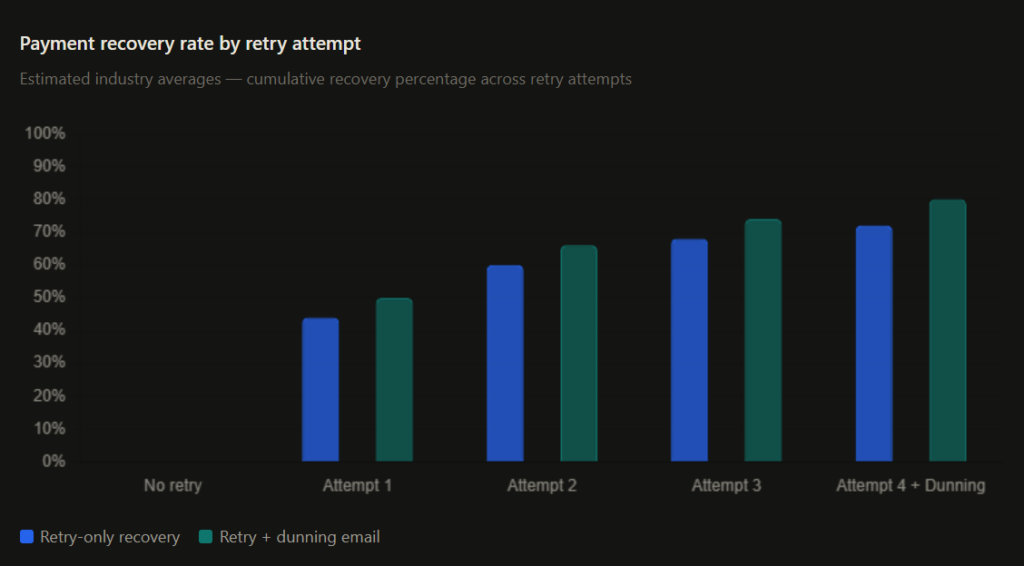
The chart above illustrates a consistent pattern across subscription businesses: the greatest incremental recovery comes from the first retry attempt. Each subsequent attempt yields diminishing returns, but the combination of retries and targeted dunning emails pushes total recovery meaningfully higher than either tactic alone.
Key Benefits of Smart Payment Retry Logic
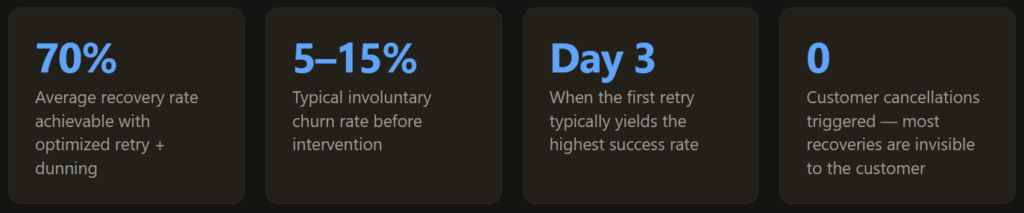
The financial case is straightforward: if your business processes $500,000/month in recurring revenue and 8% of transactions fail on the first attempt, that is $40,000 in at-risk revenue per billing cycle. Recovering 65% of that through smart retry logic represents $26,000 recovered monthly, without acquiring a single new customer.
Beyond the direct revenue impact, effective retry logic preserves customer relationships. A customer who never experiences a payment interruption is significantly less likely to evaluate competitors during the recovery window. The absence of disruption is itself a retention mechanism.
For teams managing customer management at scale, automated retry logic also reduces the operational burden on support and accounts receivable teams, with fewer manual collection calls, fewer one-off billing adjustments, and cleaner account health data.
Key Risks and Things to Watch For
Watch out: Aggressive retry logic, attempting charges too frequently or ignoring hard decline signals, can get your merchant account flagged by card networks, increase your dispute rate, and in some cases trigger card network fines. Always classify decline types before retrying.
A few specific risks are worth calling out explicitly:
Over-retrying soft declines
Even soft declines have limits. Retrying an “insufficient funds” decline five times in a single week is unlikely to succeed and creates negative bank relationship signals. Most card networks have guidelines, sometimes published, sometimes not, about acceptable retry frequency. When in doubt, err on the side of fewer, better-timed retries.
Ignoring customer timezone and billing date context
Retrying at 3am in a customer’s timezone, or on a day when their paycheck has not yet cleared, reduces success rates unnecessarily. Smarter systems account for these factors.
Dunning emails that feel punitive
A dunning email that leads with threats rather than assistance tends to backfire. Customers who feel penalized for a payment failure they didn’t cause often interpret it as a signal to cancel rather than update their payment details. Tone matters.
No visibility into why retries are failing
If you cannot report on decline codes at a granular level, you cannot optimize your retry strategy. Make sure your billing platform gives you access to raw decline data, not just a pass/fail outcome, so you can identify patterns over time.
PCI compliance and retry cadence rules
Depending on your processor and the card networks involved, there may be explicit rules about how many times you can retry a declined transaction within a given time window. Confirm these limits with your payment processor before configuring your retry engine.
Retry Strategy Comparison
Not all retry approaches are built the same. Here is how the main approaches compare across the dimensions that matter most for businesses trying to reduce billing churn:
| Approach | How It Works | Recovery Rate | Risk Level | Best For |
|---|---|---|---|---|
| Fixed cadence retry | Retry at set intervals regardless of decline reason (e.g., Day 1, 3, 7) | Moderate (40–55%) | Medium, ignores decline codes | Small teams, simple setups |
| Decline-aware retry | Classify soft vs hard declines; only retry soft declines | Good (55–65%) | Low, avoids pointless retries | Most SaaS and subscription businesses |
| ML-optimized retry | Use historical data to predict optimal retry timing per card | Best (65–75%+) | Low, intelligent routing | High-volume billing at scale |
| Retry + dunning | Combine automated retries with a structured customer communication sequence | Highest (70–80%+) | Low to medium, requires tone calibration | Any subscription business serious about churn |
| No retry (manual) | Finance team manually follows up on failed payments | Low (15–30%) | Low operationally, high revenue risk | Very low volume, high-touch businesses only |
For most businesses with recurring revenue above roughly $20K/month, the cost of implementing decline-aware retry logic pays for itself within the first billing cycle. The jump from fixed cadence to decline-aware retry is the single highest-leverage improvement most businesses can make.
How to Get Started
Implementing smart payment retry logic does not have to be a large engineering project. Here is a practical starting sequence:
1. Audit your current failure rate
Pull a report from your payment processor for the last 90 days. Identify your total transaction volume, decline rate, and. if available. the top 5 decline codes. This baseline tells you how much revenue is at stake and what types of failures you are dealing with most.
2. Configure your billing platform’s retry settings
Most modern billing platforms. including those that power recurring billing workflows. allow you to configure retry timing and decline code handling without custom code. Start with a three-attempt cadence at Days 1, 5, and 12, with hard declines excluded from retries.
3. Enable Account Updater through your processor
If your processor supports it (Stripe, Braintree, and most enterprise gateways do), enable Account Updater immediately. This is the lowest-effort, highest-impact single change most businesses can make to reduce billing churn from expired cards.
4. Build your dunning email sequence
Write at minimum: a pre-expiry notice (if your processor surfaces card-expiry data), an initial failure notification, a follow-up reminder, and a final warning. Keep the tone informational and helpful, not punitive. Link directly to your payment update page in every email.
5. Measure, iterate, and optimize
After one full billing cycle, review your recovery rate by attempt number and by decline code. Identify which retries are working and which are not. Adjust timing, expand or contract your retry window, and test email subject lines. Involuntary churn optimization is an ongoing process, not a one-time configuration.
ReliaBills provides built-in tools for managing both retry logic and dunning sequences within its recurring billing and customer management modules. So businesses can configure recovery workflows without building billing infrastructure from scratch.
Ready to reduce billing churn in your business?
ReliaBills helps subscription businesses automate payment recovery, manage dunning sequences, and reduce involuntary churn, all from a single billing platform. Get started free →
Frequently Asked Questions
1. What is the difference between voluntary and involuntary churn?
Voluntary churn happens when a customer actively decides to cancel. Involuntary churn occurs when a subscription lapses due to a failed payment. Not because the customer wanted to leave, but because of a card decline, expiry, or network error. Payment retry logic is specifically designed to address involuntary churn, since the customer’s intent to remain is still there; only the payment mechanism has failed.
2. How many times should I retry a failed payment?
Most billing best practices recommend 3–4 retry attempts over a 7–14 day window. Retrying too frequently can trigger fraud flags; retrying too rarely leaves recoverable revenue on the table. A cadence of Days 1, 3, 7, and 14 after the initial failure is a widely used starting point, though the optimal timing varies by business model, average transaction size, and customer geography.
3. What is a dunning email sequence?
A dunning email sequence is a series of automated notifications sent to customers after a payment fails. A well-designed sequence combines urgency with empathy, starting with a gentle heads-up and a link to update payment details, escalating to account suspension warnings if unresolved, and ending with a final recovery attempt or cancellation notice. The sequence runs in parallel with automated retries, not instead of them.
4. What decline codes should I retry automatically?
Soft declines, such as “insufficient funds,” “do not honor,” or “try again later,” are good candidates for automatic retries. Hard declines, such as “card reported stolen,” “invalid card number,” or “account closed,” should not be retried automatically. They instead trigger a customer notification to update their payment method. Your billing platform should be able to classify codes automatically based on mappings from your payment processor.
5. Does smart retry logic work with all payment processors?
Smart retry logic depends on the decline reason codes returned by your payment processor. Most major processors, including Stripe, Braintree, and Authorize.net, return standardized codes that billing platforms can act on. Your billing software needs to be able to read, classify, and respond to these codes programmatically. If your current processor does not expose granular decline data, that is a meaningful limitation worth addressing.
6. How does Account Updater reduce involuntary churn?
Account Updater is a card network service (offered by Visa, Mastercard, and others) that automatically pushes updated card numbers and expiry dates to merchants when a cardholder receives a new card. Businesses using Account Updater often see a significant reduction in declines caused by expired or replaced cards, without requiring any action from the customer. It is one of the highest-ROI, lowest-friction tools available for reducing billing churn from card lifecycle events.
Recent Articles:
- Subscription Billing vs. Recurring Billing: Are They the Same?
- How to Handle Failed Recurring Payments Automatically