

Main Takeaway
A professional invoice is more than a payment request; it is a legal document, an accounting record, and a reflection of your business. Missing even one required field can delay payment, create tax problems, or leave you without legal recourse if a client disputes a charge. This guide tells you exactly what to include and why each element matters.
There is a version of invoicing that most freelancers, consultants, and small business owners start with: a PDF exported from a word processor, a few line items, a bank account number, and a hope that the client pays within 30 days. It works until it doesn’t. A missing invoice number makes it impossible to track which invoices are outstanding. No payment terms means no legal basis for charging late fees. A vague description of services invites disputes. And in some jurisdictions, an invoice without your tax ID can create compliance problems that cost far more than the invoice itself was worth.
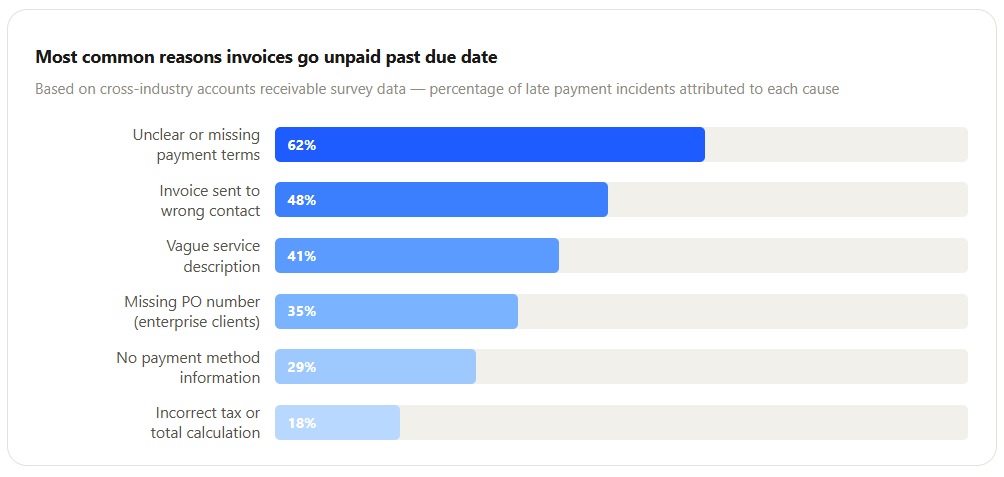
This is not an abstract concern. Studies consistently show that incomplete or unclear invoices are one of the top reasons small businesses experience delayed payments. The fix is straightforward: know exactly what your invoice requirements checklist should include, and build that structure into every invoice you send, ideally using invoicing software that does it automatically.
What Is a Professional Invoice?
A professional invoice is a formal, itemized document issued by a seller to a buyer requesting payment for goods delivered or services rendered. It establishes the amount owed, the payment due date, and the agreed-upon terms under which payment should be made.
Legally, an invoice serves as a commercial document that can be used as evidence of a transaction in contract disputes, tax audits, and financial reporting. The term “invoice requirements” refers to the set of fields and information that a compliant, professional invoice must contain, some of which are legally mandated and some of which represent industry best practice.
Invoices are central to recurring billing cycles, one-time payment arrangements, and installment billing plans alike. Regardless of the payment structure, the core information requirements on the invoice itself remain largely the same.
The Full Invoice Requirements Checklist
Below is every field that belongs on a professional invoice, organized by whether it is universally required or strongly recommended. Required fields are elements that most legal and tax frameworks expect to see. Recommended fields are those that reduce payment friction, prevent disputes, and mark your business as professional and organized.
Required fields
- The word “Invoice”: Clearly labels the document type. Required in many jurisdictions so it can be distinguished from a quote, estimate, or receipt.
- Unique invoice number: A sequential identifier (e.g., INV-0042) that allows both parties to reference this specific invoice. Required for auditing.
- Invoice date: The date the invoice was issued. Determines when the payment clock starts running for any stated payment terms.
- Your business name & address: Full legal name, physical or registered address, and contact information. The IRS and most tax authorities require this.
- Client name & billing address: The full name or legal entity name of the person or company being invoiced, plus their billing address.
- Description of goods or services: Specific enough that a third party could understand what was delivered. Vague descriptions are the #1 cause of payment disputes.
- Quantity and unit price: Hours, units, or deliverables multiplied by the agreed rate. Itemization creates clarity and enables line-item dispute resolution.
- Subtotal, tax, and total due: Show the math. Break out the subtotal before tax, the tax amount (with rate), and the final total in the invoice currency.
- Payment terms: Net 30, Net 15, due on receipt, etc. Combined with a due date, this is the legal basis for any late fee you wish to charge.
- Payment due date: A specific calendar date (not just “30 days”). Eliminates ambiguity about when the invoice becomes overdue.
- Accepted payment methods: Bank transfer details, credit card link, check instructions, or payment portal URL. Without this, clients have to ask, which delays payment.
- Tax ID / EIN (if applicable): Required for VAT-registered businesses in most countries and for US businesses issuing invoices above certain thresholds.
Strongly recommended fields
- Purchase order (PO) number: Many enterprise clients cannot process an invoice without one. Ask for a PO number before starting any work with corporate accounts.
- Project or job reference: Makes it easy for the client’s accounts payable team to match the invoice to a specific contract or statement of work.
- Late payment penalty: A stated monthly fee (e.g., 1.5%) or flat charge for overdue invoices. Must be noted on the invoice to be enforceable.
- Early payment discount: “2/10 Net 30” means a 2% discount if paid within 10 days. A powerful lever for improving cash flow with creditworthy clients.
- Your logo and brand: A professional appearance reduces the likelihood of your invoice being dismissed as spam or deprioritized in an AP queue.
- Notes or thank-you message: A brief personal note can improve client relationships and subtly reinforce prompt payment without sounding demanding.
Good practice: Even if your client has never missed a payment, include payment terms and a due date on every invoice. The moment a dispute arises, these fields become your most important evidence. Courts and collections agencies require them to act on your behalf.
Invoice Template: What It Looks Like in Practice
Below is an annotated example of what a complete, professional invoice looks like. Every field here corresponds to a requirement from the checklist above. Notice how the structure moves logically from identification (who is invoicing whom) to what was delivered to how and when payment is expected.
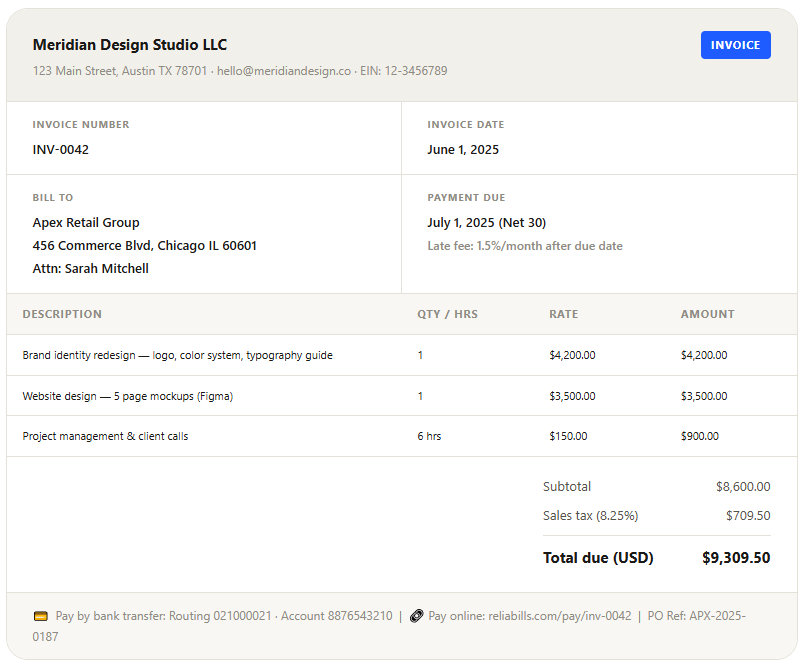
Notice what this template does not do: it does not leave the payment method as an afterthought. It does not use vague descriptions like “design work.” And it states the late fee policy on the invoice itself, not in a separate email sent after the fact, when leverage is gone.
Real-World Examples and Use Cases
Freelance consultant recovering $8,400 from a disputed invoice
A marketing consultant in Dallas had a client dispute an invoice for “consulting services rendered,” a description so vague that the client successfully argued they had no way to verify what was delivered. The consultant had no itemized breakdown and no reference to a signed statement of work on the invoice itself. The dispute dragged through 60 days of back-and-forth before a partial settlement was reached.
After revising their invoicing process, adding itemized deliverables, a project reference number, and a PO number field, the same consultant reported that payment disputes effectively stopped. The specificity of the invoice itself resolved ambiguity before it could become a disagreement.
Small agency improving cash flow with early payment discounts
A digital agency with Net 30 terms found that the average payment time was stretching to 47 days. By adding an early payment discount, 2% off if paid within 10 days, they brought their average payment time down to 14 days across their top five clients, improving monthly cash flow significantly without reducing revenue in any meaningful way. The field already existed on their invoicing software; they simply had not been using it.
Service firm using recurring invoices with installment structures
An IT managed services firm switched from issuing a single large monthly invoice to splitting project fees into three structured installments, billed at project kick-off, midpoint, and completion. Each installment invoice referenced the same master project number and stated clearly which milestone it corresponded to. Client approval rates for payment improved substantially because the sums felt proportionate to progress, a natural fit for installment billing workflows.
Why Invoice Completeness Matters: Causes of Late Payments
Key Benefits of Getting Your Invoice Right
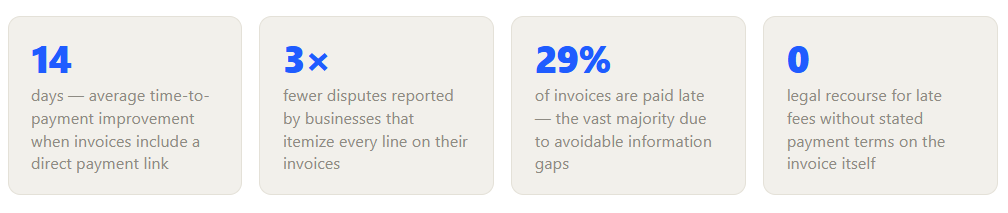
The most important benefit is one that does not show up in any metric: a complete invoice communicates that you run a professional operation. Clients who receive clear, well-structured invoices are less likely to stall, more likely to pay by the stated due date, and more likely to refer your business. The invoice is often the last document a client sees in a project cycle; make it count.
For businesses using recurring billing, a consistent invoice structure across every billing cycle also reduces the support load on your accounts receivable team. When every invoice looks the same and includes the same fields, clients know exactly where to look for what they need.
Key Risks and Common Mistakes to Avoid
Risk: In most jurisdictions, a late payment fee is only legally enforceable if it was disclosed before the work began and explicitly restated on the invoice. Mentioning it in an email after the due date has passed gives you very little legal standing.
Sequential invoice numbers with gaps. If your invoice numbers jump from INV-0041 to INV-0045 with no explanation, it can raise red flags in a tax audit. Some auditors interpret gaps as evidence of unreported revenue. Use consecutive numbering and note any voided invoices in your records.
Sending invoices to the wrong person. In larger organizations, the person who approved your work is rarely the same person who processes payment. Always ask for the name and email of the accounts payable contact at the outset of every engagement. Good customer management practices include storing AP contacts separately from project contacts.
Undated invoices or invoices without a due date. “Net 30” without an invoice date is meaningless; 30 days from when? A client can argue the clock never started. Always include both the issue date and the calculated due date as a specific calendar day.
Currency ambiguity on international invoices. If you work with international clients, always specify the currency explicitly (USD, EUR, GBP). An invoice showing “$5,000” to a client in Australia is genuinely ambiguous. Stating “USD 5,000.00” removes all doubt.
Watch out: Many freelancers and small businesses skip the tax registration number field when they are not VAT-registered, which is fine. But if you are registered and omit your tax ID, your client may not be able to reclaim the VAT component, which can become a reason for them to delay payment until you issue a corrected invoice.
Invoice vs. Related Documents: What’s the Difference?
The invoice is one of several financial documents that flow through a typical business transaction. Knowing where it sits in that sequence and what distinguishes it from similar-sounding documents prevents confusion for both you and your clients.
| Document | When issued | Purpose | Creates obligation? | Legally binding? |
|---|---|---|---|---|
| Quote / Estimate | Before work begins | Indicates expected cost; invites client approval | No | Only if signed as a contract |
| Purchase Order (PO) | Before work begins | Formal authorization from buyer to seller to proceed | Yes, for the buyer | Yes, once accepted by seller |
| Invoice | After work is complete (or milestone reached) | Requests payment; documents what was delivered | Yes, creates a payable | Yes, evidence of commercial transaction |
| Statement | Periodically (e.g. monthly) | Summary of all outstanding invoices for a client | No, references existing obligations | Informational only |
| Receipt | After payment is received | Confirms payment was made and received | No, obligation already satisfied | Yes, proof of payment |
| Credit note | After invoice is disputed or overcharged | Reduces or cancels an outstanding invoice amount | Yes, reduces existing payable | Yes, formal accounting document |
How to Get Started
If you are currently invoicing manually or using a basic template that does not enforce all the required fields, the path to improvement is shorter than it might seem.
1. Audit your last 10 invoices against the checklist above
Run every invoice you sent last month through the required fields list. Note which fields are missing across the board; those are your highest-priority gaps to close first.
2. Standardize your invoice template
Whether you use a word processor, spreadsheet, or dedicated software, create a single master template that includes every required field, even the ones you might leave blank occasionally. Having the field present reminds you to fill it in.
3. Collect AP contacts and PO numbers upfront
Before any engagement begins, ask your client for their accounts payable contact name and email, and whether they require a PO number. Store these in your customer management system alongside the client record.
4. Switch to invoicing software that enforces required fields
Manual templates put the burden of compliance on you. Good invoicing software enforces required fields automatically, assigns sequential invoice numbers, calculates tax, and sends reminders when invoices go unpaid, reducing both errors and late payments.
5. Set up recurring or installment billing where appropriate
If you bill clients on a regular schedule, automate it. Recurring billing ensures that invoices go out on time, with the right information, every billing cycle, without manual effort. For large projects, consider installment billing to align payment milestones with project progress.
ReliaBills includes a built-in invoice builder that enforces all required fields, supports recurring and installment schedules, and tracks payment status across your entire client portfolio, so nothing falls through the cracks.
Frequently Asked Questions
1. What is legally required on a professional invoice?
Legal requirements vary by country and business structure, but at minimum most jurisdictions expect the word “Invoice,” a unique invoice number, the issue date, seller and buyer names and addresses, a description of goods or services, the total amount due, and payment terms. Businesses registered for VAT or sales tax must also include their tax ID and the applicable tax amounts broken out separately.
2. What is an invoice number and why does it matter?
An invoice number is a unique, sequential identifier assigned to each invoice you issue. It matters for three reasons: it allows both parties to reference a specific invoice in correspondence, it creates an auditable trail for your accounting records, and most accounting software and tax authorities require invoice numbering to be sequential and without gaps.
3. Do I need to include payment terms on every invoice?
Yes, every invoice should include payment terms. They specify when payment is due and what happens if payment is late. Without clearly stated terms, you have no contractual basis to charge late fees or escalate to collections. Even for clients with a strong payment history, stated terms prevent ambiguity and set the professional tone of your relationship.
4. What is the difference between an invoice and a receipt?
An invoice is a request for payment issued before payment is received; it states what is owed, by when, and how to pay. A receipt is a confirmation issued after payment has been made. Invoices create a payable obligation; receipts confirm that obligation has been satisfied. Some billing systems combine both into a single document for point-of-sale or immediate payment transactions.
5. How long should I keep copies of invoices?
Most tax authorities require businesses to retain invoice records for a minimum of 3 to 7 years, depending on jurisdiction. In the US, the IRS generally recommends keeping supporting tax documents for at least 3 years from the filing date, though 7 years is common practice for businesses with complex revenue. Cloud-based invoicing software handles this automatically; your records are stored and searchable indefinitely.
6. What should I do if a client disputes an invoice?
Acknowledge the dispute in writing promptly, referencing the invoice number and the specific line item in question. A well-structured invoice makes resolution faster because both parties can point to the same documented expectations. If your invoice included specific deliverable descriptions, itemized quantities, and agreed-upon rates, the factual basis of the dispute is usually narrow and often resolves quickly once you can show the original scope agreement alongside the invoice.
Recent Articles:
- The Ultimate Guide to Subscription Management for Service Businesses
- How to Reduce Involuntary Churn with Smart Payment Retry Logic