

Overdue accounts in lawn care are not primarily a customer problem. They are a billing timing problem and a follow-up consistency problem. Lawn care companies that invoice same-day, bill recurring accounts in advance, and run an automated reminder sequence cut their overdue accounts by 40 to 60 percent within 90 days without changing a single customer relationship. The companies that continue chasing payments manually are not serving more difficult customers. They are running a billing model that makes late payment the path of least resistance for anyone who is even slightly distracted.
What is a Lawn Care Collection Automation?
Lawn care collection automation is the use of billing software to manage the full payment cycle for recurring and per-visit lawn and landscape accounts without manual intervention from the business owner or office staff. It covers same-day mobile invoicing after each service visit, automated payment reminders before and after the due date, automatic late fee application at configured thresholds, failed charge retry logic for declined cards and ACH payments, and escalating past-due notice sequences triggered by invoice age. Because most lawn care revenue comes from recurring weekly, biweekly, or monthly service accounts, the collection cycle repeats identically for every customer every period. Automating it removes the administrative overhead that scales with customer count and converts owner time into route management and growth work. It connects to recurring billing (the mechanism collecting monthly maintenance fees), invoicing software (generating per-visit statements), and customer account management (tracking payment history and overdue balances by account).
Why Lawn Care Companies Carry More Overdue Accounts Than They Realize
The overdue accounts problem in lawn care is structural, not behavioral. Most customers in arrears intend to pay. The delay comes from a billing model that makes late payment easy: service is delivered on Tuesday, an invoice arrives Friday, the customer means to pay next week, and three weeks pass before anything happens. FieldRoutes research on lawn care payment collection cites that according to QuickBooks, 73 percent of businesses are negatively impacted by late invoices, affecting cash flow, growth, and employment, and around 40 percent of SMBs agreed that businesses could be forced to close in the next year if late payments continued.
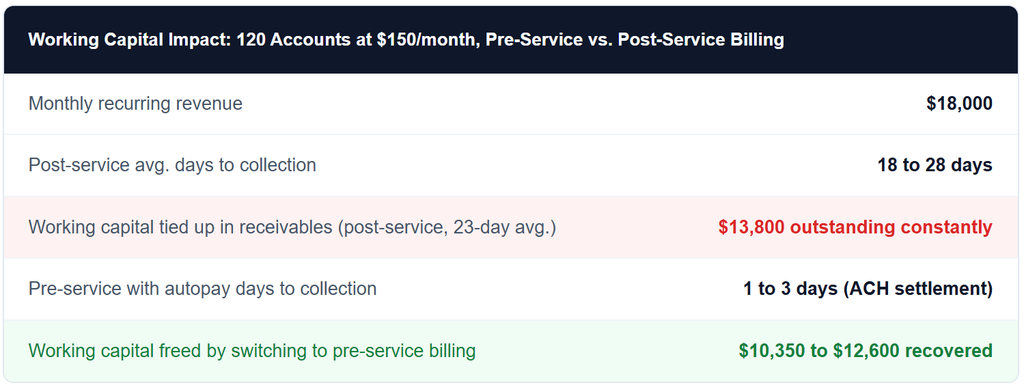
For a lawn care company running 120 recurring accounts at $150 per month, a 10 percent chronic late payment rate represents $18,000 in receivables outstanding at any given time. That is not a customer loyalty problem. That is an operational problem caused by invoice timing, follow-up inconsistency, and the absence of automated consequences for late payment.
The lawn care businesses that scale past five trucks all run on the same boring discipline: invoice the same day, accept the cheapest payment method per customer type, follow up at predictable intervals on aged receivables, and tie the whole thing back to the accounting system without double entry. That discipline is what collection automation delivers for companies that have not yet built those habits manually.
Invoice Timing: The Variable That Affects Payment Speed More Than Anything Else
The single most impactful change a lawn care company can make to reduce overdue accounts has nothing to do with reminders or late fees. It is delivering the invoice on the same day as the service. An invoice that arrives the day of service, when the customer has just watched the crew finish the job, reaches the customer at their moment of highest psychological willingness to pay. An invoice that arrives three days later reaches a customer who has mentally moved on and has to reconstruct the context for the charge.
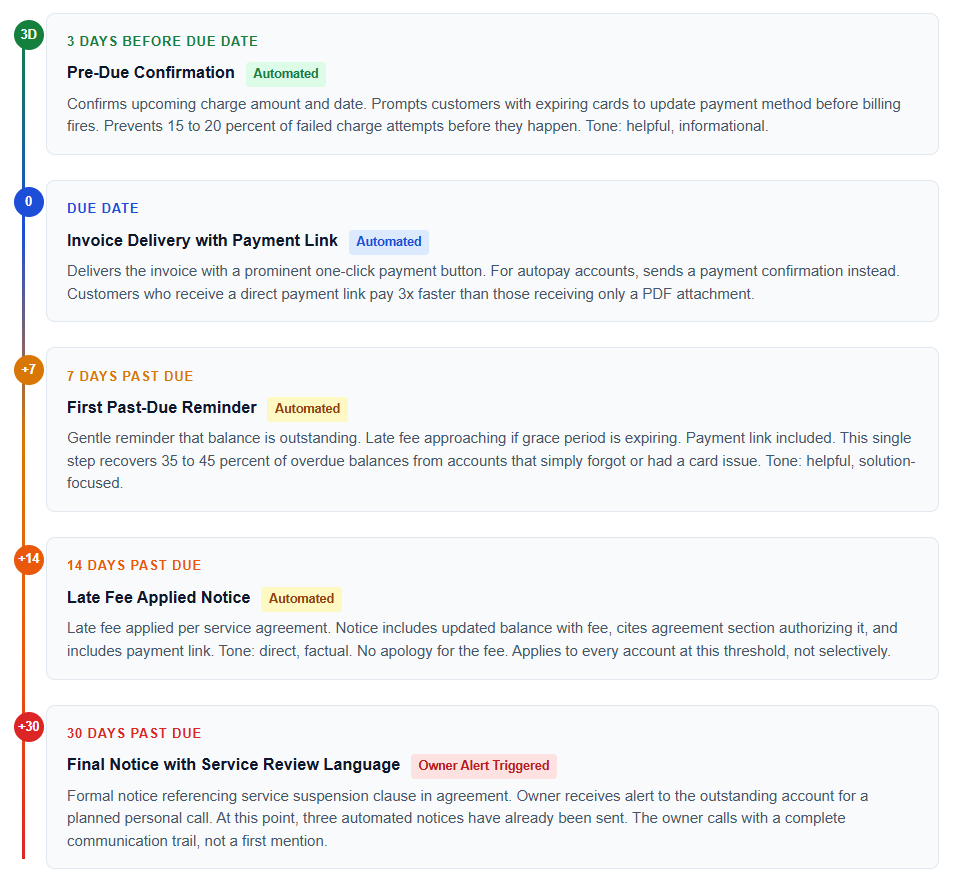
For recurring monthly maintenance contracts, same-day invoicing is replaced by pre-service billing: charging on the first of the month for that month’s service before any visits occur. The customer authorizes autopay at sign-up, the charge happens on the 1st, and the relationship proceeds without any payment event during the service period. A reminder three days before the due date, on the due date, and at intervals after such as seven days and fifteen days keeps invoices top-of-mind and drives substantially faster collection than batch end-of-month invoicing.
For per-visit services like one-time cleanups, aeration, or storm debris removal, mobile invoicing from the job site is the equivalent of pre-service billing for monthly contracts. The crew lead sends the invoice from a mobile app while still on the property. The customer receives it before the truck leaves. Payment rates on same-day job-site invoices run 30 to 45 percent higher than on invoices sent from the office the following day.
The Automated Reminder Sequence That Cuts Overdue Accounts by 40 to 60 Percent
A reminder sequence that fires consistently for every account, every billing period, without anyone deciding whether to send it, eliminates the “forgot to follow up” gap that allows most avoidable late accounts to age past 30 days. The five-step sequence below handles the complete collection cycle from pre-due through 30 days past due without requiring any manual action from the owner or office.
ACH vs. Credit Card: Why Payment Method Choice Affects Your Overdue Rate
The payment method you set as default for recurring lawn care accounts is not just a cost decision. It directly affects how often charges fail and how many accounts end up in your overdue queue.
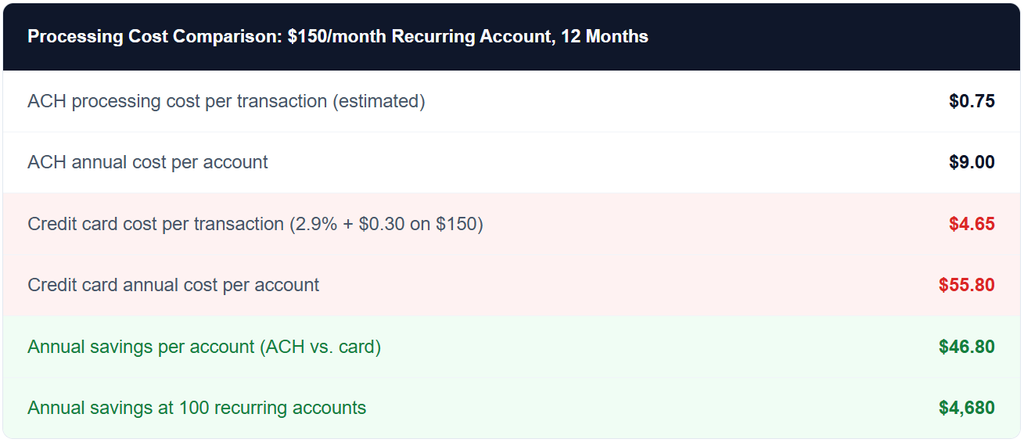
Beyond the cost difference, ACH payments directly pull funds from a customer’s checking account, and like employees paid by direct deposit, they make things easy and streamlined for both parties if companies have recurring customers. The practical advantage is stability: ACH bank account details rarely change and do not expire on a monthly cycle the way credit cards do. A customer with a card that expires in January generates a failed charge in January. An ACH customer’s bank account number from two years ago is almost certainly still the same account. Failed charges create overdue balances. Fewer failed charges mean fewer overdue accounts before any reminder sequence is needed.
Seasonal Billing: The Edge Case That Manual Systems Handle Worst
Seasonal lawn care billing creates two specific problems that generic billing tools and manual systems handle poorly, and those are the most common sources of billing disputes and customer confusion in the lawn care industry.
Seasonal rate changes on recurring accounts
A mowing customer billed at $60 per biweekly visit during the growing season switches to a monthly winterization visit at $35 in November. The recurring billing amount changes. In a manual system, the owner or office must update every affected account’s billing configuration at each seasonal transition. In a well-configured automated billing system, the seasonal rate is configured as a schedule change in the customer account that triggers on the defined date without any manual update required.
This matters because seasonal transition periods, spring and fall, are when lawn care companies are simultaneously the busiest and the most likely to miss billing updates. Accounts billed at the wrong seasonal rate for two months are a common audit finding in lawn care companies during their first billing automation review.
Service Suspension for Non-Payment: Policy Beats Personal Judgment Every Time
Lawn care companies have one collection lever that most other service businesses do not: they can simply not show up. A customer who has not paid in 35 days is mowing their own lawn when the crew skips the visit. That consequence is immediate, visible, and resolved far faster than any invoice reminder.
The service suspension policy belongs in the service agreement the customer signs at enrollment. It should specify the number of days past due that triggers suspension eligibility, whether written notice is required before suspension (and how many days in advance), and what balance clearance is needed to restore service. When a customer calls about a suspended visit, the service agreement is the answer. When no service agreement exists or its language is vague about suspension, the owner is back in the negotiation they were trying to avoid.
Manual Collection vs. Automated Collection: A Direct Comparison
| Factor | Manual Collection | Automated Collection Sequence | Business Impact |
|---|---|---|---|
| Invoice timing | End of week or month; often 3 to 5 days after service | Same day via mobile app, or 1st of month for recurring | Same-day invoicing improves payment speed by 30 to 45 percent |
| Reminder consistency | Owner remembers to follow up; often delayed or skipped | Every account gets same reminder sequence every cycle | Eliminates “fell through the cracks” accounts that age to 60+ days |
| Late fee application | Applied selectively; long-term customers often get a pass | Applied automatically at the configured threshold for every account | Consistent application changes payment behavior; inconsistency enables it |
| Failed payment recovery | Discovered at next billing review; no automatic retry | Automatic retry at 3 and 7 days; customer notified same day | Recovers 20 to 30 percent of failed charges without staff involvement |
| Seasonal rate changes | Manual update required for every affected account | Seasonal schedule configured once; triggers automatically on date | Eliminates wrong-rate billing during transition periods |
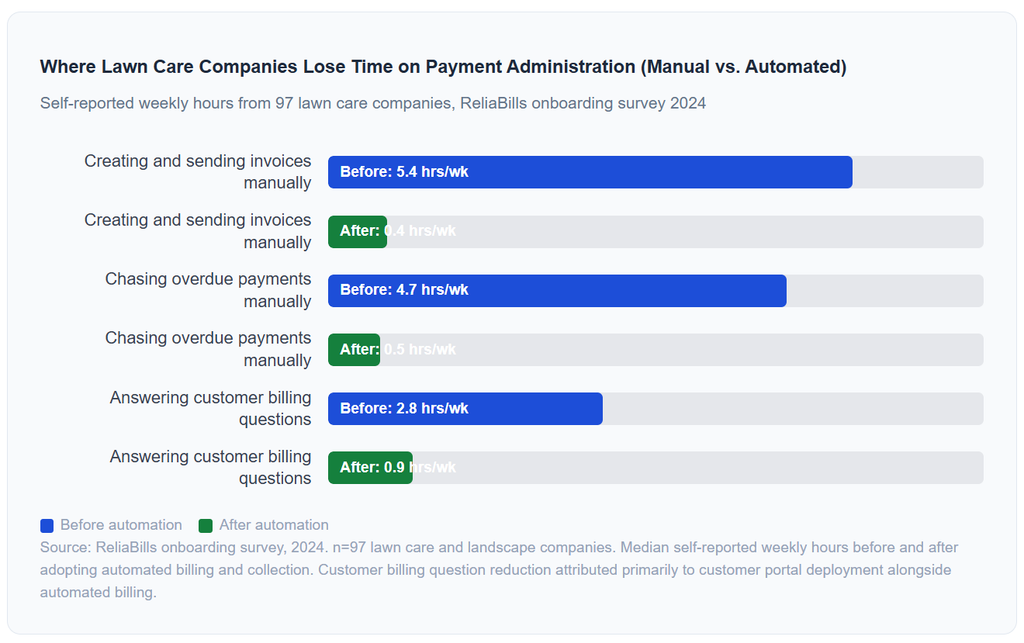
| Owner time per week | 8 to 14 hours across 100 to 200 accounts | Under 90 minutes reviewing exceptions and AR aging | Recovered time goes to route growth, upselling, and customer acquisition |
| AR aging visibility | Mental accounting; the owner estimates outstanding receivables | Real-time aging report showing 30/60/90-day overdue buckets | Identifies at-risk accounts before they reach 60 days, when options narrow |
Setting Up Collection Automation for Your Lawn Care Company
Update your service agreement with billing, late fee, and suspension language
Before configuring any automated billing, the service agreement must explicitly authorize recurring automatic charges, state the billing date and cycle, define the late fee amount and grace period in days, describe the failed payment retry policy, and specify the suspension process. Every automated action the billing system takes flows from this document’s authority. A late fee applied by software to a customer whose agreement does not mention late fees is a fee the customer can successfully dispute. Update the template and send it to existing customers at their next renewal before activating automated enforcement.
Migrate all recurring accounts to pre-service billing on the 1st of the month
For existing monthly maintenance customers, migrate to pre-service billing at the next renewal cycle or when a payment method update is needed. The customer conversation is straightforward: “We have updated our billing system to charge on the first of the month for that month’s service. Here is the ACH authorization form to keep your service running without interruption.” Most customers sign without objection. For new customers, establish pre-service billing as the default at sign-up and never offer the alternative unless specifically requested.
Set up mobile invoicing for per-visit and one-time services
Configure a mobile invoicing tool that the crew lead or owner can use from the job site immediately after service completion. The invoice should show the service performed, the date, the amount, and a payment link. Send it before leaving the property. For one-time seasonal services billed alongside recurring maintenance, configure the one-time charge as a separate line item on that month’s invoice with a reference to the approved quote. ReliaBills and similar platforms support line-item-level invoicing that keeps recurring and one-time charges clearly distinct within the same billing statement.
Configure the five-step reminder sequence with late fee triggers
Set up the pre-due reminder three days before billing, the due-date invoice delivery, and the past-due sequence at seven, fourteen, and thirty days. Configure the late fee to trigger automatically at the fourteen-day step, citing the service agreement section in the notification message. Write each message with deliberate tone escalation from helpful to formal. Test the full sequence with a staff account before enabling it for customers. The most common configuration error is setting the same reminder tone for all five steps, which creates reminder fatigue and reduces response rates for the later messages.
Configure failed charge retry logic with a three-day delay
Set automated retry for failed ACH and card charges at three days and seven days after initial failure, not same-day. Same-day retry almost never recovers a failed charge because the conditions that caused it have not changed. A three-day delay allows payroll deposits to post, bank holds to clear, and card replacements to arrive. Configure automatic customer notification on the day of failure with a link to update payment details. For recurring monthly customers, a pre-due expiry alert sent 30 days before a stored card expires prevents the most common card failure pattern entirely.
Review the AR aging report every Monday before route planning
Make the AR aging report the first thing reviewed each Monday morning. The 1 to 30-day column needs no action beyond the automated sequence. The 31 to 60-day column needs a personal call before the thirty-day final notice fires. The 60-plus-day column needs a decision: is this heading toward service suspension, a payment plan, or write-off? That decision should be made at 60 days, not at 90 days when options have narrowed. The aging report surfaces each account’s position in the collection timeline without requiring a review of individual invoices.
Common Mistakes and What I Got Wrong at First
Automating billing without updating the service agreement first
The most expensive mistake in lawn care billing automation is enabling automated late fees and service suspension on accounts where the service agreement does not authorize them. When a longtime customer disputes a late fee and the service agreement they signed says nothing about late fees, the business has no defensible position regardless of what the billing software’s configuration says. Update the service agreement template, collect signatures from existing customers at renewal, and only then enable automated enforcement. The agreement is the legal foundation. Automation without it is an enforcement system built on sand.
Sending automated reminders to customers who have not been told to expect them
Customers who have only ever received personal calls or texts from the owner will sometimes be surprised or confused by automated billing reminders that arrive from a system email address they do not recognize. Send a one-time communication before activating the automated sequence, explaining that the company has updated its billing system and that customers will now receive automatic invoice confirmations and payment reminders. Frame it as a service improvement that makes it easier to track payments and pay online. Customers who expect automated reminders never object to receiving them.
Applying late fees inconsistently across the customer base
The most common behavioral failure in lawn care collection is waiving late fees for long-term customers and applying them inconsistently based on the owner’s comfort level with each relationship. The result is that the customers who most need the behavioral signal are the ones least likely to receive it, because their relationship with the owner is the most established and the owner is most reluctant to risk it. Automated late fees applied consistently across all accounts at the same threshold solve this. When the system applies the fee, it is not a personal judgment. It is policy. That framing makes the fee far easier for customers to accept and far less awkward for the owner to discuss if asked.
Configuring seasonal rate changes as one-time manual updates
Lawn care companies that update seasonal billing rates manually at each transition, rather than configuring them as scheduled account changes, will miss accounts in the chaotic weeks of spring startup and fall shutdown. The correct setup stores seasonal rates as scheduled billing configurations at the account level that activate and deactivate on the defined calendar dates, not as manual updates that depend on someone remembering to make changes during the busiest period of the year. One season billed at the wrong rate is an inconvenience. A pattern of missed seasonal updates across 60 accounts is a revenue accuracy problem that compounds over time.
Not separating one-time services from recurring fees on the same invoice
Bundling a spring cleanup charge into the monthly maintenance invoice without clearly labeling it creates confusion every time. The customer sees a higher-than-expected charge, assumes the monthly rate increased without notice, and calls to dispute it. Showing the recurring maintenance fee and any one-time services as separately labeled line items, with the one-time service cross-referencing the quote number the customer approved, makes the invoice self-explanatory. This formatting change eliminates most seasonal billing disputes without any other process change.
Frequently Asked Questions
1. What is collection automation for lawn care companies?
Collection automation for lawn care companies is the use of billing software to manage the full payment cycle without manual intervention from the owner or office. It covers same-day mobile invoicing after each service visit, automated payment reminders before and after the due date, automatic late fee application at configured thresholds, failed charge retry logic, and escalating past-due notice sequences triggered by invoice age. Because most lawn care revenue comes from recurring accounts, the collection cycle repeats identically every period. Automating it removes the 8 to 14 hours per week that lawn care owners typically spend on manual billing administration across 100 to 200 accounts.
2. Should lawn care companies bill before or after service?
For monthly maintenance contracts, pre-service billing on the first of the month is strongly preferred. Pre-service billing with ACH autopay produces collection rates of 94 to 98 percent within two to three days. Post-service invoicing averages 18 to 28 days to collect. For per-visit jobs, billing on the day of service from a mobile app while the crew is still on-site produces the highest same-day payment rates. The further the invoice delivery is from the service event in time, the longer the average payment takes. Invoice timing is the highest-impact change available to most lawn care companies without any change to the customer relationship.
3. How does automated billing work for seasonal lawn care services?
Seasonal billing for lawn care requires two separate configurations. Recurring seasonal rate changes, from active season mowing rates to off-season maintenance rates, should be stored as scheduled account configurations that trigger on the defined calendar date rather than as manual updates at each season transition. One-time seasonal services like spring cleanups, aeration, and overseeding should be billed as separate labeled line items on the same invoice as the recurring fee, cross-referenced to the approved quote, so customers can distinguish the recurring charge from the seasonal addition without calling the office.
4. What is the best payment method for lawn care recurring billing?
ACH bank transfer is the most cost-effective method for recurring lawn care billing. Transaction costs are typically $0.25 to $1.00 per charge, compared to 2.5 to 3.5 percent for credit cards. On a $150 monthly maintenance contract over 12 months, ACH costs approximately $9 per account annually while card processing costs $55 to $75 per account. For a 100-account company, that difference is $4,600 to $6,600 per year. ACH is also more reliable for recurring billing because bank account details do not expire monthly the way card numbers do, which reduces the failed charge rate that generates overdue accounts before any reminder sequence is even needed.
5. What should a lawn care service agreement say about payment terms?
A lawn care service agreement should specify the billing cycle and billing date, explicit authorization for automated recurring charges, the payment methods accepted, the grace period in days before late fees apply, the late fee amount or percentage, what happens when a charge fails, including the retry policy, and the conditions under which service may be suspended for non-payment. Without this language in the signed agreement, automated late fees and service suspension are not legally enforceable. The service agreement is the legal foundation that every automated billing action flows from. Update it before enabling any automated enforcement and collect signatures from existing customers at renewal.
6. How long does it take to set up collection automation for a lawn care company?
A basic automated collection setup for a lawn care company takes one to two days if the customer list and service agreements are organized. The steps are import customer records, configure recurring billing for monthly accounts, collect ACH authorization from existing customers, write and schedule the five-step reminder sequence, configure late fee triggers, and test the full cycle with a sample account. Companies that skip upfront customer data cleanup and try to automate on top of disorganized records spend more time troubleshooting than the setup itself requires. Organize the customer list and update the service agreement first. Then automate.
Recent Articles:
- How to Handle Late Childcare Payments Without Uncomfortable Conversations
- How to Manage Security Service Contracts and Customer Data in One System