

Between 20 and 40 percent of membership cancellations are not real cancellations. They are payment failures that no one caught in time. The member did not want to leave. A card expired, a bank flagged a transaction, or an account ran short. That is involuntary churn, and it is almost entirely preventable. A properly configured dunning sequence recovers 70 to 85 percent of failed membership payments without anyone on your team making a single phone call or sending a single manual email. The difference between the businesses that recover that revenue and those that don’t is not the payment processor. It is whether they have configured a recovery system at all.
What Is Failed Membership Payment Automation?
Failed membership payment automation is the use of configured billing logic to detect, retry, and follow up on declined or failed membership charges without requiring manual action from your team. When a membership payment fails, the automation layer takes over: it classifies the failure type, schedules retry attempts at optimized intervals, sends the member a notification with a payment update link, and escalates the response based on whether the payment is recovered or remains outstanding.
The core mechanism is called dunning, a term borrowed from debt collection that now refers broadly to the automated sequence of recovery actions that follow a payment failure. In the context of membership businesses, dunning includes smart retry logic that times each reattempt based on the failure type, multi-channel member communication (email, SMS, in-app), and access restriction rules that determine when and how member benefits are paused while a payment is unresolved.
Dunning connects directly to recurring billing infrastructure, which generates the charge events that dunning recovers, and to customer management, which determines how a member’s account status is updated during and after the recovery process. The distinction between installment billing failures and subscription billing failures also matters here, since the correct recovery response differs between a missed installment against a fixed contract and a declined open-ended monthly charge.
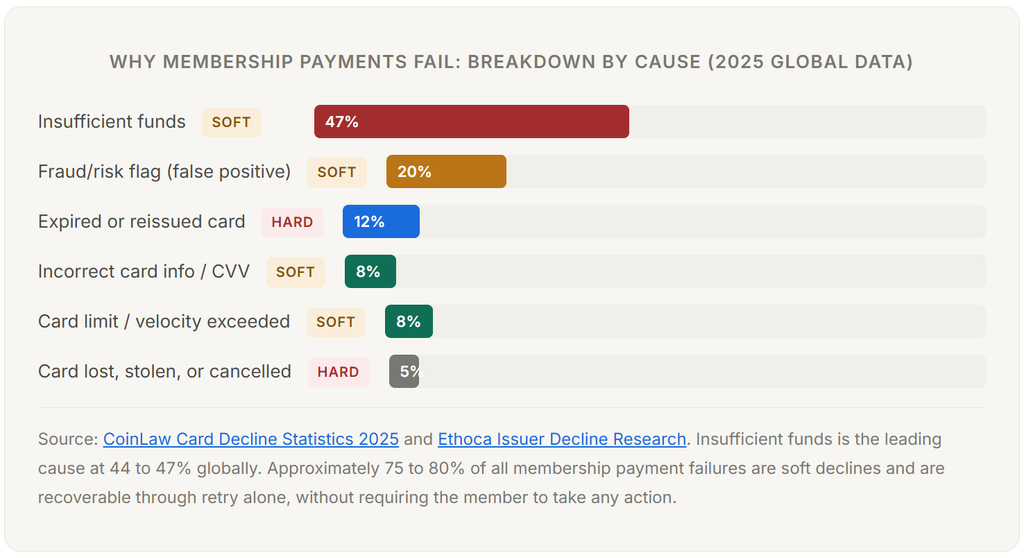
Why Membership Payments Fail: The Four Categories
The single most consequential design decision in any dunning system is treating soft declines differently from hard declines. Most membership organizations configure a generic retry sequence that applies the same logic to every failed payment, which wastes retry attempts on hard declines that will never recover and misses the optimal retry timing for soft declines that would recover quickly with the right approach.
Soft Declines vs. Hard Declines: Why the Distinction Drives Everything
A soft decline is a temporary failure. The card itself is valid, but the charge did not go through due to a transient condition: insufficient funds at the moment of charge, a bank fraud algorithm that flagged an unusual pattern, a daily spending limit the member hit earlier that day. These resolve on their own. Smart retry logic schedules the next attempt at the moment when the underlying condition is most likely to have cleared, and a large share of them succeed without any member involvement.
A hard decline is permanent. The card is expired, lost, stolen, or cancelled. No number of retries will recover a hard decline because the card itself is no longer valid. The correct response to a hard decline is to immediately stop retrying and instead send the member a direct notification asking them to update their payment method. Retrying a hard decline is not just wasted processing. It can trigger additional fraud flags from the issuer that make subsequent charges more likely to fail even after the member updates their card.
What Unrecovered Membership Payment Failures Actually Cost
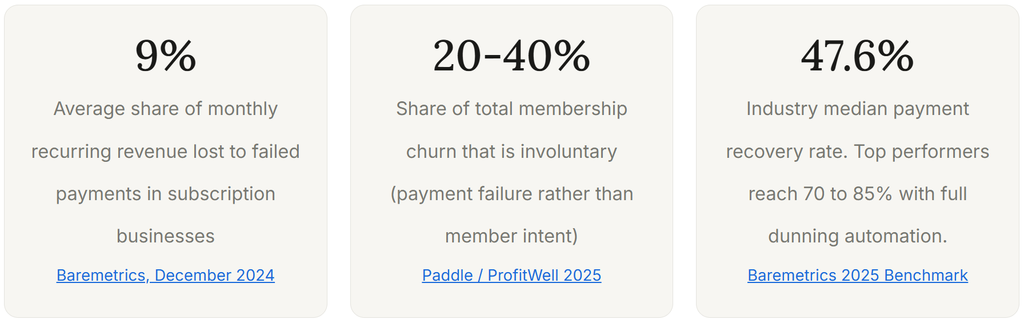
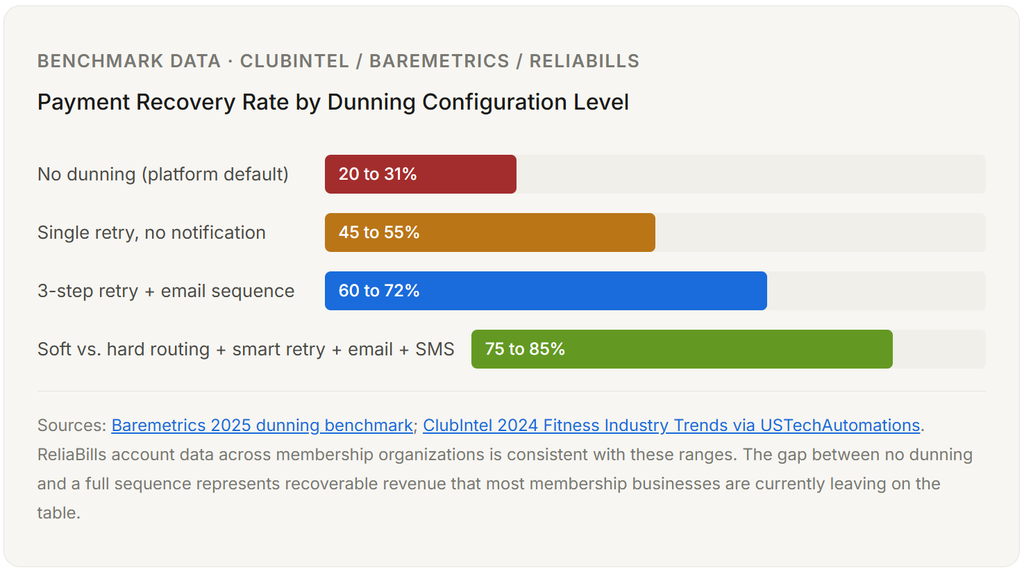
The gap between the 47.6% industry median and the 70 to 85% that well-configured dunning systems achieve is not a gap in technology. Both groups have access to the same payment processors and billing platforms. The difference is in configuration: one group has set up retry timing, decline-type routing, and member communication sequences deliberately, while the other is using default platform behavior that was designed to be broadly safe rather than optimally effective.
Translating those recovery rates into dollar amounts makes the cost of under-configuration concrete. A membership organization collecting $50,000 per month in dues with a 5% monthly failure rate has $2,500 at risk per billing cycle. At the industry median recovery rate of 47.6%, they recover approximately $1,190 and lose $1,310 permanently per month. At an 80% recovery rate from a properly configured dunning system, they recover $2,000 and lose only $500. That difference, $810 per month, is $9,720 per year in additional revenue that requires no new members, no price increases, and no additional marketing.
How Automated Recovery Works
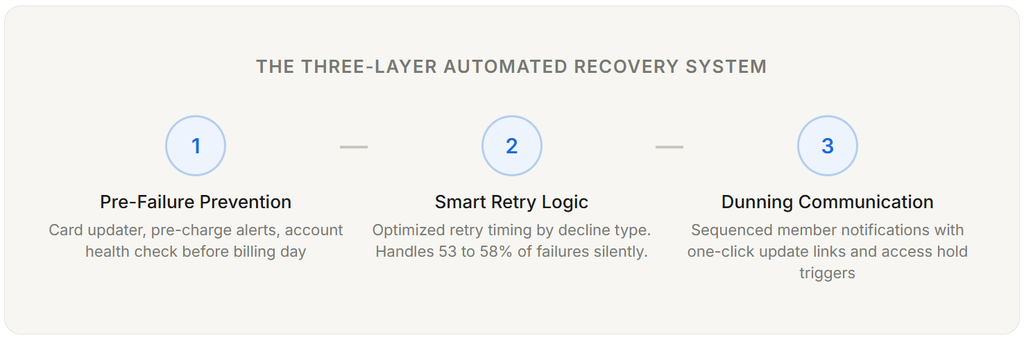
The automated recovery process has three distinct layers, and each layer handles a different segment of the failed payment population. Understanding the layers clarifies why a single-tactic approach, whether that is just sending a reminder email or just retrying the charge, consistently underperforms a layered system.
Layer 1: Pre-Failure Prevention
The most cost-effective recovery is the failure that never happens. Two tools prevent the most common failure types before they occur. A Card Account Updater service automatically refreshes stored card credentials when a bank reissues a card after expiry, loss, or fraud replacement. This eliminates a meaningful share of hard decline failures without any member action. A pre-charge notification sent 3 to 5 days before billing day prompts members to verify their payment method is current and addresses the insufficient funds cases where the member could have added money to the account if they had known the charge was coming.
Layer 2: Smart Retry Logic
Smart retry logic routes each decline to an optimized reattempt schedule based on the failure code. Insufficient funds failures, for example, are most successfully retried on Tuesday or Wednesday mornings, when bank account balances are typically highest after weekend or Monday deposits. Fraud flag failures are best retried within 24 to 48 hours, when the flag often clears automatically after the issuer’s system reviews the pattern. Generic declines benefit from a multi-day spread that catches different account states. A single retry schedule applied to all failure types performs significantly worse than decline-type-specific retry timing.
Layer 3: Dunning Communication
For failures that smart retry does not resolve, the dunning communication sequence takes over. The member receives a notification that their payment failed, with a one-click link to update their payment method. The notification design matters significantly: Baremetrics research shows that the first dunning email sent within 24 hours of failure produces an open rate of 41.29%, compared to 26.83% for emails sent later. Subject line and send timing are not cosmetic details; they are recovery mechanism variables.
Building the Dunning Sequence: Day by Day
The optimal dunning sequence for membership organizations is a 14-day ladder with defined actions at each stage. This structure recovers the large majority of recoverable failures while providing a clear endpoint for accounts that cannot be resolved automatically and need staff escalation or access termination.
Day 0: Fail – Payment Failure Detected [Automated]
Classify the decline as soft or hard. The route hard declines immediately to a card update notification. Route soft declines to the smart retry schedule. Send the member a brief notification that their payment could not be processed, with a one-click payment update link. For hard declines, suppress all retry attempts and proceed directly to the member notification.
Day 2: Retry – First Automated Retry (Soft Declines Only) [Automated]
Reattempt the charge for soft decline accounts. Recurly’s transaction data puts the recovery rate on the first retry at approximately 20 to 25% of initial failures. If this retry succeeds, confirm payment to the member and close the recovery event. If it fails, continue to day 5 without sending another notification yet. Multiple notifications in the first 48 hours increase unsubscribe rates without improving recovery.
Day 5: Retry + Alert – Second Retry and Follow-Up Email [Automated]
Reattempt the charge. Send a second notification to members whose payment has still not been resolved, with slightly more urgency in the subject line and a clear statement that access may be affected if the payment is not updated. Include the one-click update link prominently. For members who opened the day-zero email but did not click, consider an SMS nudge at this stage if you have the member’s mobile number.
Day 7: Retry + Hold – Third Retry and Optional Access Hold [Automated]
Final automated retry. At this stage, consider implementing a soft access hold for membership types where access can be controlled: physical facility access, digital content access, or premium feature access. A soft hold is more effective than account suspension because it creates urgency while keeping the member relationship intact. The hold notification should make the payment update path unmistakably clear.
Day 10: Final Alert – Final Automated Notification [Automated]
Send the final automated communication before potential account suspension. This message should be direct: the payment has been outstanding for 10 days, access will be suspended at day 14 unless the payment method is updated, and here is the one-click link to resolve it now. This notification consistently produces a higher click rate than earlier messages because the consequence is now concrete and imminent.
Day 14: Escalate – Staff Escalation or Account Suspension [Manual Escalation]
For high-value members or long-tenure accounts, route to staff for a personal outreach attempt before suspension. For standard accounts, suspend access and send a final reactivation email explaining how the member can restore their account by updating their payment method. Do not close the account or delete the payment method. Recovery after this point is less common but still possible, and easy reactivation keeps the door open.
Sequence Design Rule
The 14-day sequence above produces the best results when the Day 0 classification is accurate. Routing soft declines to card update notifications wastes the member’s attention. Retrying hard declines wastes your retry budget and risks additional fraud flags. The classification step is worth building correctly before anything else in the sequence.
Real-World Use Cases by Membership Type
The dunning sequence structure above applies across membership types, but the specific configuration choices, particularly access hold timing and escalation thresholds, differ meaningfully based on what the membership grants and what the relationship looks like between organization and member.
Gym and Fitness Studio Memberships
Fitness memberships are the highest-volume use case for dunning automation, and the stakes are significant. ClubIntel 2024 data puts average annual gym member churn at 28%, with 30 to 40% of that figure attributed to payment failures rather than member-initiated cancellations. An access hold at day 7 is effective here because the physical facility access is something the member notices and values immediately. The hold creates urgency without hostility: the member receives a notification that their fob or digital access has been paused and a direct link to restore it by updating their payment method.
Professional Association and Club Memberships
Association memberships have a longer acceptable dunning window than gym memberships because the access being restricted (member directory, event pricing, certification maintenance) is less time-sensitive to the individual member on any given day. A 21-day sequence rather than 14 days often produces better recovery rates for association memberships because members check their association benefits less frequently and need more notification attempts before they notice and respond. Staff escalation for high-tenure members is particularly high-value here, as a personal call from the association often recovers a payment that three automated emails did not.
Online Content and Subscription Communities
Digital access memberships have the cleanest access hold mechanism available: access to gated content or community spaces is suspended automatically at a defined point in the dunning sequence. The member experience of losing access is immediate and clear, which produces faster payment update action than the more gradual consequence of losing physical access. For these memberships, a day 5 soft access hold (access becomes read-only rather than fully suspended) followed by a day 10 full suspension is a structure that balances urgency with member experience.
Comparison: Manual Follow-Up vs. Automated Dunning vs. No Recovery
| Factor | No Recovery Process | Manual Staff Follow-Up | Automated Dunning |
|---|---|---|---|
| Recovery rate | 20 to 31% (platform default retries only) | 45 to 60% (varies significantly by staff consistency) | 70 to 85% with full sequence configuration |
| Staff time per failure | None, but revenue is permanently lost | 25 to 40 minutes per failure event (ClubIntel 2024) | 2 to 4 minutes for escalation cases only |
| Consistency | Consistent (no action taken on any failure) | Inconsistent. Staff follow-up varies by person, workload, and time of year. | Fully consistent. Every failure triggers the same configured sequence. |
| Member experience | Member loses access without explanation. Often results in a chargeback or negative review. | Variable. Staff outreach can be warm but is often delayed or inconsistent in tone. | Consistent, branded communication with a clear action path. The member feels informed rather than punished. |
| Scales with volume | Yes (does nothing at any volume) | No. Staff time required grows linearly with failure volume. | Yes. Configuration cost is fixed. Recovery scales with the member base. |
| Soft vs. hard routing | No routing. All failures were treated identically. | Depends on staff training. Often not applied consistently. | Built into the system at configuration. Different paths for each decline type. |
Key Risks and Edge Cases
Chargeback Risk from Aggressive Dunning
A dunning sequence that retries too aggressively or sends notifications that feel threatening can push members toward chargebacks rather than payment updates. A chargeback costs the organization the transaction amount plus a dispute fee of $15 to $35, and enough chargebacks relative to transaction volume can trigger processor review or account termination. The safest dunning tone is informational: “Your payment did not go through, here is how to update it.” Notifications that feel like collection calls produce chargeback responses.
Compliance with Auto-Renewal Disclosure Laws
Several states, including California, New York, and Illinois, have auto-renewal statutes that require advance notice before a membership renews or before a payment is charged after a failed payment results in a service interruption. These laws govern how and when you can resume charging after a dunning period without the member actively re-enrolling. Operating a dunning sequence across a multi-state member base without reviewing applicable requirements is a compliance exposure that becomes expensive when the first regulatory inquiry arrives.
The High-Value Member Escalation Edge Case
A standard 14-day dunning sequence with automatic suspension at day 14 is the right default for the majority of members. It is the wrong choice for a member who has been with the organization for 10 years, whose annual membership value is five times the average, and whose failure is almost certainly a card replacement rather than genuine non-payment. Every dunning system needs a segment or flag for high-value members that routes them to staff escalation at day 7 rather than automated suspension at day 14. The cost of losing that member relationship permanently is far higher than the cost of a brief personal call.
Common Mistakes in Membership Payment Recovery (What I Got Wrong First)
1. Treating all failed payments identically regardless of decline type
The default retry behavior on most billing platforms applies the same schedule to every failed payment, regardless of whether it was a soft decline that will likely resolve itself in 24 hours or a hard decline that will fail every subsequent retry. This means soft declines that would recover on a Tuesday morning retry are being retried on Wednesday evening instead, and hard declines are burning through three to four retry attempts that will never succeed and that increase the chargeback risk on the account. The first configuration decision in any dunning setup is routing soft declines to retry sequences and hard declines to immediate card-update notifications.
2. Relying on the platform’s default dunning behavior without reviewing it
Every billing platform has some default behavior for failed payments. Most default behaviors are deliberately conservative: a small number of retries over a short window, a generic notification, and then the payment is marked as failed. Default behavior is designed to be broadly safe rather than optimally effective. It recovers 20 to 31% of failures. A properly configured dunning sequence recovers 70 to 85%. The gap is entirely explained by configuration choices that the platform supports but does not apply by default.
3. Sending too many notifications too quickly
Multiple emails in the first 24 to 48 hours after a payment failure produce high unsubscribe rates and increase the likelihood of a chargeback response. Baremetrics research shows the highest open rate on dunning emails is achieved on the first communication within 24 hours. Subsequent messages should be spaced by several days and escalate in urgency gradually. The sequence that feels most urgent to the organization (send a reminder every day) is the sequence that produces the worst member response.
4. Suspending access too early for high-tenure members
A 14-day automatic suspension rule applied uniformly to all members will suspend accounts that could have been recovered with a single personal call on day 10. High-tenure members whose failure is almost certainly a card replacement or bank-side issue deserve a different recovery path than new members on their second billing cycle. The configuration work to segment these groups at setup is minimal. The cost of not segmenting them shows up in the loss of high-value, long-term member relationships that an automated suspension terminates unnecessarily.
5. Not tracking recovery rates as a metric
Most membership organizations that have some dunning configuration in place are not measuring their recovery rate as a distinct metric. They see that payments are being retried and some are coming in, and they consider the system to be working. Without a denominator, the numerator is meaningless. Recovery rate, expressed as the share of initially failed payments that are eventually collected, is the number that tells you whether your dunning configuration is performing well or leaving recoverable revenue on the table. An organization running at 35% recovery rate that believes its dunning is working is leaving more than half its recoverable revenue uncollected every billing cycle.
How to Get Started with Failed Membership Payment Automation
The setup sequence for the dunning configuration matters. Organizations that configure access hold rules before configuring decline-type routing, or that set up notification sequences before testing their retry logic, end up with a system that looks complete but has gaps that only surface during the first billing cycle with a significant failure volume.
Step 1: Audit Your Current Recovery Rate Before Changing Anything
Pull your last three months of billing data and calculate the ratio of initially failed payments to eventually collected payments. This is your baseline recovery rate. Organizations that skip this step and configure dunning without a baseline cannot measure improvement and often do not know whether the configuration is working. The baseline also identifies your failure rate, which tells you how much monthly revenue is at risk and how much improvement a better configuration can deliver.
Step 2: Enable Card Account Updater If Your Processor Supports It
This is the highest-ROI configuration change available and the one most commonly skipped. Card Account Updater automatically refreshes stored card credentials when a bank reissues a card, eliminating a large share of hard decline failures before they occur. Stripe, Braintree, and most major processors offer this as a native feature. ReliaBills connects to this infrastructure natively, which means enabling it is a settings change rather than a development project. Start here before building your retry sequence.
Step 3: Configure Decline Classification and Route Hard Declines Separately
In your billing platform’s failed payment settings, configure the system to classify declines and route them differently based on whether they are hard or soft. Hard declines should trigger an immediate card-update notification and suppress all retry attempts. Soft declines should enter the retry sequence. If your current platform does not support this routing natively, this is the most important capability to evaluate when selecting or switching billing software.
Step 4: Build the Dunning Notification Sequence Using Your Brand Voice
Write the notification emails at each stage of your dunning sequence before enabling the system. The first notification, sent within 24 hours of failure, should be informational: your payment did not go through, here is how to fix it. The day 5 and day 7 notifications escalate gradually in urgency without becoming adversarial. The day 10 final notification is explicit about the consequence: access will be suspended unless payment is updated by a specific date. Each notification should contain a prominently placed, one-click payment update link. The member should never need to log in, navigate menus, or find their account settings to update a payment method.
Step 5: Set Up Reporting to Track Recovery Rate Monthly
Configure a monthly report that shows failed payment volume, recovery rate by dunning stage, and permanent write-offs. This report tells you whether your configuration is working and, crucially, at which stage of the sequence the most failures are recovering, which tells you where to invest additional optimization effort. Organizations that track recovery rate as a monthly metric consistently improve it over time. Those that do not track it remain at their baseline indefinitely.
Frequently Asked Questions
1. What is the difference between a soft decline and a hard decline for membership payments?
A soft decline is a temporary charge failure caused by a transient condition: insufficient funds at the moment of charge, a bank fraud flag that the issuer may clear within hours, or a temporary system unavailability. The card itself is valid and will likely process successfully on a retry at the right time. A hard decline is a permanent failure caused by an invalid card: the card is expired, lost, stolen, or cancelled. No retry will recover a hard decline because the card number itself no longer authorizes charges. Routing these two categories to different recovery paths is the foundational design decision in any effective dunning system. Soft declines benefit from smart retry logic. Hard declines need an immediate request for the member to update their payment method.
2. When should I suspend a member’s access after a failed payment?
For most membership types, a soft access hold (reduced access rather than full suspension) at day 7 and full suspension at day 14 is the standard configuration that balances recovery urgency with member experience. High-tenure members and high-value accounts should be escalated to personal staff outreach before automated suspension, typically at day 10 rather than day 14. The timing should also reflect what the access restriction actually means to the member: gym members respond to access holds within 1 to 2 days on average because the disruption to their daily routine is immediate, while online community members may take 3 to 5 days to respond because the access disruption is less immediately felt. Access hold timing should match the behavioral characteristics of your specific member type, not just a generic default schedule.
3. How many retry attempts should I configure for a failed membership payment?
For soft declines, three to four retry attempts over a 7-day window is the range that produces the highest total recovery rate in industry benchmarks. Recurly’s analysis of 40 million subscription transactions found that the first retry recovers approximately 20 to 25% of initial failures, the second retry recovers an additional 10 to 15%, and the third retry adds another 5 to 10%. Diminishing returns set in after the third attempt for most failure types. For hard declines, the correct number of retries is zero. Retrying a hard decline wastes processor resources, risks additional fraud flags on your merchant account, and delays the more effective intervention of asking the member to update their payment method.
4. What should the payment update link in my dunning emails look like?
The payment update link should take the member directly to a pre-populated payment update form with a single click, without requiring them to log in, navigate to account settings, or find the billing section of your platform. Any additional step between the email click and the payment update form reduces conversion. The link should be displayed as a clear button, not an inline text link, and should be placed prominently in the email rather than at the bottom of a paragraph. The button text should be action-oriented: “Update My Payment Method” or “Fix My Billing” rather than “Click Here.” These design choices are supported by dunning email performance data and collectively produce meaningfully higher click-through rates than generic link placements.
5. What is involuntary churn, and how does dunning prevent it?
Involuntary churn is membership loss caused by a payment failure rather than the member’s intent to cancel. The member did not choose to leave. A card expired, a bank flagged the transaction, or an account ran short temporarily. Without a recovery system, that member loses access, stops hearing from the organization, and eventually moves on, even though they never decided to cancel. Research from Paddle and ProfitWell puts involuntary churn at 20 to 40% of total subscription churn across membership organizations, which means a meaningful share of the members you believe left voluntarily actually left because a payment failed and no one caught it in time. Dunning automation prevents involuntary churn by detecting failures immediately, retrying the charge optimally, and giving the member a clear path to resolve the issue before access is affected.
6. Can ReliaBills handle both the retry logic and the dunning email sequence in one system?
Yes. ReliaBills manages the complete failed payment recovery workflow, including automated retries on configurable schedules, pre-written notification sequences at each dunning stage, payment update link generation, and member account status updates that reflect each stage of the recovery process. The platform is designed specifically for membership and recurring billing organizations, which means the dunning configuration reflects the specific recovery dynamics of membership payments rather than being a generic subscription billing default. The same customer record that tracks the member’s payment history and program details also tracks where they are in the dunning sequence, which eliminates the coordination issue that arises when retry logic and notification sequences live in separate systems.
Recent Articles:
- How to Manage Tenant Payment Records Using Customer Data Management
- 10 Signs Your Business Needs to Switch to Automated Billing Software