
Tenant payment tracking is not an administrative task. It is a legal function. The payment ledger you maintain for each tenant is the primary evidence you rely on in a late fee dispute, a lease non-renewal, a payment plan negotiation, or an eviction proceeding. A spreadsheet maintained inconsistently by a busy landlord is not a payment record. It is a liability. Tenant payment tracking software that creates an automated, timestamped, audit-ready record is what converts that liability into documentation that actually holds up when you need it.
What is Tenant Payment Tracking Software?
Tenant payment tracking software is a platform that records, automates, and organizes rent collection and payment history across one or more rental units. It creates a complete, timestamped ledger for each tenant that includes every payment received, every late fee applied, every NSF event, and every balance outstanding. It integrates with recurring billing to collect rent automatically on the due date, applies late fees at the configured threshold without manual calculation, and generates accounts receivable aging reports that surface collection problems before they become eviction problems. When combined with client account management, tenant payment records also capture communication history, lease documents, and security deposit status in a single profile that property managers can retrieve immediately in any dispute. For portfolios with installment-based payment structures or payment plan agreements, installment billing tools add a layer of scheduled partial payment tracking on top of the core ledger.
What the Top Guides on Tenant Payment Tracking Miss
Most articles about tenant payment tracking software function as product comparison lists. They evaluate features, compare pricing tiers, and rank platforms by review scores. What they consistently skip is the reason tenant payment records matter beyond administrative convenience: they are legal documents that determine outcomes in disputes, eviction hearings, and housing court proceedings.
A landlord who has maintained a complete, consistent, timestamped payment ledger for a tenant enters any dispute from a position of documented fact. A landlord whose records exist in a combination of bank statement screenshots, text messages, and a partially updated spreadsheet enters the same dispute from a position of ambiguity. Courts and mediators do not fill gaps in payment records charitably.
This guide covers what tenant payment records actually need to contain, how customer data management principles apply to a rental portfolio, and why the tipping point between spreadsheet tracking and dedicated software arrives sooner than most landlords expect.
The Payment Landscape Landlords Are Managing in 2025
Late rent payments are more common than they were before 2021, and the trend has not reversed cleanly. The Consumer Financial Protection Bureau’s January 2025 analysis of national rental payment data found that the fraction of renters incurring a late fee in the last twelve months peaked at 23 percent in early 2023 and declined to approximately 14 percent by November 2024, but the median outstanding rental balance rose 60 percent between September 2021 and November 2024, suggesting that tenants who do fall behind are falling further behind than before.
The CFPB data also surfaces a pattern that every landlord managing more than a few units recognizes: about 42 percent of renters who incur a late fee do so again the following month, and nearly 30 percent remain delinquent five months later. A tenant who misses one payment is not necessarily a problem. A tenant who misses one payment and whose landlord has no automated system for tracking, following up, and documenting the subsequent payment history becomes an eviction case that is harder to execute than it should be.
Late payments in independently owned rentals rose from 8.8 percent in mid-2024 to 11.7 percent in June 2025, with on-time payments declining for 25 consecutive months year over year, according to Chandan Economics tracking. For independent landlords managing single-family homes or small multifamily properties, these figures mean that the probability of at least one late payment in a given 12-month period across a portfolio of 10 units is essentially certain. The question is not whether a late payment situation will arise. The question is whether the landlord’s record-keeping system can support the response to it.
What a Complete Tenant Payment Record Must Contain
The payment record is the central document in a tenant’s account. Its job is not just to confirm that rent was paid. It is to establish an unambiguous, chronologically complete history of every financial event in the tenancy that can be retrieved on demand, printed for a court, or shared with a new property manager without explanation.
The record for each tenant account needs to hold seven categories of data, all with timestamps.
Lease and account identifiers
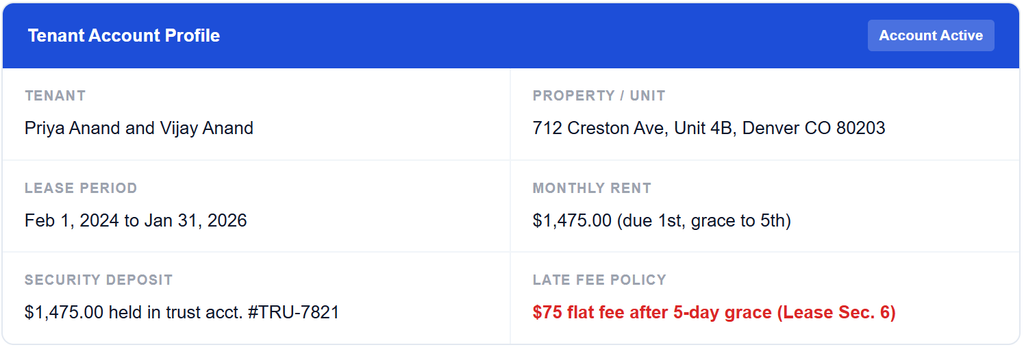
The property address, unit number, lease reference number, lease start and end date, tenant names (all adults on the lease), and contact information. These fields anchor every entry in the ledger to a specific tenancy and prevent confusion when a tenant has occupied the same unit under multiple leases over time.
Rent amount and payment schedule
The monthly rent amount as specified in the signed lease, the payment due date, the grace period in days, and the late fee amount and calculation method. Any rent increases must update this section with the effective date of the new amount and a reference to the lease addendum or notice that authorized the change. Running a ledger at the wrong rent amount for three months is a record error that tenants can exploit.
Payment history with full transaction detail
Every payment must be recorded with the date received (not the date deposited, which can differ), the amount, the payment method (ACH, check number, or online portal), and the period the payment covers. This field-level detail matters when a tenant claims to have paid for March, but the record shows the payment was received in April and applied to February’s outstanding balance. Without the period-applied field, that dispute has no clean resolution.
Late fees with lease authorization references
Every late fee must show the date applied, the amount, the lease section that authorizes it, and the grace period that was honored before the fee was assessed. A late fee applied without a record of the lease clause that permits it, or without documentation that the grace period expired, is exactly the kind of entry a tenant’s attorney will challenge successfully in a dispute.
NSF and returned payment events
Every bounced check or returned ACH transaction must be recorded with the date the return was processed, the amount, the fee charged, and any bank-generated return code. NSF events are significant both financially and legally: they affect the tenant’s payment track record and, in some jurisdictions, repeated NSF events authorize the landlord to require certified funds for future payments.
Outstanding balances and write-offs
Any unpaid balance at month end must be carried forward explicitly in the ledger, not implicitly assumed from the absence of a payment entry. A tenant who paid $400 against a $1,200 rent obligation must show an $800 outstanding balance on that date. That balance entry is what allows the AR aging report to correctly categorize the tenant’s account and triggers the appropriate follow-up sequence.
Communication log references
Every formal communication related to payment status should be logged with the date and method, whether that is an automated payment reminder, a personal call, or a written notice. This log does not need to reproduce the content of every message, but it should create a timestamp record that demonstrates the landlord followed a consistent, documented follow-up process, not an ad hoc one that happened to produce a notice only when things escalated.
What a Well-Maintained Tenant Payment Ledger Looks Like
The sample below shows six months of payment history for a single tenant account, including an NSF event, a resulting partial payment, and the late fee documentation that accompanies it. This is the standard a payment record needs to meet to be usable as legal documentation.
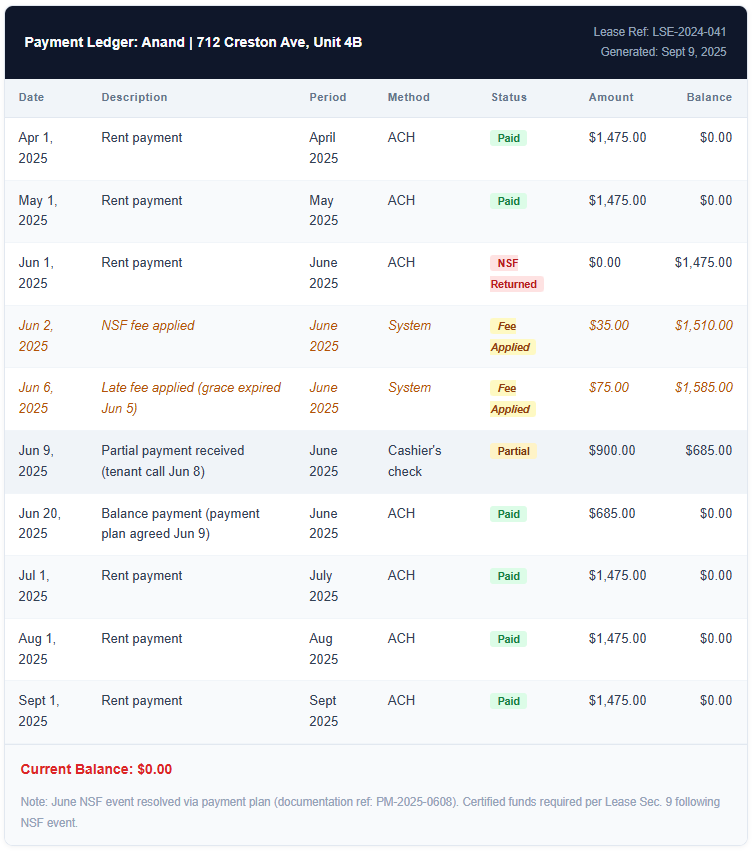
The June NSF sequence in the ledger above is the kind of entry chain that protects a landlord in a dispute. The NSF return date, the fee application dates (each referencing the lease section), the partial payment with a note referencing the call that preceded it, and the balance payment with a reference to the payment plan agreement are all documented in sequence. If the tenant later disputed the late fee or the NSF charge, the ledger provides a complete, timestamped account of exactly what happened and when, without requiring the landlord to reconstruct the story from memory.
Accounts Receivable Aging: The Management Report Most Landlords Are Not Running
For a landlord with two or three units, checking payment status is straightforward. For anyone managing 15 or more units, the question of which tenants are current and which are at risk requires a structured view of the portfolio, not a mental accounting exercise. Accounts receivable aging is that view.
Sample AR Aging Report: 8-Unit Portfolio, September 2025
| Unit / Tenant | Current | 1 to 30 Days | 31 to 60 Days | 61 to 90 Days | Total Owed |
| Unit 1A / Chen, R. | $0 | $0 | $0 | $0 | $0 |
| Unit 1B / Torres, M. | $0 | $0 | $0 | $0 | $0 |
| Unit 2A / Patel, S. | $0 | $1,250 | $0 | $0 | $1,250 |
| Unit 2B / Nguyen, L. | $0 | $0 | $0 | $0 | $0 |
| Unit 3A / Williams, D. | $0 | $0 | $1,400 | $0 | $1,400 |
| Unit 3B / Hassan, A. | $0 | $0 | $0 | $0 | $0 |
| Unit 4A / Reyes, J. | $0 | $0 | $0 | $2,800 | $2,800 |
| Unit 4B / Anand, P. | $0 | $0 | $0 | $0 | $0 |
| Portfolio Total | $0 | $1,250 | $1,400 | $2,800 | $5,450 |
The AR aging table above identifies three different situations requiring three different responses. Unit 2A is 1 to 30 days past due, meaning a payment reminder and a follow-up call are appropriate. Unit 3A is 31 to 60 days past due, meaning a formal written notice and a payment plan conversation are in order. And Unit 4A is over 60 days past due, which in most jurisdictions means the landlord should be reviewing whether a pay-or-quit notice is appropriate and whether eviction preparation is warranted if the balance is not resolved within a defined window. Without the aging report, these three situations all look the same in a mental accounting exercise: someone has not paid. The aging report tells you where each situation is in the collection timeline and what the appropriate next step is.
Tenant Payment Tracking: Tool Comparison by Portfolio Size
| Tracking Method | Suitable Portfolio Size | Audit Trail Quality | Automation | Primary Risk |
|---|---|---|---|---|
| Manual spreadsheet | 1 to 5 units | Weak: manual entry, no timestamps, no change log | None | Entry errors, gaps, and no version control create disputes the landlord cannot resolve |
| Accounting software (QuickBooks, Wave) | 3 to 15 units | Moderate: transaction records exist but lack property-specific context | Partial: invoicing only; no rent-specific fields or late fee logic | Not built for landlord-tenant context; missing grace period, NSF, and tenant portal features |
| Dedicated property management software | 10 to 500+ units | Strong: timestamped ledger, NSF tracking, automated late fees | Full: rent collection, reminders, late fees, and AR aging are all automated | Feature complexity can exceed what small portfolios need; pricing tiers vary significantly |
| Billing platform with customer data management | 5 to 100+ units | Strong: full client account history, payment ledger, communication log | Full: recurring billing, automated reminders, AR reporting | May require more configuration than purpose-built property software for complex multi-owner portfolios |
| Bank account + manual receipts | 1 to 3 units | Very weak: no organized record, only bank statement entries | None | No documentation of grace periods, fees, or communication history creates legal exposure in any dispute |
Setting Up Tenant Payment Tracking Using Customer Data Management
1. Create one account per tenant, not one account per property
The most common setup error in customer data management for rental properties is creating accounts at the property level rather than the tenant level. A property-level account cannot track lease changes, tenant turnovers, or the payment history of multiple tenants who have occupied the same unit at different times. Each tenant household gets its own account, linked to the property address, with a separate account for the new tenants when the unit turns over. The historical record from the previous tenancy stays attached to the previous tenant’s account, not overwritten.
2. Configure the lease terms at the account level before the first charge
The rent amount, due date, grace period, late fee amount, and NSF fee must be entered at account setup and matched exactly to the signed lease. A late fee configured at $50 when the lease specifies $75 is a billing error that the tenant can identify and dispute. These fields are the billing logic the system uses for every automated action. Getting them right before the first invoice is far easier than correcting them after a billing cycle has already run.
3. Collect ACH authorization at lease signing, not as a follow-up
The gap between lease signing and payment method setup is one of the most common sources of manual billing in the first month of a new tenancy. Send the ACH authorization form alongside the lease, not afterward. ReliaBills and similar platforms support collecting bank account authorization digitally at onboarding, which closes this gap entirely. The first automated rent collection should happen without any manual intervention from either party.
4. Set up automated payment reminders and late fee triggers
Configure a reminder three to five days before the due date, a confirmation on the day payment processes, and an automated notice if a payment fails or does not arrive by the end of the grace period. The late fee trigger should fire automatically on the first business day after the grace period expires, not when the landlord remembers to apply it. Inconsistent late fee application is one of the most common grounds tenants use to dispute fees they technically owe.
5. Run the AR aging report on the same day each month
Make the AR aging report a fixed part of your monthly management routine, ideally on the 10th of the month after the grace period has expired and all on-time payments have been captured. The report at that point shows you the full picture of who is current, who is mildly late, and who is accumulating a balance that requires intervention. Acting on the 31-to-60-day column is far more effective than acting on the 60-plus column, and the aging report is what tells you which column each tenant is in.
6. Document every exception in the payment record at the time it occurs
Any deviation from normal payment, a partial payment, a payment plan agreement, an NSF event, a late fee waiver, or a payment method change must be recorded in the tenant account at the time it occurs, not reconstructed later from memory or email. Each entry should note what was agreed, who authorized it (and their role), and what documentation exists for the agreement. A payment plan negotiated on June 9th and not recorded until June 20th is a record that a tenant can challenge as retroactively constructed.
Common Mistakes and What I Got Wrong at First
Recording payments by the date deposited rather than the date received
ACH payments typically take one to three business days to clear and appear in the bank account. Recording the deposit date rather than the payment submission date creates a ledger where every on-time payment appears to arrive two days late. Over twelve months of tenancy, that two-day gap produces a payment history that reads as consistently late even for a tenant who pays on time every month. The grace period is measured from the due date to the payment submission date, not the deposit date. Configure the payment record to capture the submission timestamp from the ACH system, not the settlement date from the bank.
Applying late fees inconsistently across the portfolio
The most common fair housing complaint in rental billing is inconsistent late fee application, where a landlord applies the fee to some tenants and not others based on a judgment call about the relationship. Every late fee decision that deviates from the automated policy must be documented with a specific reason and applied consistently across similar situations. Waiving a fee once for a long-term tenant is legally defensible if documented. A pattern of waiving fees for some tenants but not others, with no documented rationale, is not.
Accepting partial payments without documenting the conditions
In many jurisdictions, accepting a partial payment can be interpreted as waiving the right to pursue eviction for the remaining balance in that period. Whether or not your state follows this interpretation, every partial payment must be recorded with the date, the amount, the outstanding balance, the payment method, and a note about any reservation-of-rights communication provided to the tenant at the time of acceptance. “Accepted partial payment of $800; balance of $675 due by June 20, 2025; acceptance does not waive landlord’s rights per Lease Sec. 14” is the format that protects the landlord. A ledger entry that shows only “$800 received” is insufficient.
Treating the payment tracking record as private and not producing it proactively in disputes
Landlords who maintain excellent payment records sometimes fail to produce them at the first sign of a dispute, waiting instead for a formal legal request. The payment ledger is your strongest tool in any tenant dispute, and producing it proactively, along with all supporting documentation, typically resolves disputes faster than any other approach. A tenant who disputes a late fee and receives a timestamped ledger showing every payment date, grace period expiry, and fee application date within 24 hours of making the claim has very little ground left to stand on. The record does the work. Produce it immediately.
Not backing up or exporting payment records before a platform change
Payment records that exist only inside a software platform are vulnerable to platform changes, account terminations, and pricing model shifts that restrict data access. Export a full payment history in a portable format (CSV at minimum, PDF for individual tenant ledgers) at least annually and at the end of every tenancy. These exports should be stored in a document management system that is separate from the billing platform. The test: if the billing platform became inaccessible tomorrow, how quickly could you produce a complete, organized payment history for every active tenant?
What Automated Payment Tracking Changes in Practice
The pattern in that case study is consistent with what ReliaBills sees across property managers who transition from manual tracking to automated billing. The administrative time reduction is real but expected. The dispute reduction is where the operational value shows up in ways that are harder to predict but consistently observed. When the record is complete and accessible, there is nothing to dispute.
For portfolios that also manage installment payment plans for tenants in arrears, the tracking requirement extends to the payment plan schedule itself: which installments have been paid, which are pending, and what the total remaining balance is under the plan agreement. That structure requires the same timestamped, audit-ready approach as the core rent ledger, not a separate informal note about what was agreed on the phone.
Frequently Asked Questions
1. What is tenant payment tracking software?
Tenant payment tracking software is a platform that records, automates, and organizes rent collection and payment history across rental units. It creates a complete, timestamped ledger for each tenant showing every payment received, every late fee applied, every NSF event, and every outstanding balance. It integrates with recurring billing to collect rent automatically, applies late fees at configured thresholds without manual calculation, and generates AR aging reports that show which tenants are current and which require follow-up. Unlike general accounting software, it is built around the recurring, relationship-based billing structure of landlord-tenant arrangements, with rent-specific fields and tenant portal functionality that generic tools do not include.
2. What data should a tenant payment record contain?
A complete tenant payment record must include the property address and unit number, lease reference number and dates, monthly rent amount and due date, security deposit amount and trust account reference, a timestamped log of every payment received with amount, date, method, and period covered, every late fee applied with the lease section cited and the grace period documented, every NSF or returned payment event with the return date and fee, all outstanding balances carried forward explicitly, and a log of formal communications related to payment status. This record must be complete enough to serve as standalone legal documentation without supplementation from memory or informal notes.
3. What is accounts receivable aging for rental properties?
Accounts receivable aging for rental properties is a report that organizes outstanding rent balances by how long they have been unpaid: current, 1 to 30 days past due, 31 to 60 days past due, 61 to 90 days past due, and over 90 days. It is the core management report for any portfolio of 10 or more units because it converts individual payment status information into an actionable view of the portfolio’s collection health. A tenant in the 1-to-30-day column needs a reminder. A tenant in the 61-to-90-day column needs a formal notice and a conversation about eviction preparation. The aging report tells you which column each tenant is in without requiring you to review individual ledgers one by one.
4. How does tenant payment tracking software differ from a spreadsheet?
A spreadsheet records what you enter. Tenant payment tracking software generates entries automatically when payments are received, applies late fees without manual calculation, produces AR aging reports on demand, sends automated reminders before and after the due date, and maintains a tamper-evident audit trail that a court will accept as documentation. Spreadsheets are workable below 8 to 10 units. Above that threshold, the combination of monthly data entry, late fee calculation, follow-up communication, and year-end documentation creates enough administrative overhead and record-gap risk to justify a dedicated system.
5. How should landlords handle partial rent payments in the record?
Every partial payment must be recorded with the date received, the amount, the period it applies to, and the outstanding balance. Whether to accept partial payments and what accepting them implies legally varies by state. In many jurisdictions, accepting a partial payment can affect the landlord’s right to pursue eviction for the remaining balance in that period. For this reason, any partial payment acceptance should be accompanied by a written communication to the tenant noting that the acceptance does not waive the landlord’s rights under the lease, and that note should be referenced in the payment record entry. Never record a partial payment without also recording the outstanding balance and the date by which full payment is expected.
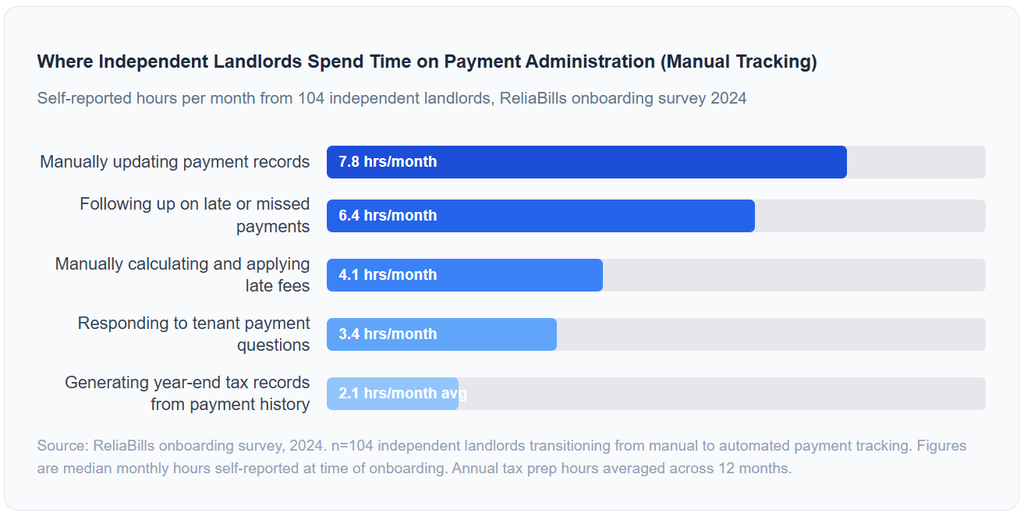
6. How many units does a landlord need before manual payment tracking becomes unsustainable?
The practical tipping point is around 8 to 12 units for independent landlords tracking payments manually. Below that number, manual tracking is inconvenient but usually manageable if done consistently. Above it, the combination of monthly data entry across multiple units, late fee calculation, automated reminder replacement, NSF follow-up, and year-end tax record production creates enough overhead to justify dedicated software. For property managers handling units across multiple owner accounts, manual tracking is not viable at any scale because the liability from record gaps and inconsistent late fee application outweighs any savings from avoiding software costs.
Recent Articles:
- 10 Signs Your Business Needs to Switch to Automated Billing Software
- Installment Billing for Large Digital Marketing Campaigns and Retainers