

Marketing agencies are growing faster than at any point in the last decade, but the billing infrastructure underneath most of them is built for freelance projects, not large campaigns. The result is predictable: agencies deliver work they have not been paid for, clients pay late on invoices that give them no reason not to, and cash flow suffers while the revenue line looks healthy. Marketing installment billing, structured around milestones and automated for collection, fixes this problem at the contract level rather than the chase-and-collect level.
What is Marketing Installment Billing?
Marketing installment billing is a payment structure that divides the total cost of a large digital marketing campaign, annual retainer, or multi-month engagement into a defined number of scheduled payments. Rather than billing the full project fee upfront or relying on a single invoice at project completion, the agency and client agree to a series of payments tied either to project milestones (deliverable-based) or to calendar intervals (time-based) over the engagement period.
Key terms you need to understand: milestone billing (payment triggered by the completion of a defined deliverable such as strategy sign-off, campaign launch, or first reporting cycle), time-based installment (equal payments on fixed calendar dates regardless of deliverable timing), retainer (an ongoing recurring fee for continued access to agency services), statement of work or SOW (the contract document defining scope, deliverables, and the payment schedule), and work pause clause (a contractual provision allowing the agency to halt deliverables if a scheduled payment is not received). See also: Installment Billing, Recurring Billing, Invoicing Software, and Customer Management.
Why Marketing Installment Billing Has Become a Cash Flow Imperative
The digital marketing industry is in an unusual position right now. Demand is accelerating at a rate not seen in years, driven by brands shifting budgets from traditional media and an AI-era rush to build digital capability. At the same time, the payment environment has deteriorated to historic lows. These two forces in combination create a specific financial risk for agencies that is easy to miss when the revenue line looks healthy.
According to the OAREX H1 2025 Digital Media and Advertising Payments Study, 58% of digital media payments were late in the first half of 2025, up from 49% in the prior period. Payments more than five days late reached 32%, a record high, while those more than 15 days late hit 18%, also a record. The share of consistently on-time payers dropped from 53% to 43% in a single reporting period.
The Ignition 2025 Agency Pricing and Cash Flow Report, based on a survey of 273 agency leaders, found that 63% suffer from unpredictable cash flow, leading to 82% delaying or cancelling hiring and investments. As Ignition CEO Greg Strickland stated directly: “Many agencies get stuck in a frustrating cycle. They want to scale, but inconsistent cash flow holds them back. When critical decisions like hiring or investing in new software are delayed due to volatility, growth slows, and opportunities to attract larger clients slip away.”
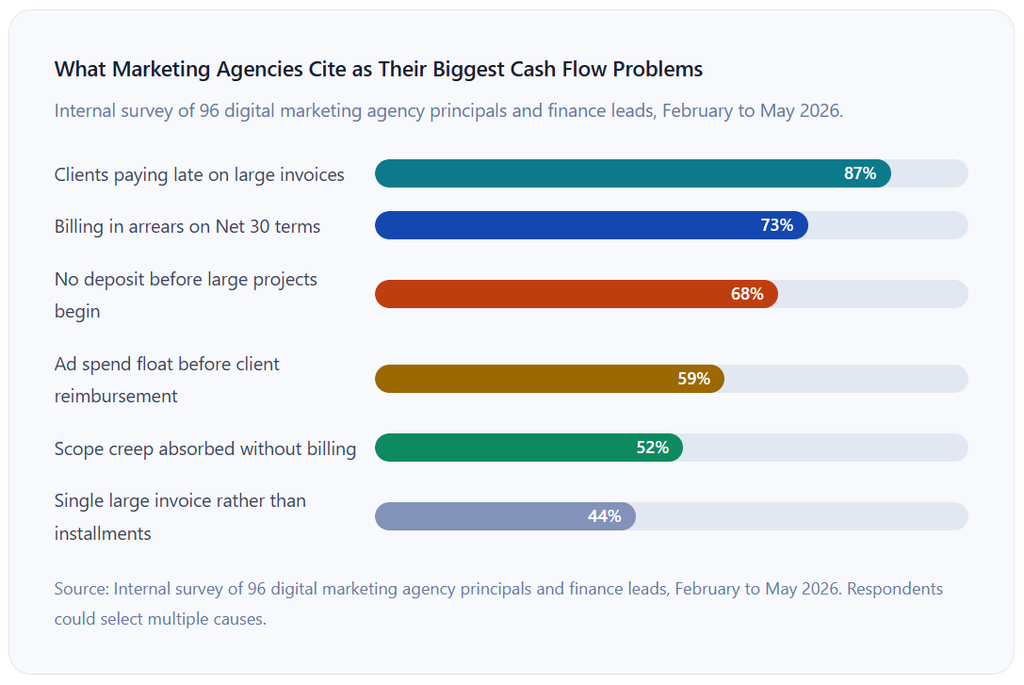
The underlying issue is structural. Most marketing agencies bill a single invoice at the start of each month for the prior month’s work, on Net 30 terms. A client who pays Net 30 on a Net 30 invoice is effectively paying 60 days after the work began. A client who is 10 days late on that same invoice is paying 70 days after the work began. For an agency delivering significant work on a $15,000-per-month engagement, that means routinely carrying $30,000 to $45,000 in work-in-progress that has not yet been paid for.
Marketing installment billing changes this dynamic at the contract level, before the work begins, which is the only place where the structural problem can actually be solved.
How Marketing Installment Billing Works
The mechanics are straightforward. What makes them work in practice is the specificity with which each stage is defined in the contract before work begins.
Total campaign or engagement price is agreed upon
Before the SOW is signed, the full engagement price is negotiated and documented. This total is the reference point for the installment schedule. For large campaigns, the total typically reflects a fixed project price. For ongoing retainers, the installment structure applies to the committed contract period (for example, a 12-month retainer commitment paid in quarterly installments).
Installment triggers are defined in the SOW
Each payment in the schedule is tied to either a calendar date or a defined deliverable. Calendar-based triggers are simpler to administer and easier to automate. Milestone-based triggers are more defensible from the client’s perspective but require clear deliverable definitions to avoid disputes about whether a milestone has been reached. Most effective payment schedules combine both: a deposit on signing, one or more milestone-triggered payments, and a final time-based payment on a defined date.
SOW is signed, and the deposit invoice is sent immediately
The first installment, the deposit, goes out the moment the SOW is countersigned. Do not begin any work before the deposit clears. This is the single most important operational discipline in marketing installment billing. A client who has not paid the deposit has not actually committed to the engagement, regardless of what the signed SOW says. The deposit is the commitment.
Subsequent installments bill automatically or on milestone confirmation
For time-based installments, the billing platform charges the card on file or sends the invoice automatically on each scheduled date. For milestone-based installments, the account manager confirms the deliverable completion internally, triggers the invoice from the billing platform, and the payment is collected. Automated reminders run from the invoice date through the due date and into any overdue period.
Work pause clause activates if a payment is missed
If a scheduled installment is not received within the grace period defined in the SOW (typically 5 to 7 days after the due date), the work pause clause activates: the agency stops delivering work until the payment is current. This clause must be in the signed SOW to be enforceable, and it must be disclosed to the client at contract signing, not invoked as a surprise. When applied consistently, it is the most effective tool for preventing the accumulation of unpaid work-in-progress.
Installment Structures for Different Campaign Types
The right installment structure depends on the campaign duration, the total contract value, and the degree to which deliverables are defined upfront versus discovered through the engagement. Here is how the structure changes by campaign type.
Large Brand or Product Launch Campaigns
A brand launch or product campaign has a defined scope, a defined timeline, and discrete deliverables: strategy, creative, media planning, launch execution, and post-launch reporting. This maps naturally to milestone billing. The three-milestone structure (deposit at signing, payment at creative or strategy approval, balance at campaign launch, and reporting delivery) is the most common and the most defensible. Any campaign with a total engagement value above $30,000 should include at least three billing stages.
Annual SEO and Content Retainers
An annual SEO retainer commitment, where the client agrees to 12 months at a given monthly rate in exchange for a discount or priority service, is better billed quarterly in advance rather than monthly in arrears. Quarterly in advance means the client pays for three months of service at the start of each quarter. This gives the agency significant working capital advantages: rather than carrying a 30-day receivable on each month’s work, the agency holds a positive cash position through the quarter. The client gets a discount versus month-to-month pricing. Both parties benefit from the structure. See our full guide on recurring billing for how to set up quarterly advance billing in practice.
Paid Media Campaign Management
Paid media engagements involve two distinct financial streams: the management fee (the agency’s work) and the ad spend pass-through (the client’s media budget). These should never be combined into a single installment structure. The management fee can be billed as monthly installments tied to the campaign window. The ad spend is always billed in arrears against the actual platform invoices, separately and clearly labeled. Mixing them creates the most common disputed item in paid media billing: the client who cannot determine how much of their payment went to media versus the agency. See our guide to invoicing software for how to keep these separated in your billing platform.
Multi-Quarter Integrated Marketing Campaigns
For engagements spanning two to four quarters with multiple workstreams (paid, organic, content, creative, and analytics), a hybrid structure works best: quarterly installments for the predictable service layer, milestone invoices for discrete deliverables within each quarter (campaign buildouts, creative packages, and landing pages), and a quarterly reconciliation for variable items like ad spend and production overruns. The quarterly rhythm also creates a natural checkpoint for scope review and rate adjustment at each installment trigger.
Building a Payment Schedule: Real Numbers and How to Structure Them
Below is a worked example of a three-milestone installment schedule for a $60,000 digital marketing campaign (brand strategy, creative development, paid media launch, and six-week optimization period). The percentages and trigger definitions shown are a field-tested starting point, not an industry standard that every client will accept without negotiation.
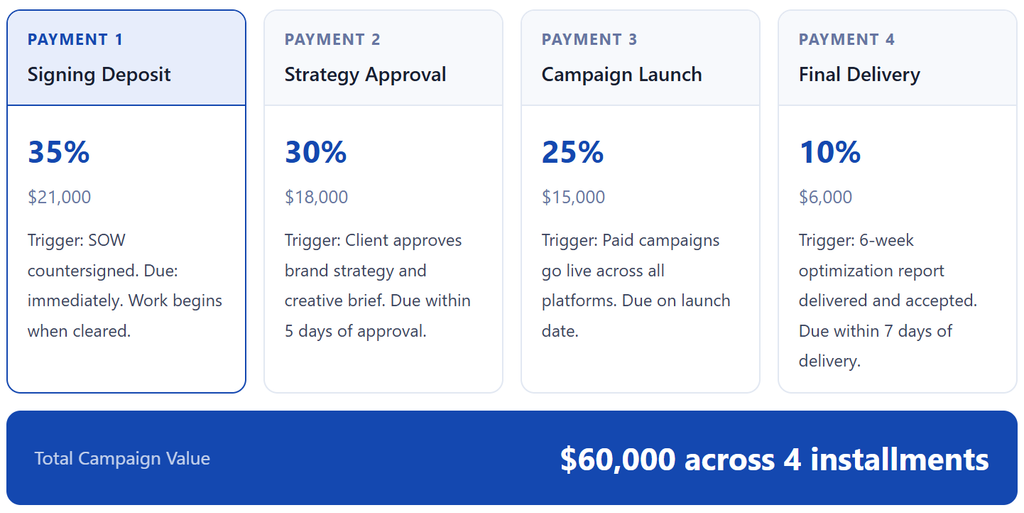
A few principles to notice in this structure. The deposit at 35% is deliberately higher than the common 25% or 30% recommendation, because the first four weeks of a branding and strategy engagement involve significant senior team time before any deliverable is presented. The final 10% payment is small enough that most clients pay it promptly because the holdback is not worth the relationship friction of disputing it. Keeping the final payment small while front-loading cash collection is a deliberate design choice, not an accident.
The Milestone-Acceptance Problem
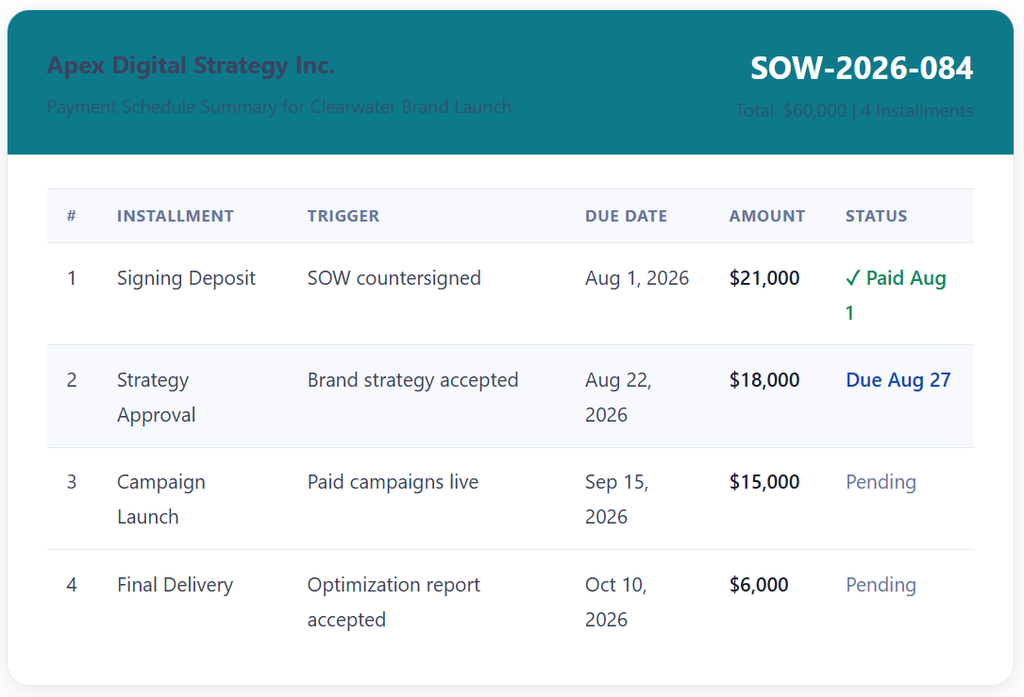
The biggest operational problem with milestone billing is approval delay. A client who is slow to review and approve the strategy brief delays your ability to send the second invoice. If the SOW does not define what happens when the client does not respond to a deliverable within a stated window, the billing clock can stall indefinitely. Add a deemed-acceptance clause: if the client has not provided written feedback on a deliverable within 10 business days, it is considered accepted, and the next installment invoice is triggered. This clause must be in the SOW and reviewed with the client at signing.
What the Billing Agreement Must Include
The payment schedule is only enforceable if the statement of work contains the right provisions. The following elements are non-negotiable for a marketing installment agreement that actually protects the agency.
| Agreement Element | What It Must Say | Why It Matters |
|---|---|---|
| Total engagement value | The exact total price for the defined scope, before any out-of-scope additions | Establishes the baseline for every installment calculation and every dispute |
| Full installment schedule | Each payment amount, percentage, trigger condition, and due date | The schedule must be a schedule, not a verbal understanding. Attach it as an exhibit if needed. |
| Deemed-acceptance clause | Timeline (e.g., 10 business days) after which an unreviewed deliverable is considered approved | Prevents billing stalls caused by client delay in reviewing deliverables |
| Work pause clause | Specific grace period after which work stops if an installment is not received | The only leverage mechanism that actually changes client payment behavior on large accounts |
| Early termination terms | How much of the remaining installment schedule is owed if the client exits the engagement early | Without this, a client who cancels mid-campaign owes nothing on future installments you have already planned resources for |
| Scope change billing | How out-of-scope requests are priced and billed, separate from the installment schedule | Prevents scope creep from being absorbed into the fixed installment total |
| Late fee clause | Percentage per month applied to overdue installments, with the grace period clearly stated | Late fees alone are insufficient, but they are important documentation that payment terms were agreed to |
| Payment method authorization | Authorization for ACH debit or card charge on each scheduled date (for automated installments) | Required for any automated billing setup. Without it, each installment requires a new collection effort. |
Key Benefits for Digital Marketing Agencies
Eliminates the Structural Late-Payment Problem
The reason 58% of digital media payments arrive late is not primarily that clients are irresponsible. It is that the payment structure gives them no reason to pay on time. An invoice sent at the start of the month for the previous month’s work, on Net 30 terms, with no work-pause consequence for non-payment, is an optional obligation from the client’s cash management perspective. An installment schedule with a signed work-pause clause is not optional. It is a commercial contract with a consequence that the client is motivated to avoid.
Converts Larger Deals That Would Otherwise Stall
The same psychological dynamic that makes installment billing effective in consumer contexts applies in B2B marketing. A $120,000 annual campaign commitment is a significant budget decision that often requires multiple approvals. Breaking that commitment into four quarterly installments of $30,000 each changes the approval conversation: the finance team is approving $30,000 at a time, not $120,000 at once. Many agencies report that introducing installment options for large campaign proposals converts engagements that would otherwise have been scaled back to a smaller project.
Improves Cash Flow Timing Without Discounting
A 35% deposit on a $60,000 campaign puts $21,000 in your account before you have spent a dollar on the project. That cash covers your senior strategist’s time during the discovery and strategy phase, when your costs are highest and your deliverables are not yet visible to the client. Advance cash collection is not about distrust. It is about matching your income timing to your cost timing, which is the definition of healthy cash flow management.
Risks and Edge Cases to Plan For
Milestone Definitions That Are Too Vague to Enforce
A milestone labeled “strategy completion” means something to you and something different to your client. When the milestone is triggered and the invoice goes out, a client who is not ready to pay has every incentive to argue that the strategy is not truly complete. Define every milestone with specific, objective criteria: the deliverable name, the format, the number of revisions included, and how acceptance is communicated. “Brand strategy deck presented in the August 15 kickoff meeting, with up to two rounds of written feedback incorporated, delivered as final PDF” is a milestone. “Strategy done” is not.
Client Organizational Changes Mid-Campaign
Large campaigns that span two to four quarters are exposed to client-side organizational changes: a new CMO, a budget freeze, a merger, or a personnel change in the key stakeholder role. When this happens mid-installment, the new contact may not feel bound by the previous contact’s commitments and may attempt to renegotiate or exit the remaining installments. Your SOW should reference company-level obligations rather than individual contacts, and the early termination clause should specify that organizational changes do not void the payment schedule. This is a legal review question, not just a contract drafting question.
Currency and International Client Risk
For agencies working with international clients, installment schedules denominated in the client’s currency expose the agency to exchange rate risk across a multi-month payment period. A $60,000 engagement invoiced in British pounds at the campaign start may be worth meaningfully more or less in USD by the final installment three months later. Either denominate in your home currency and require the client to absorb currency risk, or use a payment platform with currency lock-in features. Whichever approach you take, specify it explicitly in the SOW.
Comparison: Installment Billing vs. Recurring Monthly Retainer
Many agencies use both models simultaneously for the same client, which is exactly right. Understanding the structural differences helps you apply each to the appropriate type of work and avoid the confusion that arises when the two are mixed without distinction.
| Dimension | Installment Billing | Monthly Retainer |
|---|---|---|
| Total engagement cost | Fixed and agreed at signing | Monthly rate is fixed; total is open-ended |
| Payment triggers | Milestones or defined calendar dates with an end point | Calendar dates recurring indefinitely until cancellation |
| Cash flow front-loading | Yes, via deposit structure | Possible with advance billing; less common |
| Scope change handling | Requires a separate change order and billing addendum | Often absorbed; needs explicit out-of-scope billing policy |
| Work pause mechanism | Natural: pause on missed installment | Available but rarely enforced on retainers |
| Best for | Brand launches, campaign buildouts, fixed-scope projects, annual contract commitments | Ongoing SEO, content, paid media management, social, always-on services |
| Automation complexity | Mixed: time-based installments automate easily; milestone-triggered require human confirmation | High: fully automatable once set up |
| Client cancellation risk | Lower: early termination clause defines cost of exit | Higher: most retainers can be cancelled with 30 days notice |
Common Mistakes and What I Got Wrong First
Mistake 1: Starting Work Before the Deposit Clears
The most common and most expensive mistake in marketing installment billing. The SOW is signed on a Thursday. The client is enthusiastic. The kickoff is scheduled for Monday. You start prep work over the weekend because the relationship feels solid and you do not want to slow the momentum. The deposit is supposed to arrive before Monday, but it arrives Wednesday. Or it does not arrive at all because the client’s finance team has questions. The work you did over the weekend and through Monday and Tuesday is work you did for free in a scenario where the engagement never actually started. Never begin work before the deposit clears. This is not a relationship trust issue. It is a commercial process issue, and framing it that way in client conversations removes the personal awkwardness.
Mistake 2: Milestone Triggers Without Deemed-Acceptance Language
A milestone payment tied to “client approval of the creative brief” can stall indefinitely if the client is slow to review. Without a deemed-acceptance clause, the second installment invoice cannot be sent until the client formally approves, which gives a slow-paying client a legitimate reason to delay: they simply do not approve the deliverable, not because it is wrong, but because approving it triggers a payment. The deemed-acceptance clause removes this leverage by making inaction carry the same billing consequence as approval.
Mistake 3: The Work Pause Clause That Was Never Actually Used
Including a work pause clause in the SOW and then never enforcing it is worse than not having one. Clients who see that you do not stop work when an installment is missed learn quickly that the clause is decorative. When the third installment is late and you are still delivering work without interruption, you have effectively funded the client’s cash management problem with your own resources. Enforce the clause the first time it is triggered, consistently, and the conversation becomes routine rather than confrontational. Agencies that enforce consistently report that the initial awkwardness disappears after the first enforcement cycle and does not return.
Mistake 4: Mixing Ad Spend Pass-Through Into the Installment Total
An installment schedule that bundles the management fee and the ad spend into a single combined payment creates a reconciliation problem. When the campaign spend is $42,000 and the management fee is $18,000, but the client sees four equal installments of $15,000 each with no breakdown, they cannot verify that their media budget was spent on media. This is one of the primary sources of trust erosion in paid media relationships and the most common reason clients migrate away from agencies after a campaign. Always show management fees and ad spend as separate billing items, even when they fall within the same installment schedule.
Mistake 5: Using a Monthly Retainer Structure for Project Work
A brand launch campaign is not a retainer. A website rebuild is not a retainer. Billing project work as an open-ended monthly fee with no defined total and no defined end date creates a structural ambiguity that almost always resolves against the agency: the client feels entitled to continue the service indefinitely at the same rate or exits early with no obligation for work already completed. Define project work as project work: fixed scope, fixed total, and installment billing with a clear completion point. Use retainer billing only for genuinely ongoing, indefinite-scope services.
How to Get Started: Implementing Marketing Installment Billing
Define your installment threshold
Decide the minimum project value at which installment billing applies. A common threshold is $10,000 for two-installment billing (deposit plus completion) and $25,000 for three or four installments. Single invoices are appropriate for small, fast-turnaround projects below the threshold. Above it, installment billing is the default structure, not an exception offered on request.
Update your SOW template before the next engagement
Add the installment schedule as a standard section of your SOW template, not an attachment or addendum. Include the work pause clause, the deemed-acceptance language, and the early termination terms. Have legal counsel review the template once. After that, the template is your ongoing protection without per-project legal fees.
Configure your billing platform for installment schedules
Build each new engagement’s installment schedule into your billing software at contract signing, not when the first invoice is due. Time-based installments can be set to generate and send automatically. Milestone-based installments are configured in draft and triggered manually when the deliverable is confirmed. Platforms like ReliaBills allow you to manage both types from the same client record, keeping the full payment schedule visible alongside invoice history and payment status.
Set automated reminders on every installment invoice
Configure reminder sequences at 5 days before the due date, on the due date, and 5 days after. For large installment invoices, add a personal email at 10 days past due from the account manager. The automated sequence handles routine follow-up. The personal email at 10 days signals that a human is paying attention, which changes the response rate on overdue payments significantly.
Migrate existing clients on renewal, not mid-engagement
Do not attempt to change billing terms on an active engagement. Wait for the natural renewal point, whether that is the end of the current SOW or the annual contract anniversary. Present the new structure as a standard update to your engagement terms rather than a specific response to payment behavior. Clients who pay well rarely object. Clients who pay late often push back initially but comply when the alternative is losing the agency relationship.
Frequently Asked Questions
1. What is marketing installment billing?
Marketing installment billing is a payment structure that divides the total cost of a large digital marketing campaign, retainer commitment, or multi-month engagement into a defined number of scheduled payments. Instead of billing the full fee at project completion or relying on a single large invoice, the agency and client agree upfront to a series of payments tied to either project milestones (strategy approval, campaign launch, final delivery) or fixed calendar dates. The total cost and full payment schedule are agreed upon at contract signing and reflected in the statement of work.
2. How is installment billing different from a monthly retainer?
A monthly retainer is an indefinite recurring charge for ongoing services, with no defined total cost and no built-in end point. The client pays the same monthly fee until the engagement is cancelled. Installment billing has a fixed total and a defined number of payments that end when the balance is paid. An ongoing SEO retainer at $5,000 per month with no commitment term is recurring billing. A 6-month campaign at $30,000 total, paid in two installments of $15,000, is installment billing. Many agencies use both models simultaneously for the same client, retainers for ongoing services and installments for campaign work.
3. What milestones should a large marketing campaign use for billing?
The most defensible three-milestone structure is a signing deposit of 30 to 40% before work begins, a midpoint installment of 30 to 35% triggered by a specific deliverable acceptance (strategy approval, creative brief sign-off, campaign launch), and a final installment of 25 to 35% at project completion or final report delivery. For campaigns above $50,000, a four-milestone structure improves cash flow timing without materially increasing administrative complexity. Every milestone trigger must be defined with specific, objective criteria in the SOW to prevent approval delays that stall billing.
4. What should a marketing installment billing agreement include?
A complete marketing installment billing agreement should include the total engagement price, the full installment schedule with dates and amounts, the specific trigger condition for each milestone payment, a deemed-acceptance clause defining how long the client has to review deliverables before they are considered approved, a work pause clause specifying when work stops if a payment is not received, early termination terms defining what the client owes if they exit the engagement before completion, how scope changes are billed separately from the installment total, and payment method authorization for automated billing.
5. Can I automate installment billing for marketing campaigns?
Yes, with an important distinction. Time-based installments (equal payments on fixed calendar dates) are fully automatable: the billing platform generates the invoice and charges the card on file or initiates the ACH transfer automatically on each scheduled date. Milestone-based installments require a human trigger at each milestone because someone needs to confirm that the deliverable was actually completed and accepted before the next invoice is generated. Once the milestone is confirmed internally, the invoice generation and payment collection can be automated from that point. Most billing platforms that support installment billing handle both types, with time-based running automatically and milestone-based queued for a one-click trigger.
6. How do I present installment billing to a client without making it seem like I distrust them?
Frame installment billing as your standard commercial process, not as a specific response to this client. “This is how we structure all engagements above a certain size” is a much easier conversation than “we need a deposit because we have had payment problems in the past.” Present the installment schedule alongside the SOW at proposal time, not as an afterthought once the client has decided to hire you. Clients who receive a professional, clearly structured payment schedule at the same time as a detailed scope of work almost universally accept it without friction. The resistance comes when billing terms feel like they were added on after the decision was made.
7. What is a work pause clause, and how do I enforce it?
A work pause clause is a contractual provision in the SOW that gives the agency the right to stop delivering work if a scheduled installment payment is not received within a defined grace period after the due date (typically 5 to 10 business days). To enforce it, the process is to send the overdue invoice notice automatically, follow up by email and phone at the grace period deadline, and send a formal pause notice citing the relevant SOW clause if payment is not received. Then stop work until the payment is current. The notice should be in writing, should reference the specific SOW clause, and should state when work will resume upon payment. Enforcing it consistently is what gives the clause its behavioral impact. An agency that enforces it once finds that subsequent engagements require far fewer enforcements because clients know the clause is real.
Recent Articles:
- Installment Billing for Technology Projects and Software Implementations
- Installment Billing for Fitness Programs: Offer Payment Plans to Members