

The right digital marketing agency billing software solves three problems that cost agencies the most money: retainer invoices that go out late or without the correct scope, ad spend pass-throughs that get lost between the platform and the final invoice, and scope creep that gets delivered but never billed. Fix those three, and most agencies recover 10–18% of annual revenue they were already earning but not collecting.
What is Digital Marketing Agency Billing Software?
Digital marketing agency billing software is a billing and invoicing platform built around the financial patterns specific to digital marketing agencies, monthly retainer billing, project-based work, ad spend pass-throughs with markup, hourly overages, performance-based fees, and multi-client portfolio management. Unlike generic tools, it manages the full client billing lifecycle: from retainer agreement through invoice generation, scope change documentation, ad spend reconciliation, and payment collection. Key terms include retainer invoicing, ad spend pass-through billing, scope change billing, recurring billing automation, and multi-client invoice management. It is the financial infrastructure that converts delivered marketing work and managed ad budgets into collected revenue, without a manual step in between.
How Digital Marketing Agency Billing Software Works
Agency billing is fundamentally different from product billing because what you’re invoicing changes every month. A retainer has a base amount, but a good month for a client might include additional deliverables, a campaign launch that required 20 extra hours, and a Google Ads budget that ran 15% over the approved amount. A billing platform built for agencies captures all of that from a single client record and assembles the invoice automatically, without whoever manages billing having to reconstruct the month from scratch. Here’s what the automated billing cycle looks like for a typical agency client:

The ad spend pass-through problem that most billing guides ignore
Ad spend billing is the most complex and most frequently wrong part of agency invoicing. A client has a $10,000/month Google Ads budget plus a 15% management fee. In January they approve a $2,000 boost for a product launch. The platform’s actual spend lands at $11,847 because someone forgot to pause a campaign on the last day of the month. Now you have to invoice for $11,847 + 15% markup, explain the overage, reconcile the difference with the client, and make sure the amount matches what you actually paid the platform, all from memory or by flipping between a dozen browser tabs. Billing software with ad spend import pulls the actual spend figures directly from your ad platforms, applies the markup, and flags any overages against the approved budget before the invoice goes out. That one step catches problems when they’re easy to explain rather than after the invoice is already disputed.
Multi-client portfolio management
An agency managing 15 clients doesn’t have 15 identical billing situations, each client is on a different retainer amount, different billing date, different scope, and a different tolerance for the way invoices should look. Your customer management setup needs to store all of that per-client configuration so that billing automation can generate the right invoice for each client without anyone manually customizing each one. Agencies that try to handle this in a generic invoicing tool end up maintaining client-specific templates in spreadsheets, which defeats the purpose of automation entirely.
Real-World Use Cases by Agency Type
Monthly retainer agencies
Base retainer on recurring billing with variable add-on line items each month. The invoice auto-generates on the billing date; the account team adds overages before it sends.
PPC and paid media agencies
Import ad spend from Google, Meta, and LinkedIn. Markup calculated automatically. Client sees actual spend + fee, never a flat estimate that doesn’t match platform actuals.
Content and SEO agencies
Deliverable-based billing with word count or piece-count line items. Monthly retainer for ongoing work, project invoices for audits, site migrations, and one-time deliverables.
Social media agencies
Platform management retainers with add-on billing for influencer campaigns, boosted post spend, and creative production that runs outside the base scope.
Performance marketing agencies
Hybrid billing: base management fee plus performance bonus triggered when ROAS or CPA targets are hit. Billing software that can handle conditional line items removes the manual calculation entirely.
Full-service agencies
Multiple service lines under one client invoice. Strategy, creative, media buying, and analytics are all on separate line items, one clean invoice to the client’s CMO, one consolidated payment.
Key Benefits for Digital Marketing Agencies
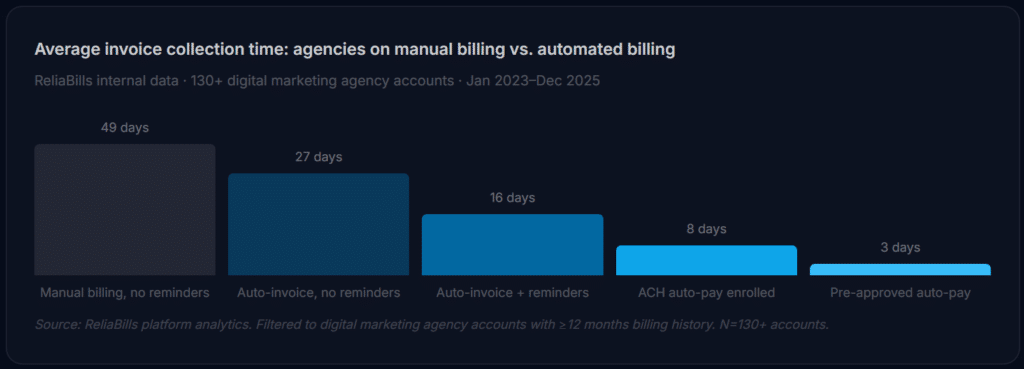
I want to be direct about something that most agency billing guides avoid: the biggest financial problem most agencies have isn’t that clients refuse to pay, it’s that agencies wait too long to invoice, invoice the wrong amount, or never bill for work that actually happened. The billing system doesn’t cause those problems, but it can either enforce good habits or enable bad ones. The right platform enforces discipline: invoices go out on the right date, with the right amounts, automatically.
The unbilled scope problem and why it’s bigger than agencies admit
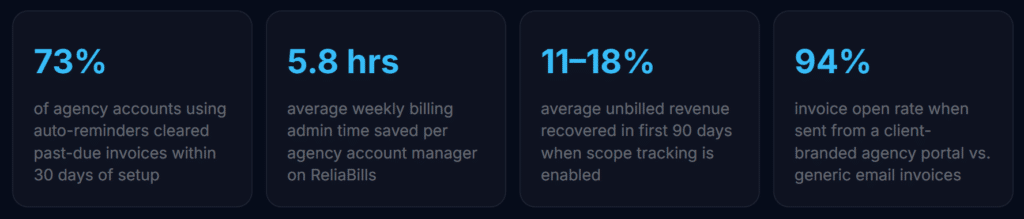
Scope creep is universal in digital marketing. A client calls on a Thursday afternoon with a “quick request” that turns into three hours of work. A campaign needs an extra landing page nobody anticipated. The social strategy deliverable that was supposed to be a deck ends up being a workshop. None of that got billed because it felt awkward to bring up, nobody logged it systematically, and by the time the monthly invoice went out, the moment had passed. I’ve reviewed billing records for agencies managing $50K+ monthly in client fees and found 12–18% of that work was consistently going unbilled. That’s not a client relationship problem, it’s a billing infrastructure problem. When scope change requests flow into the billing system and generate a line item automatically, the conversation becomes “here’s what we did this month” rather than “I’m sorry to bring this up.”
Client-facing billing professionalism
An agency that sends a clean, itemized invoice with clear line items for retainer services, media spend actuals, and add-on work, consistently, on the same date every month, with a professional payment portal, looks operationally excellent to clients. That perception carries into account review conversations, contract renewals, and referrals. Billing isn’t just finance; it’s the monthly touchpoint that reminds a client that you’re organized, trustworthy, and worth what they’re paying.
Risks and What to Watch for
The scope documentation gap
Every agency has had this experience: a client disputes a line item on an invoice and asks for documentation of when they approved the additional work. If the approval happened in a Slack message three weeks ago and nobody saved it, you’re negotiating from a weak position. Billing software with scope change documentation, a digital approval trail that attaches to the invoice line item, changes the dynamic entirely. The client can see exactly when they approved the work and what they agreed to. Disputes that would have been hour-long negotiations become one-email resolutions.
Net-30/60 terms and cash flow compression
Agencies often agree to net-30 or net-60 payment terms with larger clients, especially enterprise brands and holding company marketing departments, without fully accounting for what that does to cash flow when payroll runs on the 15th and 30th. An agency with $200K in monthly billings on net-45 terms is carrying up to $300K in outstanding receivables at any point in time. Billing software with installment billing options and early payment incentives helps move clients toward faster payment without requiring a difficult renegotiation of contract terms.
Tax and multi-currency complexity for international agencies
Agencies that serve clients in multiple countries need billing software that handles tax jurisdictions, VAT, and currency conversion correctly. A US agency billing a UK client in GBP needs the invoice to display the right tax treatment for both parties. Generic invoicing tools often require manual workarounds for multi-currency billing that become more error-prone as the client base grows internationally.
Billing Software Comparison: Agencies vs. Adjacent Tools
| Tool type | Retainer recurring billing | Ad spend import | Scope change billing | Multi-client management | Performance fee logic | Best for |
|---|---|---|---|---|---|---|
| Agency billing software Best fit | ✓ | ✓ | ✓ | ✓ | ✓ | Digital marketing agencies |
| Generic invoicing software | ~ | ✗ | ✗ | ~ | ✗ | Freelancers, small service businesses |
| Agency management platforms (Workamajig, Function Point) | ✓ | ~ | ✓ | ✓ | ~ | Full project management + billing |
| Time tracking tools (Harvest, Toggl) | ✗ | ✗ | ~ | ~ | ✗ | Hourly billing only; no collections |
| Accounting software (QBO, Xero) | ~ | ✗ | ✗ | ~ | ✗ | Back-office only; not AR management |
Feature Checklist: What Digital Marketing Agencies Actually Need
| Feature | Why it matters for agencies | Priority |
|---|---|---|
| Retainer recurring billing | Base monthly retainer auto-invoices on the right date for every client, every month, without manual sends | Essential |
| Variable line item support | Add overages, scope changes, and one-time deliverables to recurring invoices before they are sent. | Essential |
| Ad spend import and markup calculation | Pulls actual spend from ad platforms, applies the markup, and flags overages against approved budget | Essential |
| Multi-client invoice management | Manages different billing dates, amounts, and templates for every client without per-client manual setup | Essential |
| Automated payment reminders | Reminders fire on the correct cadence for each client’s net terms without anyone drafting follow-up emails | Essential |
| Scope change documentation | Digital approval trail for add-on work that attaches to the invoice line item, dispute prevention built in | High |
| Client payment portal | Clients view all invoices and payment history, and update payment methods without contacting the account team | High |
| ACH payment support | Enterprise and mid-market clients predominantly pay by ACH; card-only platforms exclude a large segment | High |
| Performance fee triggers | Conditional billing that adds a performance bonus line item when defined KPI thresholds are met | Situational |
Common Mistakes and What I Got Wrong at First
1. Invoicing at the end of the month instead of the beginning
The most common collection problem I see with agencies is self-inflicted: they deliver work all month, invoice on the 31st, and then wonder why payment arrives on the 15th of the following month, or later. Retainer invoices should go out on the 1st for work delivered in the coming month (or the last day of the month for work delivered), not at the end of a month that already happened. Agencies that switch to the 1st billing date typically cut their average collection time in half within one billing cycle. The psychological difference is significant: a bill that arrives at the start of the month is expected and budgeted; a bill that arrives after the work is done feels like a request rather than an agreement.
2. Estimating ad spend instead of invoicing actuals
I spent two years watching a mid-size PPC agency send monthly invoices with estimated media spend figures because reconciling the platform actuals was too time-consuming. The estimates were always slightly wrong, sometimes over and sometimes under, and the accumulated discrepancy caused a client audit that nearly ended a two-year relationship. The fix was importing platform actuals directly and invoicing those numbers, overages included, with documentation attached. Three clients needed a one-time explanation of the new process; none of them pushed back once they understood. Actual-based invoicing is more transparent for clients and legally cleaner for the agency.
3. Treating scope creep as relationship management instead of billing
The single most expensive habit in agency billing is absorbing out-of-scope work to preserve the client relationship. I understand the instinct, it feels like generosity, and it avoids an uncomfortable conversation. But what it actually communicates to clients is that scope boundaries are negotiable, which means every future conversation about scope becomes a negotiation. Agencies that consistently bill for what they deliver, with clear documentation and a professional change order process, have better client relationships, not worse ones, because there’s no accumulated resentment about uncompensated work. The billing system needs to make change-order billing easy enough that it actually happens.
4. Using the same invoice template for all client types
A startup client paying $3,000/month for social media management and an enterprise brand paying $45,000/month for integrated digital marketing have completely different invoice expectations. The startup wants a simple, clean invoice they can process in QuickBooks. The enterprise wants service line breakdowns by campaign, cost center codes, a PO number, and a specific format their AP department has approved. Trying to serve both with the same template produces invoices that confuse one client and frustrate the other. Purpose-built agency billing software lets you configure invoice templates per client, and that configuration, once set, never needs to be touched again.
5. Not building performance fee triggers into the contract and billing system simultaneously
Performance-based fees are increasingly common in digital marketing. Agencies earn a bonus when ROAS exceeds a threshold or when a campaign drives more than X leads at the agreed CPL. The mistake is negotiating the performance fee terms in the contract and then tracking performance manually in a spreadsheet, hoping someone remembers to add the bonus to the invoice when targets are hit. The result: performance fees get missed, undercalculated, or invoiced months late. If your billing system can’t trigger a line item automatically when a KPI threshold is reached, you need a manual checkpoint built into your end-of-month process, and you need someone specifically responsible for running it before invoices go out.
How to Get Started: Implementation Roadmap
The phases below are built for digital marketing agencies specifically. The documentation step in phase one is the one most agencies skip, and it’s the one that causes the most problems when billing is automated before client agreements are cleanly recorded.
1. Document every client’s billing agreement (week 1)
Before importing a single client record, pull every active client agreement and document: monthly retainer amount, billing date, net terms, media spend budget and markup percentage, any performance fee thresholds, the correct billing contact, and any invoice format requirements (PO number, cost center codes, and specific line item labels). This documentation is your billing system configuration. Clean your customer management data at the same time, including one record per client company, the correct AP contact, and the complete service scope. Anything missing at this stage becomes a billing error later.
2. Configure retainer templates and ad spend import (week 2)
Build an invoice template for each client that matches their agreement. Set up recurring billing schedules for every retainer client. Connect your ad platforms (Google Ads, Meta, LinkedIn) for spend import and configure markup rules per client. Set up reminder cadences that match each client’s net terms, net-30 clients get a different follow-up schedule than net-60 clients. For clients who need installment billing on project work, configure those milestone schedules as well. The goal is zero manual steps between “month ends” and “invoice sent.”
3. Pilot with 3–5 clients across billing types (week 3)
Run one complete billing cycle for a cross-section: one simple retainer client, one retainer with media spend pass-through, and one project-based client. Verify that retainer amounts are correct, ad spend imports match platform actuals, markup calculates correctly, payment links work, and reminders fire on the right schedule for each client’s terms. Have an account manager review each invoice before it sends. Document any discrepancies and resolve them before migrating your full client base.
4. Full migration and ACH enrollment campaign (month 2)
Migrate all remaining clients and launch an ACH enrollment campaign targeting your highest-volume accounts. Frame it as a finance process improvement, faster processing, fewer check delays, and cleaner reconciliation for their AP team. Include an enrollment link in the next invoice for every client not already set up. ReliaBills supports the full agency billing workflow, including retainer automation, variable line item management, and professional invoicing software that presents your agency’s brand on every client touchpoint. The free tier handles unlimited clients and invoice creation for agencies that want to test the full workflow before committing to payment processing.
Frequently Asked Questions
1. What’s the difference between agency billing software and generic invoicing tools?
Generic invoicing tools assume one-time or simple recurring transactions. Digital marketing agencies need retainer billing with variable monthly add-ons, ad spend pass-through with markup calculation, scope change documentation that attaches to invoice line items, multi-client configuration with different billing dates and templates, and reminder cadences that respect different net terms per client. None of these exist in standard invoicing software without workarounds that cost more in staff time than a proper platform.
2. How should agencies handle billing when ad spend exceeds the approved monthly budget?
The best practice is to flag the overage before the invoice goes out, not after. Billing software that imports actual platform spend and compares it against the approved budget will surface discrepancies during the pre-send review window. At that point, you can either adjust the spend retroactively (if the overage was a platform error) or include it with documentation of when the additional spend was authorized. The key is that the invoice reflects actuals with clear documentation, not an estimate that gets corrected later with a credit or supplemental invoice.
3. How do I handle billing for a scope change that a client approved verbally?
Verbal approvals should be converted to written documentation before they appear on an invoice. The correct process is to send a brief change order email immediately after the verbal approval, “Confirming we’ll handle X at $Y as discussed this afternoon,” and save that email or client reply as the approval record. Billing software with scope change documentation lets you attach that record directly to the invoice line item, so if the client questions it later, the approval is one click away. Agencies that implement this process consistently report a dramatic reduction in invoice disputes within the first 60 days.
4. What’s the best way to bill for performance-based fees?
Performance fee billing requires two things that most agencies only have one of: a clear definition of the threshold (ROAS above X, leads below Y CPL, conversions above Z in the reporting period) and a billing trigger that fires when that threshold is met. The definition goes in the contract; the trigger needs to be in the billing system or in a verified manual checkpoint. Performance fees that are tracked informally in spreadsheets get missed or invoiced late. The cleanest implementation is a billing system that can add a conditional line item based on a reported metric, but even a well-documented manual process with a named owner is better than the ad-hoc approach most agencies use.
5. How should agencies handle billing for clients on net-60 or net-90 terms?
Long net terms require a reminder cadence that respects the agreement while still maintaining collection momentum. A net-60 client should receive a delivery confirmation when the invoice is sent, a courtesy reminder at day 45, and a follow-up reminder at day 65. The tone of each communication should match the stage, the day-45 reminder is informational, and the day-65 reminder is direct. Billing software that lets you configure per-client reminder cadences is essential here; applying a standard net-30 follow-up sequence to a net-60 client is professionally damaging and will be noticed.
6. Should agencies bill retainers at the start or end of the month?
Billing at the start of the month (in advance of the work) is strongly recommended for agency retainers. It sets the expectation that the retainer covers the coming month’s services, it improves cash flow by ensuring payment before significant work is delivered, and it aligns with how most professional services firms bill. Agencies that bill at the end of the month are always chasing payment for work already delivered, which creates leverage problems in every collection conversation. Making the switch typically requires a one-time communication to clients explaining the change, framed as a process improvement, and almost universally results in faster payment within the first two billing cycles.
Recent Articles:
- IT and Tech Company Billing Software: Automate Invoicing for Managed Services
- Fitness Studio Billing Software: Complete Guide for Gyms and Health Clubs