

The right fitness studio billing software does three things your current system almost certainly doesn’t: it retries failed payments automatically before writing them off, it handles membership pauses and freezes without creating billing errors, and it separates members who are genuinely late from members whose cards expired last month. All three are fixable with one properly configured billing platform, and all three directly affect how much revenue your studio actually collects each month.
What is Fitness Studio Billing Software?
Fitness studio billing software is a membership and invoicing platform built around the billing patterns specific to gyms, yoga studios, CrossFit boxes, martial arts schools, and health clubs, monthly and annual memberships, class pack billing, personal training packages, initiation fees, membership pauses, and freeze requests. Unlike generic invoicing tools, it manages the full member payment lifecycle: from enrollment through recurring billing, failed payment recovery, membership status changes, and renewal. Key terms include recurring membership billing, recurring billing automation, dunning management, failed payment retry logic, and membership freeze handling. It is the financial engine that converts signed member agreements into collected revenue every month, automatically, without manual intervention.
How Fitness Studio Billing Software Works
The billing cycle in a fitness studio runs on a rhythm that most service businesses don’t have, monthly recurring charges across a large member base, often on different billing dates, with different membership tiers, and a steady stream of status changes (pauses, freezes, cancellations, and upgrades). A billing platform built for this industry manages all of that from a single member record. Here’s what the full automated cycle looks like:

The failed payment problem most studios underestimate
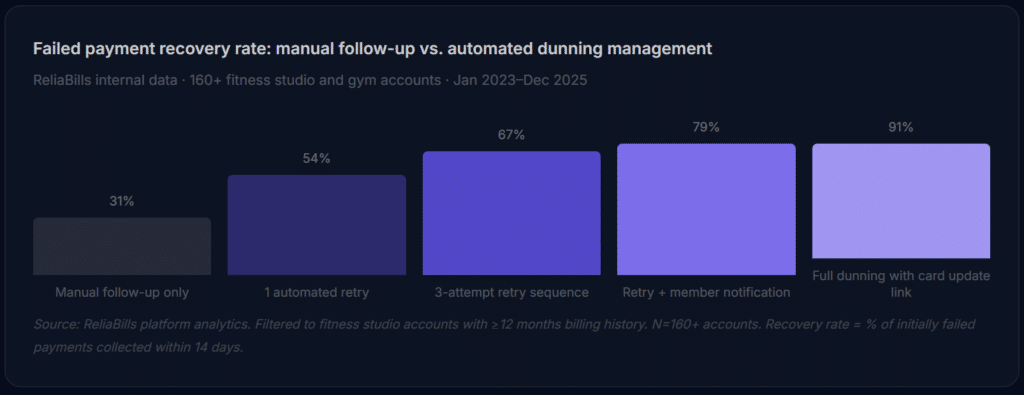
The average fitness studio with 300 active members will see 18–24 failed payments on any given billing day, including cards that expired, accounts that were overdrafted, and banks that flagged the charge as suspicious. In a manual billing process, each failed payment is a task: find the member, send an email, wait for a response, update the card, and rerun the charge. Multiply that by 20 members, and you’re looking at a half-day of administrative work every month for revenue that was already earned. Billing software with dunning management, automated retry sequences that attempt the card again at defined intervals and notify the member automatically, recovers 60–70% of failed payments without any staff involvement.
Membership freeze and pause handling
Membership pauses are one of the most administratively complex billing situations in fitness. A member pauses for two months, billing stops, and when the pause ends, the billing needs to resume at exactly the right date for exactly the right amount, prorated if the pause ended mid-cycle. Generic billing tools can’t handle this cleanly. Purpose-built fitness billing software tracks pause periods, resumes billing automatically at the end of the freeze window, and applies the correct prorated amount without anyone manually touching the member record. Your customer management data drives all of this correctly when it’s set up right.
Real-World Use Cases by Fitness Business Type
Traditional gyms and health clubs
Monthly memberships on recurring billing, multiple tiers (basic, premium, family), annual contracts with monthly installments, and initiation fee billing at sign-up.
Boutique fitness studios
Class pack billing (10, 20, or 50 classes), unlimited monthly memberships, and drop-in rates, all three models are active simultaneously for different member segments.
Yoga and Pilates studios
Intro offers (first month half-price), package billing with session tracking, and autopay memberships with freeze options for travel seasons.
Martial arts schools
Family multi-member billing under one account, belt-level membership tiers, and annual contract billing with installment billing options for upfront payment plans.
Personal training practices
Session packages tracked against prepaid balances, auto-invoicing at package depletion, and monthly retainers for clients on ongoing programming.
Corporate wellness programs
Monthly invoicing to HR or benefits departments, employee enrollment tracking, and consolidated billing across multiple employees under a single company account.
Key Benefits for Fitness Studios and Gyms
The business case for billing automation in fitness is unusually strong because the revenue is almost entirely predictable, you know exactly what every member owes each month, and the only variable is whether you actually collect it. The gap between what you’re owed and what you collect is a function of your billing system, not your member satisfaction. Studios that automate billing don’t get more members to pay; they stop losing money that members were already willing to spend.

Involuntary churn is the most underreported problem in fitness billing
When a member’s card declines and nobody follows up, the member often doesn’t notice for weeks, and by then, they’ve either moved on mentally or feel awkward about the unpaid balance. This is called involuntary churn: members who didn’t intend to cancel but ended up cancelling because the billing process failed them. Studios with poor failed payment recovery see involuntary churn rates of 8–12% annually. Studios with strong dunning automation see that number drop below 3%. The difference isn’t member satisfaction, it’s billing infrastructure.
Annual membership billing and the cash flow advantage
Annual memberships paid upfront are significantly better for cash flow than monthly billing, but they require a billing system that can offer installment billing as an alternative for members who want the annual rate without paying the full amount upfront. Studios that offer “annual pricing, monthly payments” as a configured option, where the member commits to 12 months but pays monthly, see 30–40% higher annual contract uptake compared to studios that only offer a lump-sum annual option.
Risks and What to Watch for
The mid-cycle membership change problem
A member upgrades from a basic membership to a premium tier on the 12th of the month. They already paid for the month on the 1st. What do they owe today? The prorated difference for the remaining 18 days at the premium rate. Generic billing tools can’t calculate this cleanly, they either charge the full new rate (which the member disputes), skip the upgrade charge entirely (which you eat), or require a manual calculation. Purpose-built fitness billing software handles mid-cycle upgrades, downgrades, and plan changes with automatic prorated billing that the member can see clearly on their statement.
Freeze periods that bleed into billing cycles
A member requests a 6-week freeze starting on the 20th of the month. Their billing date is the 1st. Do they get charged on the 1st (three weeks into their freeze)? Do they get a prorated refund for the 10 days of the current month they didn’t use? Does the freeze extend their annual contract by 6 weeks? These are the questions that create billing support tickets and member frustration, and they need to be answered by your billing system configuration, not by whoever happens to be at the front desk when the freeze request comes in.
Stored payment method data security
Fitness studios that store card numbers in spreadsheets, POS systems not designed for recurring billing, or software without PCI-DSS compliance are creating liability that exceeds the cost of any proper billing platform. Members who provide card numbers for auto-pay have an expectation of secure storage. PCI-DSS-compliant billing platforms with tokenized card storage handle this correctly by design, raw card numbers are never stored anywhere in your system.
Billing Software Comparison: Fitness Studios vs. Adjacent Tools
| Tool type | Recurring membership billing | Dunning and retry logic | Freeze and pause handling | Class pack tracking | Mid-cycle proration | Best for |
|---|---|---|---|---|---|---|
| Fitness studio billing software Best fit | ✓ | ✓ | ✓ | ✓ | ✓ | Gyms, studios, health clubs |
| Generic invoicing software | ~ | ✗ | ✗ | ✗ | ✗ | Freelancers, product businesses |
| Fitness industry platforms (Mindbody, Glofox, Pike13) | ✓ | ✓ | ✓ | ✓ | ✓ | Full operations platform; higher cost |
| Accounting software (QBO, Xero) | ~ | ✗ | ✗ | ✗ | ✗ | Back-office only, not AR |
| POS / payment terminal | ✗ | ✗ | ✗ | ✗ | ✗ | In-person transactions only |
Feature Checklist: What Fitness Studios Actually Need
| Feature | Why it matters for fitness studios | Priority |
|---|---|---|
| Automated recurring membership billing | Charges every member on their billing date without manual intervention, the foundation of everything else | Essential |
| Failed payment dunning sequence | Retries declined cards at defined intervals; notifies members with card update links; recovers up to 79% of failed payments | Essential |
| Membership freeze and pause handling | Stops billing during freeze, resumes automatically at the correct date with prorated amounts if needed | Essential |
| Mid-cycle proration | Handles upgrades, downgrades, and joins mid-cycle with accurate prorated charges the member can understand | Essential |
| Class pack and session tracking | Decrements sessions from prepaid packs on each visit; notifies both member and studio when packs are low | High |
| Annual contract with monthly installments | Lets members commit to annual pricing and pay monthly, increases annual contract uptake by 30–40% | High |
| Member self-service card update | Members update expired or replaced cards via a link, eliminates the most common cause of unnecessary churn | High |
| Multi-member family or corporate accounts | One billing contact, multiple members, common in family plans and corporate wellness programs | Situational |
Common Mistakes and What We Got Wrong at First
1. Turning on automation without configuring the dunning sequence first
The single most common implementation error: a studio enables recurring billing and collects payments successfully for two months, then hits a batch of card failures on month three and has no automated recovery in place. The failed payments sit until someone manually exports the AR report and starts emailing members. By then, two to three weeks have passed, and 30–40% of those members have already mentally cancelled. The Dunning configuration, the retry schedule, the member notification emails, and the card update link need to be set up before the first billing run, not after the first failure batch.
2. Not having a written freeze policy before offering freezes
Studios that offer membership freezes without a clearly documented policy, maximum freeze duration, how many per year, whether annual contracts are extended by freeze periods, and whether a freeze fee applies, end up negotiating each one individually. The billing system can only enforce rules that exist. Before enabling freeze requests in any billing platform, write the policy, add it to your membership agreement, and then configure the system to match it exactly. The policy document and the billing system configuration should say the same thing.
3. Billing every member on the 1st instead of their join date
Studios that normalize all billing to the 1st of the month create a batching problem: every failed payment, every freeze request, and every renewal conflict arrives at the same time. Members who join on the 15th also get a prorated charge for the rest of the month, then a full charge 15 days later, which confuses them and generates support tickets. Billing on the member’s actual join date, a per-member billing date, distributes the load evenly, reduces batch failures, and makes the prorated first charge logic much cleaner.
4. Treating a failed payment as a cancellation
Some studios immediately cancel access when a payment fails. The logic makes sense, don’t provide service that isn’t paid for, but the execution is brutal. A member whose card expired gets locked out of the studio before they even know there was a problem. The correct approach is a grace period: maintain access for 3–7 days while the dunning sequence runs and the member updates their card. If payment still hasn’t cleared after the grace period, then restrict access. Studios that immediately cancel access on failure see 40–60% of those members never come back, even when the payment issue was resolved. Studios that use a grace period recover over 70% of those members.
5. Offering intro pricing without a clear transition billing plan
First-month-free and half-price intro offers are effective acquisition tools. They also create the most common billing surprise in fitness: the member who loved the studio for their $29 intro month is shocked when month two bills at $89. If the billing system doesn’t clearly communicate the upcoming rate change before it happens, an automated pre-billing notice 5–7 days before the standard rate kicks in, you’ll get chargebacks, cancellations, and negative reviews from members who felt deceived, even though the pricing was disclosed at sign-up. The notice, not the pricing, is what determines whether the transition feels fair.
How to Get Started: Implementation Roadmap
The phases below are built for fitness studios specifically, not a generic software rollout. The freeze policy and dunning configuration steps (phases one and two) are the ones most studios skip, and they’re the ones that cause the most problems three months in.
1. Audit members and define your billing policies (week 1)
Before importing a single member record, document your membership tiers and pricing, your freeze and pause policy, your cancellation notice requirements, and your failed payment grace period. Also pull your current AR aging, any outstanding balance is your first collection priority. Clean your customer management data: one record per member, correct email for billing notifications, and the billing date you want to use (join date is recommended). This documentation becomes your billing system configuration in phase two.
2. Configure membership tiers, dunning, and freeze rules (week 2)
Build a membership template for each tier, basic, premium, family, punch-card, and personal training package. Set up your dunning sequence: retry on day 3, retry on day 7, and member notification with card update link on day 5. Configure freeze rules to match your written policy. Set up intro offer transition notifications. If you offer annual pricing with monthly installments, configure the installment billing schedule so annual members pay monthly without requiring separate invoices. This configuration phase takes half a day and prevents 80% of future billing support tickets.
3. Pilot with 20–30 members across billing types (week 3)
Run one full billing cycle with a cross-section of member types, one monthly member, one annual installment member, one class pack member, and one member near a freeze request. Verify that charges process correctly, dunning fires as configured, freeze handling works as documented, and receipt emails look professional. Simulate a failed payment to confirm the retry sequence and notification trigger correctly. Fix what doesn’t match your policy documentation before migrating your full member base.
4. Full migration and self-service card enrollment (month 2)
Import all remaining active members and send a card enrollment email to any member not already on stored auto-pay. Frame it as a convenience upgrade, no need to bring a card to the studio and no risk of losing access if they forget to pay. ReliaBills supports the full recurring membership billing workflow, including dunning management, freeze handling, and invoicing software for members who prefer invoice-based billing. The free tier handles unlimited members and recurring schedules for studios that want to test the full workflow before committing to payment processing. Expect auto-pay enrollment to reach 70–80% within 60 days when the request is framed as a default upgrade rather than an optional add-on.
Frequently Asked Questions
1. What makes fitness studio billing software different from generic invoicing tools?
Generic invoicing tools are built for one-time transactions. Fitness studios need recurring membership billing with automatic retries, membership freeze and pause handling, mid-cycle proration for plan changes, class pack session tracking, and dunning sequences that recover failed payments without staff involvement. None of these exist in standard invoicing software. The workarounds required to force a generic tool into these patterns cost more in staff time and lost revenue than any purpose-fit billing platform.
2. What is dunning management, and why does it matter for gyms?
Dunning management is the automated process of retrying failed payments and notifying members when their card declines. For a gym with 300 members, 6–8% of monthly payments will fail on the first attempt. Without dunning automation, each failure requires manual follow-up. With a properly configured dunning sequence, retrying on day 3, retrying on day 7, and member notification with a self-service card update link on day 5, studios recover 75–80% of initially failed payments without any staff involvement. The remaining 20–25% represent members who need personal outreach, which is a much more manageable number.
3. How should billing software handle membership freezes?
A properly configured freeze handles three things: it stops billing for the freeze period, it resumes billing automatically on the correct end date, and it applies prorated charges if the freeze starts or ends mid-cycle. It should also track how many freezes a member has used against their annual allowance and whether the freeze extends their annual contract term. These rules need to be configured in the billing system before you start accepting freeze requests, not after.
4. Should I bill all members on the 1st or on their individual join dates?
Individual join dates are strongly recommended for studios with more than 50 members. Billing everyone on the 1st creates a large batch of charges, failures, and freeze requests all hitting simultaneously, which is both an operational problem and a cash flow concentration risk. Per-member billing dates spread the load evenly through the month, reduce batch failure rates, and make prorated first-charge logic simpler and more transparent for new members.
5. What happens to a member’s access when their payment fails?
Best practice is to maintain access during a grace period of 3–7 days while the dunning sequence runs. If the payment is recovered during the grace period, nothing changes for the member. If the payment is still outstanding after the grace period, access is restricted until payment clears. Studios that immediately restrict access on payment failure see much higher permanent churn from failed payments than those that use a grace period. The grace period is especially important for members whose cards expired, they often don’t realize it until they get the notification, and they pay immediately.
6. How do I handle intro pricing transitions without chargebacks?
The key is a pre-billing notification sent 5–7 days before the member’s rate transitions from the intro price to the standard rate. The notification should name the amount that will be charged, the date it will be charged, and include a link to update their payment method if needed. Members who receive this notice rarely dispute the charge, they had advance warning, they knew the terms, and the communication felt transparent. Members who receive no notice and see an unexpected charge at the standard rate frequently dispute it even when the pricing was disclosed at sign-up.
Recent Articles:
- Restaurant Catering Billing Software: How to Invoice Events and Get Paid Faster
- Lawn and Landscape Billing Software: Automate Your Landscaping Business