

Most late payments are not personal, they are the result of unclear invoices, missing payment terms, and no follow-up system. The businesses that consistently get paid on time send professional invoices the moment work is delivered, automate tiered reminders, and have a polite-but-firm escalation script ready before they ever need it. This guide gives you all three, plus the language to handle the harder conversations without damaging the relationship.
What Is a Late Paying Client?
A late paying client is any customer who does not remit payment by the agreed-upon due date stated on an invoice. In the context of service-based businesses, this typically means the client has not paid within the window defined by the invoice’s payment terms, most commonly Net 15, Net 30, or Due on Receipt. A client can be classified as a chronically late payer if this pattern repeats across multiple billing cycles, regardless of whether the invoices themselves are eventually settled.
The phrase “invoice late paying clients” refers to the full set of strategies, communications, and systems a business uses to manage, follow up on, and collect payment from clients who consistently miss their payment deadlines. It encompasses everything from the structure of the original invoice to the language used in a final demand letter.
Before diving into solutions, it helps to understand the terminology that defines this space:
| Term | Definition |
|---|---|
| Overdue Invoice | An invoice that has not been paid by its stated due date. |
| Payment Terms | The agreed timeframe in which payment is expected (e.g., Net 30 = 30 days from the invoice date). |
| Accounts Receivable (AR) | The total amount owed to your business by clients for completed work. |
| Days Sales Outstanding (DSO) | The average number of days it takes to collect payment after invoicing. A rising DSO is a cash flow warning sign. |
| Late Fee | A charge applied to invoices not paid by the due date, typically a flat amount or a percentage per month (e.g., 1.5%). |
| Payment Reminder | A proactive communication, email, SMS, or phone call, prompting a client to pay an outstanding invoice. |
| Demand Letter | A formal written notice stating that payment is overdue and must be received by a specific date to avoid further action. |
| Collections | The process of pursuing unpaid debts, either in-house or through a third-party collections agency. |
Understanding these terms matters because the right response to a late invoice depends on how late it is and what stage of the relationship you are in. A first-time, three-day overdue invoice from a great long-term client calls for a very different approach than an invoice that is 60 days past due from a repeat offender. The client’s payment history, accessible inside a good customer management system, is your first reference point before crafting any outreach.
Why Clients Pay Late and Why It Matters More Than You Think
Late payment is one of the most common operational challenges facing service businesses, yet it is widely misunderstood. The instinct is to assume that a late-paying client is a bad client. In reality, the data tells a more nuanced story: the majority of late payments stem from avoidable administrative and process failures on both sides of the relationship.
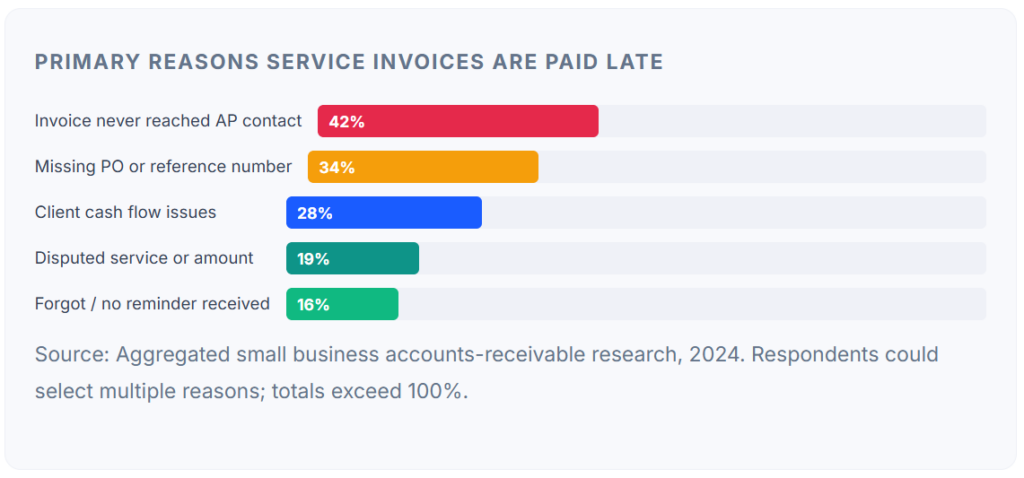
The financial impact of slow payment is significant and compounds quickly. When a client delays a $5,000 invoice by 45 days, that is $5,000 your business cannot use to pay suppliers, cover payroll, or invest in growth. Across multiple clients, a pattern of 30–60 day delays can create the paradox of a profitable business that is perpetually cash-constrained.
There is also a relationship cost. The longer an invoice goes unpaid without a structured response, the more awkward the dynamic becomes, making future conversations harder and increasing the risk that you stop following up altogether. That is exactly what some clients, consciously or not, are counting on.
The good news: most late-payment situations are recoverable, and the right system prevents the majority of them from occurring in the first place. For businesses that bill the same clients on a repeating basis, migrating to automated recurring billing removes the human variable from the equation entirely, invoices go out on schedule and reminders fire automatically, without anyone on your team having to remember.
The Escalation Timeline: A Step-by-Step Framework
The most effective approach to late-paying clients is a tiered escalation system, a structured sequence of contacts that increases in urgency while remaining professional at every stage. Here is the framework that works for most service businesses:
D-3 Pre-Due Reminder (3 Days Before the Due Date: Friendly Heads-Up)
A brief, warm email reminding the client that an invoice is coming due. This is not a collections call, it is a courtesy. Many corporate clients appreciate the advance notice because it gives their AP department time to queue the payment. Include the invoice number, amount, and due date. No pressure language, no mention of late fees.
D+1 First Follow-Up (1 Day After the Due Date: Polite Check-In)
Assume good faith. Send a short email noting that you have not yet received payment, attaching the invoice again, and asking if everything looks correct. Phrase this as an inquiry, not an accusation. Many clients simply forget, and this single touchpoint resolves a large percentage of overdue invoices immediately.
D+7 Second Follow-Up (7 Days Overdue: Firm but Friendly)
If no response or payment after the first follow-up, escalate slightly. Send another email, more direct in tone, and make a phone call the same day. Mention the outstanding balance and due date clearly. Ask if there is a specific reason for the delay and whether a payment plan would help. This is also the appropriate point to reference your late fee policy if one exists.
D+14 Third Follow-Up (14 Days Overdue: Consider Pausing Work)
Send a written notice that, per your contract terms, you are pausing new deliverables until the outstanding balance is resolved. This is a legitimate and legally recognized business action. For project-based work, this is often the moment that prompts payment; clients who need something from you suddenly have a very direct incentive. Keep the communication professional and matter-of-fact.
D+30 Formal Notice (30 Days Overdue: Formal Demand Letter)
At this stage, send a formal demand letter, ideally on company letterhead, stating the amount owed, the original due date, the number of days elapsed, and a final deadline (typically 7–10 days) for payment before you pursue external resolution. This letter should be sent via email with read receipt and also by certified mail if the amount is significant.
D+60 Escalation Options (60+ Days Overdue: External Resolution)
If the formal demand letter does not result in payment, your options are: small claims court (for amounts within your jurisdiction’s limit, typically up to $10,000–$25,000), a commercial collections agency (which typically retains 25–40% of recovered amounts), or a commercial litigation attorney for larger balances. None of these should be rushed into, they are last resorts, and a well-executed escalation sequence usually resolves the situation long before this point.
Document Every Touchpoint: Keep a written record, even a simple log, of every email sent, call made, and voicemail left, including the date and time. If you ever need to escalate externally, this documentation demonstrates that you made genuine, professional efforts to resolve the matter before taking further action.
Word-for-Word Scripts for Every Stage
Below are ready-to-use templates for each stage of the escalation sequence. Each script is designed to be professional in tone, direct about the facts, and non-confrontational, qualities that preserve the business relationship while making the expectation clear. Customize the variables (shown in [brackets]) before sending.
Script 1: Pre-Due Reminder (3 Days Before)
📧 Email Template: Pre-Due Reminder
Subject: Friendly reminder: Invoice [#INV-XXX] due [DATE]
Hi [Client Name],
Just a quick note to let you know that invoice [#INV-XXX] for [$AMOUNT] is due on [DATE]. I’ve attached a copy for reference in case it would be helpful for your records.
As always, payment can be made via [payment methods: bank transfer / credit card / payment link].
Please let me know if you have any questions about the invoice or the work it covers.
Thanks so much,
[Your Name]
[Your Business]
Script 2: First Follow-Up (1 Day After Due Date)
📧 Email Template: Day +1 Follow-Up
Subject: Invoice [#INV-XXX], just checking in
Hi [Client Name],
I hope you’re doing well. I wanted to follow up on invoice [#INV-XXX] for [$AMOUNT], which was due on [DATE]. I haven’t seen a payment come through yet, this may simply be a timing issue on your end, which is completely fine.
I’ve re-attached the invoice below. If anything looks incorrect or you have questions about any of the line items, please let me know and I’ll sort it out straight away.
You can pay via [payment link / bank transfer / credit card].
Thanks, [Your Name]
Script 3: Second Follow-Up with Phone Call (7 Days Overdue)
📧 Email Template: Day +7
Subject: Following up: Invoice [#INV-XXX] now 7 days overdue
Hi [Client Name],
I’m writing again about invoice [#INV-XXX] for [$AMOUNT], which is now 7 days past due. I’ve reached out once already and haven’t heard back, so I want to make sure this hasn’t fallen through the cracks.
Could you let me know the status of this payment or flag if there’s an issue I can help resolve? If a payment plan would be useful, I’m open to that conversation.
Per our agreement, a late fee of [1.5% / $X] per month applies to overdue balances. I’d prefer to resolve this before that becomes a factor.
I’ll also be giving you a call today at [your phone number]. Please feel free to reach me directly if that’s easier.
Best,
[Your Name]
Script 4: Formal Demand Letter (30 Days Overdue)
⚠️ Formal Demand Letter: Day +30
Subject: Formal notice: Outstanding payment required by [DEADLINE DATE]
Dear [Client Name / Company Name],
This letter serves as formal notice that invoice [#INV-XXX], issued on [Invoice Date] for services rendered per our agreement dated [Contract Date], remains unpaid. The original due date was [Due Date]. As of today, the invoice is [X] days overdue.
Total amount outstanding: [$AMOUNT] Accrued late fees (per our agreement): [$FEE] Total now due: [$TOTAL]
I am requesting that full payment be received no later than [DEADLINE, 7 to 10 days from today]. Payment can be made via [payment methods].
If I do not receive payment or a response by this date, I will have no choice but to pursue resolution through [small claims court / a collections agency / legal counsel], and all associated costs will be sought in addition to the principal amount.
I would strongly prefer to resolve this matter directly. Please contact me at [phone / email] at your earliest convenience.
Sincerely,
[Your Name]
[Your Business Name]
[Contact Details]
Use ReliaBills to Automate the First Three Stages
The pre-due reminder, the day-after follow-up, and the week-two check-in can all be automated inside ReliaBills. Set your reminder sequence once, and the platform handles the timing, the invoice attachments, and the delivery, so your attention is only required when the situation genuinely needs a human response.
Prevention: How to Stop Late Payments Before They Happen
Collecting overdue invoices will always be part of running a service business, but the best operators minimize how often they need to do it. These are the structural changes that have the highest impact on payment timeliness:
Require a Deposit Before Work Begins
A deposit, typically 25–50% of the total project fee, is the most effective single tool for filtering out late-paying clients. It demonstrates the client’s commitment and gives you partial coverage if the final invoice is contested. Frame it as standard practice, not a sign of distrust: “Our process requires a 30% deposit before we begin, with the balance due on delivery.” Most good clients accept this without question.
Shorten Your Payment Terms
Many service providers default to Net 30 without questioning whether it fits their business. For smaller projects, Net 15 or Due on Receipt is entirely reasonable and substantially reduces the window in which a client can delay. If a corporate client pushes back and insists on Net 45 or Net 60, factor that into your pricing, longer payment windows represent a real cost of capital.
Invoice the Moment Work Is Delivered
Same-day invoicing is one of the most consistently cited behaviors among service businesses with low accounts receivable backlogs. When you wait until the end of the week or batch invoices monthly, you have already extended the client’s de facto payment window and removed the psychological link between receiving the work and receiving the bill. For clients on a monthly retainer, explore automated recurring billing that generates and sends invoices on the same date every cycle.
Offer Multiple, Frictionless Payment Methods
Every additional barrier between the client and the “Pay” button extends your wait. Accept ACH bank transfers, credit cards, and digital payment platforms. Include a direct payment link in the invoice email body, not just as an attachment the client has to open separately. For larger projects broken into stages, consider offering installment billing, which pre-schedules a payment plan that both parties agree to upfront, removing the friction and ambiguity of the final invoice.
State Late Fees, and Enforce Them
A late fee policy is only as effective as your willingness to apply it. Include your late fee terms in every contract and on every invoice. When fees accrue, add them to the next invoice without apology, you stated them in advance, and they are legally valid. Clients who know late fees will be enforced tend to prioritize your invoices accordingly.
Late Payment Prevention Checklist
- Require a 25–50% deposit before starting any project over $1,000
- Use Net 15 or Net 30 (not Net 60) unless a client contract specifically requires it
- Send the invoice the same day the work is delivered or the billing period closes
- Address the invoice to the specific person (or team) who approves and processes payments
- Include a clickable payment link in the email body, not just as an attached PDF
- State your late fee policy on every invoice and in your contract
- Automate a pre-due reminder 3 days before the due date
- Review your top 10 clients’ payment histories quarterly and address patterns early
Reactive vs. Proactive Payment Management
The difference between businesses that constantly chase invoices and those that rarely have to comes down to one distinction: reactive versus proactive systems. The table below maps out how these two approaches differ across the key dimensions of accounts-receivable management.
| Dimension | Reactive Approach | Proactive Approach | Impact |
|---|---|---|---|
| Invoice timing | Batched weekly or monthly | Same day as delivery | Faster payment start |
| Payment terms | Default Net 30, rarely questioned | Actively negotiated per client type | Shorter DSO |
| Reminders | Manual, inconsistent, often avoided | Automated sequence, pre-scheduled | Higher collection rate |
| Deposits | Rarely required | Standard for all new clients | Lower exposure |
| Late fees | Stated but rarely applied | Applied consistently per policy | Stronger deterrent |
| Client history tracking | Memory or spreadsheet | Centralized system with payment records | Informed decisions |
| Response to late payment | Ad hoc, emotionally charged | Scripted, tiered, professional | Relationship preserved |
| Time spent on AR per month | 4–8 hours (or more) | <1 hour (automated systems) | Significant time savings |
The proactive approach is not about being aggressive, it is about being organized. Clients generally pay the vendors who make it easiest to pay them and hardest to forget. Structure your billing process with that reality in mind, and the volume of overdue invoices drops naturally.
Key Risks: What Not to Do When Chasing Late Payment
The way you follow up on late invoices matters as much as whether you follow up. These are the most common mistakes that damage both the payment outcome and the client relationship:
🚫 Sending Accusatory or Emotional Language
“You still haven’t paid me” reads very differently to a client than “I wanted to follow up on the outstanding invoice.” The first creates defensiveness; the second opens a conversation. Always assume administrative error over bad intent, at least until the evidence clearly suggests otherwise.
🚫 Threatening Before Escalating
Jumping straight to “I’ll take legal action” on a 10-day overdue invoice destroys trust and may expose you to legal liability for making threats you are not ready to execute. Follow the tiered sequence, reserve strong language for the formal demand letter stage.
🚫 Continuing to Deliver Work Without a Payment Plan
If a client owes you $8,000 and asks you to start a new project, you are taking on additional exposure with zero guarantee of recovery. Pause new work professionally until the outstanding balance is resolved or a clear payment arrangement is in place in writing.
🚫 Not Having Payment Terms in Writing
A verbal agreement is nearly impossible to enforce. Every client engagement should begin with a signed contract or a written acknowledgment (even an email confirmation) that references your payment terms, late fee policy, and deposit requirements. Without this, your leverage in any dispute is significantly weakened.
⚠️ Writing Off the Debt Too Soon
Many business owners give up on overdue invoices before exhausting their options. A collections agency, while costly, can recover balances you have mentally written off, and the effort required on your end is minimal once you hand off the account. Small claims court is accessible, inexpensive, and effective for amounts within the jurisdictional limit.
How to Automate Your Follow-Up with Invoicing Software
The most time-consuming part of managing late-paying clients is the manual follow-up: drafting emails, remembering who is overdue by how many days, and figuring out what to say in each situation. Purpose-built invoicing software eliminates the majority of that manual overhead.
A well-configured invoicing platform will send a pre-due reminder on a schedule you define, follow up automatically on overdue invoices at intervals you control, attach the invoice PDF to every outreach, and show you at a glance which clients are current, upcoming, or overdue, and by exactly how many days. For businesses managing 15 or more active billing relationships, this alone can recover several hours per week that currently go to AR management.
Integrating with Your Client Records
The other half of the equation is knowing your clients. A client who is first-time overdue by three days is not in the same category as one who has paid late on seven of the last ten invoices. Keeping a centralized record of each client’s payment history, contact details, and billing notes, inside a proper customer management system, allows you to calibrate your response appropriately and make informed decisions about which client relationships are worth continuing.
Frequently Asked Questions
The questions service businesses ask most often about handling overdue invoices and late-paying clients:
1. What is the best way to follow up on an overdue invoice?
Start with a polite email the day after payment is due, referencing the invoice number and amount. If there is no response within three business days, send a second email and make a phone call the same day. Escalate to a formal demand letter if payment is still not received after 30 days. Keep a written record of every communication attempt and its outcome.
2. Can I charge a late fee on an overdue invoice?
Yes, provided your late fee policy was clearly communicated before work began, in your contract and stated on the original invoice. A typical structure is 1.5% of the outstanding balance per month, or a flat monthly fee. Check your local regulations, as some jurisdictions set a ceiling on permissible late fee rates.
3. How do I stop a client from paying late in the future?
The most effective measures are requiring a deposit before starting work, shortening your payment terms, sending invoices the same day work is delivered, offering online payment options with a direct payment link, and automating reminder sequences. For repeat clients, setting up automated recurring billing removes the manual variable entirely.
4. What should I do if a client disputes an invoice?
Respond in writing quickly. Acknowledge the dispute, reference your original agreement, and provide supporting documentation such as a signed contract, email approvals, or time logs. Offer a call to resolve the matter directly. Do not continue performing new work until the dispute is resolved and, ideally, the existing balance is settled or a clear payment plan is agreed to in writing.
5. Should I stop work for a client with an overdue invoice?
For ongoing engagements, pausing new deliverables once an invoice is 14 or more days past due is a reasonable and professionally recognized action. Communicate this in writing, state that delivery of additional work is contingent on resolving the outstanding balance. This gives the client a direct, practical incentive to pay and protects you from accumulating more unpaid exposure.
Recent Articles:
- Net 30 vs Net 15 vs Net 60: Which Payment Terms Work Best?
- How to Write an Invoice for Services: Step-by-Step Guide