
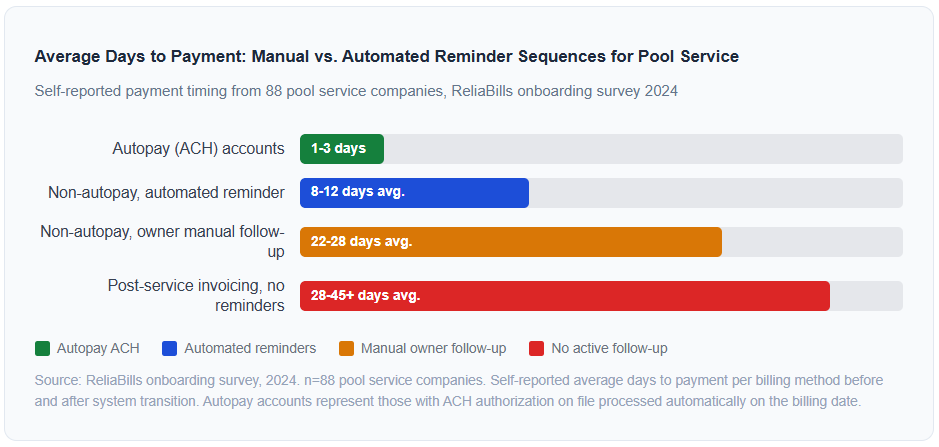
Most pool service owners spend four to eight hours every month chasing overdue invoices through text messages, personal calls, and awkward on-site conversations. That time is not going to collections because the clients are difficult. It goes there because the billing system makes late payment easy and chasing it manual. A five-step automated reminder sequence, combined with autopay enrollment at onboarding and ACH pre-authorization for recurring accounts, cuts average days to payment from 32 to under 10 for most pool service operations without changing a single client relationship.
What are Pool Service Payment Reminders?
Pool service payment reminders are automated notifications sent to clients before and after a payment due date to confirm upcoming charges, prompt payment of outstanding balances, and alert clients when a charge fails or a late fee applies. They are sent by the billing platform rather than by the owner or office, which removes the human discomfort from payment follow-up and ensures every account receives the same consistent sequence regardless of the relationship or the season. Effective reminders connect to recurring billing (which generates the monthly charge), invoicing software (which produces per-visit or one-time statements), and client account management (which tracks each account’s payment history and outstanding balance). For pool companies offering equipment financing or large repair payment plans, reminders also integrate with installment billing to notify clients of each scheduled installment.
Why Pool Service Companies Collect Payments Slower Than They Should
The late payment problem in pool service is not primarily a customer problem. It is a billing architecture problem. The average pool service company invoices after service is delivered, sends invoices manually or in batch at the end of the month, follows up by text or personal call when it remembers to, and applies late fees inconsistently depending on the relationship and how uncomfortable the owner feels charging a longtime customer.
Fieldproxy’s pool service billing analysis puts a number on the structural cost: pool service companies lose an average of $18,000 annually to billing delays, payment processing errors, and collections inefficiencies. For a 120-account residential operation billing $160 per month per client, a 10 percent chronic late payment rate keeps $19,200 in receivables constantly outstanding. That is not bad-faith non-payment. It is the predictable result of a billing model that places no automatic consequence on late payment.
The behavioral economics here are straightforward. Most late payers are not trying to cheat you. Autopay eliminates late payments before they start. Follow the same steps for every late payment. Automate your reminders. The path of least resistance in a billing system without automatic consequences is inaction. Automated reminders change the path of least resistance to paying.
The Five-Step Pool Service Payment Reminder Sequence
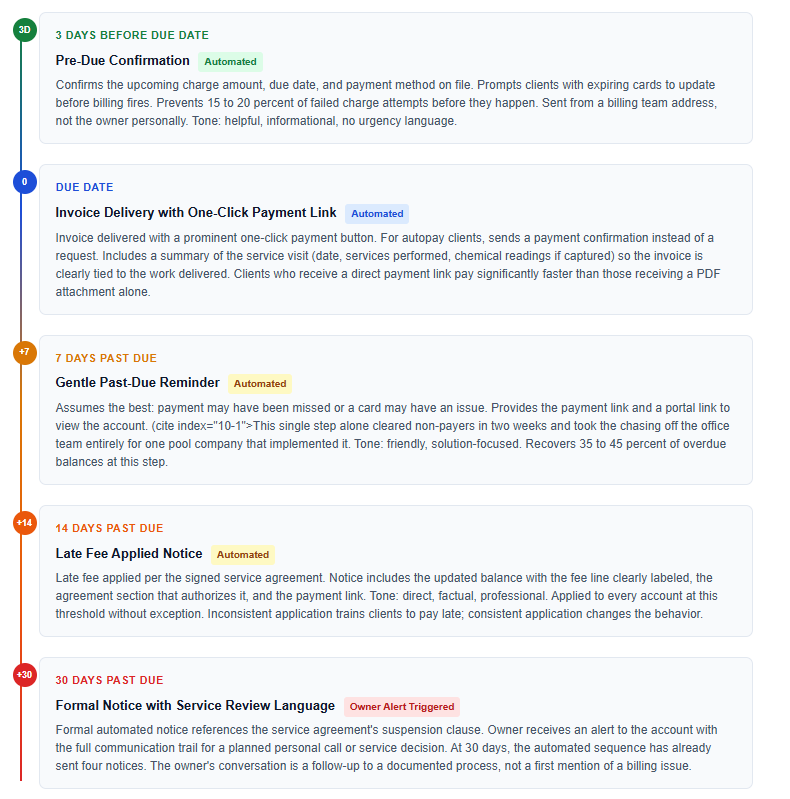
The sequence below handles the complete payment cycle for a monthly recurring pool maintenance account, from pre-due confirmation through thirty days past due. Owner involvement begins only at Step 5, when the automated trail has not resolved the balance and a personal conversation is genuinely the right next step.
Skimmer’s guidance on automated reminders makes the same point about the pre-due window: schedule reminders on both sides of the due date, and the pre-due nudge can read like a courtesy while the post-due one can get firmer. Failed payment notifications email the customer immediately and put every declined transaction on a daily report for you, which turns a slow leak into a same-day fix.
What a Professional Pool Service Payment Reminder Looks Like
The first past-due reminder is the most important message in the sequence. It reaches the largest share of clients who are simply distracted or whose card has expired, and its tone sets whether the client receives it as professional communication or as a personal accusation. The example below shows the seven-day past-due reminder, written to feel informational and helpful rather than confrontational.
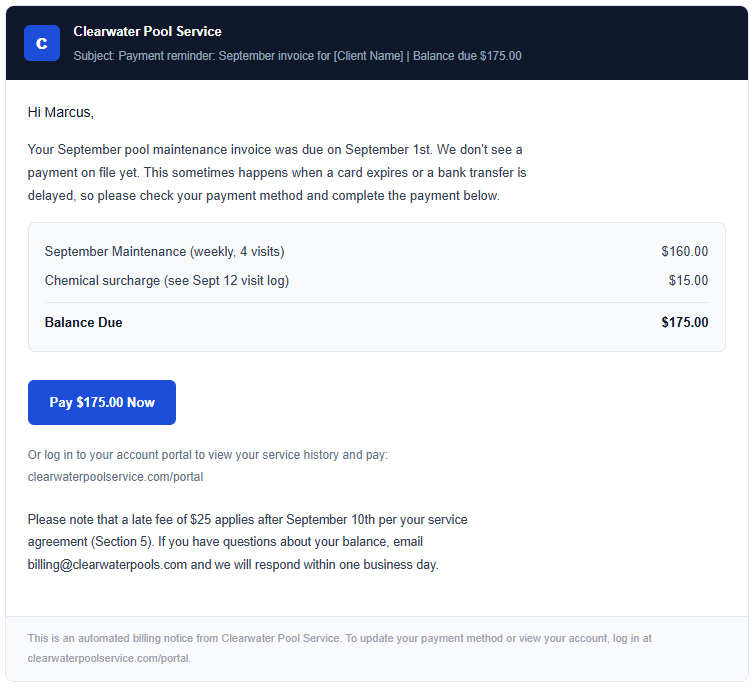
The email above does three specific things that most pool service billing reminders do not. First, it offers a benign explanation for the missed payment before implying any negligence. This reduces defensiveness and moves the client to payment faster. Second, the chemical surcharge appears as a separate labeled line item rather than being folded into the base monthly fee, which eliminates the “why is this amount different” question before it is asked. Third, the late fee is mentioned before it applies, with the agreement section reference, so when it does appear on the next notice, it is not a surprise.
Autopay Enrollment: The Change That Makes Reminders Mostly Unnecessary
The most effective pool service payment reminder is the one that never has to be sent. A client who authorizes ACH autopay at onboarding does not receive a payment reminder because the charge processes on the billing date without any action from them or any reminder from the billing system. The payment confirmation they receive is the only communication about money for that billing cycle.
Automated digital agreement sends auto-pay enrollment form immediately when pool maintenance contract is signed, achieving a 96.3 percent payment collection rate and a 99.1 percent eventual collection rate while eliminating 87 percent of administrative billing tasks. The lever here is timing. A client who is asked to set up autopay at the moment they are signing the service agreement, already in payment mode and already committing to the service, is far more likely to authorize it than a client asked three months into service when the relationship is established and the request feels like an operational change to something that has been working.
ACH vs. Card: Why the Payment Method Affects Your Reminder Volume
The choice between ACH bank transfer and credit card for recurring pool service billing is not just a processing cost decision. It directly affects how often charges fail and how many accounts need reminder sequences at all.
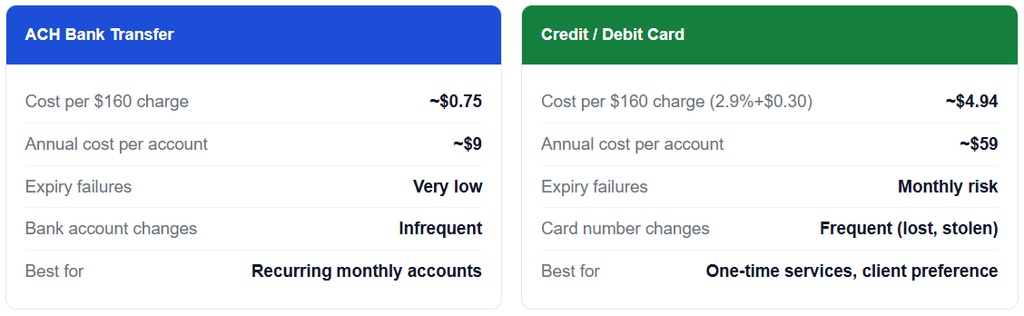
For a 120-account pool company, that cost difference is $5,940 per year in processing fees alone. The more operationally significant difference is the failure rate. A bank account number used for ACH two years ago is almost certainly still the same account. A credit card issued two years ago may have been replaced multiple times for expiry, fraud replacement, and lost card situations. Each failed card charge generates a reminder that would not have been needed with ACH, a retry cycle, and a potential service interruption if the balance ages past thirty days before resolution.
The Seasonal Billing Edge Cases Most Reminder Systems Miss
Pool service billing has two seasonal transition problems that standard payment reminder guides do not address and that generate the most billing disputes and collection friction outside the normal monthly cycle.
Spring opening and fall closing invoices billed alongside recurring fees
When a spring opening service is billed in the same cycle as the April recurring maintenance fee, the total invoice is higher than the client expects. Without a clearly labeled line item breakdown that separates the one-time seasonal service from the regular monthly fee, clients call to dispute what they assume is a billing error. The invoice must show the recurring maintenance fee and the seasonal service charge as distinct labeled line items, with the seasonal service cross-referenced to the estimate or proposal the client approved. This single formatting change eliminates the majority of spring billing disputes before they happen.
Automated Reminders vs. Manual Follow-Up: What Actually Differs
| Factor | Manual Owner Follow-Up | Automated Reminder Sequence | Business Impact |
|---|---|---|---|
| Consistency | Depends on the owner remembering, having time, and feeling comfortable | Same sequence for every account at every billing event, every month | Eliminates accounts that age past 30 days simply because nobody followed up |
| Late fee application | Applied selectively; long-term clients often waived; creates resentment | Applied automatically at 14 days for every account without exception | Consistent application changes payment behavior; selective application enables lateness |
| Client relationship risk | Owner’s personal relationship is the medium for uncomfortable payment requests | Billing system sends follow-up; the owner relationship stays focused on service quality | Owner retains authority as the service provider, not the bill collector |
| Failed charge recovery | Discovered at end-of-month billing review; no automatic retry | Client notified same day; retry at 3 and 7 days; portal link to update method | Recovers 20 to 30 percent of failed charges without any staff involvement |
| Seasonal billing gaps | Seasonal surcharges invoiced inconsistently; disputes common | One-time services configured as separate line items; labeled automatically | Eliminates the most common source of spring billing disputes in one template update |
| Owner time cost | 4 to 8 hours per month across 80 to 150 accounts | Under 60 minutes reviewing exceptions and aged AR report | Recovered time goes to route management, new client acquisition, and service quality |
| Documentation | Verbal conversations and texts leave no record; disputes become unverifiable | Every automated notice is timestamped and stored in the client account record | Owner enters any service suspension or escalation with a full documented trail |
Setting Up Automated Payment Reminders for Your Pool Service Business
1. Update the service agreement with billing authorization, late fee, and suspension language
Before enabling any automated billing action, the service agreement must explicitly authorize recurring automatic charges, define the billing date and cycle, state the grace period in days before late fees apply, specify the late fee amount, describe the failed payment retry process, and define the service suspension conditions and required notice period. Every automated action the billing system takes flows from this document. A late fee applied by software to a client whose agreement says nothing about late fees is a fee the client will dispute successfully. Update the template and collect signatures from existing clients at their next renewal before activating automated enforcement.
2. Enroll every new client in ACH autopay at service agreement signing
Present ACH autopay authorization as part of the onboarding paperwork rather than as a separate optional step. A client who authorizes autopay at the moment they sign the service agreement is in payment mode and has already committed to the service. Present it as the default and as a convenience. For existing clients not on autopay, ask for ACH authorization at the next service visit or at annual renewal. Pool companies that make this request at a natural decision point, rather than cold-requesting it mid-season, achieve significantly higher enrollment rates.
3. Configure the five-step reminder sequence with calibrated tone escalation
Write all five reminder messages before activating the sequence. The pre-due confirmation, the due-date invoice, the seven-day past-due reminder, the fourteen-day late fee notice, and the thirty-day formal notice each need distinct tones that escalate visibly from helpful to formal. Send automated reminders from a billing team email address rather than the owner’s personal address, so the communication feels like business process rather than personal pressure. Test the full sequence with a staff account before enabling it for clients. ReliaBills and similar billing platforms support customizable reminder templates at the account or program level before any automated delivery begins.
4. Configure failed charge retry with a three-day delay
Set retry for failed ACH and card charges at three days after initial failure, not same-day. Same-day retry almost never recovers a failed charge because the conditions that caused it, insufficient funds, a bank hold, or a recently expired card, have not changed in 24 hours. A three-day delay allows payroll deposits to post, bank holds to clear, and card replacements to arrive. Send the client automatic notification on the day of failure with a direct link to update their payment method. Configure the client portal so they can update payment details without calling the office.
5. Review the AR aging report weekly before route planning
Make the accounts receivable aging report the first billing review every week, not a monthly reconciliation task. The 0 to 30-day column needs no action beyond the automated sequence. The 31 to 60-day column needs a personal call from the owner, with the automated communication trail as context, before service at those accounts is continued. The 60-plus-day column needs a decision: service pause, payment plan, or discontinuation. Making that decision at 60 days rather than at 90 days changes the owner’s leverage and the client’s options. Accounts past 90 days with no payment and no plan are rarely recovered without external collections involvement.
6. Deploy a client payment portal for self-service balance and payment management
A portal where clients can view their current balance, payment history, last visit report, and update their payment method eliminates most billing questions before they reach the office. A client who notices a higher-than-expected invoice at 10pm can view the line item breakdown, see the chemical surcharge from the September 12th visit, and pay immediately without calling anyone. Include the portal link in every reminder message. Present it to clients at onboarding as a convenience feature rather than introducing it only when there is a problem.
When to Stop Servicing a Pool for Non-Payment: Policy Beats Judgment Every Time
Pool service companies have a collection lever that most other service businesses lack entirely: they can simply not show up. A client who has not paid in 35 days and whose pool has not been maintained for a week calls to ask about service far faster than they respond to billing reminders. This is the industry’s most effective collection tool, and it is almost entirely unused because most pool companies do not have a defined policy that authorizes it.
Pause service 30 days past due. Service stops until payment is made. Tell them service will resume as soon as payment is made. Put the due date, reminder schedule, late fee, service-pause date, restart terms, and collection cutoff in the agreement before work begins. The service agreement is what converts the service pause from a personal confrontation into a policy enforcement. When the owner calls at 31 days past due, the conversation is: “Our system flagged your account as past due and service is on hold per the agreement you signed. Once the balance is cleared, service resumes automatically at the next scheduled visit.” That is a very different conversation from “I need you to pay your invoice or I’m going to have to stop coming out.”
Common Mistakes and What I Got Wrong at First
Sending automated reminders from the owner’s personal email address
The first version of an automated pool service reminder that arrives from “Mike” rather than “Billing at Clearwater Pool Service” feels personal rather than systematic. Clients respond to it as if Mike personally noticed they hadn’t paid and sent a note, which creates a conversational dynamic rather than an administrative one. Some clients reply to apologize personally. Some feel judged. A few get defensive. Automated reminders sent from a billing team email address are received as routine process, which is exactly how they should be received. The account manager or owner stays focused on service quality. The billing system handles the billing, including recurring and installment billing when services are paid in scheduled amounts.
Applying late fees to clients whose signed agreements do not mention them
A late fee applied to a client whose service agreement says nothing about late fees will be disputed, and the client will be right to dispute it. The fee was not part of their agreement. Update the service agreement template with specific late fee language, the amount, the grace period, and the authorization language, before enabling automated fee application. Send the updated agreement to existing clients at their next renewal or as a standalone amendment. The one-time administrative work of getting new signatures protects every automated billing action that follows it.
Invoicing seasonal services as a line item adjustment rather than a separate labeled charge
Folding a spring opening charge into the April maintenance invoice without labeling it as a separate service creates confusion every year. The client sees an April total of $285 when they normally pay $160, assumes a billing error, and calls or disputes. Showing the monthly maintenance fee and the seasonal opening charge as separately labeled line items, with the opening service cross-referencing the estimate the client approved, makes the invoice self-explanatory. This one formatting change eliminates most seasonal billing disputes without changing the price or the service.
Configuring all reminder messages with the same urgent tone
A pre-due confirmation that uses the same language as a 30-day formal notice creates reminder fatigue. If every message sounds like an emergency, none of them feel like one, and the escalating urgency of the sequence fails to produce escalating urgency in the client’s response. The pre-due confirmation should be neutral and helpful. The seven-day reminder should be gentle and assume the best. The fourteen-day late fee notice should be direct and factual. The thirty-day formal notice should be formal and reference the service agreement explicitly. Each message should feel noticeably different from the previous one in tone, so the escalation is perceived and the behavioral response matches the intent.
Not including a one-click payment link in every reminder message
A payment reminder that tells the client they owe $175 but does not include a payment link requires the client to navigate to a portal, remember a login, find their account, and initiate payment. Every additional step between receiving the reminder and completing payment increases the percentage of clients who intend to pay but do not get around to it that day. A one-click payment link that takes the client directly to a pre-filled payment page is not an optional feature. It is the component that converts reminder receipt into immediate payment for the majority of clients who are not deliberately withholding. Every reminder message, at every step of the sequence, must contain a payment link or button.
Frequently Asked Questions
1. What are pool service payment reminders?
Pool service payment reminders are automated notifications sent to clients before and after a payment due date to confirm upcoming charges, prompt payment of outstanding balances, and alert clients when a charge fails or a late fee has been applied. They are sent by the billing system rather than the owner, which ensures every account receives the same consistent follow-up on the same schedule regardless of the season or the relationship. An effective sequence includes a pre-due confirmation three days before billing, a due-date invoice delivery with a payment link, and escalating past-due notices at seven, fourteen, and thirty days before requiring any personal owner involvement.
2. How do you set up automated payment reminders for a pool company?
Setting up automated payment reminders requires four things in order: a signed service agreement that authorizes automated charges and defines the late fee policy; a billing platform that supports configurable reminder sequences and ACH or card autopay; client accounts configured with the correct monthly fee, billing date, and payment method; and reminder message templates with calibrated tone escalation from helpful to formal. The setup takes one to two days if client records are organized. Trying to automate on top of disorganized records creates more troubleshooting than the clean setup would have required.
3. When should pool service companies send payment reminders?
For monthly recurring accounts, the optimal schedule is: a pre-due confirmation three days before the billing date, an invoice with a payment link on the due date, a gentle reminder at seven days past due, a late fee notice at fourteen days, and a formal notice at thirty days. For per-visit invoices, the same-day invoice after service delivery is the first touchpoint, followed by the same past-due sequence. The three-day pre-due confirmation is the most underused and highest-impact step because it prevents card expiry failures before they happen and prompts clients to update payment methods proactively.
4. Should pool service companies charge late fees?
Yes, when the fee is defined in the signed service agreement and applied consistently to every overdue account at the same threshold. The behavioral effect of consistent late fee application is stronger than the revenue from the fees themselves. Clients who know a late fee applies automatically at fourteen days past due pay more reliably than those in a system where fees are applied selectively based on the owner’s comfort level. A late fee applied without written authorization from a signed agreement is not enforceable. Update the service agreement before enabling automated fee application.
5. What is the difference between autopay and payment reminders?
Autopay is an ACH or card authorization that charges the client automatically on the billing date without any action required from them. Payment reminders are notifications sent when a charge is upcoming or overdue, prompting the client to take action. They work together: autopay enrollment reduces the number of accounts needing reminder sequences because charges process automatically; payment reminders handle the accounts where autopay is not set up, where a charge fails, or where a one-time invoice requires action. Maximizing autopay enrollment at onboarding reduces the volume of accounts in the reminder system at any given time.
6. What happens when a pool client ignores payment reminders?
When a client does not respond after the automated 30-day final notice, the owner initiates a personal call with the full automated communication trail as context. The service agreement should specify that service may be paused for non-payment after a defined number of days, with a required notice period before the pause takes effect. Pool service companies have a collection lever most other businesses lack: they can stop showing up. A client whose unmaintained pool turns green resolves the balance faster than any number of billing reminders. The service suspension policy must be in the signed agreement to be enforceable without dispute.
Recent Articles:
- Member Data Management: How to Keep Your Club’s Billing Records Organized
- Property Management Income Reporting: How to Track Rent Revenue and Vacancies