
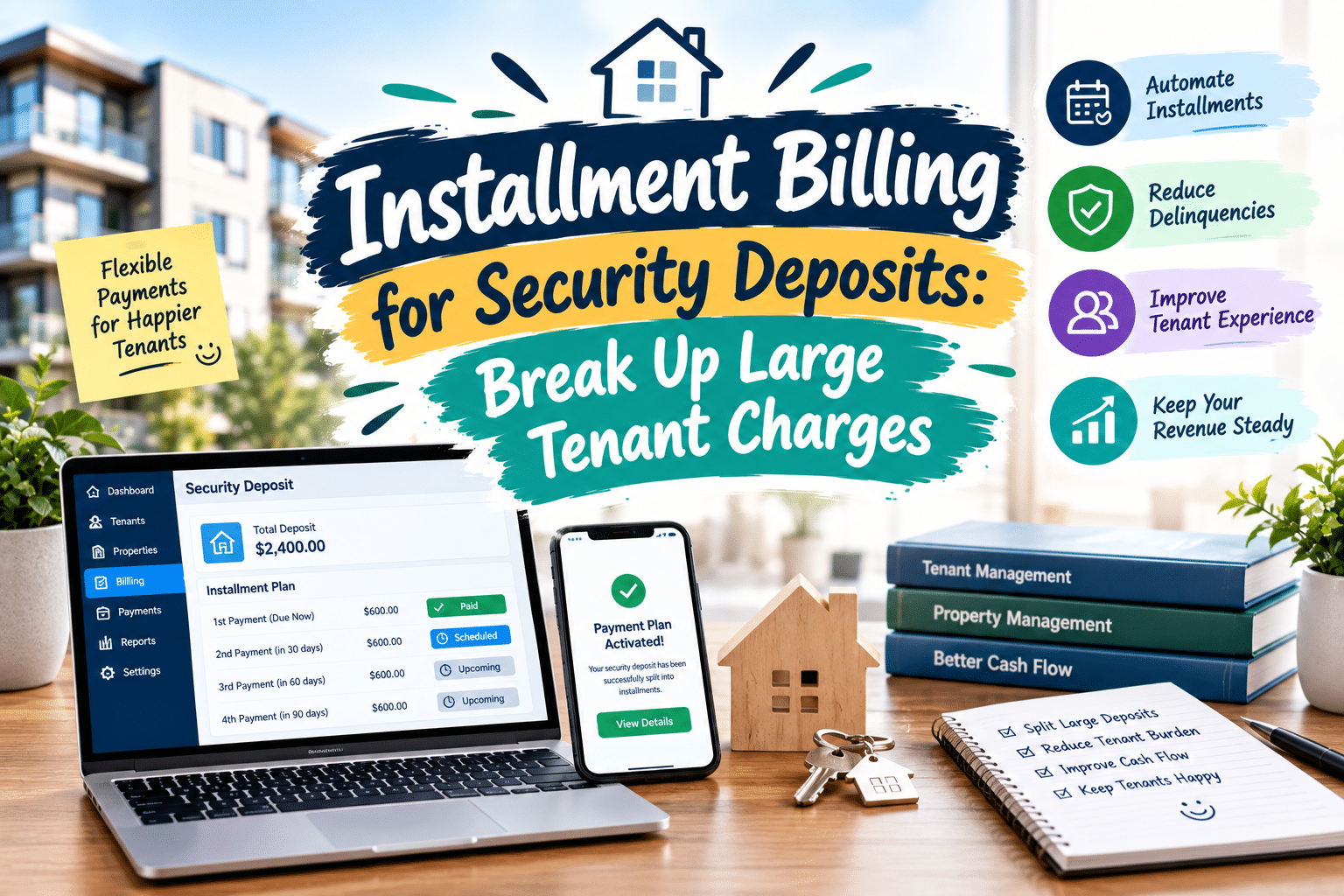
Security deposit installments lower the cash a tenant needs on day one while the landlord still ends up holding the full amount. They work when the schedule is written down, tracked as its own ledger line, and built around your local rules on fees and deposits.
What are Security Deposit Installments?
Security deposit installments are a payment arrangement where a tenant pays a required security deposit in two or more scheduled payments instead of one lump sum at lease signing. The total deposit stays the same. Only the timing changes.
What Security Deposit Installments Are, in More Detail
A security deposit is money a landlord holds against unpaid rent, damage beyond normal wear, and other lawful charges. It is not income, and it is not a fee. It belongs to the tenant until a valid claim says otherwise, which is why many states treat it almost like a trust balance. Installments change one variable: when the money arrives.
Instead of collecting the entire amount at signing, the landlord sets a schedule. A common version asks for the first month of rent plus part of the deposit at move-in, then spreads the remainder over the next few billing cycles. The required deposit stays at, say, $3,000 from day one. What moves is the funded balance, the portion actually received so far, which climbs from a partial number to the full number as each payment lands.
It also helps to separate this idea from its neighbors. Installment billing covers any fixed total split into a fixed number of payments, and a deposit plan is one use of it. Recurring billing repeats without an end date, the way monthly rent does. Invoicing software produces each individual request for payment, and customer management keeps the tenant’s contact details, payment method, and history in one place. A well-run deposit plan touches all four, which is exactly why it falls apart when they live in separate spreadsheets.
How Security Deposit Installments Work
On paper the mechanics are simple. Most compliant plans follow this sequence.
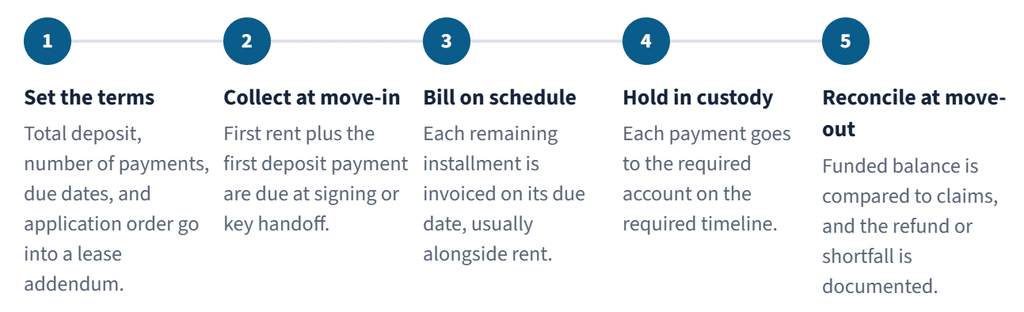
Pick a schedule the rules will allow
Schedules fall into two families. In some jurisdictions the law dictates the shape. Philadelphia asks for one month of rent at signing and the balance in three equal payments starting the following month, while Washington lets a tenant elect three equal installments beginning at the start of the tenancy. Everywhere else, you design it. Three to six payments is typical, and shorter is easier to defend if a dispute ever reaches a judge.
Decide how each payment is applied
This is the step most guides skip. When a tenant sends $2,800 on the first of the month, which charges does it satisfy? Rent, the current installment, or whichever item is oldest? Put the order in the addendum. Rent first is the conventional choice because rent drives the lease, but you should be able to explain it. Without a stated order, a partial payment can leave a tenant behind on rent yet fully current on the deposit, and that is a fight nobody wants.
Track funded versus required
Keep two numbers per tenant at all times: the required deposit and the funded deposit. Billing software that supports installment plans, such as ReliaBills, can generate each scheduled invoice, send reminders, and retry failed payments automatically, so the funded balance stays visible without a monthly reconciliation exercise. Whatever tool you use, the goal is the same. Anyone on your team should be able to answer “How much of this deposit do we actually hold?” in ten seconds.
The Legal Picture: Where Installments Are Required
Whether you must offer installments can depend on where the property sits. Three examples show the range. None of this is legal advice, and local rules change, so treat the table as a map to the primary sources rather than a replacement for them.
| Jurisdiction | Who it covers | Schedule | Cost to the tenant |
|---|---|---|---|
| Washington State, RCW 59.18.610 | Tenancies of three months or longer, on the tenant’s written request. Exempt if deposits and fees are 25% or less of the first month’s rent and no last month’s rent is required. | Three consecutive equal monthly installments starting at the beginning of the tenancy, due with rent, in a written schedule signed by both parties. | No fee, interest, or added cost allowed for choosing installments. |
| Philadelphia, Bill No. 250044-A | Landlords with three or more units, when the first-year deposit exceeds one month of rent. Applies to leases executed or renewed after the ordinance took effect on December 2, 2025. | One month of rent at signing, then the remaining deposit in three equal monthly payments starting the month after. | Total deposit is the same whichever method the tenant picks. |
| Portland, City Code 30.01.087 | Additional deposit amounts covered by the city code. Check the section for the exact threshold. | Installments over up to three months, in amounts reasonably requested by the tenant. | Deposit funds go into a segregated account within two weeks of receipt. |
What the mandates have in common
Read the three side by side, and a pattern shows up. The schedule is short, the installments are equal, the agreement is in writing, and the tenant pays nothing extra for choosing it. Washington’s statute puts the last point bluntly: “A landlord may not impose any fee or charge any interest” because a tenant elected installments. Small landlords are often carved out, as in Philadelphia, where owners of two or fewer units are exempt.
Where installments are voluntary
Outside those places, offering a plan is your call. Deposit caps still apply, and they range from one month of rent to no statutory cap at all, so check the cap first. An installment plan cannot make an over-limit deposit legal.
Real-World Examples and Use Cases
A single-family landlord with a pet deposit
Take a house renting for $1,800 a month. The landlord requires a deposit of 1.5 times rent ($2,700) plus a $300 pet deposit, so $3,000 in total. Under a lump sum, move-in costs $4,800: the first month plus the full deposit. Under a three-payment plan, the tenant pays $2,800 at move-in, $2,800 in month two, $2,800 in month three, and $1,800 from month four onward.
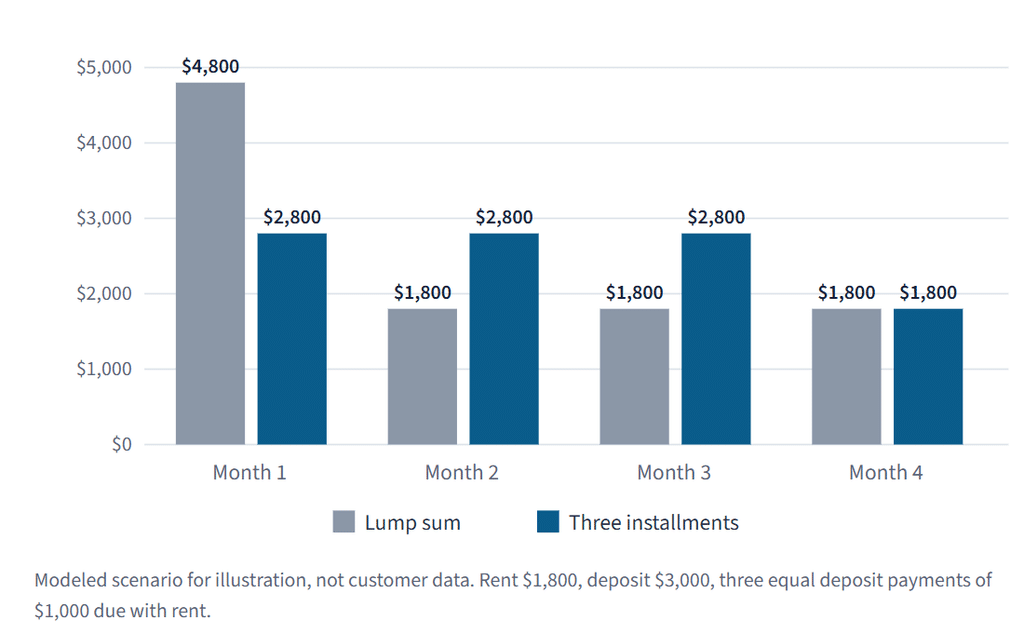
Peak cash needed in the first month falls from $4,800 to $2,800, a 42 percent reduction. By the end of month three, both tenants have paid exactly $8,400 in total. The landlord has lost nothing except the option of having the whole deposit in hand on day one.
A property manager running a portfolio
At the portfolio scale, every plan is a small receivable, and the question shifts to “How many open deposit balances are we carrying right now?” Forty active plans means forty sets of due dates and forty potential failed payments. That is where spreadsheets stop working. Managers in this position lean on collection automation for reminders and retries and on a customer portal so tenants can see what they have paid without calling the office.
Beyond housing
Refundable deposits show up wherever something valuable changes hands: event equipment, coworking desks, storage units, and club memberships. The logic carries over unchanged: a fixed total, a fixed number of payments, clear rules on what the deposit covers, and a record of what has arrived.
Key Benefits of Security Deposit Installments
A lower barrier to entry for tenants
The most obvious benefit is the one legislators cite. When Philadelphia’s bill sponsor argued for the measure, she said it was about making sure people aren’t “priced out of housing before they even have a chance to sign a lease,” and the numbers above show why. A tenant who can comfortably handle $1,800 a month may still not have $4,800 in liquid cash the week they move.
A wider pool of qualified applicants for landlords
Fewer applicants get screened out for move-in costs alone, which can shorten vacancy. One vendor claims payment plans lift lease conversion by two to five percent, but that figure comes from its own marketing. Treat it as a hypothesis to test, not a benchmark.
Cleaner operations when the plan is automated
Once installments are invoiced automatically, the schedule stops depending on someone’s memory. Each payment is documented and timestamped, which is worth more than it looks when you are itemizing a refund weeks after move-out.
Key Risks and Things to Watch For
The funding gap
The central risk is simple. Until the last payment lands, you hold less than the deposit you required. If the tenant leaves early or damages the unit, the shortfall is yours to chase. Using the same $3,000 deposit, imagine a tenant who moves out after month two, having paid $2,000.
| Damage claim | Lump-sum deposit | Installment deposit |
|---|---|---|
| $1,400 | Covered in full. Tenant refund: $1,600. | Covered in full. Tenant refund: $600. |
| $2,400 | Covered in full. Tenant refund: $600. | $2,000 applied, $400 uncovered. Refund: $0. |
| $3,000 | Covered in full. Refund: $0. | $2,000 applied, $1,000 uncovered. Refund: $0. |
Whether you can pursue the unpaid third installment or the uncovered damage depends on the lease and on local law. Many landlords assume a missed installment can be treated like missed rent. That assumption deserves a lawyer’s review before it appears in a notice, since some jurisdictions limit the remedies.
Fees, interest, and the surcharge trap
It is tempting to add a small “plan fee” to cover admin time. Where the statute bars it, as in Washington, that fee is a violation. Where the statute is silent, it still undercuts the goodwill the plan was meant to create.
Custody timing on partial funds
Portland’s code requires funds received as a security deposit to be placed in a segregated account within two weeks. A cautious reading is that the clock runs on each payment you receive, so a first installment is not a reason to wait until the deposit is whole. The same discipline applies in any state that requires trust or escrow accounting.
Failed payments and silent drift
Cards expire and bank transfers bounce. A failed deposit installment can sit unnoticed behind the noise of rent collection, so set separate alerts for deposit line items and send the tenant a clear message about how to fix it.
How Installments Compare With Related Approaches
Installments are one of several ways to lower a tenant’s move-in cost. Each trades protection for accessibility differently.
| Approach | Tenant cash at move-in | What the landlord holds | Admin load | Main watch-out |
|---|---|---|---|---|
| Lump-sum deposit | Highest | Full deposit from day one | Low | Screens out otherwise qualified applicants. |
| Deposit installments | Lower, rising to the full amount over weeks | Partial, then full | Moderate without automation | Funding gap during the first months. |
| Deposit guarantee program | Lowest | A third-party guarantee. One program, Nomad, spreads the deposit over six monthly payments and guarantees the total to the owner. | Depends on the provider | Provider terms, eligibility rules, and who bears the cost. |
| Prepaid last month’s rent | High | Rent credit, not a damage fund | Low | Does not cover damage, and some states limit or regulate it. |
| Recurring deposit-alternative fee | Low | Nothing refundable | Low | Only where local law permits, and tenants may pay more overall. |
What Most Guides Leave Out
Before writing this page, we read the kinds of results that rank for this topic: state law roundups, landlord forum threads, city ordinances, and vendor blogs. They cover the basics well. They say much less about what decides whether a plan works in practice.
The first gap is accounting. A partially funded deposit is a liability you owe back, not revenue, and it belongs on its own ledger line from the first payment. The second is early move-out math, like the funding-gap table above. The third is the payment application order. The fourth is documentation: a signed addendum and receipts showing which balance each payment reduced. The fifth is the tenant’s experience, since a confusing reminder or a surprise late notice can turn a cooperative tenant hostile.
Common Mistakes to Avoid
| Mistake | Why it hurts | Better approach |
|---|---|---|
| Letting deposit payments blend into rent | You cannot tell what is funded, and late fees can be applied to the wrong balance. | Bill the deposit as its own line item with its own due date. |
| Agreeing to a schedule verbally | Nothing to point to in a dispute. | Use a signed addendum listing amounts, dates, and application order. |
| Ignoring the deposit cap | An installment plan does not make an over-limit total legal. | Confirm the cap before you set the required amount. |
| Waiting to bank partial funds | Trust or segregated-account rules may already be running. | Deposit each payment on the required timeline. |
| Reminders only when payments are late | Tenants forget, and the first sign of trouble is a bounce. | Send a heads-up a few days before each due date. |
A Note for Crypto-Native Readers
If you are used to vesting schedules and streaming payments, deposit installments will feel familiar. Think of an escrow that fills over time: the target is fixed in the agreement, payments arrive on a schedule, and the party holding funds owes custody duties. The differences are legal, not technical. Deposit statutes are written in dollars. If a tenant offers stablecoins, confirm that your lease, jurisdiction, and accounting treat each payment as a dollar amount received, and record the conversion at the time. Volatile assets are a poor fit for a deposit whose refund value is meant to be certain.
Frequently Asked Questions
1. Can a landlord require security deposit installments?
In some places, yes. Washington State lets eligible tenants elect three equal installments on written request, and Philadelphia requires landlords with three or more units to offer an installment option when the deposit exceeds one month of rent. In most other places installments are optional, so it is up to the landlord.
2. Can I charge extra when a tenant pays a deposit in installments?
Usually you should not. Washington’s statute bars any fee, interest, or added cost for choosing installments, and Philadelphia’s ordinance keeps the total deposit the same under either payment method. Even where no rule applies, a surcharge invites disputes and undermines the point of the plan.
3. How many installments are typical for a security deposit?
Three payments is the most common structure in the laws that mandate installments. Voluntary plans often run from two to six payments. Shorter schedules leave you under-funded for less time and are easier to administer.
4. What happens if a tenant misses a deposit installment?
It depends on your lease and your jurisdiction. Some places let a landlord treat the shortfall like other unpaid charges, while others limit the remedies. Track deposit installments as a separate line item from rent and have a lawyer review your late notice language before you use it.
5. Does a partially funded deposit still need to go into a separate account?
In many jurisdictions, yes. Portland’s code, for example, requires funds received as a security deposit to be placed in a segregated account within two weeks of receipt. A cautious approach is to treat every installment as funds received and deposit it on the same timeline.
6. Can I use installments for pet deposits and other refundable charges?
Generally yes, as long as the total stays within your local caps and the charge is genuinely refundable. Keep pet deposits as their own line on the schedule so you can show exactly what each payment covered.
Recent Articles:
- How to Automate Collections for Unpaid Digital Marketing Agency Invoices
- How to Automate Client Billing for IT Service Providers