
Security companies manage some of the most complex recurring service contracts in the field service industry: multi-site clients, variable post configurations, rate escalation clauses, compliance documentation requirements, and renewal cycles that directly affect both revenue and legal liability. When contracts, customer data, and billing live in separate systems, the gaps between them become the primary source of revenue leakage, compliance risk, and client disputes. Managing all three in one integrated system is not a convenience upgrade. It is the operational decision that separates companies that grow profitably from those that grow busy.
What is Security Contract Management Software?
Security contract management software is a platform that centralizes the creation, execution, tracking, and billing of service contracts for private security companies. It connects contract terms directly to recurring billing so that rate changes, scope adjustments, and renewal events trigger the correct billing actions automatically. It stores all client data, site specifications, compliance documentation, and incident records in a unified customer account that links to the active contract rather than sitting in a separate file system. For security companies managing ongoing patrol contracts, monitored alarm accounts, or staffed guard services, it is the operational backbone that connects field operations, account management, and invoicing in one place rather than across disconnected spreadsheets, email threads, and accounting tools.
The Revenue Gap That Security Companies Are Not Tracking
The private security industry generated $36.6 billion in U.S. revenue in 2024, with residential and commercial contract services accounting for the majority of that figure. Inside that revenue base is a persistent and largely unmeasured gap between what security companies are contractually entitled to collect and what they actually invoice. It is not primarily a client payment problem. It is a contract management problem.
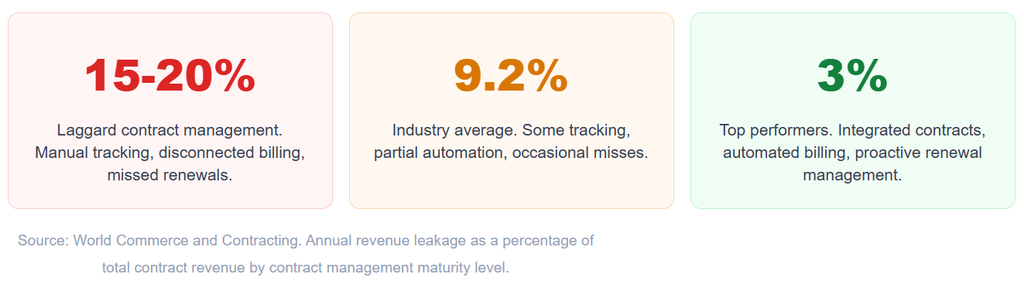
World Commerce and Contracting research found that the average organization loses 9.2 percent of annual revenue through missed deadlines, unfavorable renewals, and overlooked contract terms. Top performers keep this below 3 percent. Laggards lose 15 to 20 percent. The difference is not company size. It is how actively contracts are managed.
For a security company generating $2 million in annual contract revenue, that gap between average and best-in-class contract management represents $124,000 per year in recoverable value. That is not money a client refused to pay. It is money the company failed to invoice correctly because the contract terms and the billing system were not connected.
What Standard Contract Management Guides Miss for Security Companies
Every existing guide on contract management software covers the same categories: version control, digital signatures, renewal alerts, and clause libraries. These are general business contracting features that apply to procurement departments in large organizations. They are not the features that solve the specific operational problems of a security company managing 80 recurring service contracts across multiple client sites.
The security industry has three contract management challenges that generic CLM (contract lifecycle management) software addresses inadequately and that purpose-built or well-configured billing and account management systems handle correctly.
Multi-site contract structures with site-level service specifications
A security company with a single corporate client may service 12 separate locations under one master contract, each with a different guard posting schedule, different hourly rate, different alarm monitoring configuration, and different response protocol. The master contract governs the overall relationship. Each site has its own service specification that determines the actual billing. Generic contract management software tracks the master contract. It typically does not track the site-level service specifications as linked records that connect individually to the billing engine. This gap is where line-item billing errors accumulate invisibly.
Compliance documentation tied to specific sites and staff
Security companies face payroll complications managing different pay rates, overtime calculations, and shift premiums across various contracts, as well as client reporting demands for incident reports, guard logs, and performance metrics for different client requirements. The compliance record for a given site, including guard licensing, background check status, insurance certificates, and incident logs, is not separate from the contract. It is part of the contractual performance record and must be accessible alongside the contract and billing data, not in a separate file system that someone has to cross-reference manually.
Rate escalation clauses that never get billed
Many security service contracts include Consumer Price Index escalation clauses or fixed annual rate increases of 3 to 5 percent. The contract says the rate increases on January 1st of each service year. The billing system was configured at contract start with the Year 1 rate. Nobody updated it. The client is now in Year 3 of a contract that specifies Year 3 rates, and the billing system is still running Year 1 rates. A price increase written into a contract but never billed is one of the primary patterns of revenue leakage in contract-heavy service businesses. Without a system where the contract record drives the billing configuration, this happens silently across multiple clients until someone audits the contracts against the invoice history.
What a Complete Security Client Contract Record Must Contain
The contract record is not just the signed PDF. It is the operational data structure that drives billing, compliance, and account management throughout the engagement. The following example shows a well-structured client contract record for a multi-site security client.
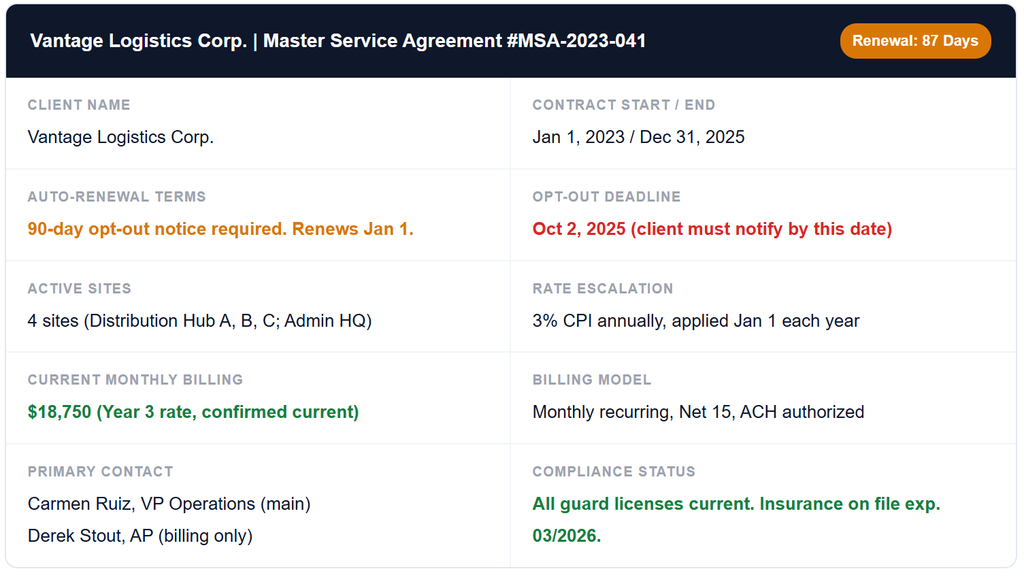
The auto-renewal opt-out deadline in red is the most critical field in the record above for a security company’s revenue protection. A client who sends a termination notice on October 3rd, one day after the opt-out window closes, is contractually obligated to another full term under most security service agreements. Without that field surfacing in the account manager’s dashboard at the right time, the company might receive a late October termination letter and assume they need to honor it, walking away from three months of contracted revenue they were legally entitled to collect.
The Security Contract Lifecycle: Where Integration Matters Most

Steps 3 and 5 are where most security company revenue leakage occurs. At Step 3, the contract is signed and the billing is configured, but the two are linked only by whoever manually enters the rate into the billing system. At Step 5, an amendment is executed, a site is added or removed, and the billing system may or may not be updated depending on whether the person who processed the amendment also updated the invoice. In an integrated system, the contract record is the billing configuration. The billing system reads from the contract. No manual transfer step means no manual transfer error.
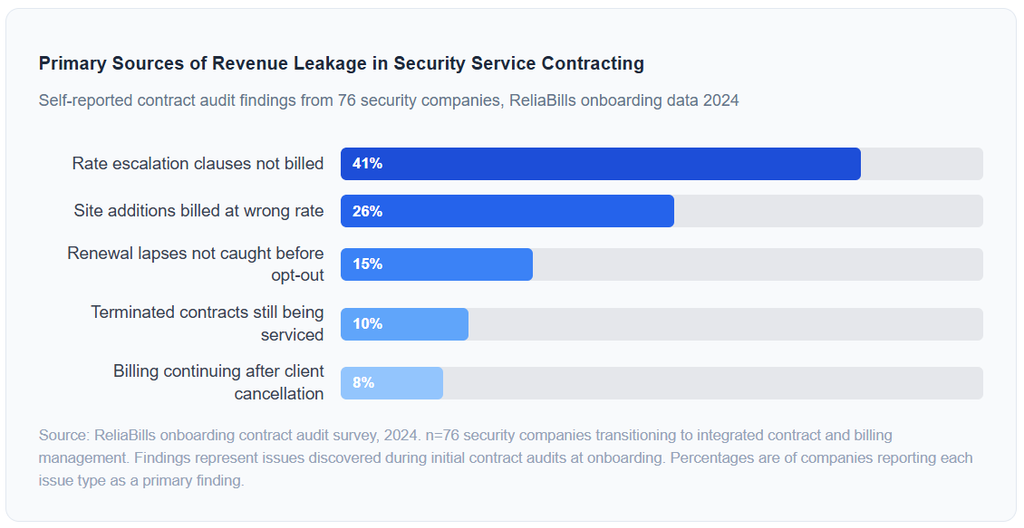
The 41 percent figure for unbilled rate escalation clauses is the one that surprises security company owners most consistently. These are not hidden charges or disputed items. They are contractually agreed rate increases that the company itself failed to collect because the billing system was not connected to the contract that authorized the increase. The audit process that surfaces this finding during onboarding typically recovers $8,000 to $25,000 in backbilled revenue for a 50-account security company, which more than justifies the system transition cost in the first quarter.
Managing Multi-Site Clients Without Losing Site-Level Detail
The multi-site client structure is the most complex data management challenge specific to security company contracting, and it is where generic customer relationship management tools most consistently fall short. A corporate client with five locations is not five clients. It is one client relationship with five service records, five billing configurations, five compliance documentation sets, and five individual points of contact who each need site-specific communication.
The account hierarchy that works for multi-site security clients is a parent-child structure: one master client account that holds the master service agreement, billing terms, primary contacts, and consolidated payment history; linked to individual site records that each hold the specific service specifications, guard assignments, incident logs, site contact, and site-level billing detail.
Security Contract Management: Integrated System vs. Disconnected Tools
| Function | Disconnected Tools (spreadsheet + email + separate billing) | Integrated Contract + Billing System | Business Impact |
|---|---|---|---|
| Contract storage | PDF in shared folder, terms in separate spreadsheet | Contract record with structured fields linked to billing configuration | Eliminates manual rate transfer errors at contract start and amendment |
| Renewal tracking | Calendar reminder if someone added it; often missed | Automated 90/60/30-day alerts from the contract end date field | Prevents silent lapses of auto-renewal opt-out windows worth months of revenue |
| Rate escalation billing | Someone must remember to update the invoice each January | Escalation clause triggers a billing update automatically at the configured date | Eliminates the 41% of accounts with unbilled rate increases |
| Site-level billing | One invoice, total calculated manually from the site spreadsheet | Individual site billing records roll up to the parent account invoice automatically | Makes site additions and removals a single record change, not a math update |
| Compliance documentation | Separate folder system; no link between guard records and client account | Guard licenses and insurance certificates attached to site records within the client account | Single screen answers client compliance questions during audits or incidents |
| Amendment management | Email approval, PDF appended to folder, billing updated if remembered | Amendment record stored in contract; billing configuration updates from amendment | Closes the amendment-to-billing gap that accounts for 26% of site billing errors |
| Payment history by contract | Bank records only; no contract-period linkage | Payment history linked to specific contract period; supports disputes and audits | Provides complete documentation in any client dispute about what was paid when |
Setting Up an Integrated Contract and Customer Management System for Security Companies
Audit every active contract before configuring the system
Before migrating to an integrated system, audit every active contract against its current billing configuration. Identify rate escalation clauses that have not been applied, sites that have been added or removed without billing updates, and renewal dates that are approaching without a defined response plan. This audit typically reveals the scope of the disconnected-system problem and quantifies the recoverable revenue. Run the audit first; configure the system to reflect the correct current state rather than migrating the errors.
Build the master client account structure with site-level records
Create one parent account per client with all master service agreement fields, primary contacts, and consolidated billing terms. Under each parent account, create individual site records for every service location, each with its specific service schedule, post configuration, site contact, billing amount, and compliance documentation. The parent account holds the relationship. The site records hold the operational detail. This hierarchy is what makes multi-site changes manageable and what gives you an accurate per-site profitability picture that a flat single-account structure cannot provide.
Configure billing from the contract record, not from memory
For each active contract, configure the recurring billing from the contract field values: the current monthly rate (reflecting all applied escalations), the billing date, the payment terms, and the authorized payment method. Set rate escalation triggers from the contract’s escalation clause so the billing system updates the charge amount automatically at the configured date without manual intervention. ReliaBills supports this kind of account-level billing configuration where recurring charge amounts can be set to update on a defined schedule, removing the annual January billing update task from the operations team’s calendar entirely.
Set up renewal alerts at 90, 60, and 30 days before contract end
Every contract record must have automated renewal alerts configured at the 90-day, 60-day, and 30-day thresholds before the contract end date, with the opt-out notice deadline calculated and displayed prominently in the account view. The 90-day alert goes to the account manager for proactive client outreach. The 60-day alert escalates if no renewal confirmation is in the record. The 30-day alert goes to senior management for any contract still without a renewal or termination confirmation. This sequence ensures no renewal decision happens by default rather than by choice.
Link compliance documentation to site records rather than client-level folders
Guard license records, background check confirmations, and site-specific insurance certificates belong attached to the site record where that guard works, not in a general client folder. When a client calls about compliance status for a specific location, the account manager should be able to pull the site record and see the current status of every compliance item on one screen. When a guard’s license renewal is due, the system should surface that in the site record’s compliance field rather than requiring a separate license tracking system to be consulted.
Connect the client account portal for self-service invoice and contract access
Clients who can access their own invoice history, current contract terms, site service records, and payment history through a client portal generate fewer inbound calls and questions than those who rely on account managers to retrieve this information on request. For security companies whose clients include corporate facilities managers and property management firms, portal access to contract documentation and billing history is often expected as part of a professional service relationship. Connecting the portal to the integrated system means the client sees the same data the account manager sees, without requiring the account manager to produce reports on demand.
Common Mistakes and What I Got Wrong at First
Migrating to a new system without auditing the existing contracts first
The temptation when adopting integrated contract management software is to import the existing client and contract data as quickly as possible and then optimize from there. The problem is that existing data in security companies almost always contains billing discrepancies that get imported alongside the clean data. Rate escalations not yet applied, sites at wrong rates, and terminated accounts still active in the billing system. Importing these without an audit means spending the first six months of the new system correcting problems that should have been resolved before migration. Audit first, import clean, and configure correctly from day one.
Treating the contract PDF as the contract record
Storing the signed PDF in a folder and calling it contract management is how the revenue leakage problem stays invisible. The PDF is the legal document. The contract record is the structured data that the billing and operations systems read from to perform their functions. A PDF cannot trigger a 90-day renewal alert. A PDF cannot update the January billing amount when the escalation clause activates. A PDF cannot tell you which of your 80 contracts renews in the next 60 days without someone opening and reading each one. The record must be a structured data object, not just a document file.
Setting up billing at the client level for multi-site clients
The most common multi-site billing error is configuring one recurring billing entry at the master account level with the total monthly charge across all sites. This works until any site-level change occurs. A site gets added, removed, or repriced. The account manager updates the service schedule. The billing total is not automatically adjusted because the billing was not linked to the individual site records. Moving to site-level billing records, where each site has its own recurring charge that feeds into the parent account’s monthly total, makes every site-level change a single record update rather than a manual recalculation of the combined total.
Not documenting rate escalation application in the contract record
When a 3 percent annual escalation is applied to a contract’s billing amount in January, that application needs to be recorded as an event in the contract history, with the old rate, the new rate, and the date of change documented. Without this record, a client who disputes the rate increase two months later has no clear audit trail to reference. The contract says the rate increases. The billing shows the increase. But without a documented application event, the account manager must reconstruct the calculation from memory or external documents. The record event makes the answer immediate and indisputable.
Using the same renewal alert timeline for all contract terms
A contract with a 90-day opt-out notice requirement needs renewal alerts starting at 120 days before expiration to give the account manager enough lead time to engage the client before the opt-out window opens. A contract with a 30-day opt-out requirement can use a 60-day lead alert. Configuring all contracts with the same 30-day renewal alert and then discovering that several clients had 90-day opt-out windows that are now closed is one of the most recoverable-but-painful errors in security contract management. Every contract’s alert timeline should be configured from its specific opt-out notice requirement, not from a global system default.
Frequently Asked Questions
1. What is security contract management software?
Security contract management software is a platform that centralizes the creation, execution, tracking, and billing of service contracts for private security companies. It connects contract terms directly to recurring billing so that rate changes, scope adjustments, and renewal events trigger the correct billing actions automatically rather than requiring manual updates. For security companies managing recurring patrol contracts, monitored alarm accounts, or staffed guard services, it connects field operations, client account management, and invoicing in one place rather than across disconnected spreadsheets and tools.
2. How much revenue do security companies lose to poor contract management?
World Commerce and Contracting research found that the average organization loses 9.2 percent of annual revenue through missed deadlines, unfavorable renewals, and overlooked contract terms. Top performers keep this below 3 percent. For a security firm at average contract management maturity generating $2 million in annual revenue, closing that gap to best-in-class performance represents approximately $124,000 per year in recoverable revenue. The primary sources of leakage in security companies specifically are unbilled rate escalation clauses, site additions billed at incorrect rates, and auto-renewal opt-out windows missed because no one was tracking the deadline.
3. How should security companies handle multi-site client billing?
Multi-site clients require a parent-child account structure: one master client account linked to individual site records, each with its own service specification, billing amount, site contact, and compliance documentation. Billing should be configured at the site level, with each site’s recurring charge contributing to the parent account’s monthly invoice total automatically. This structure makes site additions and removals a single-record change rather than a manual recalculation of the combined total and provides per-site billing visibility that a flat single-amount billing structure cannot support at scale.
4. What is the difference between contract management software and CRM for security companies?
A CRM manages the sales pipeline, client relationship data, and communication history before and during the sale. Contract management software governs what happens after signature: service specifications, billing terms, renewal dates, compliance documentation, amendment history, and the connection between contract terms and billing configuration. Most security companies need both, either as integrated modules or connected systems, because managing client relationships well requires different data and workflows than managing the operational execution of active service contracts. The gap between the two is where revenue leakage most commonly occurs.
5. How should security companies set up renewal tracking?
Renewal tracking should be automated from the contract’s end date field, configured to alert the account manager at 90 days, escalate at 60 days if no renewal confirmation is recorded, and reach senior management at 30 days for any contract without a renewal or termination decision. The opt-out notice deadline should be calculated from the contract’s specific opt-out requirement and displayed prominently in the account record, because a 90-day opt-out clause requires alerts starting at 120 days before contract end, not at the 90-day mark most generic systems default to. Every contract’s alert timeline should be configured from its specific opt-out notice requirement.
6. How does recurring billing connect to security service contracts?
In an integrated system, the contract record is the source of truth for the billing configuration. The contracted rate, billing frequency, payment terms, and any scheduled rate escalations are stored in the contract and drive the recurring billing setup. When an annual escalation clause triggers, the billing platform updates the charge amount from the contract record automatically rather than requiring a manual invoice change. When a site is added mid-contract, the billing adjustment flows from the amendment to the invoice without a separate manual step. This contract-to-billing connection eliminates the most common revenue leakage pattern: services delivered at the new rate while billing continues at the old rate because no one updated the invoice configuration.
Recent Articles:
- Customer Data Management for Pet Service Businesses: Track Pet and Owner Records
- CPA Invoice Template: What to Include for Professional Client Billing