
A CPA invoice is the one document that a client’s finance team reads carefully every time it arrives. It forms an opinion of the firm. The most common billing problems in accounting practices, delayed payments, scope disputes, and client questions about line items, do not come from charging too much. They come from invoices that are ambiguous about what was done, when, and why the charge is the amount it is. A well-structured CPA invoice template eliminates that ambiguity and converts the billing moment from a potential friction point into a routine confirmation of professional quality.
What is a CPA Invoice Template?
A CPA invoice template is a standardized billing document used by certified public accountants and accounting firms to request payment from clients for professional services rendered. Unlike generic invoices, it includes CPA-specific fields: the firm’s license number and state of licensure, engagement letter references that link each charge to an authorized scope of work, service period coverage (particularly important for tax returns, where the return year matters as much as the billing date), itemized line items organized by service type (tax preparation, bookkeeping retainer, payroll processing, advisory hours, and audit work), and clearly separated reimbursable expenses. A CPA invoice template connects directly to the firm’s invoicing software, populates from the engagement letter and billing model configuration, and may trigger recurring billing for retainer clients or installment billing for larger project engagements. For firms managing multiple clients across multiple billing models, it sits at the center of the firm’s client account management system.
What the Top CPA Invoice Guides Consistently Miss
Every existing guide on CPA invoice templates covers the basics: firm name, client name, invoice number, due date, line items, and total. These are necessary but not sufficient. The fields that actually prevent billing disputes and delayed payments in CPA practices are the ones that tie each invoice to its contractual basis, distinguish the current period’s charges from prior balances, and make the scope boundary unmistakably clear to a client who may have assumed certain services were included in their retainer when they were not.
The friction in professional billing is rarely the amount. It is a surprise. Fixed fees and retainers invoice cleanly because the number is expected. The surprise is when the client sees a charge they did not anticipate, whether an out-of-scope service, a reimbursable expense, or a year-end adjustment that was not communicated in advance.
This guide builds the CPA invoice template from the ground up, covering every required field, the edge cases specific to accounting billing models, and the transition from a static template to an automated billing system that handles recurring and one-time engagements without manual invoice construction.
Every Field a CPA Invoice Template Needs
The field structure below covers a complete CPA invoice. Each field is marked as required, recommended, or optional depending on the billing context. The “required” designation reflects both professional best practice and, in some cases, state licensing board requirements for professional document disclosure.
| Field | Status | Notes and Edge Cases |
|---|---|---|
| Firm name, address, phone, email | Required | Use the firm name exactly as registered with the state CPA board. Inconsistency between the invoice name and the engagement letter creates questions about which entity the client is paying. |
| CPA license number and state | Required | Required on attest service documents in most jurisdictions; best practice on all client billing. Verifiable by the client’s accounts payable team for compliance purposes in larger organizations. |
| Firm EIN or Tax ID | Required | Business clients need the firm’s EIN for their accounts payable records and 1099 issuance purposes. Omitting it creates a routine request every year from clients who should not have to ask for it. |
| Client name and billing address | Required | Use the entity name exactly as it appears in the engagement letter. Billing to “John Smith” when the engagement is with “Smith Family Trust” creates account reconciliation problems for the client. |
| Client ID or matter number | Recommended | Essential for firms with multiple entities per client household. A family with a personal return, an LLC, and a trust generates three separate billing tracks that must be distinguished on each invoice. |
| Unique invoice number | Required | Sequential format by client (001-0047 for client 001, invoice 47) or by date and sequence. The invoice number is the primary reference for any follow-up and must appear on all payment remittances. |
| Invoice date | Required | The date the invoice is issued, not the date services were performed. For tax return billing, the invoice date and the return year must both appear to avoid confusion about what tax period is being billed. |
| Service period covered | Required | Especially critical for retainer clients and hourly billing. “Services rendered: July 1 through July 31, 2025” removes all ambiguity about what month’s work is being invoiced and prevents double-billing questions. |
| Payment due date and terms | Required | State the due date explicitly, not just “Net 30.” A client whose billing date is July 1 and whose terms are Net 15 needs to see “Due: July 15, 2025” to process payment against their own payables schedule. |
| Engagement letter reference | Required | Every charge on the invoice must connect to an authorized engagement. The reference number prevents “we never agreed to this” disputes and accelerates accounts payable approval in clients with formal procurement processes. |
| Tax year (for tax services) | Required | List the tax year explicitly on every tax preparation line item. A 2024 individual return billed in 2025 should say “2024 Form 1040 preparation” not just “tax return preparation.” The year is the deliverable identifier. |
| Return type and schedules | Recommended | List each return form and each included schedule as a separate line or sub-line. Clients who later add a Schedule C should see it as a distinct charge, not a silent upward adjustment to the base return fee. |
| Hourly rate and hours by staff level | Required (hourly) | For hourly engagements, each billing line must show the staff member or role, the hourly rate, and the hours worked. Blended rate billing without disclosure is difficult to defend if a client requests a breakdown. |
| Reimbursable expenses (separate section) | Required | Always separate from service fees. Each expense line needs a description, date, and amount. Attach receipts or provide a receipt reference number. Folding reimbursables into service line totals is the most common billing transparency dispute in accounting practices. |
| Late fee policy | Recommended | State the late fee amount and grace period on every invoice, referencing the engagement letter section that authorizes it. Clients who later dispute a late fee cannot credibly claim they were unaware of the policy if it appears on every invoice they received. |
| Payment methods and portal link | Required | Clients who receive an invoice without payment instructions must make an extra contact to find out how to pay. Every additional step between receiving the invoice and paying it increases average days to payment. Include an online payment link on every invoice. |
| Outstanding balance from prior period | Recommended | Show the balance from the previous billing period at the top of the invoice if applicable. Clients who carry a balance and receive a new invoice without prior balance visibility are more likely to pay only the new invoice and leave the prior balance unresolved. |
A CPA Invoice Template: Annotated Full Example
The invoice below shows a multi-service client billing that includes a monthly retainer, out-of-scope advisory work, and reimbursable expenses, all in the same billing period. This is the most complex common scenario and the structure that causes the most disputes when handled poorly.
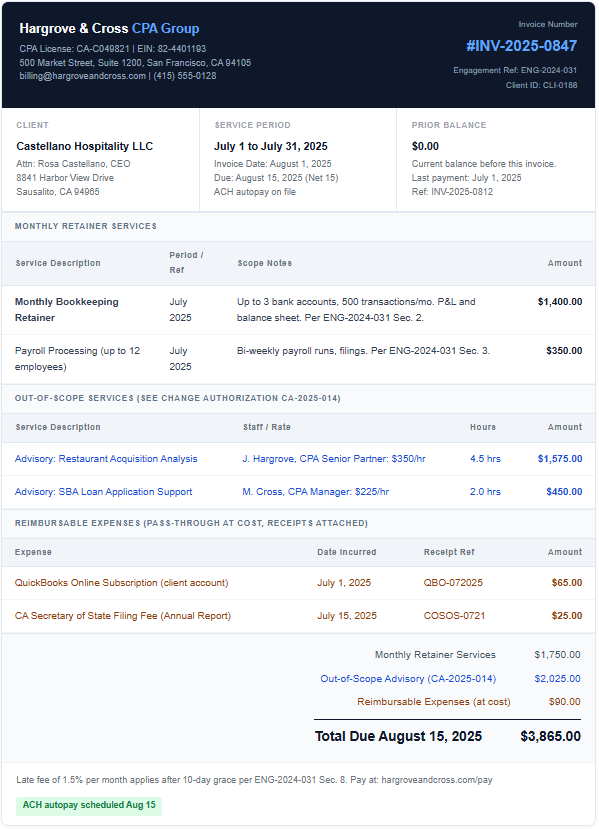
Several structural choices in the invoice above prevent the most common billing disputes in CPA practices. The prior balance field, shown as $0.00, gives the client immediate confirmation that the account is current before they see the current month’s charges. The out-of-scope advisory work appears in its own clearly labeled section, referencing the change authorization number that the client signed. The reimbursable expenses are at cost with individual receipt references, not folded into service totals. The late fee policy and payment link appear in the footer so they are visible without scrolling and without a separate communication.
How CPA Invoice Structure Changes by Billing Model
CPA firms typically use three billing models, sometimes on the same client account. The invoice structure must adapt to each model while maintaining visual consistency so clients can orient themselves quickly regardless of which engagement type generates a given invoice.
Hourly billing invoices
Each service line must show the staff member or staff level, the hourly rate, the hours worked in the billing period, and the line total. Time descriptions should be specific enough to justify the time, not generic (“research and analysis” is not specific; “research California nexus implications of proposed Nevada office opening, 3.5 hrs” is). For engagements with multiple staff billing at different rates, use a timesheet summary format that groups hours by staff member rather than a single blended line, which clients often question.
Retainer billing invoices
The retainer amount and the scope it covers should be stated on every monthly invoice, not just in the original engagement letter. A client who has been on retainer for 18 months may have forgotten exactly what the retainer covers, and the invoice is the document they reference when they wonder whether a specific request falls inside or outside the scope. List the package price and itemize what is included. Always be transparent about what services are covered. Out-of-scope services appear in a separate section with a change authorization reference, never silently merged into the retainer line.
Fixed-fee and tax preparation invoices
For tax return preparation, every invoice must identify the return by form number and tax year. Invoice per return type, such as Form 1040 or Form 1120 or Form 1065, with clear descriptions. List additional schedules, state returns, or amendments as separate line items. A client who pays for a 1040 with Schedule C and E should see those three line items, not a single “tax preparation” fee. This level of specificity removes the guesswork when the fee changes year over year because the return complexity changed.
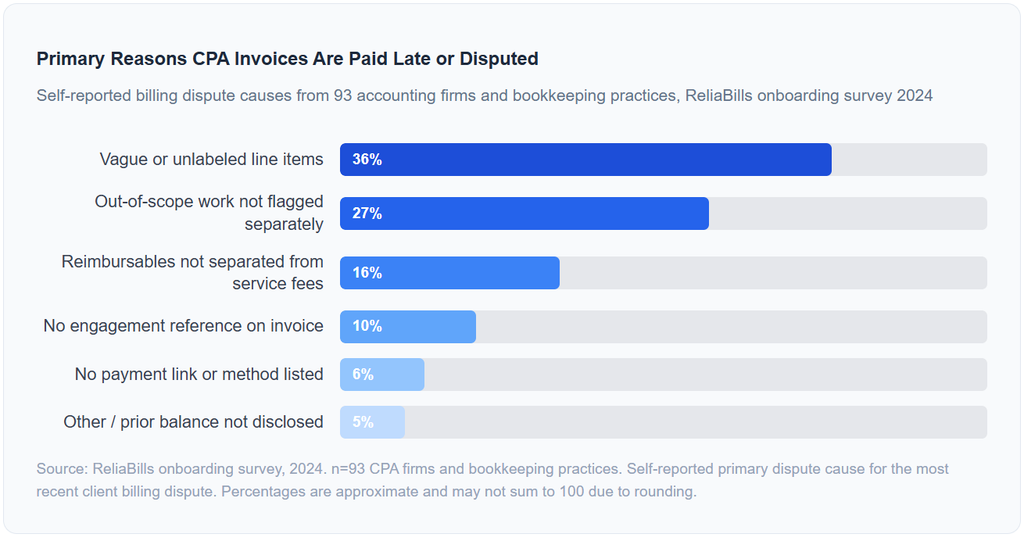
The top two categories, vague line items and out-of-scope work that is not clearly flagged, account for over 60 percent of billing disputes in the firms surveyed. Both are template structure problems, not pricing problems. A client who disputes a line item labeled “advisory services, July” is not necessarily disputing the amount. They are disputing the lack of information that would let them process the payment with confidence. Specificity is the fix, not a discount.
CPA Invoice vs. Related Billing Documents
| Document | Purpose | When Generated | Contains |
|---|---|---|---|
| CPA invoice | Requests payment for a specific service or billing period | Monthly, at project completion, or at a defined milestone | Current charges, reimbursables, payment terms, prior balance summary |
| Billing statement | Account-level summary of invoices, payments, and balance | Quarterly or annually for multi-engagement clients | All invoices issued, all payments received, current total outstanding |
| Engagement letter | Establishes the authorized scope and fee structure before work begins | At the start of each engagement or annually at renewal | Scope definition, fee amount or rate, billing model, payment terms, termination conditions |
| Change authorization | Authorizes additional work outside the original engagement scope | When client requests out-of-scope work | Description of additional work, fee, timeline impact, client signature |
| Receipt / payment confirmation | Confirms that a specific payment was received | Immediately upon payment processing | Invoice reference, amount paid, payment method, date |
| Deposit request | Requests upfront payment before work commences | At engagement start for new clients or tax preparation engagements | Deposit amount, project total, balance due on completion |
Collecting a Deposit Before Tax Season: The Invoice Structure That Works
Many CPAs collect 50 percent upfront for new clients. For tax return preparation specifically, a deposit invoice sent when the engagement letter is signed achieves two things simultaneously: it confirms the client’s commitment before the firm allocates staff time, and it funds the work before the highest-cost preparation period. The deposit invoice is a distinct document from the completion invoice. It should clearly identify the project, the total fee, the deposit amount, and the balance due upon delivery of the completed return.
When a Template Is No Longer Enough: Moving to Automated CPA Billing
A well-designed CPA invoice template in Word or Excel works effectively up to about 30 active clients. Above that, the per-client time cost of populating, reviewing, and sending individual invoices becomes material. A firm spending 20 minutes per client invoice at 50 clients is investing over 16 hours per month in billing administration. At 100 clients, it is a part-time job.
The shift to automated billing does not mean losing the professional quality of a carefully structured invoice. It means generating that same invoice structure from data the firm already has in its engagement and time tracking system, without rebuilding it manually each cycle. Retainer clients on recurring billing receive their monthly invoice automatically, generated from the retainer configuration, with the engagement reference and period auto-populated. Hourly clients receive invoices generated from approved timesheets. Tax preparation clients receive deposit requests and completion invoices triggered by workflow status changes, not by a staff member remembering to build them.
ReliaBills supports this kind of billing model configuration at the client account level, allowing CPA firms to configure each client’s billing structure once and generate consistent, professional invoices automatically each cycle. The template quality is maintained. The manual construction time is eliminated. The client account management layer keeps the full billing history, engagement references, and communication log in one place, accessible immediately if a client questions any charge from any period.
Common Mistakes and What I Got Wrong at First
Describing line items at the task level rather than the deliverable level
Early invoice templates used task-level descriptions: “email correspondence,” “phone calls,” “review of documents.” These descriptions tell the client what the accountant did but not what they accomplished, which makes the fee feel less justifiable than the same hours described as “review of Q2 financial statements and communication with bookkeeper to resolve accounts payable discrepancy.” Reframing line items around deliverables and outcomes rather than activities both reduces disputes and reinforces the value of the work being billed.
Burying reimbursable expenses inside service line totals
The most common reimbursable expense mistake is adding the QuickBooks subscription, a state filing fee, and an overnight delivery charge to the service fee total and presenting one combined number. Clients who later notice the combined total does not match the agreed retainer amount ask questions. Clients who receive a clearly labeled reimbursable section at cost, with receipts available, almost never do. Separate sections for service fees and reimbursables are not optional for professional CPA billing. They are what distinguishes transparent professional billing from opaque invoicing that invites scrutiny.
Not referencing the engagement letter on invoices for out-of-scope work
The most expensive billing dispute pattern in CPA practices is the “we never agreed to that” conversation about advisory or project work that was requested informally, performed without a change authorization, and billed on the next invoice without any reference to what authorized it. Every out-of-scope service on a CPA invoice must cite a change authorization number or at minimum a written communication reference. If that document does not exist before the work is billed, the firm’s negotiating position is weaker than it should be regardless of whether the work was genuinely requested.
Sending invoices without a payment link
An invoice that tells a client how much they owe but not how to pay it adds friction that delays payment. Every step a client must take between receiving the invoice and completing the payment increases average days to collection. An online payment portal link in the invoice footer, a specific ACH instruction, or a QR code that goes directly to the payment page removes that friction entirely. The difference between “please remit payment” and “pay now at hargroveandcross.com/pay” is a measurable reduction in average days to payment that requires a one-time template update.
Using the same invoice template for all billing models without section headers
A CPA firm that bills some clients hourly, some on retainer, and some on fixed-fee project terms and uses a single invoice template without adapting the section structure for each model produces invoices that are confusing to parse. The retainer client who sees “hours” fields on their invoice wonders if they are being billed hourly. The hourly client who sees a retainer-formatted invoice wonders if they agreed to a monthly fee. Section headers that identify the billing model for each section, along with the engagement reference that confirms the terms, eliminate both types of confusion in one template update.
Frequently Asked Questions
1. What should a CPA invoice include?
A CPA invoice should include the firm’s name, address, CPA license number, and EIN; the client’s name and billing address exactly as they appear in the engagement letter; a unique invoice number; the invoice date and payment due date; the service period covered; an engagement letter reference number; itemized line items organized by service type with specific descriptions; reimbursable expenses in a clearly labeled separate section at cost with receipt references; the payment methods accepted, including an online payment link; and the late fee policy. For tax return billing, each return must be identified by form number and tax year. For hourly billing, each line must show the staff member or role, rate, and hours.
2. Does a CPA invoice need to show a license number?
In most U.S. jurisdictions, CPAs must include their license or certificate number on professional documents when providing attest services, and it is best practice to include it on all client billing. The license number confirms regulatory standing, distinguishes the firm from non-CPA accounting services, and gives the client’s accounts payable team verification information that can accelerate invoice approval in larger organizations. Check your state CPA society’s guidelines for specific disclosure requirements in your practice area.
3. How should reimbursable expenses appear on a CPA invoice?
Reimbursable expenses must appear in a clearly labeled separate section, never folded into service fee line totals. Each expense needs a description, the date incurred, the amount, and a receipt reference number. Common reimbursables include software subscriptions purchased on the client’s behalf, state filing fees, e-file fees, certified mail, and any third-party costs passed through at cost. Presenting reimbursables transparently at cost, with receipts available, is one of the simplest and most effective ways to prevent the most common category of CPA billing dispute.
4. How should CPA invoices handle out-of-scope work?
Out-of-scope work should always appear in a clearly labeled separate section on the invoice, distinct from the regular retainer or project fee. Each out-of-scope line item must reference the change authorization number or the written communication that authorized the work. If no written authorization exists before the work is invoiced, the firm’s position in any dispute is weaker than it should be. Never silently fold out-of-scope charges into the regular service total. The “we never agreed to that” conversation is almost entirely preventable through change authorization discipline and clear invoice section labeling.
5. Should CPAs collect a deposit before starting work?
Yes, for new clients and tax preparation engagements. Many CPA practices collect 50 percent upfront for new clients and for tax return preparation, where the deliverable is a completed return. The deposit request is a separate invoice at engagement start, clearly identified as a deposit with the total fee, the deposit amount, and the balance due upon completion. The engagement letter should reference the deposit policy. Clients who object to a reasonable deposit requirement are sometimes signaling that their payment reliability warrants extra caution at the outset.
6. When should a CPA firm move from invoice templates to billing software?
The practical threshold for most CPA firms is around 30 active billing clients. Below that, a well-structured Word or Excel template is manageable if populated consistently. Above 30 clients, the per-invoice time cost of manually populating, reviewing, and sending individual invoices becomes material enough to justify dedicated billing software. A firm spending 20 minutes per invoice at 50 clients is investing over 16 hours per month in billing administration. Billing software that generates invoices automatically from engagement configurations and approved timesheets converts those 16 hours to under 3 hours of exception review and maintains the same invoice quality throughout.
Recent Articles:
- How to Reduce Overdue Accounts with Collection Automation for Pool Companies
- How to Handle Failed or Declined Membership Payments Automatically