
Pool service companies carry more overdue receivables than almost any other home service category because their billing model creates a specific vulnerability: service is delivered continuously before payment is confirmed. The fix is not more aggressive follow-up. It is moving the payment event before the service event, automating every step of the reminder and recovery cycle, and defining service suspension as a documented, policy-driven process rather than an awkward last resort. Most pool companies that implement these three changes cut their overdue accounts by 40 to 60 percent within 90 days without changing a single customer relationship.
What is Pool Service Collection Automation?
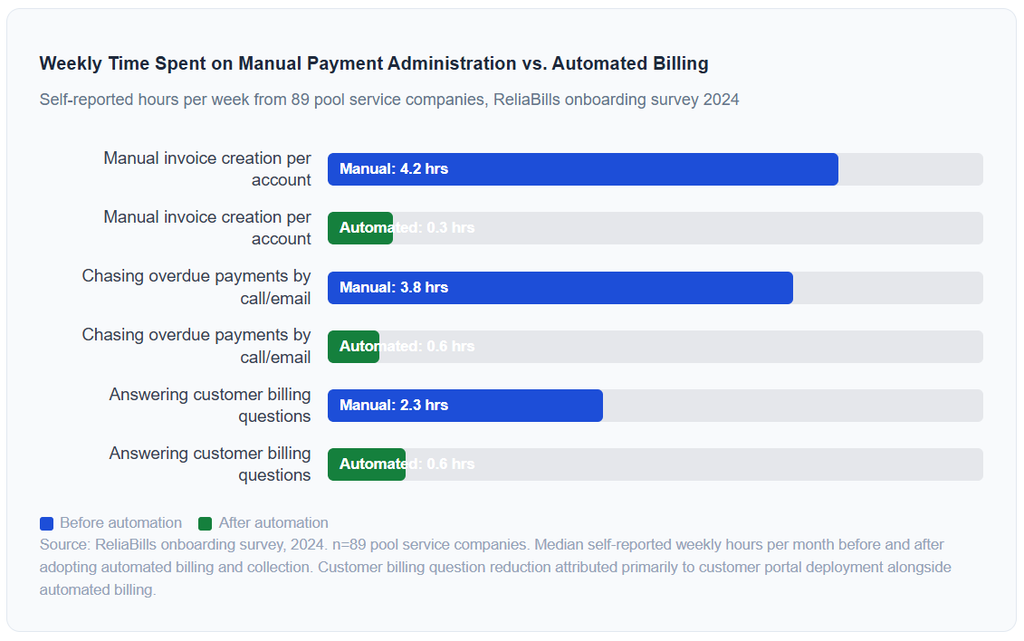
Pool service collection automation is the use of billing software to manage the payment follow-up cycle for recurring service accounts without manual intervention. It encompasses automated payment reminders sent before and after the due date, automatic late fee application at configured thresholds, failed charge retry logic for declined ACH and card payments, and escalating past-due notice sequences that trigger based on invoice age. Because pool service revenue is 85 to 95 percent recurring monthly charges, the collection cycle repeats identically every month for every customer. Automating it removes the 4 to 8 hours per week that pool company owners typically spend manually chasing payments and converts those hours into route management, customer acquisition, and service quality work. Collection automation connects directly to recurring billing (the mechanism that generates the monthly charge), customer account management (the system that tracks each account’s payment history and status), and invoicing software (the document layer that gives customers a clear statement of what they owe and why).
Why Pool Companies Carry More Overdue Receivables Than They Should
The overdue accounts problem in pool service is not primarily a customer behavior problem. Most customers intend to pay. The problem is structural: the billing model that most pool companies use by default creates a receivables gap that makes late payment almost inevitable for a portion of the customer base.
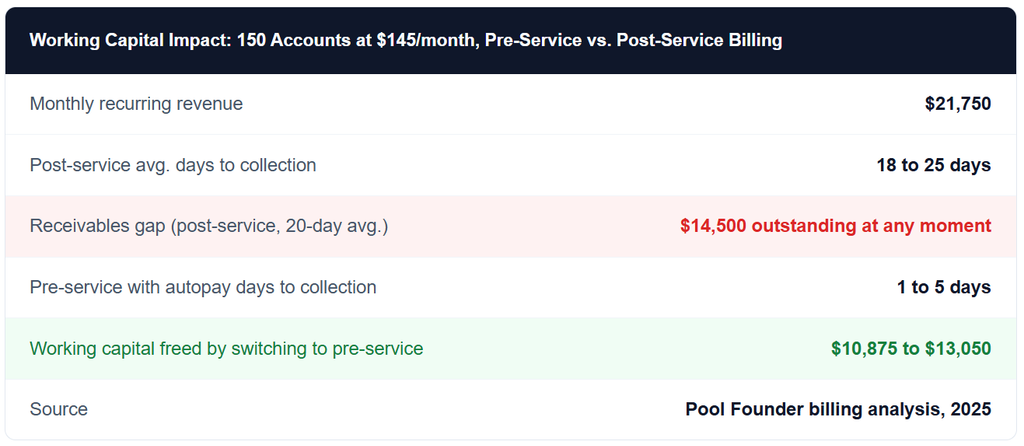
The structural issue is post-service billing. The technician services the pool, the invoice is created at the end of the month or after each visit; the customer receives it on the 1st or the 5th; and payment arrives sometime in the following two to three weeks, if it arrives at all. Every month, the company is funding service delivery with money it has not yet collected. At 150 accounts, that means the company is continuously carrying $10,000 to $20,000 in service it has delivered but not been paid for.
The broader small business data reinforces this pattern. According to The Kaplan Group’s 2025 analysis of B2B payment data, 55 percent of all B2B invoiced sales in the U.S. are overdue, and 73 percent of small businesses report that customer delinquency numbers increased over the past year. Pool service sits inside that landscape, with the added complication that its recurring service model means overdue accounts accumulate month-over-month rather than resolving after a single billing cycle.
The fix exists and is not complicated. It requires changing when billing happens, automating what happens after billing, and defining what the company does when payment does not arrive. This guide addresses all three.
Pre-Service vs. Post-Service Billing: The Decision That Determines Your Starting Receivables Gap
The single most impactful change a pool company can make to reduce overdue accounts is switching from post-service billing to pre-service billing. This is not primarily a collection automation decision. It is a business model decision that automation then executes reliably.
Pre-service billing charges on the first of the month for that month’s service. The customer pays before the service begins or authorizes autopay that collects on the 1st automatically. Pre-service billing with autopay produces 95 to 98 percent collection within five days, while post-service invoicing averages 18 to 25 days to collect.
The objection that customers will not pay in advance almost never materializes in practice when pre-service billing is combined with autopay enrollment. Customers who authorize automatic payment on the 1st of each month are not paying “in advance” in any meaningful psychological sense. The charge happens, they get a confirmation, and the pool gets maintained. The friction disappears for both parties.
For existing customers billed post-service, the migration to pre-service autopay is handled as a service agreement update at annual renewal or when a payment method change is needed. It does not require renegotiating pricing or disrupting the customer relationship. It requires updating the billing configuration and explaining the change clearly in a customer communication before it takes effect.
The Automated Reminder Sequence That Cuts Overdue Accounts by 40 to 60 Percent
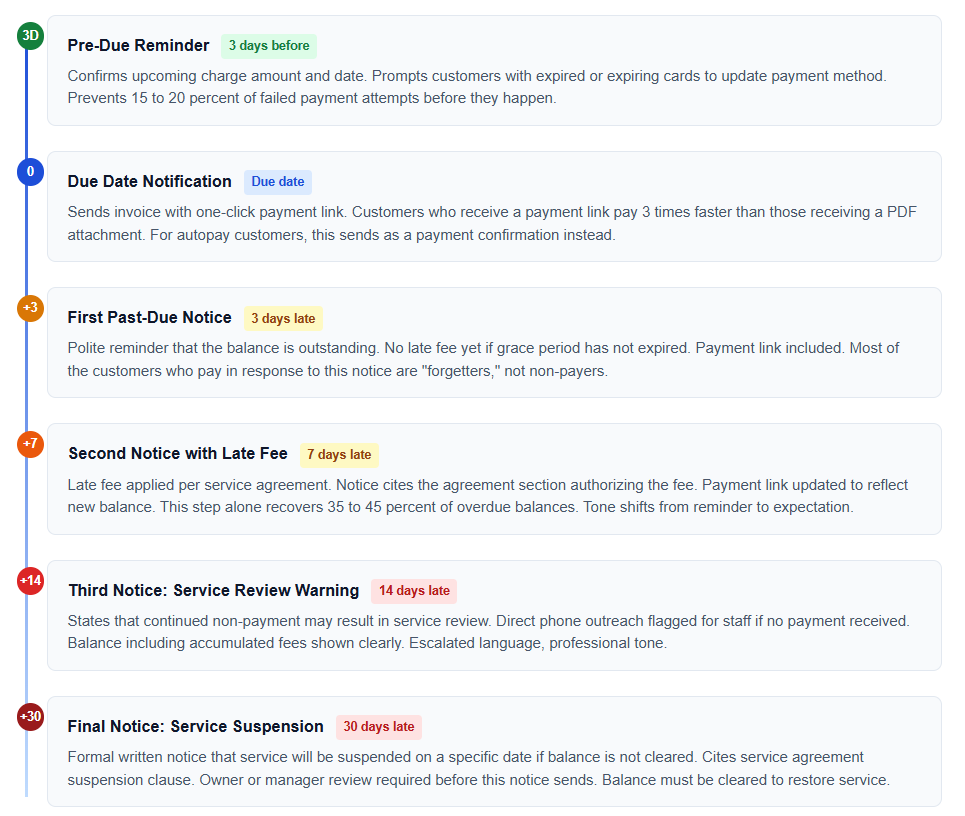
Automated payment reminders sent three days before due, on the due date, and at three, seven, fourteen, and thirty days past due reduce overdue accounts by 40 to 60 percent compared to manual follow-up. The seven-day reminder alone recovers 35 to 45 percent of overdue balances. The consistency of automated reminders is what produces these numbers, not the content of any individual message. A reminder sequence that fires reliably every time, for every customer, without anyone deciding whether to send it, removes the “forgot to chase” gap that causes most small pool companies to carry $5,000 to $15,000 in avoidable receivables.
Where Pool Service Companies Lose Time and Revenue Without Automation
Failed Payment Recovery: The Revenue Most Pool Companies Leave on the Table
A failed card charge or returned ACH in pool service billing is not a collection problem. It is almost always a payment method problem with a temporary cause: an expired card, a replacement card with a new number, a bank security flag, or a momentary account balance issue. Treating it as a customer relationship problem rather than a billing logistics problem causes unnecessary friction and missed recovery opportunities.
Automated retry logic that recharges declined cards at three and seven days after initial failure recovers 20 to 30 percent of initially failed charges without any staff involvement. Same-day retry almost never works because the conditions that caused the initial failure have not changed in four hours. A two-to-three-day delay allows payroll deposits to post, bank holds to clear, and card replacements to arrive. The retry should happen automatically, the customer should be notified on the day of failure with a link to update their payment method, and the staff should receive an alert only if both retries fail.
Managing Seasonal Billing Gaps Without Creating a Collection Problem
Seasonal pool service markets, including most of the Northeast, Midwest, and Mountain West, create a billing challenge that standard collection automation guides never address: what happens to the billing relationship when service pauses in October and resumes in April? The gap itself is not a problem. What becomes a problem is when chemical treatments, winterization charges, or equipment service performed during the off-season accumulate without clear invoicing and then appear as a large, unexplained balance when the customer gets their spring opening statement.
Most pool companies generate 85 to 95 percent of their revenue from recurring monthly service agreements, and seasonal adjustments require pausing, resuming, or changing rates mid-cycle without manual effort for every account. The billing system must support variable recurring charges and mid-cycle rate adjustments. A pool company with 120 accounts that must manually update each account’s billing amount when switching from full-service summer rates to chemical-only fall rates is doing 120 individual data entry operations every season change, each carrying its own error risk.
The right setup treats seasonal rate changes as account-level configurations set at the beginning of the season rather than manual updates triggered by the calendar. The technician marks the service type change in the field, the billing system reads that signal and adjusts the account charge accordingly, and the customer receives a notification that their service and billing are transitioning to the seasonal schedule. No manual billing intervention required for any individual account.
Service Suspension as a Collection Tool: Policy Beats Personality Every Time
Service suspension is the most powerful collection lever available to pool companies, and it is the one most owners are most reluctant to use. The reluctance is understandable. Pool service involves a personal relationship with the customer’s property, and suspension feels confrontational in a way that sending invoices does not. But the discomfort with suspension is almost entirely reduced when it is documented policy applied consistently, rather than a reactive decision made case by case by the owner.
The suspension policy must live in the service agreement that the customer signs at enrollment. It should specify the number of days past due that triggers suspension eligibility, the number of days’ written notice required before suspension takes effect, the balance that must be cleared to restore service, and whether any service charges accrue during the suspension period for ongoing chemical treatments that are still being provided. When a customer disputes the suspension, the service agreement is the answer. When no service agreement exists or its language is silent on suspension, the owner is back in the negotiation they were trying to avoid.
Collection Automation vs. Manual Follow-Up: A Direct Comparison for Pool Service
| Factor | Manual Follow-Up | Automated Collection Sequence | Impact on Receivables |
|---|---|---|---|
| Reminder consistency | Depends on owner/staff remembering to send; often irregular | Fires on every account, every cycle, without human trigger | Automation removes the “forgot to chase” gap that creates most avoidable receivables |
| Late fee application | Often inconsistent; some customers get fee, others do not | Applied automatically at the configured threshold for every account | Consistent application reduces disputes and incentivizes on-time payment |
| Failed payment recovery | Usually discovered at the next billing review; no automatic retry | Automatic retry at 3 and 7 days; customer notified same day | Recovers 20 to 30 percent of failed charges without staff involvement |
| AR aging visibility | Ad hoc; the owner checks the bank account and estimates outstanding | Real-time aging report by account showing 30/60/90-day buckets | Weekly aging review reduces collection time by 25 to 35 percent vs. reactive checking |
| Customer experience | Inconsistent communication; customers uncertain about billing status | Predictable, branded touchpoints at every billing event | Customers who understand billing status pay faster and dispute less |
| Owner time cost | 4 to 8 hours per week across 100 to 200 accounts | Under 1 hour per week reviewing exceptions and failures | Time recovered goes to route management, customer acquisition, and service quality |
| Seasonal handling | Manual account updates for each rate or schedule change | Account-level configurations updated once per season change | Eliminates a major manual workload at each season transition |
Common Mistakes and What I Got Wrong at First
Configuring automated reminders without telling customers they were coming
The first time automated billing reminders went out to a customer base that had been receiving manual, personalized follow-up from the owner, several longtime customers responded with confusion about why they were receiving what felt like generic automated dunning notices. The fix is a one-time customer communication before the first automated sequence fires, explaining that the company has updated its billing system and that customers will now receive automatic payment confirmations and reminders as a service improvement. Framing automation as a customer benefit, rather than letting customers discover it unexpectedly, removes most of the friction.
Applying late fees before updating the service agreement
Automatic late fee application is one of the highest-value automation features for reducing overdue accounts, but it only holds up if the service agreement explicitly authorizes the fee. A late fee applied by the automated system to a customer whose service agreement does not mention late fees is a fee the customer can legitimately dispute, and the company will lose. Update the service agreement template to include the late fee amount, grace period, and the basis for the fee before enabling automated late fee logic in the billing system. Send the updated agreement to existing customers at annual renewal.
Setting the same reminder tone for every stage of the sequence
A reminder sequence where every message uses the same neutral tone provides almost no escalation signal to the customer. The pre-due reminder should be informational and helpful. The due-date notification should be clear and actionable. The seven-day past-due notice should be noticeably more direct in tone and should include the late fee application. The fourteen-day notice should reference the service suspension policy. If every message sounds like the first one, customers have no reason to prioritize the later ones over their other bills. Tone escalation is a feature, not an accident.
Not reviewing the AR aging report weekly
Companies that review aging reports weekly collect 25 to 35 percent faster than those that check receivables reactively. Setting up automation and then not monitoring the aging report is like installing a smoke detector and never testing the battery. The automated sequence handles most overdue accounts. The aging report surfaces the ones the sequence did not recover, which are the accounts that need human intervention before they cross into the 60-plus-day column, where collection becomes materially harder.
Enrolling all customers in autopay but not verifying payment method accuracy
A bulk autopay enrollment where customers authorize automatic billing without verifying their stored payment details is a collection event waiting to fail. A customer whose card number changed six months ago, whose bank account has a different routing number, or whose billing address no longer matches their card’s file will generate a failed charge on the first autopay attempt. Build a payment method verification step into the autopay enrollment flow and configure the pre-due reminder to include a payment method check link so customers can verify and update their details before each billing cycle fires.
Setting Up Collection Automation for a Pool Service Company: Step by Step
1. Update your service agreement with billing, late fee, and suspension language
Before configuring any automated billing, the service agreement must explicitly authorize recurring automatic charges, specify the billing date and billing cycle, state the late fee amount and the grace period in days, and define the suspension process, including the number of days past due that triggers eligibility and the notice period required. An automated collection system that operates without this language in the agreement is creating enforcement actions that the company cannot defend in a dispute. Have a local attorney review the updated language if your current agreement is silent on these points.
2. Move all recurring accounts to pre-service billing on the 1st of the month
Configure every monthly service account to bill on the 1st for that month’s service. For new customers, establish this as the default at enrollment. For existing customers, migrate at the annual renewal or at the next billing cycle where a payment method update is required. The migration conversation is simple: “We have updated our billing system to pre-service billing with autopay. Here is the authorization form to keep your service active.” Most customers sign without objection.
3. Configure the six-step reminder sequence with appropriate tone escalation
Set up the pre-due reminder at three days before the due date, the due-date notification, and the past-due sequence at three, seven, fourteen, and thirty days. Write the message content for each step with deliberate tone escalation from informational to direct to formal. Configure the late fee application to trigger at the seven-day step, citing the service agreement section in the message. Test the full sequence using a staff account before enabling it for customers.
4. Enable failed charge retry logic with a three-day initial delay
Configure automatic retry for declined charges at three days and seven days after initial failure. Do not configure same-day retry. Enable automatic customer notification on the day of failure with a direct link to update payment details. Set up a staff alert for accounts where both retries fail, flagging them for personal outreach within 24 hours of the second failure. This sequence recovers 20 to 30 percent of failed charges without any manual involvement and routes the unrecovered ones to staff attention before they age into the 30-plus-day column.
5. Deploy a customer payment portal for self-service balance and payment management
A portal where customers can see their current balance, payment history, upcoming charges, and update their payment method eliminates the majority of billing-related inbound calls. When customers can self-serve on billing questions, the office spends less time answering routine billing queries and can focus on issues that actually require attention. ReliaBills includes client account portal functionality that supports exactly this kind of self-service billing transparency, which reduces the customer-facing friction that otherwise converts billing questions into service relationship problems.
6. Review the AR aging report every Monday before route planning
Make the AR aging report the first thing reviewed each Monday. Accounts in the 1-to-30-day column need no action beyond the automated sequence already running. Accounts in the 31-to-60-day column need a personal call from the office before the fourteen-day notice fires. Accounts in the 60-plus-day column need a decision: is this heading toward suspension, a payment plan, or write-off? That decision should be made at 60 days, not at 90 days when the options have narrowed. The aging report makes this decision obvious and timely rather than reactive and late.
Frequently Asked Questions
1. What is collection automation for pool service companies?
Collection automation for pool service companies is the use of billing software to manage the payment follow-up cycle automatically, without manual intervention. It covers automated payment reminders before and after the due date, automatic late fee application at configured thresholds, failed charge retry logic, and escalating past-due notices that trigger based on invoice age. Because pool service revenue is 85 to 95 percent recurring monthly service, the collection cycle repeats identically every month for every customer. Automating it removes the 4 to 8 hours per week that pool company owners spend manually chasing payments in unautomated businesses and converts that time into route management and customer growth work.
2. Should pool companies bill before or after service?
Pre-service billing, charging on the first of the month for that month’s service, produces collection rates of 95 to 98 percent within five days. Post-service invoicing averages 18 to 25 days to collect. For a company with 150 accounts at $145 per month, switching to pre-service billing with autopay frees approximately $10,875 in working capital that was previously tied up in receivables. The objection that customers will not pay in advance almost never materializes when pre-service billing is combined with autopay enrollment, where the customer authorizes automatic collection and the billing happens without requiring any action from either party.
3. How does a payment reminder sequence work for pool service billing?
An effective six-step reminder sequence starts with a pre-due reminder three days before the due date to prompt payment method updates, a due-date notification with a one-click payment link, and past-due notices at three, seven, fourteen, and thirty days past due with escalating urgency and language. Late fee automation should trigger at the seven-day step, citing the service agreement section. The seven-day reminder alone recovers 35 to 45 percent of overdue balances without any manual follow-up. The consistency of automated reminders, not the content of any individual message, is what produces these recovery rates.
4. What happens when a pool service customer’s card payment fails?
The billing system should notify the customer on the same day of failure with a clear explanation and a direct link to update their payment method, then retry the charge automatically at three days and seven days after the initial failure rather than the same day. Automated retry recovers 20 to 30 percent of initially failed charges. If both retries fail, a staff alert should fire for personal outreach within 24 hours. Pre-due reminders that prompt customers to update expiring cards prevent 15 to 20 percent of failed payment attempts before they occur.
5. How should pool companies handle seasonal billing gaps?
Seasonal rate changes and service pauses should be managed through account-level billing configurations updated once per season transition, not manual per-account updates. Off-season service charges, winterization materials, and equipment work must be invoiced within five days of completion, not accumulated into the spring opening statement. A customer who receives a large spring statement covering months of off-season work they had forgotten about will dispute it even if the charges are legitimate. Communicate any seasonal billing changes to customers in writing before they take effect.
6. At what point should a pool service company suspend service for non-payment?
Service suspension should be defined as a policy in the service agreement, not an ad hoc owner decision. Most pool companies set the suspension threshold at 30 to 45 days past due after two or three automated reminders have been sent. The service agreement should specify the number of days past due that triggers suspension eligibility, the written notice period required before suspension takes effect, and the balance that must be cleared to restore service. When suspension follows a documented, communicated process rather than a reactive decision, it is both more effective as a collection tool and less damaging to the customer relationship when the account is eventually resolved.
Recent Articles:
- How to Handle Failed or Declined Membership Payments Automatically
- How to Manage Tenant Payment Records Using Customer Data Management